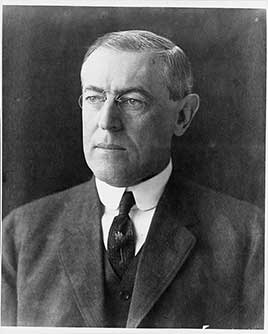
Woodrow Wilson
This presidency falls in the realignment era (1896–1932), when the two parties were trading positions and both had progressive and conservative wings.
A former Princeton president and New Jersey governor. He created the Federal Reserve, signed the first income tax under the new 16th Amendment, the Clayton Antitrust Act and the Federal Trade Commission, and took the U.S. into World War I in 1917. His plan for a League of Nations was rejected by the Senate. He also segregated federal offices and jailed critics of the war. A 1919 stroke left him disabled, which was hidden from the public.
The economy, first day to last
Shaded areas show the years in office, with a few years before and after for comparison. Budget years ran July to June until 1976 (now October to September), so each year's figures cover parts of two calendar years.
National debt
June 30, 1912 (end of fiscal 1912): $2.87 billion → June 30, 1920 (end of fiscal 1920): $25.95 billion
Daily debt figures don't exist before 1993, so Wilson's numbers use the fiscal years closest to his terms, the same rule as every other page. World War I borrowing drove the rise; the debt peaked at $27.4 billion in June 1919.
Debt compared with the economy
Debt as a share of GDP. Above 100% means the debt is bigger than a year of everything the country produces.
Deficits and surpluses
Money borrowed each budget year (below the line) or paid down (above).
Unemployment
1913: 4.4% → 1920: 4.0%. Yearly averages; monthly figures begin in 1948. Estimates by economist Stanley Lebergott (NBER, 1957).
Inflation
How much prices rose each year (consumer price index).
Cost of living
What everyday prices and paychecks did while in office.
Prices use the consumer price index (MeasuringWorth). The minimum wage is the federal rate set by Congress.
Executive orders
1,803 orders. Count from the American Presidency Project.
Orders signed each year
Yearly counts aren't reliable for this era. Orders were not numbered until 1907, when the State Department numbered the ones already in its files, and many orders were never numbered at all, so only the total is shown.
Source: American Presidency Project: executive orders (full list of every order).
Notable orders
Committee on Public InformationEO 2594April 13, 1917
Created the government's wartime propaganda agency, run by journalist George Creel, which also issued voluntary censorship rules for the press.
Federal RegisterEvery executive order we have 150Search, filter by topic or year, and open any order's full text
Incomplete: orders before 1929 were not numbered or collected consistently. This archive has 150 of the roughly 1,803 orders counted for this president.
- EO 1772May 6, 1913Withdrawing From the Public Domain Certain Lands in the State of California
- EO 1774May 6, 1913Withdrawing From Public Domain Certain Lands in the State of New Mexico
- EO 1782June 2, 1913Adding Lands to the Gila River Indian Reservation in Arizona
- EO 1786June 11, 1913Temporarily Withdrawing From Public Domain Certain Lands in the State of Arizona
- EO 1798July 18, 1913Revocation of Executive Order No. 1540
- EO 1819September 4, 1913Anaho Island Reservation
- EO 1857November 7, 1913To Regulate the Carrying of Arms in the Canal Zone
- EO 1860November 11, 1913Fixing the Rate of Interest on Money
- EO 1864December 1, 1913Navajo Reservation, New Mexico
- EO 1880January 21, 1914To Prevent the Corrupt Influencing of Agents, Employees or Servants in the Canal Zone
- EO 1884January 27, 1914To Prevent Fire-Hunting at Night, and Hunting by Means of a Spring or Trap in the Canal Zone, and to Repeal the Executive Order of September 8, 1909
- EO 1885January 27, 1914To Establish a Permanent Organization for the Operation and Government of the Panama Canal
- EO 1888February 2, 1914Providing Conditions of Employment for the Permanent Force for the Panama Canal
- EO 1926April 30, 1914Relating to Salaries of Consular Officers
- EO 1944May 20, 1914To Create a Committee to Formally and Officially Open the Panama Canal
- EO 1959June 6, 1914Establishing Smith Island Reservation for the Protection of Native Birds
- EO 1988July 9, 1914To Require Ocean-Going Vessels to be Fitted With Wireless Apparatus
- EO 1995July 23, 1914Military Reservation for National Guard
- EO 1997July 25, 1914Amending the Civil Service Rules Providing for the Appointment of Aliens When No Citizens Are Available
- EO 1999July 28, 1914Governing the Inspection of Returns of Corporations, Joint Stock Companies, Associations, or Insurance Companies
- EO 2006July 30, 1914Establishing a Wireless Telegraph Station in the Canal Zone for Use of the Navy
- EO 2011August 5, 1914To Enforce Neutrality of Wireless Stations
- EO 2012August 5, 1914For the Relief, Protection and Transportation Home of Americans in Europe at the Outbreak of the European War of 1914
- EO 2013August 6, 1914Establishing Board of Relief for Benefit of Americans Stranded Abroad During the European War of 1914
- EO 2016August 8, 1914Relating to the Customs Service and Providing for Fines for Dishonest Manifests in the Canal Zone
- EO 2017August 8, 1914Giving the Treasury Department Full Authority to All Customs Officers in the Enforcement of the Neutrality Laws During Emergency
- EO 2018August 14, 1914Relating to Postal Crimes in the Canal Zone
- EO 2019August 14, 1914To Require Security for Costs in Civil Cases in the Canal Zone
- EO 2020August 14, 1914To Amend the Executive Order of April 15, 1913, Entitled: "Executive Order to Provide Maritime Quarantine Regulations for the Canal Zone and the Harbors of the Cities of Panama and Colon, Republic of Panama."
- EO 2021August 14, 1914Amending the Rules Governing the Granting of Passports
- EO 2022August 14, 1914Temporarily Abolishing Fees for Passports and Providing for Certification of Same
- EO 2023August 14, 1914Chuckekanzie
- EO 2024August 14, 1914For a Lookout Station at Twin Sisters Administrative Site (Near Colorado National Forest), Colorado
- EO 2029August 26, 1914Transferring Deadmans Island to the Health Service
- EO 2030August 27, 1914Gila River Reservation
- EO 2031August 27, 1914Designating Customs Collection Districts
- EO 2039September 4, 1914Admitting Foreign-Built Ships to American Registry
- EO 2042September 5, 1914Taking Over High-Power Radio Station for Use of the Government
- EO 2044September 10, 1914Appointing Experts for War Risk Insurance in Treasury Department
- EO 2045September 10, 1914Combining Manzano and Zuni National Forests in Arizona and New Mexico
- EO 2046September 14, 1914Ranger Station for Clear Creek Administrative Site Near Coconino National Forest, Arizona
- EO 2047September 15, 1914Setting Aside Public Land for an Elk Refuge
- EO 2048September 15, 1914To Divide Administrative Site Within Oregon National Forest, Oregon
- EO 2051September 19, 1914To Amend the Canal Zone Law Against Gambling
- EO 2052September 19, 1914To Amend the Executive Order of March 20, 1914, Relating to Compensation to be Paid to Injured Employees of the Panama Canal and Panama Railroad Company
- EO 2060October 8, 1914Alaskan Townsite Withdrawal No. 4
- EO 2067October 28, 1914Gray's Lake Administrative Site (Near Caribou National Forest) Idaho
- EO 2133February 3, 1915Relating to Indians on Public Domain
- EO 2138February 19, 1915Military Reservation for the National Guard
- EO 2185April 27, 1915Changing the Name of Culebra Cut to Gaillard Cut
- EO 2223July 19, 1915Siletz Indian Reservation
- EO 2262October 21, 1915Prescribing Consular Regulations for Maintaining the Rights and Enforcing the Duties of American Sailors in Foreign Ports
- EO 2268October 30, 1915Establishing a United States Sheep Experiment Station
- EO 2269November 2, 1915Suspending Operation of the Act to Promote the Welfare of American Seamen and to Forbid Their Arrest and Imprisonment for Desertion
- EO 2273November 22, 1915Colorado River Indian Reservation
- EO 2285December 15, 1915Requiring American Citizens Traveling Abroad to Procure Passports
- EO 2326February 23, 1916Relating to Indians on Public Domain
- EO 2332February 29, 1916Former Siletz Indian Reservation
- EO 2341March 13, 1916Relating to Cancellation and Reissue of Passports
- EO 2345March 21, 1916Increasing the Strength of the Regular Army
- EO 2375April 29, 1916Addition of Lands to the Reservation of the Camp or Fort Independence Indians
- EO 2413June 30, 1916Waiving Citizenship Requirement for Specified Federal Appointment
- EO 2418July 11, 1916Alaska—Regulations for Sale of the Federal and Cliff Additions to Seward Townsite, Alaska
- EO 2456September 16, 1916Philippines—Requiring Governor General to Report to Secretary of War
- EO 2461September 28, 1916Amending Consular Regulations 172
- EO 2462September 28, 1916Amending Consular Regulations 692
- EO 2479October 22, 1916Providing for the Payment of Interest on Deposit Money Orders Issued in the Canal Zone
- EO 2505January 3, 1917Relating to Indians on Public Domain
- EO 2524February 1, 1917Reserving Certain Lands in the State of Arizona for the Papago Indians in Arizona
- EO 2526February 6, 1917Relating to the Exclusion of Chinese from the Panama Canal Zone
- EO 2533February 20, 1917Naval Radio Stations for Alaska
- EO 2537February 21, 1917Naval Radio Stations for Alaska
- EO 2549March 21, 1917Indians of the Laguna Pueblo
- EO 2569March 31, 1917Establishing Civil Service in First, Second and Third Classes of Post Offices
- EO 2570April 2, 1917Amending Civil Service Regulations
- EO 2572April 3, 1917Temporarily Suspending Eight-Hour Law Provisions in the Department of Agriculture
- EO 2585April 6, 1917Taking Over Necessary and Closing Unnecessary Radio Stations
- EO 2587April 7, 1917Federal Employees Removal on Security Grounds
- EO 2594April 13, 1917Creating Committee on Public Information
- EO 2596April 14, 1917Allowing Treasury Department Employees to be Appointed on Defense Organizations
- EO 2600April 17, 1917Employees of Council of National Defense
- EO 2602April 18, 1917Cooperation Among Civil Service Commissions
- EO 2604April 28, 1917Censorship of Submarine Cables, Telegraph and Telephone Lines
- EO 2605April 28, 1917Suspending Eight-Hour Law in Contracts Under the War Department
- EO 2605April 30, 1917Taking Over Necessary and Closing Unnecessary Radio Stations
- EO 2612May 7, 1917Military Reservation for the National Guard
- EO 2617May 11, 1917Civil Service Commission Authorized to Permit Appointment of Civilians
- EO 2619May 14, 1917German Boats
- EO 2621May 16, 1917German Boats
- EO 2624May 22, 1917German Boats
- EO 2625May 22, 1917German Boats
- EO 2626May 22, 1917Reinstating Certain Persons Formerly in the Competitive Service
- EO 2628June 4, 1917Authorizing Employment of Foreign Inspectors
- EO 2635June 12, 1917German Boats
- EO 2641June 18, 1917Amending Alaskan Railroad Townsite Regulations
- EO 2645June 22, 1917Export Licenses Exports Council
- EO 2651June 30, 1917German Boats
- EO 2653July 3, 1917German Boats
- EO 2664July 11, 1917Exercise of Authority Under the Emergency Shipping Fund Act
- EO 2670July 20, 1917Lighthouse Service—Virgin Islands
- EO 2673July 28, 1917Explaining Exemption of Indispensable Government Employees From the Selective Draft
- EO 2681August 14, 1917Authority to Organize Food Administration Grain Corporation
- EO 2687August 21, 1917Exercise of Authority Under the "Naval Emergency Fund Act," and Others
- EO 2690August 23, 1917Appointment of Fuel Administrator
- EO 2691August 24, 1917Rules for the Government of the Virgin Islands
- EO 2692August 27, 1917Establishing Defensive Sea Areas for Terminal Ports of the Panama Canal, and Providing Regulations for the Government of Persons and Vessels Within Said Areas
- EO 2694September 2, 1917Authority to Exercise Powers Bestowed by Sections 15 and 16 of the Food Control Act
- EO 2696September 7, 1917Suspending Law Admitting Foreign-Built Ships to American Entry
- EO 2697September 7, 1917Regulations Relating to the Exportation of Coin, Bullion, and Currency
- EO 2705September 20, 1917Suspending the Eight-Hour Day in the Bureau of Standards
- EO 2708September 25, 1917Creating Divisions of Pictures, Films and Publications under the Committee on Public Information
- EO 2709September 27, 1917German Boats
- EO 2717September 27, 1917Assigning Quarantine Duties in the Virgin Islands to the Treasury Department
- EO 2718September 27, 1917Suspending the Eight-Hour Day in Construction of Immigrant Station at Baltimore, Md
- EO 2720September 29, 1917Giving Chief of Staff Control over the War Department in the Absence of the Secretary of War and Assistant Secretary of War
- EO 2729October 12, 1917Vesting Power and Authority in Designated Officers and Making Rules and Regulations Under Trading with the Enemy Act and Title VII of the Act Approved June 15, 1917
- EO 2730October 13, 1917Free Consular Services
- EO 2734October 15, 1917Suspending Civil Service Rules in Training Camp Activities
- EO 2736October 23, 1917Providing for Requisitioning of Foods and Feeds
- EO 2741October 25, 1917Waiving Civil Service Regulations for Confidential Positions under the Trading with the Enemy Act
- EO 2744October 29, 1917Fixing Salary of, and Vesting Certain Power and Authority in, the Alien Property Custodian Appointed Under Trading with the Enemy Act
- EO 2748November 2, 1917German Boats
- EO 2765November 27, 1917Determination of a Just, Fair, and Reasonable Profit Under Section 5 of the Food Control Act
- EO 2770December 7, 1917Vesting Power and Authority in Designated Officers and Making Rules and Regulations Under the Trading with the Enemy Act and Title VII of the Act Approved June 15, 1917
- EO 2774December 17, 1917Division Created Under the Public Information Committee
- EO 2777December 26, 1917Rules for the Government of the Virgin Islands
- EO 2778December 31, 1917Relating to Indians on Public Domain
- EO 2789January 19, 1918Military Reservation for the National Guard
- EO 2796January 26, 1918Prescribing Rules and Regulations Under Section 5 of the Trading with the Enemy Act and Supplementing Rules and Regulations Heretofore Prescribed Under Title 7 of the Espionage Act
- EO 2859May 11, 1918National Research Council of the National Academy of Sciences
- EO 2868May 28, 1918Establishment of War Industries Board
- EO 3024January 11, 1919Indians on Public Domain
- EO 3176November 24, 1919Taking Possession and Title of German Vessels
- EO 3182November 25, 1919Conditions of Employment for the Permanent Force for the Panama Canal
- EO 3204December 23, 1919Indians on Public Domain
- EO 3206December 30, 1919Constituting Board of Surveys and Maps
- EO 3231February 20, 1920Authorizing the Departure of Alien Enemies for European Ports
- EO 3235February 28, 1920Continuing Control of Director General of Railroads Over Coal Distribution, etc.
- EO 3292June 26, 1920Reduction of Capital Stock of United States Grain Corporation
- EO 3294June 27, 1920Authorizing the Departure of Hostile and Enemy Aliens Without Permits
- EO 3313July 21, 1920Wages of Seamen
- EO 3320August 21, 1920Liquidation of United States Grain Corporation
- EO 3332October 2, 1920Retention of Hoboken Piers
- EO 3336October 8, 1920Ordering Flags at Half-Mast in Memory of American Dead in World War
- EO 3338October 8, 1920Competitive Examinations for Postmasterships
- EO 3360November 28, 1920Official Flag for Secretary of State
- EO 3363December 1, 1920Ponca Indians in Oklahoma
- EO 3365December 7, 1920Indians on Public Domain
- EO 3367December 10, 1920Punishments for Soldiers
- EO 3374December 22, 1920Confirming Powers of Federal Trade Commission Over Coal Cost Information
Source: Executive Orders Archive, compiled from the American Presidency Project and the Federal Register. Topics are the archive's automated tags; "Revoked" and similar labels come from the Federal Register's records.
Pardons and commutations
A pardon wipes out the punishment for a federal crime; a commutation shortens a sentence but leaves the conviction. Counts are by federal fiscal year (July to June). The Justice Department counts fiscal 1913, including Wilson's first four months, under Taft, and all of fiscal 1921, including Harding's first four months, under Wilson.
Granted each year
Source: U.S. Dept. of Justice, clemency statistics, which lists every recipient with the crime and sentence.
Notable grants: tap to see the crime
George BurdickPardon (refused)1914-12
The crime: None charged: the New York Tribune editor refused to tell a grand jury his sources for a story on customs fraud
Sentence: None
Why it drew attention: Wilson offered a pardon in advance to force him to testify. Burdick refused it, and the Supreme Court ruled in 1915 that a pardon can be turned down because accepting one implies guilt.
SourceInvestigations and legal record
The same checklist for every president. Tap a row for details and sources.
ImpeachedNoNo
No articles of impeachment were voted on.
Criminally chargedNoNo
Never charged.
Aides or cabinet convictedNoNo
No member of his cabinet or White House staff was convicted.
Special counselsNoNo
None were appointed.
Misuse of DOJ, FBI or IRSYes — documentedYes
During the Palmer Raids (1919–20), the Justice Department and Bureau of Investigation arrested thousands of suspected radicals, many without warrants. A 1920 report by twelve prominent lawyers documented illegal searches, arrests and abuse. The Post Office also barred antiwar publications from the mail.
SourcePeople around the president who were charged or penalized
No one in the administration was charged or formally penalized.
Controversies and scandals
What happened, what was proven, and how it ended.
Segregating federal officesProven1913–1921
His cabinet segregated offices, lunchrooms and restrooms in the Treasury and Post Office departments, and many Black civil servants were demoted or fired.
Outcome: Wilson defended the policy to Black leaders in 1914. Princeton removed his name from its public policy school in 2020.
SourceJailing critics of the warProven1917–1921
About 2,000 people were prosecuted under the Espionage and Sedition Acts, including Socialist leader Eugene Debs, sentenced to ten years for an antiwar speech.
Outcome: The Supreme Court upheld the convictions in 1919; the Sedition Act was repealed in 1920; Harding freed Debs in 1921.
SourceThe Palmer RaidsProven1919–1920
After a wave of anarchist bombings, Attorney General A. Mitchell Palmer ordered raids that arrested thousands of immigrants and suspected radicals; 556 were deported.
Outcome: A Labor Department official canceled most of the deportation orders; the raids were widely condemned by 1920.
SourceHiding his strokeProvenOctober 1919 – March 1921
A severe stroke left Wilson partly paralyzed. His wife, Edith, and his doctor controlled who could see him and what papers reached him; the public and most of the cabinet were not told how sick he was.
Outcome: The episode was one reason for the 25th Amendment (1967), which sets rules for presidential disability.
SourceIn their own words
Widely quoted remarks, with the context they were said in.
The world must be made safe for democracy.
There is such a thing as a man being too proud to fight.
Segregation is not a humiliation but a benefit, and ought to be so regarded by you gentlemen.