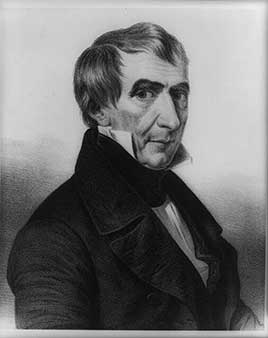
William Henry Harrison
A general famous for the Battle of Tippecanoe (1811). His 1840 'log cabin and hard cider' campaign sold him as a humble frontiersman, though he came from a wealthy Virginia planter family. He gave the longest inaugural address in history, fell ill three weeks later and died after 31 days, the shortest presidency.
The economy, first day to last
Shaded areas show the years in office, with a few years before and after for comparison. Until 1842 the federal budget year matched the calendar year and debt figures are dated January 1; from 1843 to 1976 budget years ran July to June.
National debt
January 1, 1841: $5.25 million → January 1, 1841: $5.25 million
He served only 31 days, so there is no change to measure. Until 1842 the Treasury's debt figures are dated January 1, so these are the closest readings to the start and end of the term.
Debt compared with the economy
Debt as a share of GDP. Above 100% means the debt is bigger than a year of everything the country produces.
Deficits and surpluses
Money borrowed each budget year (below the line) or paid down (above). The White House budget office's yearly figures begin in 1901.
Unemployment
No national estimates before 1890. Economist Stanley Lebergott's yearly estimates, the earliest national series, begin in 1890
Inflation
How much prices rose each year (consumer price index).
Cost of living
What everyday prices and paychecks did while in office.
Prices use the consumer price index (MeasuringWorth). The minimum wage is the federal rate set by Congress.
Executive orders
0 orders. The American Presidency Project records no executive orders.
Orders signed each year
Yearly counts aren't reliable for this era. Orders were not numbered until 1907, when the State Department numbered the ones already in its files, and many orders were never numbered at all, so only the total is shown.
Source: American Presidency Project: executive orders (full list of every order).
Notable orders
Most orders in this era were routine, such as setting aside public land or exempting jobs from civil service rules.
Pardons and commutations
A pardon wipes out the punishment for a federal crime; a commutation shortens a sentence but leaves the conviction. The Justice Department's published counts begin in 1900.
Granted each year
The Justice Department's published clemency counts begin in fiscal 1900, so there are no reliable yearly totals for this presidency.
Source: U.S. Dept. of Justice, clemency statistics, which lists every recipient with the crime and sentence.
Notable grants: tap to see the crime
No individual grants from this presidency are highlighted yet.
Investigations and legal record
The same checklist for every president. Tap a row for details and sources.
ImpeachedNoNo
No articles of impeachment were voted on.
Criminally chargedNoNo
Never charged.
Aides or cabinet convictedNoNo
No member of his cabinet or White House staff was convicted.
Special counselsNoNo
None were appointed.
Misuse of DOJ, FBI or IRSNo findingNo
No official investigation found he used federal power against political opponents.
People around the president who were charged or penalized
No one in the administration was charged or formally penalized.
Controversies and scandals
What happened, what was proven, and how it ended.
The Treaty of Fort WayneProven1809
As governor of Indiana Territory, Harrison bought about 3 million acres from several tribes for a small payment. Tecumseh and others rejected the deal, leading to the fighting at Tippecanoe.
Outcome: The land passed to the U.S.; the conflict merged into the War of 1812.
SourcePushing slavery into IndianaProven1800–1809
Harrison, who inherited enslaved people, pressed as territorial governor to allow slavery in Indiana despite the Northwest Ordinance's ban, and backed laws letting settlers hold Black people as long-term 'indentured servants'.
Outcome: Indiana's legislature ended the indenture laws in 1810.
SourceThe log-cabin imageProven1840
His campaign's log cabins and cider barrels painted him as a man of the people; he was born on a Virginia plantation and lived in a large house in Ohio.
Outcome: It worked: he won with 53% of the popular vote.
SourceIn their own words
Widely quoted remarks, with the context they were said in.
Sir, I wish you to understand the true principles of the Government. I wish them carried out. I ask nothing more.