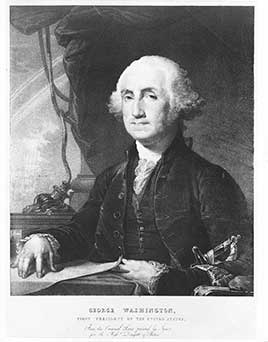
George Washington
Commander of the Continental Army and the only president elected unanimously, twice. He created the cabinet and set the two-term tradition. He backed Alexander Hamilton's plan to take on the states' war debts, create a national bank and tax whiskey, led troops to put down the Whiskey Rebellion, kept the country neutral in Europe's wars and signed the unpopular Jay Treaty with Britain.
The economy, first day to last
Shaded areas show the years in office, with a few years before and after for comparison. Until 1842 the federal budget year matched the calendar year and debt figures are dated January 1; from 1843 to 1976 budget years ran July to June.
National debt
January 1, 1790: $71.06 million → January 1, 1797: $82.06 million
The first Treasury figure is from January 1, 1790; the federal government took over about $25 million in state war debts that year. Until 1842 the Treasury's debt figures are dated January 1, so these are the closest readings to the start and end of the term.
Debt compared with the economy
Debt as a share of GDP. Above 100% means the debt is bigger than a year of everything the country produces.
Deficits and surpluses
Money borrowed each budget year (below the line) or paid down (above). The White House budget office's yearly figures begin in 1901.
Unemployment
No national estimates before 1890. Economist Stanley Lebergott's yearly estimates, the earliest national series, begin in 1890
Inflation
How much prices rose each year (consumer price index).
Cost of living
What everyday prices and paychecks did while in office.
Prices use the consumer price index (MeasuringWorth). The minimum wage is the federal rate set by Congress.
Executive orders
8 orders. Count from the American Presidency Project.
Orders signed each year
Yearly counts aren't reliable for this era. Orders were not numbered until 1907, when the State Department numbered the ones already in its files, and many orders were never numbered at all, so only the total is shown.
Source: American Presidency Project: executive orders (full list of every order).
Notable orders
Reports from the departmentsOrderJune 8, 1789
Asked the officials left over from the old Confederation government to give him a full account of their departments, the first directive now counted as an executive order.
Federal RegisterEvery executive order we have 1Search, filter by topic or year, and open any order's full text
Incomplete: orders before 1929 were not numbered or collected consistently. This archive has 1 of the roughly 8 orders counted for this president.
- OrderJanuary 22, 1791Commission—Appointing Commissioners for Surveying the District of Territory for the Permanent Seat of the Government of the United States
Source: Executive Orders Archive, compiled from the American Presidency Project and the Federal Register. Topics are the archive's automated tags; "Revoked" and similar labels come from the Federal Register's records.
Pardons and commutations
A pardon wipes out the punishment for a federal crime; a commutation shortens a sentence but leaves the conviction. The Justice Department's published counts begin in 1900.
Granted each year
The Justice Department's published clemency counts begin in fiscal 1900, so there are no reliable yearly totals for this presidency.
Source: U.S. Dept. of Justice, clemency statistics, which lists every recipient with the crime and sentence.
Notable grants: tap to see the crime
Whiskey Rebellion leadersPardons and amnesty1795
The crime: Treason, for armed resistance to the federal whiskey tax (1794)
Sentence: Death for the two men convicted
Why it drew attention: Washington pardoned Philip Vigol and John Mitchell, the only two convicted, and offered amnesty to others who swore loyalty.
SourceInvestigations and legal record
The same checklist for every president. Tap a row for details and sources.
ImpeachedNoNo
No articles of impeachment were voted on.
Criminally chargedNoNo
Never charged.
Aides or cabinet convictedNoNo
No member of his cabinet or White House staff was convicted.
Special counselsNoNo
None were appointed.
Misuse of DOJ, FBI or IRSNo findingNo
No official investigation found he used federal power against political opponents.
People around the president who were charged or penalized
No one in the administration was charged or formally penalized.
Controversies and scandals
What happened, what was proven, and how it ended.
SlaveholdingProven1743–1799
At his death, 317 enslaved people lived at Mount Vernon, 123 of them owned by Washington. As president in Philadelphia he rotated enslaved workers out of Pennsylvania to avoid a state law that would have freed them, and pursued Ona Judge after she escaped in 1796. He signed the Fugitive Slave Act of 1793.
Outcome: His will freed the people he owned after his wife's death; Martha Washington freed them in 1801. He was the only slaveholding founding president to do so.
SourcePutting down the Whiskey RebellionDisputed1794
Washington led about 13,000 militia into western Pennsylvania to end armed resistance to the whiskey tax, the only time a sitting president has led troops in the field.
Outcome: The rebellion collapsed without a battle; the two men convicted of treason were pardoned.
SourceThe Jay TreatyDisputed1795
The treaty avoided war with Britain but gave up on many American demands; it was so unpopular that Chief Justice John Jay said he could travel at night by the light of his burning effigies.
Outcome: Ratified 20–10; the fight helped create the first political parties.
SourceIn their own words
Widely quoted remarks, with the context they were said in.
It serves always to distract the Public Councils and enfeeble the Public Administration. It agitates the Community with ill-founded jealousies and false alarms.
It is our true policy to steer clear of permanent alliances with any portion of the foreign world.
To bigotry no sanction, to persecution no assistance.