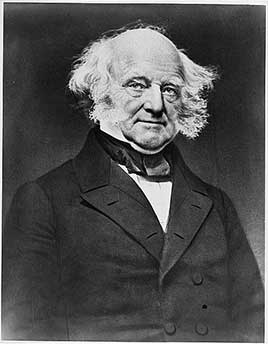
Martin Van Buren
The New York organizer who built the Democratic Party. The Panic of 1837 struck weeks after he took office and began a five-year depression. He created an independent Treasury to hold federal money outside private banks, refused to annex Texas as a slave state, and carried out the forced removal of the Cherokee. In 1848 he ran again as the antislavery Free Soil candidate.
The economy, first day to last
Shaded areas show the years in office, with a few years before and after for comparison. Until 1842 the federal budget year matched the calendar year and debt figures are dated January 1; from 1843 to 1976 budget years ran July to June.
National debt
January 1, 1837: $336,958 → January 1, 1841: $5.25 million
The debt was almost zero when he took office, after Jackson paid it off. Until 1842 the Treasury's debt figures are dated January 1, so these are the closest readings to the start and end of the term.
Debt compared with the economy
Debt as a share of GDP. Above 100% means the debt is bigger than a year of everything the country produces.
Deficits and surpluses
Money borrowed each budget year (below the line) or paid down (above). The White House budget office's yearly figures begin in 1901.
Unemployment
No national estimates before 1890. Economist Stanley Lebergott's yearly estimates, the earliest national series, begin in 1890
Inflation
How much prices rose each year (consumer price index).
Cost of living
What everyday prices and paychecks did while in office.
Prices use the consumer price index (MeasuringWorth). The minimum wage is the federal rate set by Congress.
Executive orders
10 orders. Count from the American Presidency Project.
Orders signed each year
Yearly counts aren't reliable for this era. Orders were not numbered until 1907, when the State Department numbered the ones already in its files, and many orders were never numbered at all, so only the total is shown.
Source: American Presidency Project: executive orders (full list of every order).
Notable orders
A ten-hour dayOrderMarch 31, 1840
Limited laborers on federal public works to ten hours a day without a cut in pay.
Federal RegisterEvery executive order we have 2Search, filter by topic or year, and open any order's full text
Incomplete: orders before 1929 were not numbered or collected consistently. This archive has 2 of the roughly 10 orders counted for this president.
- OrderMarch 7, 1837Executive Order
- OrderMarch 31, 1840Executive Order
Source: Executive Orders Archive, compiled from the American Presidency Project and the Federal Register. Topics are the archive's automated tags; "Revoked" and similar labels come from the Federal Register's records.
Pardons and commutations
A pardon wipes out the punishment for a federal crime; a commutation shortens a sentence but leaves the conviction. The Justice Department's published counts begin in 1900.
Granted each year
The Justice Department's published clemency counts begin in fiscal 1900, so there are no reliable yearly totals for this presidency.
Source: U.S. Dept. of Justice, clemency statistics, which lists every recipient with the crime and sentence.
Notable grants: tap to see the crime
No individual grants from this presidency are highlighted yet.
Investigations and legal record
The same checklist for every president. Tap a row for details and sources.
ImpeachedNoNo
No articles of impeachment were voted on.
Criminally chargedNoNo
Never charged.
Aides or cabinet convictedNoNo
No member of his cabinet or White House staff was convicted.
Special counselsNoNo
None were appointed.
Misuse of DOJ, FBI or IRSNo findingNo
No official investigation found he used federal power against political opponents.
People around the president who were charged or penalized
No one in the administration was charged or formally penalized.
Controversies and scandals
What happened, what was proven, and how it ended.
The Trail of TearsProven1838–1839
Under the removal treaty signed during Jackson's term, the Army forced about 16,000 Cherokee from their homes in Georgia and nearby states into camps and west to Indian Territory.
Outcome: About 4,000 died from disease, exposure and hunger.
SourceThe Amistad AfricansProven1839–1841
Africans who had seized the slave ship Amistad were jailed in Connecticut. The administration tried to send them back to their Spanish claimants.
Outcome: The Supreme Court freed them in 1841, with John Quincy Adams arguing their case.
SourceSlaveholdingProven1814
Van Buren owned one enslaved man, Tom, who escaped around 1814. When Tom was found years later, Van Buren agreed to sell him to the finder.
Outcome: Whether the sale went through is not known.
SourceIn their own words
Widely quoted remarks, with the context they were said in.
I must go into the Presidential chair the inflexible and uncompromising opponent of every attempt on the part of Congress to abolish slavery in the District of Columbia against the wishes of the slaveholding States.