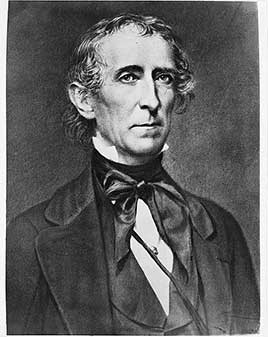
John Tyler
The first vice president to become president when a president died, and he insisted on full powers rather than acting as a caretaker. A states'-rights former Democrat on the Whig ticket, he vetoed the Whigs' bills to recreate a national bank; his whole cabinet except Daniel Webster resigned and the party expelled him. He settled the Maine border with Britain and pushed through the annexation of Texas days before leaving office. In 1861 he sided with the Confederacy.
The economy, first day to last
Shaded areas show the years in office, with a few years before and after for comparison. Until 1842 the federal budget year matched the calendar year and debt figures are dated January 1; from 1843 to 1976 budget years ran July to June.
National debt
January 1, 1841: $5.25 million → June 30, 1844 (end of fiscal 1844): $23.46 million
Daily debt figures don't exist before 1993. Until 1842 the Treasury's figures are dated January 1; after that, the end of the budget year. The debt rose in the depression that followed the Panic of 1837.
Debt compared with the economy
Debt as a share of GDP. Above 100% means the debt is bigger than a year of everything the country produces.
Deficits and surpluses
Money borrowed each budget year (below the line) or paid down (above). The White House budget office's yearly figures begin in 1901.
Unemployment
No national estimates before 1890. Economist Stanley Lebergott's yearly estimates, the earliest national series, begin in 1890
Inflation
How much prices rose each year (consumer price index).
Cost of living
What everyday prices and paychecks did while in office.
Prices use the consumer price index (MeasuringWorth). The minimum wage is the federal rate set by Congress.
Executive orders
17 orders. Count from the American Presidency Project.
Orders signed each year
Yearly counts aren't reliable for this era. Orders were not numbered until 1907, when the State Department numbered the ones already in its files, and many orders were never numbered at all, so only the total is shown.
Source: American Presidency Project: executive orders (full list of every order).
Notable orders
Most orders in this era were routine, such as setting aside public land or exempting jobs from civil service rules.
Every executive order we have 2Search, filter by topic or year, and open any order's full text
Incomplete: orders before 1929 were not numbered or collected consistently. This archive has 2 of the roughly 17 orders counted for this president.
- OrderJuly 5, 1841Executive Order
- OrderFebruary 29, 1844Executive Order
Source: Executive Orders Archive, compiled from the American Presidency Project and the Federal Register. Topics are the archive's automated tags; "Revoked" and similar labels come from the Federal Register's records.
Pardons and commutations
A pardon wipes out the punishment for a federal crime; a commutation shortens a sentence but leaves the conviction. The Justice Department's published counts begin in 1900.
Granted each year
The Justice Department's published clemency counts begin in fiscal 1900, so there are no reliable yearly totals for this presidency.
Source: U.S. Dept. of Justice, clemency statistics, which lists every recipient with the crime and sentence.
Notable grants: tap to see the crime
No individual grants from this presidency are highlighted yet.
Investigations and legal record
The same checklist for every president. Tap a row for details and sources.
ImpeachedNo — resolution defeatedNo
In January 1843 the House voted 127–83 against a resolution to investigate impeaching him over his vetoes, the first such vote against a president.
SourceCriminally chargedNoNo
Never charged.
Aides or cabinet convictedNoNo
No member of his cabinet or White House staff was convicted.
Special counselsNoNo
None were appointed.
Misuse of DOJ, FBI or IRSNo findingNo
No official investigation found he used federal law enforcement against opponents.
People around the president who were charged or penalized
No one in the administration was charged or formally penalized.
Controversies and scandals
What happened, what was proven, and how it ended.
Vetoing the bank and losing his partyDisputed1841
Tyler vetoed two Whig bills to create a new national bank, saying they were unconstitutional. Five of six cabinet members resigned, and Whigs in Congress expelled him from the party.
Outcome: He governed without a party; a House committee condemned his use of the veto in 1842.
SourceAnnexing Texas to expand slaveryDisputed1844–1845
When the Senate rejected his annexation treaty, Tyler had Congress annex Texas by simple majority vote. His secretary of state, John C. Calhoun, openly defended annexation as a way to protect slavery.
Outcome: Texas joined as a slave state in December 1845; Mexico cut relations, a step toward war.
SourceSlaveholdingProven1840s–1862
Tyler enslaved dozens of people at his Virginia plantation, Sherwood Forest, before, during and after his presidency.
Outcome: He never freed them.
SourceJoining the ConfederacyProven1861–1862
After a failed peace conference, Tyler backed Virginia's secession and was elected to the Confederate Congress.
Outcome: He died in 1862 before taking his seat; Washington did not officially mourn him.
SourceIn their own words
Widely quoted remarks, with the context they were said in.
No widely quoted remarks with a reliable source are included yet.