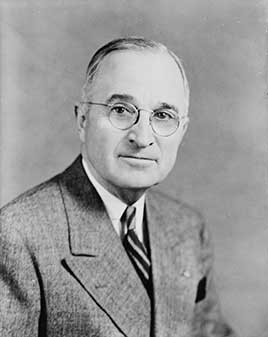
Harry S. Truman
Became president when Roosevelt died in April 1945. He ordered the atomic bombings of Hiroshima and Nagasaki, launched the Marshall Plan and NATO, desegregated the armed forces by executive order, won a surprise victory in 1948 and took the country into the Korean War. The Supreme Court struck down his seizure of the steel mills in 1952.
The economy, first day to last
Shaded areas show the years in office, with a few years before and after for comparison. Budget years ran July to June until 1976 (now October to September), so each year's figures cover parts of two calendar years.
National debt
June 30, 1944 (end of fiscal 1944): $201.00 billion → June 30, 1952 (end of fiscal 1952): $259.11 billion
Daily debt figures don't exist before 1993, so Truman's numbers use the fiscal years closest to his term, the same rule as every other page. Almost all of the rise came in fiscal 1945 (July 1944 to June 1945), which was mostly Roosevelt's and wartime; from June 1945 to June 1952 the debt went from $258.7 billion to $259.1 billion.
Debt compared with the economy
Debt as a share of GDP. Above 100% means the debt is bigger than a year of everything the country produces.
Deficits and surpluses
Money borrowed each budget year (below the line) or paid down (above).
Unemployment
1945 (year): 1.9% → Jan 1953: 2.9%. Monthly figures begin in 1948. Chart shows yearly averages; before 1948, estimates by economist Stanley Lebergott.
Inflation
How much prices rose each year (consumer price index).
Cost of living
What everyday prices and paychecks did while in office.
Prices use the consumer price index (MeasuringWorth). The minimum wage is the federal rate set by Congress.
Executive orders
894 orders, numbered 9538–10431. The American Presidency Project counts 907, including lettered orders.
Orders signed each year
Source: Wikipedia: list of Truman's executive actions (full list of every order).
Notable orders
Committee on Civil RightsEO 9808December 5, 1946
Created the committee whose 1947 report, 'To Secure These Rights', called for anti-lynching and voting rights laws.
Federal RegisterLoyalty programEO 9835March 21, 1947
Required loyalty investigations of every federal employee; about 300 were fired as security risks by 1952.
Federal RegisterFair employment in the federal governmentEO 9980July 26, 1948
Banned racial discrimination in federal hiring.
Federal RegisterDesegregating the armed forcesEO 9981July 26, 1948
Ordered equal treatment in the military regardless of race; the last all-Black units were disbanded in 1954.
Federal RegisterSeizing the steel millsEO 10340April 8, 1952
Took over the steel industry to head off a strike during the Korean War. The Supreme Court ruled it unconstitutional two months later.
Federal RegisterEvery executive order 907Search, filter by topic or year, and open any order's full text
- EO 9538April 13, 1945Authorizing Certification for Probational Appointment of Persons Who Lost Opportunity for Probational Appointment Because of Entry Into the Armed Forces
- EO 9539April 13, 1945Reinstating Avra M. Warren in the Foreign Service of the United States
- EO 9540April 17, 1945Authorizing the Petroleum Administratior to Take the Possession of and to the Cities Service Refining Corporation, Located in and Around Lake Charles, Louisiana
- EO 9541April 19, 1945Transferring the Office of Surplus Property of the Procurement Division of the Department of the Treasury to the Department of Commerce
- EO 9542April 23, 1945Authorizing the Secretary of the Navy to Take Possession of And to Operate the Plants and Facilities of the United Engineering Company, Ltd. Located At San Francisco, California
- EO 9543April 23, 1945Designating the Reconstruction Finance Corporation as the Agency to Act With Respect to Certain Bonds, Notes, and Other Securities Acquired on Behalf of the United States Under the Provisions of the Transportation Act, 1920
- EO 9544April 25, 1945Authorizing and Directing the Secretary of War to Assume Full Control of a Certain Airport
- EO 9545April 27, 1945Restoring Certain Lands Comprising Part of the Aiea Military Reservation to the Use of the Territory of Hawaii
- EO 9546May 1, 1945Inspection By the Federal Security Agency of Statistical Transcript Punch Cards Prepared from Individual Income Tax Returns
- EO 9547May 2, 1945Providing for Representation of the United States in Preparing and Prosecuting Charges of Atrocities and War Crimes Against the Leaders of the European Axis Powers and Their Principal Agents and Accessories
- EO 9548May 3, 1945Authorizing the Secretary of the Interior to Take Possession of and to Operate Certain Coal Mines
- EO 9549May 8, 1945Designation of Mrs. Ruth W. Talley and Mrs. Alice M. Grove to Sign Land Patents
- EO 9550May 10, 1945Relating to Aerial Flights By Personnel of the Coast and Geodetic Survey
- EO 9551May 16, 1945Providing for the Transfer to the Republic of Panama of the Water and Sewage Systems Installed By the United States in the Cities of Panama and Colon
- EO 9552May 19, 1945Authorizing the Secretary of War to Take Possession of and Operate the Plants and Facilities of the Cocker Machine and Foundry Company, Located At Gastonia, North Carolina
- EO 9553May 22, 1945Creating An Emergency Board to Investigate a Dispute Between the River Terminal Railway Company and Its Employees
- EO 9554May 23, 1945Possession and Operation of Property of Motor Carriers in and About the City of Chicago, Illinois
- EO 9555May 24, 1945Creating An Emergency Board to Investigate a Dispute Between the Illinois Central Railroad Company and Its Employees
- EO 9556May 26, 1945Providing for the Exercise of Certain Functions, Duties, and Powers of the President With Respect to Certain Court Martial Cases By the Secretary of War, the Under Secretary of War, the Secretary of the Navy and the Under Secretary of the Navy
- EO 9557May 26, 1945Amendment of Executive Order 9210 of August 1, 1942, Prescribing Regulations Governing the Payment of Additional Compensation to Enlisted Men of the Navy and Coast Guard Specially Qualified in the Use of Arms
- EO 9558May 26, 1945Reinstating Certain Former Foreign Service Officers
- EO 9559May 28, 1945Authorizing the Secretary of War to Take Possession of and Operate the Plants and Facilities of the Gaffney Manufacturing Company, Located At Gaffney, South Carolina
- EO 9560June 1, 1945Authorizing the Secretary of War to Take Possession of and Operate the Plants and Facilities of the Mary-Leila Cotton Mills, Inc., Located At Greensboro, Georgia
- EO 9561June 1, 1945Amending Executive Order No. 9386 of October 15, 1943, Prescribing Regulations Governing the Granting of Allowances for Quarters and Subsistence to Enlisted Men
- EO 9562June 4, 1945Termination of the Office of Civilian Defense
- EO 9563June 4, 1945Amendment of Rule 46 of Executive Order No. 4314 of September 25, 1925, Establishing Rules Governing Navigation of the Panama Canal and Adjacent Waters
- EO 9564June 5, 1945Authorizing the Petroleum Administrator to Take Possession of and Operate the Plants and Facilities of the Humble Oil and Refining Company Located in Ingleside, Texas
- EO 9565June 5, 1945Authorizing the Petroleum Administrator to Take Possession of and Operate the Plants and Facilities At the Cabin Creek Oil Field of the Pure Oil Company Located At Dawes, West Virginia
- EO 9566June 5, 1945Revocation of Executive Order 9090 of March 6, 1942, Establishing An Airspace Reservation Over Portions of Ulster and Dutchess Counties, New York
- EO 9567June 8, 1945Amending Executive Order No. 9095, as Amended by Executive Order No. 9193, to Define Further the Functions and Duties of the Alien Property Custodian With Respect to Property of Germany and Japan and Nationals Thereof
- EO 9568June 8, 1945Providing for the Release of Scientific Information
- EO 9569June 14, 1945Inspection By the Office of Price Administration of Corporation Statistical Transcript Cards Prepared from Income and Declared Value Excess Profits Tax Returns
- EO 9570June 14, 1945Possession and Operation of the Transportation System, Plants, and Facilities of the Scranton Transit Company Located in and About the City of Scranton, Pennsylvania
- EO 9571June 15, 1945Authorizing the Secretary of the Interior to Acquire and Dispose of Certain Property
- EO 9572June 15, 1945Possession, Control, and Operation of the Toledo, Peoria & Western Railroad
- EO 9573June 16, 1945Creating An Emergency Board to Investigate a Dispute Between the Georgia and Florida Railroad and Its Employees
- EO 9574June 18, 1945Authorizing the Secretary of War to Take Possession of and Operate the Plants and Facilities of the Diamond Alkali Company, Located in Or Around Painesville, Ohio
- EO 9575June 21, 1945Declaring the Commissioned Corps of the Public Health Service to Be a Military Service and Prescribing Regulations Therefor
- EO 9576June 28, 1945Creating an Emergency Board to Investigate a Dispute Between the Erie Railroad Company and Its Employees
- EO 9577June 29, 1945Terminating the War Food Administration and Transferring Its Functions to the Secretary of Agriculture
- EO 9578June 30, 1945Approving Regulations of the Civil Service Commission Under the Federal Employees Pay Act of 1945
- EO 9579June 30, 1945Amendment of Executive Order No. 8937 of November 7, 1941, Extending the Period of Elibibility On Civil Service Registers Or Lists of Persons Who Serve in the Armed Forces of the United States
- EO 9580June 30, 1945Amendment of Executive Order No. 1888 of February 2, 1914, as Amended, Relating to Conditions of Employment in the Service of the Panama Canal and the Panama Railroad Company On the Isthmus of Panama
- EO 9581June 30, 1945Amending Executive Order No. 9299 of February 4, 1943, to Give the Territorial War Labor Board for the Territory of Hawaii Jurisdiction Over Voluntary Wage and Salary Adjustments of Employees in the Territory of Hawaii Subject to the Railway Labor Act
- EO 9582June 30, 1945Restoring Land to the Territory of Hawaii for Aeronautical Purposes, and Reserving Land for Military Purposes
- EO 9577AJuly 1, 1945Authorizing the Petroleum Administrator to Take Possession of and Operate the Plants and Facilities of the Texas Company Located in and Around Port Arthur, Texas
- EO 9583July 2, 1945Amendment of Executive Order 9356 of June 24, 1943, Prescribing Regulations Governing the Furnishing of Clothing in Kind Or Payment of Cash Allowances in Lieu Thereof to Enlisted Personnel of the Navy, the Coast Guard, the Naval Reserve, and the Coast Guard Reserve
- EO 9584July 3, 1945Suspending Certain Statutory Provisions Relating to Employment in the Canal Zone
- EO 9585July 4, 1945Authorizing the Secretary of the Navy To Take Possession of and Operate the Plants and Facilities of Goodyear Tire & Rubber Company Inc., Located at Akron, Ohio
- EO 9586July 6, 1945The Medal of Freedom
- EO 9587July 6, 1945Amending Executive Order 8588 Entitled "Prescribing Regulations Governing the Payment of Expenses of Transportation of Household Goods and Personal Effects of Certain Civilian Officers and Employees of the United States" and Prescribing Regulations Governing the Payment of Expenses of Transportation of the Immediate Family of Civilian Officers and Employees of the Government
- EO 9588July 6, 1945Creating An Emergency Board to Investigate the Disputes Between the Chicago, North Shore, & Milwaukee Railroad Company and the Chicago Aurora & Elgin Railroad Company and Their Employees
- EO 9589July 16, 1945Restricting Competition in Certain Civil Service Examinations to Veterans
- EO 9589AJuly 19, 1945Authorizing the Petroleum Administrator To Take Possession of and Operate the Butadiene Plant Operated by Sinclair Rubber, Inc., at Houston, Texas
- EO 9590July 21, 1945Establishing Certain Awards for the Coast and Geodetic Survey
- EO 9591July 21, 1945Amending the Foreign Service Regulations of the United States
- EO 9592July 21, 1945Extension of the Provisions of Executive Order No. 9001 of December 27, 1941, to Contracts of the Office of War Information and the Office of Alien Property Custodian
- EO 9592AJuly 23, 1945Amendment of Executive Order No. 9400 of December 3, 1943, Authorizing the Secretary of the Navy to Take Possession of and Operate the Shipyard of the Los Angeles Shipbuilding and Drydock Corporation At Los Angeles, California
- EO 9593July 25, 1945Authorizing the Secretary of War to Take Possession of and Operate the Plants and Facilities of the Springfield Plywood Corporation, Located At Springfield, Oregon
- EO 9594July 28, 1945Designating the Chief of Engineers, United States Army, as a Member of the Federal Fire Council in Lieu of the Quartermaster General
- EO 9595July 30, 1945Authorizing the Secretary of War to Take Possession of and Operate the Plants and Facilities of the United States Rubber Company, Located in Or Around Detroit, Michigan
- EO 9596August 13, 1945Revoking Executive Order No. 9528 Which Provides a Change in the Order of Succession of Officers to Act as Secretary of the Navy
- EO 9597August 14, 1945Amending Executive Order No. 9240 Entitled "Regulations Relating to Overtime Wage Compensation"
- EO 9598August 17, 1945Modifying the Conditions Upon Which a Classified Status May Be Granted
- EO 9599August 18, 1945Providing for Assistance to Expanded Production and Continued Stabilization of the National Economy During the Transition from War to Peace, and for the Orderly Modification of Wartime Controls Over Prices, Wages, Materials and Facilities
- EO 9600August 18, 1945Amending Executive Order No. 9240 Entitled "Regulations Relating to Overtime Wage Compensation"
- EO 9601August 21, 1945Revocation of Executive Order 9240 as Amended, Entitled "Regulations Relating to Overtime Compensation"
- EO 9602August 23, 1945Possession, Control, and Operation of the Transportation System, Plants, and Facilities of the Illinois Central Railroad Company
- EO 9603August 25, 1945Termination of Possession of Certain Property Taken By the Government
- EO 9604August 25, 1945Providing for the Release of Scientific Information (Extension and Amendment of Executive Order No. 9568)
- EO 9605August 29, 1945Revoking Paragraph 4 of Executive Order No. 9279 of December 5, 1942, So as to Permit Voluntary Enlistments in the Armed Forces
- EO 9606August 29, 1945Adopting and Ratifying the Capture of the German Motor Vessel "Caribia"
- EO 9607August 30, 1945Revoking Executive Order 9301 of February 9, 1943, Establishing a Minimum Wartime Workweek of Forty-Eight Hours
- EO 9608August 31, 1945Providing for the Termination of the Office of War Information, and for the Disposition of Its Functions and of Certain Functions of the Office of Inter-american Affairs
- EO 9609September 5, 1945Authorizing the National Advisory Committee for Aeronautics to Acquire and Dispose of Property
- EO 9610September 6, 1945Authorizing the Administrator of Veterans' Affairs to Acquire and Dispose of Property
- EO 9611September 10, 1945Reestablishing the Advisory Board on Just Compensation
- EO 9612September 12, 1945Amending Executive Order 8902 Prescribing Regulations Pertaining to the Entry of Coffee Into the United States from Countries Signatories of the Inter-american Coffee Agreement
- EO 9613September 13, 1945Withdrawing and Reserving for the Use of the United States Lands Containing Radio-active Mineral Substances
- EO 9614September 14, 1945Termination of the War Refugee Board
- EO 9615September 14, 1945Making Certain Time Limitations Imposed By Executive Order No. 4601 of March 1, 1927, Prescribing Regulations Pertaining to the Award of the Distinguished Flying Cross, Inapplicable to Certain Cases
- EO 9616September 14, 1945Relating to the United States High Commissioner to the Philippine Islands
- EO 9616ASeptember 14, 1945Creation of a Special Temporary Position in the Public Health Service
- EO 9617September 19, 1945Transfer of Certain Agencies and Functions to the Department of Labor
- EO 9618September 19, 1945Appointment of Edwin G. Arnold, Director, Division of Territories and Island Possessions, Department of the Interior, as Administrator of the Puerto Rico Reconstruction Adminstration
- EO 9619September 19, 1945Amending Subdivision Vii of Schedule a of the Civil Service Rules
- EO 9620September 20, 1945Abolishing the Office of Economic Stabilization and Transferring Its Functions to the Office of War Mobilization and Reconversion
- EO 9621September 20, 1945Termination of the Office of Strategic Services and Disposition of Its Functions
- EO 9622September 20, 1945Revocation of Executive Order 9103 of March 18, 1942, Providing Uniform Control Over the Publication and Use of Federal Statistical Information Which Would Give Aid and Comfort to the Enemy
- EO 9623September 20, 1945Reinstating Leland B. Morris in the Foreign Service of the United States
- EO 9624September 20, 1945Reinstating Wilys R. Peck in the Foreign Service of the United States
- EO 9625September 21, 1945Revoking Executive Order 9294 of January 4, 1943, Further Defining the Functions and Duties of the Office of Defense Transportation
- EO 9626September 24, 1945Appointment of the Member and Alternate Member for the United States of the International Military Tribunal Established for the Trial and Punishment of the Major War Criminals of the European Axis
- EO 9627September 24, 1945Amending Executive Order 9611 of September 10, 1945, Reestablishing the Advisory Board On Just Compensation
- EO 9628September 25, 1945Authorizing the Appointment to Positions of Contact Representative, Veterans Administration, Without Regard to the Requirements of the Civil Service Rules
- EO 9629September 25, 1945Amending Executive Order 9492, Prescribing Regulations Governing Non-military and Non-naval Transportation On Army and Navy Air Transports
- EO 9630September 27, 1945Redistribution of Foreign Economic Functions and Functions With Respect to Surplus Property in Foreign Areas
- EO 9631September 28, 1945Termination of the Office of Censorship
- EO 9632September 28, 1945Transfer of Jurisdiction from the War Department to the Department of the Interior Over the Interest of the United States in Certain Mineral Deposits in Jefferson Parish, Louisiana
- EO 9633September 28, 1945Reserving and Placing Certain Resources of the Continental Shelf Under the Control and Jurisdiction of the Secretary of the Interior
- EO 9634September 28, 1945Providing for the Establishment of Fishery Conservation Zones
- EO 9635September 29, 1945Organization of the Navy Department and the Naval Establishment
- EO 9636October 3, 1945Observance by Government Agencies of Holidays Falling on Sundays
- EO 9637October 3, 1945Medal for Merit
- EO 9638October 4, 1945Creating the Civilian Production Administration and Terminating the War Production Board
- EO 9639October 4, 1945Authorizing the Secretary of the Navy to Take Possession of and Operate Certain Plants and Facilities Used in the Transportation, Refining and Processing of Petroleum and Petroleum Products
- EO 9640October 5, 1945Creating An Emergency Board to Investigate the Disputes Between the Railway Express Agency, Inc., and Certain of Its Employees
- EO 9641October 15, 1945Sale of Certain Combatant Vessels of the Navy
- EO 9642October 18, 1945Amendment of Executive Order 9356 of June 24, 1943, as Amended, Prescribing Regulations Governing the Furnishing of Clothing in Kind Or Payment of Cash Allowances in Lieu Thereof to Enlisted Personnel of the Navy, the Coast Guard, the Naval Reserve, and the Coast Guard Reserve
- EO 9643October 19, 1945Transferring Certain Personnel, Records, Property, and Funds of the Department of Commerce, With Resepct to Surplus Property, to the Reconstruction Finance Corporation
- EO 9644October 19, 1945Authorizing the Civil Service Commission to Confer a Competitive Classfied Civil-service Status Upon Certain Disabled Veterans
- EO 9645October 24, 1945Termination of the Authority Conferred By Executive Order No. 9489 of October 18, 1944
- EO 9646October 25, 1945Coat of Arms, Seal, and Flag of the President of the United States
- EO 9647October 25, 1945Regulations Relating to the Giving of Public Notice and the Presentation of Views in Connection With Foreign Trade Agreements
- EO 9648October 25, 1945Discontinuing the Matagorda Bay Defensive Sea Area
- EO 9649October 29, 1945Termination of the Office of Fishery Coordination
- EO 9650October 29, 1945Discontinuing Portland, Maine; Portsmouth, New Hampshire; Boston, Massachusetts; Narragansett Bay; New London, Connecticut; New York Harbor; Delaware Bay and River; Chesapeake Bay-norfolk; Charleston Harbor; and Buzzards Bay and Vineyard Sound Defensive Sea Areas
- EO 9651October 30, 1945Amending Executive Order 9599, Providing for Assistance to Expanded Production and Continued Stablization of the National Economy During the Transition from War to Peace, and for the Orderly Modification of Wartime Controls Over Prices, Wages, Materials and Facilities
- EO 9652October 31, 1945Authorizing the Appointment of Certain Personnel in the Department of State
- EO 9653November 1, 1945Amending Schedules a and B of the Civil Service Rules
- EO 9654November 3, 1945Adopting and Ratifying the Capture of the German Steamship "Milwaukee"
- EO 9655November 14, 1945Regulations Relating to Commissioned Officers and Employees of the Public Health Service
- EO 9656November 15, 1945Transfer of Shipbuilding Stabilization Committee
- EO 9657November 16, 1945Providing for the Representation of the United States in the Observation of Elections in Greece
- EO 9658November 21, 1945Possession, Control, and Operation of the Transportation System, Plants, and Facilities of the Capital Transit Complany, Washington, District of Columbia
- EO 9659November 21, 1945Extension of Trust Periods On Indian Lands Expiring During Calendar Year 1946
- EO 9660November 29, 1945Conferring Certain Authority Upon the Chief of Counsel in the Preparation and Prosectution of Charges of War Crimes Against the Major Leaders of Japan and Their Principal Agents and Accessories
- EO 9661November 29, 1945Possession, Control, and Operation of the Transportation System, Plants, and Facilities of the Great Lakes Towing Company, Cleveland, Ohio
- EO 9662November 29, 1945Restricting Competition in Certain Civil-service Examinations to Veterans
- EO 9663November 30, 1945Creating An Emergency Board to Investigate a Dispute Between the Texas & New Orleans Railway Company and Hospital Association of the Southern Pacific Lines in Texas and Lousiana, and Certain of Its Employees
- EO 9664December 18, 1945Continuing the Work of the Fair Employment Practice Committee
- EO 9665December 27, 1945Transfer of the Functions of the Smaller War Plants Corporation to the Reconstruction Finance Corporation and the Department of Commerce
- EO 9666December 28, 1945Directing the Return of the Coast Guard to the Treasury Department
- EO 9667December 28, 1945Revoking Executive Order 9074 of February, 25, 1942, Directing the Secretary of the Navy to Take Action Necessary to Protect Vessels, Harbors, Ports and Waterfront Facilities
- EO 9668December 28, 1945Amending Subdivision Iii of Schedule a of the Civil Service Rules
- EO 9669December 28, 1945Transfer of Air-navigation Facilities and Functions in Iran from the War Department to the Administrator of Civil Aeronautics
- EO 9670December 28, 1945Establishing the Tennessee National Wildlife Refuge
- EO 9671December 29, 1945Restoring Certain Lands to the Territory of Hawaii
- EO 9672December 31, 1945Establishing the National Wage Stabilization Board and Terminating the National War Labor Board
- EO 9673January 3, 1946Transfer of Certain Production Research and Development Functions from the Civilian Production Administration to the Department of Commerce
- EO 9674January 4, 1946Liquidation of War Agencies
- EO 9675January 5, 1946Creating An Emergency Board to Investigate the Disputes Between the St. Louis-san Francisco Railway Company and the St. Louis, San Francisco and Texas Railway Company, Carriers, and Certain of Their Eimployees
- EO 9676January 14, 1946Terminal Date for Filing Application for Non-Necessity Certificate Under Section 124(d) of the Internal Revenue Code
- EO 9677January 14, 1946Authorizing the Appointment of Certain Persons at the Home of Franklin D. Roosevelt National Historic Site, National Park Service, Without Regard to the Civil Service Rules
- EO 9678January 14, 1946Amendment of Executive Order No. 8743 of April 23, 1941, Extending the Classified Civil Service
- EO 9679January 16, 1946Amendment of Executive Order No. 9547 of May 2, 1945, Entitled "Providing for Representation of the United States in Preparing and Prosecuting Charges of Atrocities and War Crimes Against Leaders of the European Axis Powers and Their Principal Agents and Accessories"
- EO 9680January 17, 1946Abolishing the United States of America Typhus Commission
- EO 9681January 17, 1946Designating the Honorable Jorge L. Cordova as Acting Judge of the District Court of the United States for Puerto Rico
- EO 9682January 18, 1946Providing for the Furnishing of Information and Assistance to the Joint Anglo-american Committee of Inquiry On Jewish Problems in Palestine and Europe
- EO 9683January 19, 1946Restoring Limitations Upon Punishments for Certain Violations of Articles of War 58, 59, 61 and 86
- EO 9684January 23, 1946Creating An Emergency Board to Investigate Disputes Between the Indiana Harbor Belt Railroad, Chicago Junction Railway (the C. R. & I. R. R. Co., Lessee) and Chicago River and Indiana Railroad Company, Carriers, and Certain of Their Employees
- EO 9685January 24, 1946Authorizing the Secretary of Agriculture to Take Possession of and Operate Certain Plants and Facilities Used in the Production, Processing, Transportation, Sale and Distribution of Livestock, Meat, Meat Products and By-Products
- EO 9686January 26, 1946Providing for the Administration By the Housing Expediter of Certain Functions Relating to Housing
- EO 9687January 26, 1946Revoking Executive Orders Concerning Foreign Service Pay Adjustment
- EO 9688January 31, 1946Amending Schedule B of the Civil Service Rules
- EO 9689January 31, 1946Consolidation of Surplus Property Functions
- EO 9690February 2, 1946Amending Executive Order 9685 Authorizing the Secretary of Agriculture to Take Possession of and Operate Certain Plants and Facilities Used in the Production, Processing, Transportation, Sale and Distribution of Livestock Meat, Meat Products and By-Products
- EO 9691February 4, 1946Directing the Civil Service Commission to Resume Operations Under the Civil Service Rules, and Authorizing the Adoption of Special Regulations During the Transitional Period
- EO 9692February 5, 1946Amending Executive Order 9472 of August 29, 1944, Establishing Certain Awards for the Merchant Marine
- EO 9693February 5, 1946Possession, Control, and Operation of the Transportation Systems, Plants, and Facilities of Certain Towing and Transportation Companies Operating in New York Harbor and Contiguous Waters
- EO 9694February 6, 1946Inspection of Income, Excess-profits, and Declared Value Excess-profits Tax Returns By the War Contracts Price Adjustment Board
- EO 9695February 8, 1946Revocation of Executive Order No. 9243 of September 12, 1942, Providing for the Transfer and Release of Federal Personnel
- EO 9696February 12, 1946Reinstating Monnett B. Davis in the Foreign Service of the United States
- EO 9697February 14, 1946Providing for the Continued Stabilization of the National Economy During the Transition from War to Peace
- EO 9698February 19, 1946Designating Public International Organizations Entitled to Enjoy Certain Privileges, Exemptions, and Immunities
- EO 9699February 21, 1946Re-establishing the Office of Economic Stabilization
- EO 9700March 1, 1946Creating An Emergency Board to Investigate the Disputes Between the Texas & New Orleans Railroad Company, Carrier, and Certain of Its Employees
- EO 9701March 4, 1946Providing for the Reservation of Rights to Fissionable Materials in Lands Owned By the United States
- EO 9702March 8, 1946Creating an Emergency Board to Investigate a Dispute Between the Alton Railroad Company and Other Carriers, and Certain of Their Employees
- EO 9703March 12, 1946Regulations Relating to the Medical Care of Certain Personnel of the Coast Guard, Coast and Geodetic Survey, Public Health Service, and Former Lighthouse Service
- EO 9704March 14, 1946Functions of the American Battle Monuments Commission
- EO 9705March 15, 1946Delegating Certain Functions and Authority Under the Agricultural Marketing Agreement Act of 1937 to the Economic Stabilization Director
- EO 9706March 15, 1946Amending Executive Order No. 9265 of November 6, 1942, Establishing the American, European-african-middle Eastern and Asiatic-pacific Campaign Medals
- EO 9707March 23, 1946Amendment of the Executive Order of January 31, 1946 Entitled "Consolidation of Surplus Property Functions"
- EO 9708March 26, 1946Specifying Communicable Diseases for the Purpose of Regulations Providing for the Apprehension, Detention, or Conditional Release of Individuals to Prevent the Introduction, Transmission, or Spread of Communicable Diseases
- EO 9709March 29, 1946Providing Interim Arrangements Respecting Certain Air Navigation Facilities Abroad
- EO 9710April 10, 1946Terminating the Office of Inter-american Affairs and Transferring Certain of Its Functions
- EO 9711April 11, 1946Providing Reemployment Benefits for Federal Civilian Employees Who Enter Civilian Service With the War Or Navy Departments in Occupied Areas
- EO 9712April 13, 1946Amendment of Executive Order No. 8743 of April 23, 1941, Extending the Classified Civil Service
- EO 9713April 17, 1946Creating An Emergency Board to Investigate a Dispute Between the Chicago, Rock Island & Pacific Railway Company and Certain of Its Employees
- EO 9714April 20, 1946Amending Executive Order No. 9492, as Amended, Prescribing Regulations Governing Non-Military and Non-Naval Transportation On Army and Navy Air Transports
- EO 9715April 23, 1946The Death of Harlan Fiske Stone
- EO 9716April 24, 1946Creating An Emergency Board to Investigate a Dispute Between the Railway Express Agency, Inc., and Certain of Its Employees
- EO 9717April 25, 1946Directing the Emergency Board Created By Executive Order 9716 of April 24, 1946 to Investigate a Dispute Between the Railway Exress Agency, Inc., and Certain of Its Employees, Also to Investigate Disputes Between the Agency and Certain Other of Its Employees
- EO 9718May 3, 1946Termination of the Petroleum Administration for War
- EO 9719May 7, 1946Creating An Emergency Board to Investigate Disputes Between the Transcontinental & Western Air, Inc., and Other Carriers, and Certain of Their Employees
- EO 9720May 8, 1946Discontinuing the Sitka and Subic Bay Naval Airspace Reservations and the Subic Bay, Manila Bay, Los Angeles-Long Beach Harbor, San Diego, San Francisco, Columbia River Entrance, and Strait of Juan De Fuca and Puget Sound Defensive Sea Areas
- EO 9721May 10, 1946Providing for the Transfer of Personnel to Public International Organizations in Which the United States Government Participates
- EO 9722May 13, 1946Reassignment of the Functions of the Service of Supply Command and the Commanding General, Services of Supply
- EO 9723May 14, 1946Termination of the President's War Relief Control Board
- EO 9724May 15, 1946Amendment of Executive Order No. 9672 Establishing the National Wage Stabilization Board
- EO 9725May 16, 1946Designating the Alien Property Custodian to Administer the Powers and Authority Conferred Upon the President by Sections 20 and 32 of the Trading With the Enemy Act, as Amended
- EO 9726May 17, 1946Transfer of Fiscal Functions Relating to Lend-lease Matters from the Department of State to the Treasury Department
- EO 9727May 17, 1946Possession, Control, and Operation of Certain Railroads
- EO 9728May 21, 1946Authorizing the Secretary of the Interior to Take Possession of and to Operate Certain Coal Mines
- EO 9729May 23, 1946Further Defining the Functions and Duties of the Office of Defense Transportation
- EO 9730May 24, 1946Amendment of Executive Order No. 9630 of September 27, 1945, Redistributing Foreign Economic Functions and Functions With Respect to Surplus Property in Foreign Areas
- EO 9731May 29, 1946Creating An Emergency Board to Investigate a Dispute Between the Hudson & Hudson & Manhattan Railroad Company and Certain of Its Employees
- EO 9732June 3, 1946Relating to the Administration of the Act of February 22, 1935, as Amended
- EO 9733June 4, 1946Authorizing Certification for Probational Appointment of Certain Classes of Persons
- EO 9734June 6, 1946President's Certificate of Merit
- EO 9735June 11, 1946Establishing a Cabinet Committee On Palestine and Related Problems
- EO 9736June 14, 1946Possession, Control, and Operation of the Transportation System, Plants, and Facilities of the Monongahela Connecting Railroad Company
- EO 9737June 17, 1946Revoking Section 3 of Executive Order 3928 of April 8, 1942, Relating to the Stabilization of Wages, Prices, and Salaries
- EO 9738June 19, 1946Restricting Competition in Examination for the Position of Correctional Officer Under the Bureau of Prisons, Department of Justice
- EO 9739June 20, 1946Prescribing Regulations Governing the Payment of Expenses of Transportation of Civilian Officers and Employees Transferred Incident to the Return of Departmental Functions to the Seat of Government
- EO 9740June 20, 1946Amendment of Executive Order No. 1888 of February 2, 1914, as Amended, Relating to Conditions of Employment in the Service of the Panama Canal and the Panama Railroad Company on the Isthmus of Panama
- EO 9741June 25, 1946Extending the Existence of the Quantico-superior Committee, Created By Executive Order No. 6783 of June 30, 1934
- EO 9742June 25, 1946Termination and Liquidation of the War Relocation Authority
- EO 9743June 26, 1946Regulations Governing the Payment of Expenses of Transportation of the Immediate Families of Civilian Officers and Employees of the Government, Fiscal Year, 1947
- EO 9744June 27, 1946Termination of the Office of the Director of Liquidation
- EO 9744AJune 29, 1946Transferring the Review Committee on Deferment of Government Employees to the Office of War Mobilization and Reconversion
- EO 9744CJune 29, 1946Amending Executive Order 9561 of June 1, 1945, Prescribing Regulations Governing the Granting of Allowances for Quarters and Subsistence to Enlisted Men
- EO 9744BJune 29, 1946Regulations Governing the Furnishing of Clothing in Kind Or Payment of Cash Allowances in Liew Thereof to Enlisted Personnel of the Navy, the Coast Guard, the Naval Resere, and the Coast Guard Reserve
- EO 9745June 30, 1946Providing for the Interim Administration of Certain Continuing Functions of the Office of Price Administration
- EO 9746July 1, 1946Authorizing the Secretary of War and the Governor of the Panama Canal to Perform Certain Functions Relating to the Panama Canal and the Canal Zone
- EO 9747July 3, 1946Continuing the Functions of the Alien Property Custodian and the Department of the Treasurer in the Philippines
- EO 9748July 3, 1946Creating An Emergency Board to Investigate a Dispute Between the Norwest Airlines, Inc., and Certain of Its Employees
- EO 9749July 10, 1946Creating An Emergency Board to Investigate a Dispute Between the Denver & Rio Grande Western Railroad Company and Certain of Its Employees
- EO 9750July 10, 1946Excluding from the Provisions of the Classification Act of 1923, as Amended Positions of Persons Whose Employment in Government Hospitals is on a Student-Training Or Resident-Training Basis
- EO 9751July 11, 1946Designating Public International Organizations Entitled to Enjoy Certain Priviliges, Exemptions, and Immunities
- EO 9752July 15, 1946Restoring Certain Land to the Territory of Hawaii for Use of the City and County of Honolulu
- EO 9753July 16, 1946Authorizing the Appointment of Ellen S. Woodward to a Position as Director of Inter-Agency Relations in the Federal Security Agency Without Regard to Civil Service Rules
- EO 9754July 16, 1946Authorizing the Appointment of Jewell Wood Swofford to a Position as Commissioner for Special Services in the Federal Security Agency Without Regard to Civil Service Rules
- EO 9755July 16, 1946Authorizing the Appointment of Hattie W. Caraway to a Position as Member of the Employees' Compensation Appeal Board in the Federal Security Agency Without Regard to Civil Service Rules
- EO 9756July 16, 1946Authorizing the Appointment of George E. Bigge to a Position as Member of Director of Federal-State Relations in the Federal Security Agency Without Regard to Civil Service Rules
- EO 9757July 16, 1946Authorizing the Appointment of Arthur J. Altmeyer to a Position as Commissioner for Social Security in the Federal Security Agency Without Regard to Civil Service Rules
- EO 9758July 19, 1946Authorizing the Secretary of the Interior to Take Possession of and to Operate Certain Coal Mines
- EO 9759July 22, 1946Suspending Certain Statutory Provisions Relating to Employment in the Canal Zone
- EO 9760July 23, 1946Conferring Certain Authority Upon the Secretary of State With Regard to Diplomatic and Consular Property of Germany and Japan Within the United States
- EO 9761July 23, 1946Preservation and Display of Enemy Flags Captured by the Navy and the Coast Guard
- EO 9762July 25, 1946Transferring the Functions of the Office of Economic Stablization to the Office of War Mobilization and Reconversion
- EO 9763July 27, 1946Creating An Emergency Board to Invetigate a Dispute Between the Pullman Company and Certain of Its Employees
- EO 9764July 29, 1946Inspection of Income, Excess-profits, Declared Value Excess-profits, and Capital Stock Tax Returns By the Special Committee Established Pursuant to Senate Resolution 71, Severnty-sevetnth Congress, First Session, to Investigate the Operation of the National-defense Program
- EO 9765July 29, 1946Authorizing the Appointment of Albert H. Ladner, Jr., to a Position as Member of the Employees' Compensation Appeal Board in the Federal Security Agency Without Regard to Civil Service Rules
- EO 9766July 31, 1946Authorizing the Detail of an Army Officer for Military Duty with the Institute of Inter-American Affairs and the Inter-American Educational Foundation
- EO 9767August 9, 1946Amending the Foreign Service Regulations of the United States
- EO 9768August 9, 1946Extending the Provisions of Executive Order 9177 of May 30, 1942, to the Secretary of Commerce
- EO 9769August 14, 1946Amendment of the Regulations Governing the Appointment of Postmasters of the Fourth Class
- EO 9770August 14, 1946Amendment of the Regulations Governing the Appointment of Postmasters of the Fourth Class
- EO 9771August 24, 1946Transferring the Use, Possession, and Control of Certain Lands to the Tennessee Valley Authority
- EO 9772August 24, 1946Restoring Limitations Upon Punishments for Certain Violations of Articles of War 58, 59, 61 and 86, as to Offenses Committed in Occupied Emeny Territory
- EO 9773September 3, 1946Disposal of the U. S. S. Lafayette (apv-4, Ex-normandie)
- EO 9774September 3, 1946Designating the Reconstruction Finance Corporation as the Agency to Act With Respect to Certan Bonds, Notes, and Other Securities Acquired on Behalf of the United States Under the Provisions of the Transportation Act, 1920
- EO 9775September 3, 1946Establishing the Federal Committee On Highway Safety
- EO 9776September 5, 1946Reopening East Executive Avenue to Public Travel
- EO 9777September 5, 1946Designating the Honorable A. Cecil Snyder as Acting Judge of the District Court of the United States for Puerto Rico
- EO 9778September 10, 1946Regulations Governing Travel and Transportation Expenses of New Appointees to Positions in the Government Service Located Outside the United States and Such Expenses of Employees Returning to the United States
- EO 9779September 18, 1946Authorizing the Appointment of Robert J. Barrett to a Position as Captain in the Metropolitan Police Force of the District of Columbia Without Regard to the Civil Service Rules
- EO 9780September 19, 1946Exemption of Certain Officers of the Executive Branch of the Government From Compulsory Retirement for Age
- EO 9781September 19, 1946Establishing the Air Coordinating Committee
- EO 9782September 23, 1946Creating An Emergency Board to Investigate a Dispute Between the Utah Idaho Central Railroad Corporation and Certain of Its Employees
- EO 9783September 23, 1946Revocation of Executive Order No. 7744, Authorizing the Solicitor of the Department of Labor to Act as Secretary of Labor
- EO 9784September 25, 1946Providing for the More Efficient Use and for the Transfer and Other Disposition of Government Records
- EO 9785October 1, 1946Amendment of Executive Order 9744-B of June 29, 1946, Prescribing Regulations Governing the Furnishing of Clothing in Kind or Payment of Cash Allowances in Liew Thereof to Enlisted Personnel of the Navy, the Coast Guard, the Naval Reserve and the Coast Guard Reserve
- EO 9786October 5, 1946Regulations Regard the Consideration, Adjustment, and Settlement of Claims Under Public Law 657, Approved August 7, 1946
- EO 9787October 5, 1946Amendment of Executive Order 7747 of November 20, 1937, as Amended, Establishing the San Clemente Island Naval Defensive Sea Area
- EO 9788October 14, 1946Terminating the Office of Alien Property Custodian and Transferring Its Functions to the Attorney General
- EO 9789October 14, 1946Terminating the Office of Alien Property Custodian and Transferring Its Functions to the Attorney General
- EO 9790October 14, 1946Amending Executive Order No. 7926 of July 7, 1938, Establishing the Wheeler Migratory Waterfowl Refuge
- EO 9791October 17, 1946Providing for a Study of Scientific Reseach and Development Activities and Establishing the President's Scientific Research Board
- EO 9792October 23, 1946Amending Executive Order No. 9492, as Amended, Prescribing Regulations Governing Non-military and Non-naval Transportation of Army and Navy Air Transports
- EO 9793October 25, 1946Creating An Emergency Board to Investigate Disputes Between the Atlanta & St. Andrews Bay Railway Company and Other Carriers, and Certain of Their Employees
- EO 9794October 26, 1946Designating the Solicitor of the Department of the Interior to Act as Under Secretary of Assistant Secretary of the Interior
- EO 9795October 26, 1946Restoring Certain Lands to the Jurisdiction of the Territory of Hawaii
- EO 9796October 31, 1946Amendment of Executive Order No. 9761 of July 23, 1946, Providing for the Preservation and Display of Enemy Flags Captured By the Navy and Coast Guard
- EO 9797November 6, 1946Transferring to the Department of Commerce Certain Functions Relating to Air-navigation Facilities Outside the Continental United States
- EO 9798November 6, 1946Creating an Emergency Board to Investigate the Dispute Between the Barre & Chelsea Railroad Company and the St. Johnsbury & Lake Champlain Railroad Company and Certain of Their Employees
- EO 9799November 8, 1946Authorizing the Secretary of State to Exercise the Authority of the President to Classify Positions Occupied By Chiefs of Mission
- EO 9800November 8, 1946Authorizing the Appointment of Mrs. Mary L. Hoffman to a Civilian Position at the Naval Powder Factory, Indian Health, Maryland, Without Compliance with the Civil Service Rules
- EO 9801November 9, 1946Removing Wage and Salary Controls Adopted Pursuant to the Stabilization Act of 1942
- EO 9802November 12, 1946Terminal Date for Filing Application for Payment Certificate Under Section 124 (h) of the Internal Revenue Code
- EO 9803November 16, 1946Creating An Emergency Board to Investigate the Dispute Between the Leigh Valley Railroad Company and Certain of Its Employees
- EO 9804November 21, 1946Revoking Executive Orders No. 2463 of September 29, 1916, and No. 4182 of March 24, 1925, Relating to Administration of the Employees' Compensation Act With Respect to Employees of Alaska Railroad, and Placing the Administration of That Act as to Such Employees in the Federal Security Agency
- EO 9805November 25, 1946Regulations Governing Payment of Travel and Transportation Expenses of Civilian Officers and Employees of the United States When Transferred from One Official Station to Another for Permanent Duty
- EO 9806November 25, 1946Establishing the President's Temporary Commission on Employee Loyalty
- EO 9807November 29, 1946Authorizing the Civil Service Commission to Confer a Competative Civil Service Status Upon Certain Groups of Employees
- EO 9808December 5, 1946Establishing the President's Committee on Civil Rights
- EO 9809December 12, 1946Providing for the Disposition of Certain War Agencies
- EO 9810December 12, 1946Excusing Federal Employees from Duty One-have Day On December 24, 1946
- EO 9811December 17, 1946Extension of Trust Periods On Indian Lands Expiring During the Calendar Year 1947
- EO 9812December 19, 1946Inspection of Income, Excess-profits, and Declared Value Excess-profits Tax Returns By the Committee On Naval Affairs, House of Representatives
- EO 9813December 20, 1946Appointment of the Members and the Alternate Member of a Military Tribunal Establlished for the Trial and Punishment of Major War Criminals in Germany
- EO 9814December 23, 1946Establishing An Amnesty Board to Review Convictions of Persons Under the Selective Training and Service Act of 1940 and to Make Recommendations for Executive Clemency With Respect Thereto
- EO 9815December 23, 1946Amending Section 7 of the Executive Order No. 9691 of February 4, 1946, Entitled "Directing the Civil Serve Commission to Resume Operations Under the Civil Service Rules, and Authorizing the Adoption of Special Regulations During the Transitional Period"
- EO 9816December 31, 1946Providing the Transfer of Properties and Personnel to the Atomic Energy Commission
- EO 9817December 31, 1946Regulations Governing Awards to Federal Employees for Metitorious Suggestions and for Exceptional or Meritorius Service
- EO 9818January 7, 1947Establishing the Philippine Alien Property Administration and Defining Its Functions
- EO 9819January 10, 1947Appointment of the Members and Alternate Member of a Miltiary Tribunal Established for the Trial and Punsihment of Major War Criminals in Germany
- EO 9820January 11, 1947Segregation of the Function of the Housing Expediter From the Functions of the National Housing Administrator
- EO 9821January 11, 1947Amending Executive Order No. 9070 of February 24, 1942, Consolidating the Housing Agencies and Functions of the Government Into the National Housing Agency
- EO 9822January 13, 1947Disposal of Certain Finnish Merchant Vessels to the Former Owners Thereof
- EO 9823January 24, 1947Designating Public International Orgaizations Entitled to Enjoy Certain Privileges, Exemptons, and Immunities
- EO 9824January 28, 1947Amending Executive Order No. 9154 of May 1, 1942, Authorizing Certain Exclusions From the Operation of the Civil Service Retirement Act of May 29, 1930, as Amended
- EO 9825January 30, 1947Amending Executive Order No. 9386 of October 15, 1943, Prescribing Regulations Governming the Granting of Allowances for Quarters and Subsistence to Enlisted Men
- EO 9826January 31, 1947Designating the Honorable A. Cecil Snyder as Acting Judge of the District Court of the United States for Puerto Rico
- EO 9827February 21, 1947Appointment of the Members and the Alternate Member of a Military Tribunal Established for the Trial and Punishment of Major War Criminals in Germany
- EO 9828February 21, 1947Transferring the Surplus Property Office of the Department of the Interior to the War Assets Administration
- EO 9829February 21, 1947Extension of the Provisions of Executive Order 9177 of May 30, 1942, to the United States Atomic Energy Commission
- EO 9830February 24, 1947Amending the Civil Service Rules and Providing for Federal Personnel Administration
- EO 9831February 24, 1947Abolishing the Board of War Communications
- EO 9832February 25, 1947Prescribing Procedures for the Administration of the Reciprocal Trade Agreements Program
- EO 9833March 7, 1947Inspection of Income, Excess-Profits, Declared Value Excess-Profits, and Capital Stock Tax Returns by Federal Trade Commission
- EO 9834March 20, 1947Regulations Governing the Payment of Expenses of Transportation of Civilian Officers and Employees Transferred to the Return of Departmental Functions to the Seat of Government
- EO 9835March 21, 1947Prescribing Procedures for the Administration of an Employees Loyalty Program in the Executive Branch of the Government
- EO 9836March 22, 1947Vesting Certain Functions and Authority With Respect to the Veterans' Emergency Housing Program in the Housing Expediter
- EO 9837March 22, 1947Regulations Governing the Transfer of Leave Between the Oreign Service and Other Government Agencies
- EO 9838March 28, 1947Creating an Emergency Board to Investigate Disputes Between the Grand Trunk Western Railroad Company, Pere Marquette Railway Company, Wabash Railroad Company, Ann Arbor Railroad Company, and Certain of Their Employees
- EO 9839April 14, 1947Transferring to the Federal Works Administrator Certain Functions, Powers, and Duties Relating to the Grand River Dan Project (PWA Docket Oklahoma 1097-P-DS)
- EO 9840April 22, 1947Amending Executive Order No. 9492, as Amended, Prescribing Regulations Governing Non-Military and Non-Naval Transportation of Army and Navy Air Transports
- EO 9841April 23, 1947Termination of the Office of Temporary Controls
- EO 9842April 23, 1947Conduct of Certain Litigation Arising Under Wartime Legislation
- EO 9843April 25, 1947Authorizing the Secretary of the Navy to Transfer Certain Vessels and Material and to Furnish Certain Assistance to the Republic of China
- EO 9844April 28, 1947Designating the United States Mission to the United Nations and Providing for Its Direction and Administration
- EO 9845April 28, 1947Amendment of Executive Order No. 9 of January 17, 1873, Relating to the Holding of State or Local Offices by Federal Officers and Employees
- EO 9846April 28, 1947Designating the United States Mission to the United Nations and Providing for Its Direction and Administration
- EO 9847May 6, 1947Liquidation of the Solid Fuels Administration for War
- EO 9848May 8, 1947Disposal of Certain Foreign Merchant Vessels
- EO 9849May 9, 1947Suspension of Eight-hour Law as to Work by the Alaska Railroad, Department of the Interior
- EO 9850May 10, 1947Amendment of Executive Order No. 9460 of August 7, 1944, Prescribing Regulations Relating to Glider Flights by Personnel of the Army, Navy, Marine Corps, and Coast Guard
- EO 9851May 13, 1947Adding Certain Lands to the Mount Vernon Memorial Highway
- EO 9852May 15, 1947Appointment of a Member of a Military Tribunal Established for the Trial and Punishment of Major War Criminals in Germany
- EO 9853May 15, 1947Regulations Governing the Payment of Actual and Necessary Expenses, or Per Diem in Lieu Thereof, to Commissioned Officers of the Coast and Geodetic Survey on Duty Outside the Continental United States or in Alaska
- EO 9854May 16, 1947Transferring a Portion of the Phoenix Indian School Reserve at Phoenix, Arizona, to the Control and Jurisdiction of the Veterans' Administration
- EO 9855May 16, 1947Creating an Emergency Board to Investigate a Dispute Between the Bingham & Garfield Railway Company and Certain of Its Employees
- EO 9856May 19, 1947Authorizing the Appointment of Samuel M. Sampler to a Position in the Classified Service Without Regard to the Civil Service Rules
- EO 9857May 22, 1947Regulations for Carrying Out the Provisions of the Act Entitled "An Act to Provide for Assistance to Greece and Turkey"
- EO 9857AMay 27, 1947Medal for Merit
- EO 9857BMay 27, 1947Amendment of Executive Order No. 9734 of June 6, 1946, Establishing the President's Certificate of Merit
- EO 9858May 31, 1947Appointment of the Members and the Alternate Member of a Military Tribunal Established for the Trial and Punishment of Major War Criminals in Germany
- EO 9859May 31, 1947Revoking Executive Order No. 9196 of July 9, 1942
- EO 9860May 31, 1947Restoring Certain Land, and Granting an Easement in Certain Other Land, to the Territory of Hawaii
- EO 9861May 31, 1947Restoring Certain Land, and Granting an Easement in Certain Other Land, to the Territory of Hawaii
- EO 9862May 31, 1947Providing for the Transfer of Personnel to the American Mission for Aid to Greece and the American Mission for Aid to Turkey
- EO 9863May 31, 1947Designating Public International Organizations Entitled to Enjoy Certain Privileges Exemptions, and Immunities
- EO 9864May 31, 1947Regulations for Carrying Out the Provisions of the Joint Resolution Entitled "Joint Resolution Providing for Relief Assistance to the People of Countries Devastated by War"
- EO 9865June 14, 1947Providing for the Protection Abroad of Inventions Resulting from Research Financed by the Government
- EO 9866June 14, 1947Designation of Officers to Act as Secretary of the Interior
- EO 9867June 23, 1947Amending Executive Order No. 9492, as Amended, Prescribing Regulations Governing Non-military and Non-Naval Transportation on Army and Navy Air Transports
- EO 9868June 24, 1947Appointment of Members of a Military Tribunal Established for the Trial and Punishment of Major War Criminals in Germany
- EO 9869June 30, 1947Amendment of Executive Order No. 9744-B or June 29, 1946, Prescribing Regulations Governing the Furnishing of Clothing in Kind or Payment of Cash Allowances in Lieu Thereof to Enlisted Personnel of the Navy, the Coast Guard, the Naval Reserve, and the Coast Guard Reserve
- EO 9870July 8, 1947Regulations Pertaining to the Granting of and Accounting for Certain Foreign Service Allowances and Allotments
- EO 9871July 8, 1947Regulatons Governing the Granting of Allowances for Quarters and Subsistence to Enlisted Men of the Army, Navy, Marine Corps, and Coast Guard, and Per Diem Allowances to Members of Such Services and Coast and Geodetic Survey and Public Health Service on Duty Outside the Continental United States or in Alaska
- EO 9872July 15, 1947Amendment of Executive Order No. 7658, Restoring to the Territory of Hawaii a Portion of the Fort De Russy Military Reservation
- EO 9873July 16, 1947Transferring to the American Battle Monuments Commission the Functions of the War Department Pertaining to the Administration of the Mexico City National Cemetery
- EO 9874July 18, 1947Creating an Emergency Board to Investigate Disputes Between the Southern Pacific Company (Pacific Lines), the Northwestern Pacific Railroad Company and the San Diego & Arizona Eastern Railway Company and Certain of Their Employees
- EO 9875July 18, 1947Providing an Interim Administration for the Trust Territory of the Pacific Islands
- EO 9876July 24, 1947Authorizing the Philippine Alien Property Admnistrator to Perform Certain Functions of the President With Respect to Alien Property Located in the Philippines
- EO 9877July 26, 1947Functions of the Armed Forces
- EO 9878July 31, 1947Creating an Emergency Board to Investigate a Dispute Between the Terminal Railroad Association of St. Louis and Certain of Its Employees
- EO 9879July 31, 1947Designating the Honorable Borinquen Marero as Acting Judge of the District Court of the United States for Puerto Rico
- EO 9880August 1, 1947Creating an Emergency Board to Investigate a Dispute Between the River Terminal Railway Company and Certain of Its Employees
- EO 9881August 4, 1947Discontinuing the Palmyra Island Naval Airspace Reservation and the Palmyra Island Naval Defensive Sea Area
- EO 9882August 7, 1947Appointment of the Members of a Military Tribunal Established for the Trial and Punishment of Major War Criminals in Germany
- EO 9883August 11, 1947Revoking Executive Order No. 9172 of May 22, 1942, Establishing a Panel for the Creation of Emergency Boards for the Adjustment of Railway Labor Disputes
- EO 9884August 13, 1947Restoring Certain Land to the Jurisdiction of the Territory of Hawaii
- EO 9885August 18, 1947Designation of the Assistant Secretaries of Commerce and the Solicitor of Commerce to Act as Secretary of Commerce
- EO 9886August 22, 1947Amending Executive Order No. 9492, as Amended, Prescribing Regulations Governing Non-miitary and Non-naval Transportation on Army and Navy Air Tranpsports
- EO 9887August 22, 1947Designating Public International Organizations Entitled to Enjoy Certain Privileges, Exemptions, and Immunities
- EO 9888August 26, 1947Suspending Certain Statutory Provisions Relating to Employment in the Canal Zone
- EO 9889August 28, 1947Restricting Competition to Veterans in Examination for the Position of Substitute Railway Postal Clerk
- EO 9890September 6, 1947Amending Executive Order No. 6783 Creating the Quetico-Superior Committee
- EO 9891September 15, 1947Creating an Emergency Board to Investigate a Dispute Between the Railway Express Agency, Inc., and Certain of Its Employees
- EO 9892September 20, 1947Designating the Fish and Wildlife Service as the Agency Responsible for the Enforcement of the Sockeye Salmon Fishery Act of 1947
- EO 9893September 20, 1947Authorizing the Civil Service Commission to Confer a Competitive Status Upon Mrs. Charlotte Gladden Without Compliance With the Competitive Provisions of the Civil Service Rules
- EO 9894September 23, 1947Discontinuing the San Clemente Island Naval Defensive Sea Area
- EO 9895September 30, 1947Exemption of Certain Officers of the Executive Branch of the Government From Compulsory Retirement of Age
- EO 9896October 2, 1947Display of the Flag of the United States at Half-Mast to Honor the Return of World War II Dead From Overseas
- EO 9897October 10, 1947Amendments to Regulations Relating to Commissioned Officers and Employees of the Public Health Service
- EO 9898October 14, 1947Suspension of the Eight-Hour Law as to Laborers and Mechanics Employed by the Departments of the Army and the Air Force on Certain Public Works
- EO 9899October 15, 1947Creating an Emergency Board to Investigate a Dispute Between the Atlanta & West Point Rail Road Company and the Western Railway of Alabama and Certain of Their Employees
- EO 9900October 21, 1947Creating an Emergency Board to Investigate a Dispute Between the Railway Express Agency, Inc., and Certain of Its Employees
- EO 9901October 25, 1947Appointment of James P. Davis, Director, Division of Territories and Island Possessions, Department of the Interior, as Administrator of the Puerto Rico Reconstruction Administration
- EO 9902November 1, 1947Establishing a Seal for the Department of the Air Force
- EO 9903November 12, 1947Termination of Duty-Free Admission of War Materials Purchased by Certain Agencies
- EO 9904November 13, 1947Amending Paragraph 8 of Executive Order No. 9635 of September 29, 1945, Prescribing the Order of Succession of Officers Authorized to Act as Secretary of the Navy
- EO 9905November 13, 1947Designating the Membership of the National Security Resources Board and Defining the Functions, Duties, and Authority of the Chairman of the Board
- EO 9906November 18, 1947Revocation of Executive Order No. 7165 of August 29, 1935, Relating to the Preparation and Publicity of Decisions in Respect of Overassessments of Income, Profits, Estate, and Gift Taxes Allowed in Excess of $20,000
- EO 9907December 2, 1947Excusing Federal Employees Rom Duty One-Half Day on December 24, 1947
- EO 9908December 5, 1947Reservation of Source Material in Certain Lands Owned by the United States
- EO 9909December 9, 1947Exempting the District Court of the United States for Puerto Rico and the Department of Justice From Making the Reports Provided for by Section 49b(2) of the Organic Act of Puerto Rico, as Amended
- EO 9910December 16, 1947Creating an Emergency Board to Investigate a Dispute Between the Georgia Railroad and the Brotherhood of Locomotive Firemen and Enginemen
- EO 9911December 19, 1947Designating the International Cotton Advisory Committee as a Public International Organization Entitled to Enjoy Certain Privileges, Exemptions, and Immunities
- EO 9912December 24, 1947Establishing the Interdepartmental Committee on Scientific Research and Development
- EO 9913December 26, 1947Terminating the Office of Scientific Research and Development and Providing for the Completion of Its Liquidation
- EO 9914December 26, 1947Providing for the Administration of the Foreign Aid Act of 1947
- EO 9915December 30, 1947Delegating to the Secretary of Agriculture the Authority Vested in the President by Section 4(b) of the Joint Resolution Approved December 30, 1947
- EO 9916December 31, 1947Amendment of Executive Order No. 6868 of October 9, 1934, as Amended, Designating Members of the National Capital Housing Authority
- EO 9917December 31, 1947Appointment of Members and Alternate Member of Military Tribunals Established for the Trial and Punishment of Major War Criminals in Germany
- EO 9918December 31, 1947Creating an Emergency Board to Investigate Disputes Between the Alabama, Tennessee and Northern Railroad Company and Other Carriers, and Certain of Their Employees
- EO 9919January 3, 1948Delegating Authority and Establishing Procedures Under the Joint Resolution Approved December 30, 1947
- EO 9920January 8, 1948Extension of Trust Periods on Indian Lands Expiring During the Calendar Year 1948
- EO 9921January 10, 1948Authorizing the Philippine Alien Property Adminitrator to Transfer Certain Property to the Republic of the Philippines
- EO 9922January 13, 1948Creating an Emergency Board to Investigate a Dispute Between the Chicago, North Shore & Milwaukee Railway Company and Certain of Its Employees
- EO 9923January 13, 1948Creating an Emergency Board to Investigate a Dispute Between the Akron & Barberton Belt Railroad and Certain of Its Employees
- EO 9924January 13, 1948Designating the Honorable Martin Travieso as Acting Judge of the District Court of the United States for Puerto Rico
- EO 9925January 17, 1948Establishing Airspace Reservations Over Certain Facilities of the United States Atomic Energy Commission
- EO 9926January 17, 1948Amendment of Executive Order No. 9898, Suspending the Eight-Hour Law as to Laborers and Mechanics Employed by the Departments of the Army and the Air Force on Certain Public Works
- EO 9927January 17, 1948Restoring Certain Lands to the Jurisdiction of the Territory of Hawaii
- EO 9928January 21, 1948Suspending Professional Examinations for Permanent Promotion of Officers in the Medical Department of the Army
- EO 9929January 27, 1948Creating an Emergency Board to Invetigate a Dispute Between the Akron, Canton & Youngstwn Railroad Company and Other Carrires and Certain of Their Employees
- EO 9930February 4, 1948Authorizing and Directing the Publication of the 1949 Edition of the Code of Federal Regulatons
- EO 9931February 19, 1948Amendment of Executive Order No. 9905, Designating the Membership of the National Security Resources Board
- EO 9932February 27, 1948Acquisition of Competitive Status and Reemployment of Certain Persons Appointed or Assigned to the Foreign Service
- EO 9933February 27, 1948Amending Executive Order No. 9805 Prescribing Regulations Governing Payment of Travel and Transportation Expenses of Civilian Officers and Employees of the United States When Transferred From One Official Station to Another for Permanent Duty
- EO 9934March 5, 1948Creating a Board of Inquiry to Report on a Labor Dispute Affecting the Operation of Atomic Energy Facilities
- EO 9934AMarch 15, 1948Creating a Board of Inquiry to Report on a Labor Dispute Affecting the Meat-packing Industry of the United States
- EO 9935March 16, 1948Directing the Transfer of Certain Vessels to the Government of Italy
- EO 9936March 18, 1948Creating an Emergency Board to Investigate a Dispute Between the Terminal Railroad Association of St. Louis and Certain of Its Employees
- EO 9937March 20, 1948Authorizing the Agencies Participating in the Philippine Rehabilitation Program to Exercise the Authority Vested in the President by Section 4 of the Philippine Property Act of 1946
- EO 9938March 22, 1948Revoking Executive Order No. 9544 of April 25, 1945, Authorizing the Secretary of War to Assume Control of a Certain Airport in Oregon
- EO 9939March 23, 1948Creating a Board of Inquiry to Report on a Labor Dispute Affecting the Bituminous Coal Industry of the United States
- EO 9940March 25, 1948Creating an Emergency Board to Investigate a Dispute Between the Railway Express Agency, Inc., and Certain of Its Employees
- EO 9941March 26, 1948Authorizing the Secretary of State to Prescribe Rules and Regulations Relating to the Foreign Service Retirement and Disability System
- EO 9942April 1, 1948Providing for the Performance of Certain Functions Under the Rubber Act of 1948
- EO 9943April 9, 1948Providing for Carrying Out the Foreign Assistance Act of 1948
- EO 9944April 9, 1948Authorizing the Department of State to Administer Certain Functions Under the Foreign Assistance Act of 1948
- EO 9945April 9, 1948Further Amending Executive Order No. 9154 of May 1, 1942, Authorizing Certain Exclusions From the Operation of the Civil Service Retirement Act of May 29, 1930, as Amended
- EO 9946April 10, 1948Regulations Governing Allowances for Actual Transportation Expenses in Excess of the Lowest First-Class Rate in Certain Cases
- EO 9947April 10, 1948Creating an Emergency Board to Investigate a Dispute Between the Pennsylvania Railroad and Certain of Its Employees
- EO 9948April 10, 1948Creating an Emergency Board to Investigate a Dispute Between the Aliquippa and Southern Railroad Company and Certain of Its Employees
- EO 9949April 17, 1948Modifying Executive Order No. 9721, Providing for the Transfer of Personnel to Certain Public International Organizations
- EO 9950April 21, 1948Revoking Executive Order No. 9877 of July 26, 1947, Prescribing the Functions of the Armed Forces
- EO 9951April 21, 1948Restoring Certain Land of the Kuwili Park Military Reservation to the Jurisdiction of the Territory of Hawaii
- EO 9952April 22, 1948Termination of Reemployment Rights of Federal Civilian Employees Who Transferred to Public or Private Agencies for National-Defense or War Work
- EO 9953April 23, 1948Establishing the Interdepartmental Committee for the Peacetime Voluntary Payroll Savings Plan for the Purchase of United States Savings Bonds
- EO 9954April 26, 1948Exemption of John Monroe Johnson From Compulsory Retirement for Age
- EO 9955May 6, 1948Regulations Pertaining to Promotions to Certain Grades in the Regular Corps of the Public Health Service
- EO 9956May 6, 1948Exemption of Harry B. Mitchell From Compulsory Retirement for Age
- EO 9957May 10, 1948Possession, Control, and Operation of Certain Railroads
- EO 9958May 15, 1948Creating an Emergency Board to Investigate a Dispute Between the National Airlines, Inc., and Certain of Its Employees
- EO 9959May 18, 1948Creating a Board of Inquiry to Report on a Labor Dispute Affecting the Communications Industry of the United States
- EO 9960May 19, 1948Providing for the Administration of Aid and Relief for the People of Certain Countries
- EO 9961May 19, 1948Directing the Civil Service Commission to Make Determinations With Respect to the Reemployment Rights of Persons Who Left the Federal Service to Serve in the Armed Forces of the Merchant Marine
- EO 9962May 24, 1948Regulations Governing the Payment of Salaries and Compensation of Federal Employees Outside the Continental United States or in Alaska
- EO 9963May 28, 1948Exemption of Samuel B. Hill From Compulsory Retirement for Age
- EO 9964June 3, 1948Creating a Board of Inquiry to Report on Certain Labor Disputes Affecting the Maritime Industry of the United States
- EO 9965June 3, 1948Creating an Emergency Board to Investigate Certain Disputes Between the National Airlines, Inc., and Certain of Its Employees
- EO 9966June 4, 1948Exemption of Carroll Miller From Compulsory Retirement for Age
- EO 9967June 12, 1948Designation of Certain Officers to Act as Secrtary of Agriculture
- EO 9968June 17, 1948Designation of Certain Officers to Act as Secretary of Labor
- EO 9969June 19, 1948Suspension of Eight-hour Law as to Work by the Alaska Railroad, Department of the Interior
- EO 9970June 19, 1948Creating a Board of Inquiry to Report on a Labor Dispute Affecting the Bituminous Coal Industry of the United States
- EO 9971June 23, 1948Creating an Emergency Board to Investigate Disputes Between Certain Transportation Systems Operated by the Secretary of the Army and Certain Workers
- EO 9972June 25, 1948Designating the International Joint Commission-united States and Canada as a Public International Organization Entitled to Enjoy Certain Privileges, Exemptions, and Immunities
- EO 9973June 28, 1948Amendment of Executive Order No. 9830 of February 24, 1947, Amending the Civil Service Rules and Providing for Federal Personnel Administration
- EO 9974July 1, 1948Extension of Executive Order No. 9898 of October 14, 1947, as Amended, Suspending the Eight-Hour Law as to Laborers and Mechanics Employed by the Departments of the Army and the Air Force on Certain Public Works
- EO 9973AJuly 2, 1948Exemption of Frank H. Wang From Compulsory Retirement for Age
- EO 9975July 7, 1948Regulations Governing the Allowance of Travel Expenses of Claimants and Beneficiaries of the Veterans' Administration and Their Attendants
- EO 9976July 12, 1948Amendment of Executive Order No. 9871 of July 8, 1947, Prescribing Regulations Governing the Granting of Allowances for Quarters and Subsistence to Enlisted Men of the Army, Navy, Marine Corps, and Coast Guard, and Per Diem Allowances to Members of Such Services and Coast and Geodetic Survey and Public Health Service on Duty Outside the Continental United States or in Alaska
- EO 9977July 14, 1948Discontinuing Certain District Land Offices
- EO 9978July 17, 1948Transfer of the District Land Offices at Blackfoot and Coeur D'alene, Idaho, to Boise, Idaho
- EO 9979July 20, 1948Prescribing Portions of the Selective Service Regulations and Authorizing the Director of Selective Service to Perform Certain Functions of the President Under the Selective Service Act of 1948
- EO 9980July 26, 1948Regulations Governing Fair Employment Practices Within the Federal Establishment
- EO 9981July 26, 1948Establishing the President's Committee on Equality of Treatment and Opportunity in the Armed Services
- EO 9982July 29, 1948Extending the Provisions of Executive Order No. 9870 of July 8, 1947, Prescribing Regulations Pertaining to the Granting of and Accounting for Certain Foreign Service Allowances and Allotments
- EO 9983July 31, 1948Exemption of Garland S. Ferguson From Compulsory Retirement for Age
- EO 9984July 31, 1948Regulations Governing the Furnishing of Clothing in Kind or Payment of Cash Allowances in Lieu Thereof to Enlisted Personnel of the Navy, Coast Guard, Naval Reserve and Coast Guard Reserve
- EO 9985August 16, 1948Authorizing the Appointment of Mrs. Margaret E. Batick to a Competitive Position Without Compliance With the Requirements of the Civil Service Rules
- EO 9986August 16, 1948Sale of Vessels of the Navy
- EO 9987August 17, 1948Creating a Board on Inquiry to Report on Certain Labor Disputes Affecting the Maritime Industry of the United States
- EO 9988August 20, 1948Prescribing Portions of the Selective Service Regulations
- EO 9989August 20, 1948Transferring Jurisdiction Over Blocked Assets to the Attorney General
- EO 9990August 21, 1948Enlarging the Membership of the Air Coordinating Committee to Include a Representative of the Treasury Department
- EO 9991August 26, 1948Creating an Emergency Board to Investigate a Dispute Between the Pittsburgh & West Virginia Railway Company and Certain of Its Employees
- EO 9992August 28, 1948Amending the Selective Service Regulations
- EO 9993August 31, 1948Regulations Relating to Commissioned Officers and Employees of the Public Health Service
- EO 9994September 1, 1948Amendment of Executive Order No. 9952 of April 22, 1948, Providing for the Termination of Reemployment Rights of Federal Civilian Employees Who Transferred to Public or Private Agencies for National-Defense or War Work
- EO 9995September 2, 1948Restoring Cetain Lands of the Schofield Barracks Military Reservation and the Wheeler Field Military Reservation to the Jurisdiction of the Territory of Hawaii
- EO 9996September 8, 1948Creating an Emergency Board to Investigate a Dispute Between the Public Belt Railroad Commission for the City of New Orleans and Certain of Its Employees
- EO 9997September 8, 1948Amendment of Executive Order No. 9805, Prescribing Regulations Governing Payment of Certain Travel and Transportation Expenses
- EO 9998September 14, 1948Rules of Precedence Relating to Officers of the Foreign Service and Other Officers of the United States Government
- EO 9999September 14, 1948Suspending Certain Statutory Provisions Relating to Employment in the Canal Zone
- EO 10000September 16, 1948Regulations Governing Additional Compensation and Credit Granted Certain Employees of the Federal Government Serving Outside the United StatesAmended
- EO 10001September 17, 1948Prescribing or Amending Portions of the Selective Service Regulations and Directing the Selection of Persons for Induction Into the Armed Forces and Their Induction
- EO 10002September 17, 1948Exemption of Lawrence M. Lawson From Compulsory Retirement for Age
- EO 10003October 4, 1948Providing for the Investigation of and Report on Displaced Persons Seeking Admission Into the United States
- EO 10004October 5, 1948Prescribing Procedures for the Administration of the Reciprocal Trade-Agreements Program
- EO 10005October 5, 1948Establishing the President's Advisory Commission on the Relation of Federal Laws to Puerto Rico
- EO 10006October 9, 1948Preparation, Presentation, Filing, and Publicaton of Executive Orders and Proclamations
- EO 10007October 15, 1948Organization of the Reserve Units of the Armed Forces
- EO 10008October 18, 1948Amending the Selective Service Regulations
- EO 10009October 18, 1948Revoking in Part Executive Orders No. 589 of March 14, 1907, and No. 1712 of February 24, 1913
- EO 10010October 18, 1948Creating an Emergency Board to Investigate Disputes Between the Akron & Barberton Belt Railroad Company and Other Carriers, and Certain of Their Employees
- EO 10011October 22, 1948Authorizing the Secretary of State to Exercise Certain Powers of the President With Respect to the Granting of Allowances and Allotments to Government Personnel on Foreign Duty
- EO 10012October 22, 1948Excluding From the Provisions of the Classification Act of 1923, as Amended, Positions Filled by Patients in Government Hospitals
- EO 10013October 27, 1948Establishing the President's Committee on Religious and Moral Welfare and Character Guidance in the Armed Forces
- EO 10014November 3, 1948Directing Federal Agencies to Cooperate With Sate and Local Authorities in Preventing Pollution of Surface and Underground Waters
- EO 10015November 5, 1948Amendment of Executive Order No. 10010, Creating an Emergency Board to Investigate Disputes Between the Akron & Barberton Belt Railroad Company and Other Carriers, and Certain of Their Employees
- EO 10016November 10, 1948Coat of Arms, Seal, and Flag of the Vice President of the United States
- EO 10017November 10, 1948Amendment of the Regulations Governing the Appointment of Postmasters of the Fourth Class
- EO 10018November 15, 1948Transferring the Control and Jurisdiction Over Certain Tracts of Land in Puerto Rico From the Secretary of the Interior to the Secretary of Agriculture for Forest Purposes
- EO 10019December 2, 1948Excusing Federal Employees From Duty One-Half Day on December 24, 1948
- EO 10020December 7, 1948Prescribing the Manual for Courts-Martial, U.S. Army 1949
- EO 10021December 14, 1948Further Exemption of Harry B. Mitchell From Compulsory Retirement for Age
- EO 10022December 14, 1948Transferring the Use, Possession, and Control of Certain Lands From the Department of the Army to the Tennessee Valley Authority Tennessee
- EO 10023December 20, 1948Amendment of Executive Order 9984 of July 31, 1948, Prescribing Regulations Governing the Furnishing of Clothing in Kind or Payment of Cash Allowances in Lieu Thereof to Enlisted Personnel of the Navy, Coast Guard, Naval Reserve, and Coast Guard Reserve
- EO 10024December 30, 1948Restoration of Lands to Location and Entry Under the Mining Laws of the United States
- EO 10025December 30, 1948Designating Public International Organizations Entitled to Enjoy Certain Privileges, Exemptions, and Immunities
- EO 10026January 4, 1949Adopting the Manual for Courts-Martial, U.S. Army, 1949, for Use in the Department of the Air Force
- EO 10026AJanuary 5, 1949Korea
- EO 10027January 6, 1949Extension of Trust Periods on Indian Lands Expiring During the Calendar Year 1949
- EO 10028January 13, 1949Defining Noncombatant Service and Noncombatant Training
- EO 10029January 19, 1949Creating an Emergency Board to Investigate a Dispute Between the Northwest Airlines, Inc., and Certain of Its Employees
- EO 10030January 26, 1949Administration and Supervision of the District of Columbia National Guard
- EO 10031January 26, 1949Separation of Officers of the Public Health Service on Grounds of Disloyalty
- EO 10032January 28, 1949Creating an Emergency Board to Investigate a Dispute Between the Akron, Canton & Youngstown Railroad Company and Other Carriers, and Certain of Their Employees
- EO 10033February 8, 1949Regulations Governing the Providing of Statistical Information to Intergovernmental Organizations
- EO 10034February 9, 1949Further Exemption of John Monroe Johnson From Compulsory Retirement for Age
- EO 10035February 10, 1949Designating the Honorable Luis Negron-Fernandez as Acting Judge of the District Court of the United States for Puerto Rico for the Year 1949
- EO 10036February 10, 1949Restoration of Lands to Location and Entry Under the Mining Laws of the United States
- EO 10037February 14, 1949Creating an Emergency Board to Investigate a Dispute Between the Denver & Rio Grande Western Railroad Company and Certain of Its Employees
- EO 10038February 15, 1949Creating an Emergency Board to Investigate Dispute Between the Carriers Represented by the Eastern Carriers' Conference Committee, Western Carriers' Conference Committee and Southeastern Carriers' Conference Committee, and Certain of Their Employees
- EO 10039February 21, 1949Authorizing the Civil Service Commission to Confer a Competitive Status Upon Miss Winifred R. Donnellon
- EO 10040February 21, 1949Amendment of Executive Order No. 9999, Suspending Certain Statutory Provisions Relating to Employment in the Canal Zone
- EO 10041March 10, 1949Restoring Certain Lands of the United States Naval Reservation at Hanapepe, Kona, Kauai, to the Jurisdiction of the Territory of Hawaii
- EO 10042March 10, 1949Making Certain Changes in the Customs Field Organization
- EO 10043March 10, 1949Changing the Name of the President's Committee on Religious and Moral Welfare and Character Guidance in the Armed Forces
- EO 10044March 15, 1949Amendment of Executive Order No. 9 of January 17, 1873, Relating to the Holding of State or Local Offices by Federal Officers and Employees
- EO 10045March 15, 1949Creating an Emergency Board to Investigate a Dispute Between the Wabash Railroad Company and the Ann Arbor Railroad Company and Certain of Their Employees
- EO 10046March 24, 1949Transferring Certain Lands from the Department of Agriculture to the Department of the Interior and Withdrawing Public Lands for the Use of the Department of Agriculture in Arizona, Colorado, Nevada, New Mexico, North Dakota, Oklahoma, Oregon, South Dakota, Utah, and Wyoming
- EO 10047March 26, 1949Restoring a Portion of Honolulu Harbor to the Jurisdicton of the Territory of Hawaii
- EO 10048March 30, 1949Creating an Emergency Board To Investigate a Dispute Between the Southern Pacific Company (Pacific Lines) and Certain of its Employees
- EO 10049April 2, 1949Delegating the Authority of the President to Prescribe Clothing Allowances, and Cash Allowances in Lieu Thereof, to Enlisted Men in the Armed Forces
- EO 10050April 9, 1949Creating an Emergency Board to Investigate a Dispute Between the Railway Express Agency, Inc., and Certain of Its Employees
- EO 10051April 15, 1949Creating an Emergency Board to Investigate a Dispute Between the Aliquippa and Southern Railroad Company and Certain or Its Employees
- EO 10052April 20, 1949Enlarging Naval Petroleum Reserve No. 1; Revoking in Part Public Land Order No. 460 of April 1, 1948
- EO 10053April 20, 1949Regulations Governing the Transportation of Household Goods of Members of the Air Force, Army, Navy, Marine Corps, Coast Guard, Coast and Geoectic Survey, and Public Health Service
- EO 10054April 29, 1949Modifying Executive Order No. 9721, Providing for the Transfer of Personnel to Certain Public Internationtal Organizations
- EO 10055May 6, 1949Amendment of Executive Order No. 9 of January 17, 1873. Relating to the Holding of Local Offices by Federal Officers and Employees
- EO 10056May 12, 1949Creating an Emergency Board to Investigate a Dispute Between the Union Railroad Company (Pittsburgh) and Certain of Its Employees
- EO 10057May 14, 1949Transferring to the American Battle Monuments Commission Functions Pertaining to Certain United States Military Cemeteries
- EO 10058May 24, 1949Restoring Certain Lands at Keaukaha, Waiakea, South Hilo, Hawaii, to the Jurisdiction of the Territory of Hawaii
- EO 10059May 27, 1949Amendment of Executive Order No. 9195 of July 7, 1942, as Amended, Prescribing Regulations Relating to Aerial Flights by Personnel of the Army, Navy, Marine Corps, Coast Guard, and National Guard, and Officers of the Public Health Service Detailed for Duty with the Coast Guard
- EO 10060June 2, 1949Restoring Certain Land Comprising the Keaahala Military Reservation to the Jurisdiction of the Territory of Hawaii
- EO 10061June 2, 1949Amendment of Executive Order No. 9871 as Amended, Prescribing Regulations Governing the Granting of Allowances for Quarters and Subsistence to Enlisted Men of the Army, Air Force, Navy, Marine Corps, and Coast Guard, and Per Diem Allowances to Members of Such Services and Coast and Geodetic Survey and Public Health Service on Duty Outside the Continental United States or in Alaska
- EO 10062June 6, 1949Establishing the Position of United States High Commissioner for Germany
- EO 10063June 13, 1949Defining Certain Functions of the United States High Commissioner for Germany
- EO 10064June 30, 1949Further Extension of Executive Order No. 9898 of October 14, 1947, as Amended, Suspending the Eight-Hour Law as to Laboreres and Emchanics Employed by the Departments of the Army and the Air Force on Certain Public Works
- EO 10065July 6, 1949Termination of the Office of Defense Transportation
- EO 10066July 6, 1949Including Certain Lands in the Cherokee National Forest
- EO 10067July 8, 1949Creating an Emergency Board to Investigate a Dispute Between the Missouri Pacific Railroad Company and Certain of Its Employees
- EO 10068July 13, 1949Revoking Order No. 2458 or September 20, 1916, Establishing an Inter-departmental Board on Inernational Service of Ice Observation, Ice Patrol, and Ocean Derelict Destruction
- EO 10069July 14, 1949Amendment of Executive Order No. 9805, Prescribing Regulaitons Governing Payment of Certain Travel and Transportation Expenses
- EO 10070July 20, 1949Amending Executive Order No. 9975 of July 7, 1948, Prescribing Regulations Governing the Allowance of Travel Expenses of Claimants and Beneficiaries of the Veteran Administration and Their Attendants
- EO 10071July 20, 1949Creating an Emergency Board to Investigate a Dispute Between the Southern Pacific Company (Pacific Lines) and Certain of Its Employees
- EO 10072July 29, 1949To Provide for Continuing Action to Improve the Management of the Executive Branch of the Government
- EO 10073July 29, 1949Exemption of Eugene Black From Compulsory Retirement for Age
- EO 10074August 9, 1949Transfer of the District Land Office at Carson City, Nevada to Reno, Nevada
- EO 10075August 18, 1949Eliminating Certain Public Lands From Naval Petroleum Reserve No. 2 and Reserving Them for Townsite Purposes
- EO 10076September 1, 1949Inspection of Income, Excess-profits and Declared Value Excess-profits Tax Returns by the Military Renegotiation Policy and Review Board
- EO 10077September 7, 1949Transfer of the Administration of the Island of Guam From the Secretary of the Navy to the Secretary of the Interior
- EO 10078September 9, 1949Creating an Emergency Board to Investigate a Dispute Between the Monongahela Connecting Railroad Company and Certain of Its Employees
- EO 10079September 9, 1949Transferring Certain Property in the Virgin Islands to the Permanent Control and Jurisdiction of the Secretary of the Interior
- EO 10080September 30, 1949Enabling Certain Employees of the Federal Government to Acquire a Competitive Civil Service Status
- EO 10081October 1, 1949Designation of Certain Officers to Act as Postmaster General
- EO 10082October 5, 1949Prescribing Procedures for the Administration of the Reciprocal Trade-agreements Program
- EO 10083October 10, 1949Revocation of Executive Orders Nos. 9698, 9751, and 9823, So Far as They Perain to Certain International Organizations
- EO 10084October 12, 1949Prescribing Regulations for the Administration of Certain Provisions of the Career Compensation Act of 1949
- EO 10085October 28, 1949Amendment of Executive Order No. 10011 Authorizing the Secretary of State to Exercise Certain Powers of the President With Respect to the Granting of Allowances and Allotments to Government Personnel on Foreign Duty
- EO 10086November 25, 1949Designating the South Pacific Commission as a Public International Organization Entitledto Enjoy Certain Privileges, Exceptions, and Immunities
- EO 10087December 3, 1949Amendment of Executive Order No. 10057 of May 14, 1949, Transferring to the American Battle Monuments Commission Functions Pertaining to Certain United States Military Cemeteries
- EO 10088December 3, 1949Making Certain Changes in the Customs Field Organization
- EO 10089December 6, 1949Suspending Certain Statutory Provisions Relating to Employment in the Canal Zone
- EO 10090December 6, 1949Inspection of Income Tax Returns by Federal Trade Commission
- EO 10091December 11, 1949Extension of Trust Periods on Indian Lands Expiring During the Calendar Year 1950
- EO 10092December 17, 1949Establishing an Airspace Reservation Over Certain Areas of the Superior National Forest in Minnesota
- EO 10093December 20, 1949Revocation of Executive Order No. 9512 of January 16, 1945, Providing for Coordination of the Allocations of Field Positions Subject to the Classification Act of 1923, as Amended
- EO 10094December 22, 1949Further Exemption of Clyde B. Aitchison From Compulsory Retirement for Age
- EO 10095January 3, 1950Establishment of the President's Water Resources Policy Commission
- EO 10096January 23, 1950Providing for a Uniform Patent Policy for the Government with Respect to Inventions Made by Government Employees and for the Administration of Such Policy
- EO 10097January 24, 1950Designating the Honorable A. Cecil Snyder as Acting Judge of the United States District Court for the District of Puerto Rico
- EO 10098January 25, 1950Amendment of Executive Order No 10084 of October 12, 1949, Prescribing Regulations for the Administration of Certain Provisions of the Career Compensation Act of 1949
- EO 10099January 27, 1950Providing for the Administration of the Mutual Defense Assistance Act of 1949
- EO 10100January 28, 1950Regulations Relating to the Granting of Certain Allowances by the Director of Central Intelligence
- EO 10101January 31, 1950Amendment of Executive Order No. 9746 of July 1, 1946, Relating to the Panama Canal
- EO 10102January 31, 1950Transfer of Certain Business Operations, Facilities and Appurtenances from the Panama Canal to the Panama Railroad Company
- EO 10103February 1, 1950Amendment of Executive Order No. 9721 of May 10, 1946, Providing for the Transfer of Personnel to Certain Public International Organizations
- EO 10104February 1, 1950Defining Certain Vital Military and Naval Installations and Equipment as Requiring Protection Against the General Dissemination of Information Relative Thereto
- EO 10105February 4, 1950Creating an Emergency Board to Investigate a Dispute Between the Denver and Rio Grande Western Railroad Company and Certain of Its Employees
- EO 10106February 6, 1950Creating a Board of Inquiry to Report on a Labor Dispute Affecting the Bituminous Coal Industry of the United States
- EO 10107February 8, 1950Revocation of Executive Order No. 8232 of September 5, 1939, Relating to the Control of the Panama Canal and the Canal Zone
- EO 10108February 9, 1950Designating the United States Mission to the United Nations and Providing for Its Direction and Administration
- EO 10109February 10, 1950Creating an Emergency Board to Investigate Disputes Between the Texas & Pacific Railway Company and Its Subsidiaries, Including the Fort Worth Belt Railway Company and the Texas Pacific-Missouri Pacific Terminal Railroad of New Orleans, and Certain of Their Employees
- EO 10110February 17, 1950President's Communications Policy Board
- EO 10111February 17, 1950Establishing a Seal for the Central Intelligence Agency
- EO 10112February 24, 1950Creating an Emergency Board to Investigate a Dispute Betweent the Carriers Represented by the Eastern Carriers' Conference Committee, the Western Carriers' Conference Committee, and the Southeastern Carriers' Conference Committee, and Certain of Their Employees
- EO 10113February 24, 1950Delegating the Authority of the President to Prescribe Clothing Allowances, and Cash Allowances in Lieu Thereof, for Enlisted Men in the Armed ForcesAmended
- EO 10114March 3, 1950Creating an Emergency Board to Investigate a Dispute Between the Terminal Railroad Association of St. Louis and Certain of Its Employees
- EO 10115March 8, 1950Restoring Certain Land Reserved for Military Purposes to the Jurisdiction of the Territory of Hawaii
- EO 10116March 9, 1950Amending Portions of the Selective Service Regulations and Paragraph 2 of Executive Order No. 9988 of August 20, 1948
- EO 10117March 20, 1950Creating an Emergency Board to Investigate a Dispute Between the Carriers Representd by the Western Carriers' Conference Committee and Certain of Their Employees
- EO 10118March 27, 1950Further Amendment of Executive Order No. 10084 of October 12, 1949, Prescribing Regulations for the Administration of Certain Provisions of the Career Compensation Act of 1949
- EO 10119March 27, 1950Regulations Governing the Payment of Basic Allowances for Subsistence to Members of the Uniformed Services
- EO 10120April 11, 1950Creating an Emergency Board to Investigate a Dispute Between the Carriers Represented by the Eastern Carriers' Conference Committee, the Western Carriers' Conference Committee, and the Southeastern Carriers' Conference Committee, and Certain of Their Employees
- EO 10121April 12, 1950Transferring to the Territory of Hawaii Title to Certain Public Land Needed for Operation of the Honolulu Airport
- EO 10122April 14, 1950Regulations Governing Payment of Disability Retirement Pay, Hospitalization, and Re-Examination of Members and Former Members of the Uniformed Services
- EO 10123April 20, 1950Revocation of Executive Order No. 9635 of September 29, 1945, and No. 9904 of November 13, 1947
- EO 10124April 25, 1950Regulations Governing the Election of Certain Members and Former Members of the Uniformed Services with Respect to Retirement Pay
- EO 10125April 26, 1950Creating an Emergency Board to Investigate a Dispute Between the Chicago & Illinois Midland Railway Company and Certain of Its Employees
- EO 10126May 9, 1950Establishing an Airspace Reservation Over Portions of the District of Columbia
- EO 10127May 23, 1950Establishing Airspace Reservations Over Certain Facilities of the United States Atomic Energy Commission
- EO 10128June 2, 1950Amendment of Executive Order No. 6868 of October 9, 1934, as Amended, Designating Members of the National Capital Housing Authority
- EO 10129June 3, 1950Establishing the President's Commission on Migratory Labor
- EO 10130June 6, 1950Creating an Emergency Board to Investigate a Dispute Between the Boston & Albany Railroad Company (New York Central R.R. Company, Lessee) and Certain of Its Employees
- EO 10131June 16, 1950Providing for the Investigation of and Report on Displaced Pesons and Persons of German Ethnic Origin Seeking Admission Into the United States
- EO 10132June 17, 1950Inspection of Income, Excess-Profits, Declared Value Excess-Profits, Capital Stock, Estate, and Gift Tax Returns by the Senate Special Committee to Investigate Organized Crime in Interstate Commerce
- EO 10133June 27, 1950Designating the Organization for European Economic Cooperation as a Public International Organization Entitled to Enjoy Certain Privileges, Exemptions, and Immunities
- EO 10134June 28, 1950Further Extension of the Existence of the Quetico-Superior Committee
- EO 10135June 30, 1950Further Extension of Executive Order No. 9898 of October 14, 1947, as Amended, Suspending the Eight-Hour Law as to Laborers and Mechanics Employed by the Departments of the Army and the Air Force on Certain Public Works
- EO 10136June 30, 1950Further Amendment of Executive Order No. 10084 of October 12, 1949, Prescribing Regulations for the Administration of Certain Provisions of the Career Compensation Act of 1949
- EO 10137June 30, 1950Amending Executive Order No. 10077 of September 7, 1949, Entitled "Transfer of the Administration of the Island of Guam from the Secretary of the Navy to the Secretary of the Interior"
- EO 10138July 3, 1950Creating an Emergency Board to Investigate Dispute Between the Toledo, Lorain & Fairport Dock Company and Certain of Its Employees
- EO 10139July 3, 1950Creating an Emergency Board to Investigate Dispute Between the Toledo Lakefront Dock Company and Certain of Its Employees
- EO 10140July 6, 1950Creating an Emergency Board to Investigate a Dispute Between the Pullman Company and Certain of Its Employees
- EO 10141July 8, 1950Possession, Control, and Operation of the Transportation System of the Chicago, Rock Island & Pacific Railroad Company
- EO 10142July 12, 1950Creating an Emergency Board to Investigate a Dispute Between the Braniff Airways, Inc., and Certain of Its Employees
- EO 10143July 12, 1950Authorizing the Appointment of Mrs. Ruth Edna McC. Somers to a Position in the Government Service Without Regard to the Civil Service Rules
- EO 10144July 21, 1950Amendment of Executive Order No 10062 of June 6, 1949, Establishing the Position of United States High Commissioner for Germany
- EO 10145July 27, 1950Extension of Enlistements in the Armed Forces of the United States
- EO 10146August 2, 1950Exemption of William J. Pattersn from Compulsory Retirement for Age
- EO 10147August 4, 1950Creating an Emergency Board to Investigate a Dispute Between the New York Central Railroad Company, Lines East of Buffalo, and Certain of Its Employees
- EO 10148August 5, 1950Designation of Certain Officers of the Department of Commerce to Act as Secretary of Commerce
- EO 10149August 8, 1950Suspending the Limitations Upon Punishments for Violations of Articles of War 58, 59, 61, 64, 65, and 86
- EO 10150August 11, 1950Creating an Emergency Board to Investigate Disputes Between the Atlantic & East Carolina Railway Company and Other Carriers, and Certain of Their Employees
- EO 10151August 11, 1950Exemption of William D. Hassett from Compulsory Retirement for Age
- EO 10152August 17, 1950Regulations Relating to the Right of Members of the Uniformed Services to Incentive Pay for the Performance of Hazardous Duty Required by Competent Orders
- EO 10153August 17, 1950Regulations Relating to Certain Travel Time of Members of the Uniformed Services Called to Active Duty in Excess of Thirty Days
- EO 10154August 22, 1950Designation of Certain Officers of the Post Office Department to Act as Postmaster General
- EO 10155August 25, 1950Possession, Control, and Operation of Certain Railroads
- EO 10156August 26, 1950Designation of Certain Officers of the Department of the Interior to Act as Secretary of the Interior
- EO 10157August 28, 1950Enabling Certain Employees of the Federal Government to Acquire a Competitive Status
- EO 10158August 31, 1950Further Amendment of Executive Order No. 10084 of October 12, 1949, Prescribing Regulations for the Administration of Certain Provisions of the Career Compensation Act of 1949
- EO 10159September 8, 1950Providing for the Administration of the Act for International Development
- EO 10160September 9, 1950Providing for the Preservation of Records for Certain Purposes of the Defense Production Act of 1950
- EO 10161September 9, 1950Delegating Certain Functions of the President Under the Defense Production Act of 1950
- EO 10162September 19, 1950Authorizing the Appointment of Frederick C. Kilguss to the Position of Deputy Administrative Assistant Attorney General in the Department of Justice Without Compliance with the Competitive Provisions of the Civil Service Rules and Regulations
- EO 10163September 25, 1950The Armed Forces Reserve MedalAmended
- EO 10164September 27, 1950Extension of Enlistments in the United States Coast Guard
- EO 10165October 3, 1950Creating an Emergency Board to Investigate a Dispute Between the Railway Express Agency, Inc., and Certain of Its Employees
- EO 10166October 4, 1950Establishing the National Advisory Committee on the Selection of Doctors, Dentists and Allied Specialists
- EO 10167October 11, 1950Prescribing or Amending Portions of the Selective Service Regulations
- EO 10168October 11, 1950Regulations Relating to the Right of Enlisted Members of the Uniformed Services to Additional Pay for Sea and Foreign Duty
- EO 10169October 11, 1950Establishing the National Advisory Committee on Mobilization Policy
- EO 10170October 12, 1950Amendment of Executive Order No. 10082 of October 5, 1949 Prescribing Procedures for the Administration of the Reciprocal Trade-Agreements Program
- EO 10171October 12, 1950Transferring Occupation Functions in Austria to the Department of State
- EO 10172October 12, 1950Designating the Certifying Authority with Respect to the Amortization of Emergency Facilities
- EO 10173October 18, 1950Regulations Relating to the Safeguarding of Vessels, Harbors, Ports, and Waterfront Facilities of the United StatesAmended
- EO 10174October 23, 1950Further Amendment of Executive Order No. 10084 of October 12, 1949, Prescribing Regulations for the Administration of Certain Provisions of the Career Compensation Act of 1949
- EO 10175October 25, 1950Amending Executive Order No. 7908 of June 9, 1938, and Executive Order No. 10046 of March 24, 1949
- EO 10176October 27, 1950Suspending Certain Statutory Provisions Relating to Employment in the Canal Zone
- EO 10177October 27, 1950Amendment of Section 1 of Executive Order No. 9778 of September 10, 1946, Prescribing Regulations Governing Travel and Transportation Expenses of New Appointees to Positions in the Government Service Located Outside the United States and Such Expenses of Employees Returnng to the United States
- EO 10178October 30, 1950Reserving Certain Real and Personal Property in Guam for the Use of the United States
- EO 10179November 8, 1950Establishing the Korean Service MedalAmended
- EO 10180November 13, 1950Establishing Special Personnel Procedures in the Interest of the National Defense
- EO 10181November 20, 1950Delegating to the Director of the Bureau of the Budget the Function of Determining, for Certain Purposes, Agency Programs Related Directly to the National Defense
- EO 10182November 21, 1950Providing for the Appointment of Certain Persons Under the Defense Production Act of 1950 and Prescribing Regulations for Their Exemption from Certain Conflict of Interest Statutes
- EO 10183November 21, 1950Making Certain Changes in Internal Revenue Collection Districts in the State of New York
- EO 10184November 24, 1950Transferring Certain Land Comprising a Portion of the Arecibo Coast Guard Lighthouse Reservation to the Insular Government of Puerto Rico
- EO 10185December 1, 1950Amendment of Executive Order No. 10166 of October 4, 1950
- EO 10186December 1, 1950Establishing the Federal Civil Defense Administration in the Office for Emergency Management of the Executive Office of the President
- EO 10187December 4, 1950Amendment of Executive Order No. 10011 of October 22, 1948, as Amended Authorizing the Secretary of State to Exercise Certain Powers of the President with Respect to the Granting of Allowances and Allotments to Government Personnel on Foreign Duty
- EO 10188December 6, 1950Designating the Honorable Luis Negron-Fernandez as Acting Judge of the Unites States District Court for the District of Puerto Rico
- EO 10189December 6, 1950Amendment of Executive Order No. 4601 of March 1, 1927, Prescribing Regulations Pertaining to the Award of the Distinguished Flying Cross
- EO 10190December 6, 1950Prescribing Regulations Relating to New Trials by Courts-Martial and Other Relief in Navy and Coast Guard Cases
- EO 10191December 13, 1950Extension of Trust Periods on Indian Lands Expiring During the Calendar Year 1951
- EO 10192December 15, 1950Amendment of Executive Order No. 10129 of June 3, 1950, Entitled "Estblishing the President's Commission on Migratory Labor"
- EO 10193December 16, 1950Providing for the Conduct of the Mobilization Effort of the Government
- EO 10194December 19, 1950Establishing the Federal Safety Council
- EO 10195December 20, 1950Designation of Korea and Waters Adjacent Thereto as a Combat Zone for the Purposes of Section 22(b)(13) of the Internal Revenue Code
- EO 10196December 20, 1950Amendment of Executive Order 9805 Prescribing Regulations Governing Payment of Certain Travel and Transportation Expenses
- EO 10197December 20, 1950Directing the Secretary of Commerce to Exercise Security Control Over Aircraft in Flight
- EO 10198December 21, 1950Exemption of Paul A. Walker from Compulsory Retirement for Age
- EO 10199December 21, 1950Authorizing the Secretary of Agriculture to Make Without the Approval of the President, Regulations Under the Agricultural Marketing Agreement Act of 1937, as Amended
- EO 10200January 3, 1951Establishing the Defense Production Administration
- EO 10201January 11, 1951Attaching the Virgin Islands to the Internal Revenue Collection District of Maryland
- EO 10202January 12, 1951Prescribing or Amending Portions of the Selective Service Regulations
- EO 10203January 13, 1951Creating an Emergency Board to Investigate a Dispute Between the American Airlines, Inc., and Certain of Its Employees
- EO 10204January 15, 1951Prescribing Regulations Governing the Payment of Basic Allowances for Quarters
- EO 10205January 16, 1951Amending Executive Order No. 10182 Relating to the Appointment of Certain Persons Under the Defense Production Act of 1950
- EO 10206January 19, 1951Providing for Support of United Nations' Activities Directed to the Peaceful Settlement of Disputes
- EO 10207January 23, 1951Establishing the President's Commission on Internal Security and Individual Rights
- EO 10208January 25, 1951Providing for the Administration of the Yugoslav Emergency Relief Assistance Act of 1950
- EO 10209February 1, 1951Amending Executive Order No. 8557 of September 30, 1940, Entitled "Prescribing Regulations Governing the Payment of Expenses Incurred in Connection With the Death of Certain Civilian Officers and Employees of the United States"
- EO 10210February 2, 1951Authorizing the Department of Defense and the Department of Commerce to Exercise the Functions and Powers Set Forth in Title Ii of the First War Powers Act, 1941, as Amended by the Act of January 12, 1951, and Prescribing Regulations for the Exercise of Such Functions and Powers
- EO 10211February 6, 1951Placing in Operation the Provisions of Section 31 of the Organic Act of Guam
- EO 10212February 6, 1951Transferring the Use, Possession, and Control of Certain Lands and Rights-of-Way in the Cherokee National Forest from the Department of Agriculture to the Tennessee Valley Authority
- EO 10213February 6, 1951Including Certain Lands in the Nantahala and Cherokee National Forests
- EO 10214February 8, 1951Prescribing the Manual for Courts-Martial, United States, 1951
- EO 10215February 16, 1951Exemption of Arthur A. Quinn from Compulsory Retirement for Age
- EO 10216February 23, 1951Extension of the Provisions of Part I of Executive Order No. 10210 of February 2, 1951, to the Department of Agriculture, the Atomic Energy Commission, the National Advisory Committee for Aeronautics, and the Government Printing Office
- EO 10217February 26, 1951Amending Paragraph 1(c) of Executive Order No. 10157 of August 28, 1950, Enabling Certain Employees of the Federal Government to Acquire a Competitive Status
- EO 10218February 28, 1951Establishing an Airspace Reservation Over the Las Vegas Project, Las Vegas, Nevada
- EO 10219February 28, 1951Defining Certain Responsibilities of Federal Agencies with Respect to Transportation and Storage
- EO 10220March 2, 1951Authorizing the Appointment of Stanley C. Wollaston to a Competitive Position Without Regard to the Civil Service Rules
- EO 10221March 2, 1951Providing for the Administration of Disaster Relief
- EO 10222March 8, 1951Providing for Certain Transfers to the Federal Civil Defense AdministrationRevoked
- EO 10223March 10, 1951Further Providing for the Performance of Certain Functions Under the Defense Production Act of 1950
- EO 10224March 15, 1951Establishing the National Advisory Board on Mobilization Policy
- EO 10225March 17, 1951Exemption of Bernice Pyke from Compulsory Retirement for Age
- EO 10226March 23, 1951Regulations Relating to the Safeguarding of Vessels, Harbors Ports, and Waterfront Facilities in the Canal Zone
- EO 10227March 24, 1951Extension of the Provisions of Part I of Executive Order No. 10210 of February 2, 1951, to the General Services Administration
- EO 10228March 26, 1951Designating the Inter-American Defense Board as a Public International Organization Entitled to Enjoy Certain Privileges, Exemptions and Immunities
- EO 10229March 30, 1951Exemption of Hugh H. Bennett from Compulsory Retirement for Age
- EO 10230March 31, 1951Amending the Selective Service Regulations
- EO 10231April 5, 1951Extension of the Provisions of Part I of Executive Order No. 10210 of February 2, 1951, to the Tennessee Valley Authority
- EO 10232April 18, 1951Amending the Selective Service Regulations
- EO 10233April 21, 1951Amending Executive Order 10161 with Respect to Wage Stabilization and Settlement of Labor Disputes
- EO 10234April 23, 1951Transferring Certain Lands from the Department of Agriculture to the Department of the Interior and Withdrawing Certain Public Lands for the Use of the Department of Agriculture
- EO 10235April 25, 1951Establishing a Seal for the Economic Stabilization Agency
- EO 10236April 26, 1951Amendment of Executive Order No. 10129 of June 3, 1950, Establishing the President's Commission on Migratory Labor
- EO 10237April 27, 1951Making the Provisions of the Act of August 26, 1950, Public Law 733, 81st Congress, Applicable to the Panama Canal and the Panama Railroad Company
- EO 10238April 27, 1951Making Certain Changes in the Customs Field Organization
- EO 10239April 27, 1951Exemption of Howell Cone from Compulsory Retirement for Age
- EO 10240April 27, 1951Regulations Governing the Separation from the Service of Certain Women Serving in the Regular Army, Navy, Marine Corps, or Air Force
- EO 10241April 28, 1951Amending Executive Order No. 9835 Entitled "Prescribing Procedures for the Administration of an Employees Loyalty Program in the Executive Branch of the Government"
- EO 10242May 8, 1951Prescribing Regulations Governing the Exercise by the Federal Civil Defense Administrator of Certain Administrative Authority Granted by the Federal Civil Defense Act of 1950
- EO 10243May 11, 1951Extension of the Provisions of Part I of Executive Order No. 10210 of February 2, 1951, to the Federal Civil Defense Administration
- EO 10244May 17, 1951Designating the Secretary of State and the Attorney General as the Officers to Perform Certain Functions with Respect to the Settlement of Intercustodial Conflicts Relating to Enemy Property
- EO 10245May 17, 1951Establishing a Commission for the Commemoration of the One Hundred and Seventy-Fifth Anniversary of the Signing of the Declaration of Independence
- EO 10246May 18, 1951Transferring the Use, Possession, and Control of Certain Land from the Department of the Interior to the Tennessee Valley Authority
- EO 10247May 29, 1951Suspending the Limitations Upon Punishments for Violations of Articles 82, 85, 86(3), 87, 90, 91(1) and (2), 113, and 115 of the Uniform Code of Military Justice
- EO 10248June 2, 1951Transfer of Certain Lands from the Sacramento, California, Land District to the Los Angeles California, Land District
- EO 10249June 4, 1951Prescribing Regulations with Respect to Foreign Service Reporting Functions
- EO 10250June 5, 1951Providing for the Performance of Certain Functions of the President by the Secretary of the Interior
- EO 10251June 7, 1951Suspension of the Eight-Hour Law as to Laborers and Mechanics Employed by the Department of Defense on Public Work Essential to the National Defense
- EO 10252June 9, 1951Attaching the Canal Zone to the Internal Revenue Collection District of Florida
- EO 10253June 11, 1951Providing for the Improvement of the Work of Federal Executive Agencies with Respect to Statistical Information
- EO 10254June 15, 1951Terminating the Philippine Alien Property Administration and Transferring Its Functions to the Department of Justice
- EO 10255June 22, 1951Further Exemption of Claude L. Draper from Compulsory Retirement for Age
- EO 10256June 23, 1951Amendment of Paragraph 126e of the Manual for Courts-Martial, United States, 1951
- EO 10257June 23, 1951Amendment of Executive Order 7397 of June 20, 1936, as Amended, Establishing the Federal Fire Council
- EO 10258June 26, 1951Amending the Selective Service Regulations
- EO 10259June 27, 1951Delegating to the Secretary of State the Authority Vested in the President by Title V of the Foreign Economic Assistance Act of 1950 Relating to International Children's Welfare Work
- EO 10260June 27, 1951Designating Certain Agencies Pursuant to Section 103 (a) of the Renenogiation Act of 1951
- EO 10261June 27, 1951Amendment of Executive Order No. 10000 of September 16, 1948, Prescribing Regulations Governing Additional Compensation and Credit Granted Certain Employess of the Federal Government Serving Outside the United States
- EO 10262June 28, 1951Suspension of Professional Examinations for Promotion of Medical, Dental, and Veterinary Offices in the Regular Army and Air Force
- EO 10263June 29, 1951Transfer of the Panama Canal (The Waterway), Together with Facilities and Appurtenances Related Thereto, and Other Facilities and Appurtenances Maintained and Operated by the Panama Canal (the Agency), to the Panama Railroad Company
- EO 10264June 29, 1951Transfer of the Administration of American Samoa from the Secretary of the Navy to the Secretary of the Interior
- EO 10265June 29, 1951Transfer of the Administration of the Trust Territory of the Pacific Islands from the Secretary of the Navy to the Secretary of the Interior
- EO 10266June 30, 1951Suspension of Certain Provisions of the Officer Personnel Act of 1947, as Amended, Which Relate to Officers of the Navy and Marine Corps
- EO 10267July 3, 1951Declaring Certain Lands in the Nantahala National Forest
- EO 10268July 5, 1951Restoring Certain Lands Comprisings Portions of the Fort Ruger Miltary Reservation to the Jurisdiction of the Territory of Hawaii
- EO 10269July 6, 1951Delegating to the Director of Defense Mobilization the Authority of the President to Determine, with Respect to the Need for School Facilities, Areas Which Are Critical by Reason of National-Defense Activities
- EO 10270July 6, 1951Extension of Enlistments in the Armed Forces of the United States
- EO 10271July 7, 1951Delegating the Authority of the President to Order Members and Units of Reserve Components of the Armed Forces Into Active Federal ServiceAmended
- EO 10272July 10, 1951Delegating to the Secretary of the Army the Authority of the President to Prescribe Rules, Regulations, and Restrictions with Respect to the Army and Navy Hospital At Hot Springs, Arkansas
- EO 10273July 18, 1951Exemption of Herbert E. Gaston from Compulsory Retirement for Age
- EO 10274July 18, 1951Further Amendment of Executive Order No. 9805, Prescribing Regulations Governing Payment of Certain Travel and Transportation Expenses
- EO 10275July 25, 1951Inspection of Income, Excess-Profits, Declared Value Excess-Profits, Capital Stock, Estate, and Gift Tax Returns by the Senate Committee on Expenditures in the Executive Departments
- EO 10276July 31, 1951Administration of the Housing and Rent Act of 1947, as Amended, and Termination of the Office of the Housing Expediter
- EO 10277August 1, 1951Amending Regulations Relating to the Safeguarding of Vessels, Harbors, Ports, and Waterfront Facilities of the United States
- EO 10278August 9, 1951Withdrawing from Appropriation the Phosphate Reserved to the United States in Certain Patented Lands and Transferring the Use, Possession, and Control Therefor to the Tennessee Valley Authority
- EO 10279August 16, 1951Inspection of Income, Excess-Profits, Declared Value Excess-Profits, Capital Stock, Estate, and Gift Tax Returns for Any Period to and Including 1950 by the Senate Special Committee to Investigate Organized Crime in Interstate Commerce
- EO 10280August 16, 1951Separation of Officers of the Public Health Service on Grounds of Disloyalty
- EO 10281August 28, 1951Defense Materials Procurement and Supply
- EO 10282August 29, 1951Suspension of the Eight-Hour Law as to Laborers and Mechanics Employed by the Department of the Interior on Public Work Essential to the National Defense
- EO 10283August 30, 1951Creating a Board of Inquiry To Report on Certain Labor Disputes Affecting the Copper and Non-Ferrous Metals Industry
- EO 10284September 1, 1951Extension of Time Relating to the Disposition of Certain Housing
- EO 10285September 6, 1951Creating an Emergency Board to Investigate a Dispute Between the Denver & Rio Grande Western Railroad Company, Including the Denver & Salt Lake Railroad Company, Operated by the Secrrtary of the Army, and Certain Workers
- EO 10286September 6, 1951Creating an Emergency Board to Investigate a Dispute Between the Pullman Company and Certain of Its Employees
- EO 10287September 6, 1951Revoking Executive Order No. 8304 of January 14, 1939 and Abolishing the Federal Real Estate Board
- EO 10288September 7, 1951Further Amending Executive Order No. 10157 of August 28, 1950, Enabling Certain Employees of the Federal Government to Acquire a Competitive Status
- EO 10289September 17, 1951Providing for the Performance of Certain Functions of the President by the Secretary of the Treasury
- EO 10290September 24, 1951Prescribing Regulations Establishing Minimum Standards for the Classification, Transmission, and Handling, by Departments and Agencies of the Executive Branch, of Official Information Which Requires Safeguarding in the Interest of the Security of the United States
- EO 10291September 25, 1951Establishing an Airspace Reservation Over the Savannah River Plant of the United States Atomic Energy Commission
- EO 10292September 25, 1951Amending the Selective Service Regulations
- EO 10293September 27, 1951Amending Executive Order No. 10276 with Respect to the Administration of Title I of the Housing and Rent Act of 1947, as Amended
- EO 10294September 28, 1951Designating Additional Agencies Pursuant to Section 103(a) of the Renegotiation Act of 1951
- EO 10295September 28, 1951Establishing a Seal for the United States Court of Military Appeals
- EO 10296October 2, 1951Providing for the Performance of Certain Defense Housing and Community Facilities and Services Functions
- EO 10297October 9, 1951Providing for a Telecommunications Advisor to the President
- EO 10298October 31, 1951Extending the Provisions of Part I of Executive Order No. 10210 of February 2, 1951, to the Department of the Interior.
- EO 10299October 31, 1951Designating an Additional Agency Pursuant to Section 103(a) of the Renegotiation Act of 1951
- EO 10300November 1, 1951Providing for the Administration of the Mutual Security Act of 1951 and Related Statutes
- EO 10301November 2, 1951Amending Executive Order No. 10161, as Amended, to Provide for Alternate Members of the Wage Stabilization Board
- EO 10302November 2, 1951Interdepartmental Committee on Narcotics
- EO 10303November 6, 1951Creating an Emergency Board to Investigate a Dispute Between Certain Transportation Systems Operated by the Secretary of the Army and Certain of Their Employees
- EO 10304November 12, 1951Inspection of Income, Excess-Profits, Declared Value Excess-Profits, Capital Stock, Estate, and Gift Tax Returns by the Senate Committee on Armed Services
- EO 10305November 14, 1951Revoking Executive Order No. 10207 of January 23, 1951, Establishing the President's Commission on Internal Security and Individual Rights
- EO 10306November 15, 1951Creating an Emergency Board to Investigate Disputes Between the Akron & Barberton Belt Railroad Company and Other Carriers and Certain Workers
- EO 10307November 23, 1951Delegating to the Secretary of State the Authority of the President to Prescribe Regulations Governing the Taking of Testimony with Respect to the Authentication of Foreign Documents and the Fixing of Certain Fees in Connection Therewith
- EO 10308December 3, 1951Improving the Means for Obtaining Compliance with the Nondiscrimination Provisions of Federal Contracts
- EO 10309December 3, 1951Restoring Possession, Use, and Control of Certain Lands Reserved for Military Purposes to the Territory of Hawaii and Transferring Title to Such Lands to the Territory
- EO 10310December 10, 1951Designating the Honorable A. Cecil Snyder to Act, Under Certain Circumstances, as Judge of the District Court of the United States for Puerto Rico During the Year 1952
- EO 10311December 10, 1951Suspending Certain Statutory Provisions Relating to Employment in the Canal Zone
- EO 10312December 10, 1951Providing for Emergency Control Over Certain Government and Non-Government Stations Egaged in Radio Communication or Radio Transmission of Energy
- EO 10313December 14, 1951Amendment of Executive Order No. 10011 of October 22, 1948, as Amended, Authorizing the Secretary of State to Exercise Certain Powers of the President with Respect to the Granting of Allowances and Allotments to Government Personnel on Foreign Duty
- EO 10314December 17, 1951Creating an Emergency Board to Investigate a Dispute Between the Pan American World Airways, Inc., and Certain of Its Employees
- EO 10315December 19, 1951Exemption of William E. Lee from Compulsory Retirement for Age
- EO 10316December 29, 1951Inspection of Income, Excess-Profits, Declared Value Excess-Profits, Capital Stock, Estate, and Gift Tax Returns by the Senate Committee on Armed Services
- EO 10317December 29, 1951Establishing the President's Commission of the Health Needs of the Nation
- EO 10318January 3, 1952Establishing the Missouri Basin Survey Commission
- EO 10319January 4, 1952Creating an Emergency Board to Investigate a Dispute Between the Northwest Airlines, Inc., and Certain of Its Employees
- EO 10320January 21, 1952Further Exemption of Lawrence M. Lawson from Compulsory Retirement for Age
- EO 10321January 24, 1952Inspection of Income, Excess-Profits, Declared Value Excess-Profits, Capital Stock, Estate, and Gift Tax Returns by the Senate Committee on Rules and Administration
- EO 10322January 26, 1952Amendment of Section 1 of Executive Order No. 10046 of March 24, 1949, as Amended, Transferring Certain Lands from the Department of Agriculture to the Department of Interior
- EO 10323February 5, 1952Transferring Certain Functions and Delegating Certain Powers to the Small Defense Plants Administration
- EO 10324February 6, 1952Amending Executive Order No. 10161 of September 9, 1950, with Respect to the Definitions of "Solid Fuels" and "Domestic Transportation, Storage, and Port Facilities"
- EO 10325February 7, 1952Regulations Governing the Award of the Medal for Humane Action
- EO 10326February 11, 1952Inspection of Income, Excess-Profits, Declared Value Excess-Profits, Capital Stock, Estate, and Gift Tax Returns by the Senate Committee on Expenditures in the Executive Departments
- EO 10327February 20, 1952Investigations Relating to the Conduct of Government Business
- EO 10328February 20, 1952Prescribing a Portion of the Selective Service Regulations
- EO 10329February 25, 1952Amending Executive Order No. 10318 of January 3, 1952, Relating to the Missouri Basin Survey Commission
- EO 10330February 29, 1952Exemption of Frances Perkins from Compulsory Retirement for Age
- EO 10331March 4, 1952Inspection of Income Tax Returns by the Senate Committee on Interior and Insular Affairs
- EO 10332March 7, 1952Prescribing the Order of Succession of Officers to Act as Secreetary of Defense, Secretary of the Army, Secretary of the Navy, and Secretary of the Air Force
- EO 10333March 25, 1952Further Exemption of Bernice Pyke from Compulsory Retirement for Age
- EO 10334March 26, 1952Exemption of Frederick C. Mayer from Compulsroy Retirement Age
- EO 10335March 28, 1952Designating the Provisional Intergovernmental Committee for the Movement of Migrants from Europe as a Public International Organization Entitled to Enjoy Certain Privileges, Exemptions, and Immunities
- EO 10336April 3, 1952Amendment of Executive Order No. 9586 of July 6, 1945, Establishing the Medal of Freedom
- EO 10337April 3, 1952Amendment of the Regulations Governing the Appointment of Pastmasters of the Fourth Class
- EO 10338April 4, 1952Coordination Procedures Under Section 507 of the Mutual Security Act of 1951
- EO 10339April 5, 1952Extensions of Time Relating to the Disposition of Certain Housing
- EO 10340April 8, 1952Directing the Secretary of Commerce to Take Possession of and Operate the Plants and Facilities of Certain Steel Companies
- EO 10341April 8, 1952Discontinuing the Rose Island and the Tutuila Island Naval Defensive Sea Areas and Naval Airspace Reservations
- EO 10342April 12, 1952Restoring Lands of the Sugar Loaf Military Reservation and Right-of-Way Thereto to the Jurisdiction of the Territory of Hawaii
- EO 10343April 12, 1952Inspection of Tax Returns by Committee on the Judiciary, House of Representatives
- EO 10344April 17, 1952Prescribing or Amending Portions of the Selective Service Regulations
- EO 10345April 17, 1952Extension of Enlistments in the Armed Forces of the United States
- EO 10346April 17, 1952Preparation by Federal Agencies of Civil Defense Emergency Plans
- EO 10347April 18, 1952Providing for the Affixing of the Seal of the United States to Certain Presidential Documents
- EO 10348April 26, 1952Continuing in Force Orders and Regulations Relating to Blocked Property
- EO 10349April 26, 1952Declaring the Commissioned Corps of the Public Health Service to Be a Military Service and Prescribing Regulations Therefor
- EO 10350May 14, 1952Establishing a Seal for the Federal Civil Defense Administration
- EO 10351May 15, 1952Designation of Certain Persons for the Purpose of Issuing Provisional Certificates of Registry to Certain Vessels Abroad
- EO 10352May 19, 1952Amendment of the Regulations Relating to the Safeguarding of Vessels, Harbors, Ports, and Waterfront Facilities of the United States
- EO 10353May 21, 1952Authorizing the Appointment of Mrs. Cressie E. Coffelt to a Competitive Position Without Regard to the Civil Service Rules
- EO 10354May 26, 1952Amendment of the Regulations Relating to Commissioned Officers and Employees of the Public Health Service
- EO 10355May 26, 1952Delegating to the Secretary of the Interior the Authority of the President to Withdraw or Reserve Lands of the United States for Public Purposes
- EO 10356May 29, 1952Continuing the Commissioned Corps of the Public Health Service as a Military Service
- EO 10357June 4, 1952Including Certain Lands in the Nantahala National Forest
- EO 10358June 9, 1952Observance of Holidays by Government Agencies
- EO 10359June 9, 1952Amending Executive Order No. 10161, as Amended, with Respect to Certain Plant Fibers
- EO 10360June 11, 1952Amendment of Executive Order No. 9781, Establishing the Air Coordinating Committee
- EO 10361June 11, 1952Establishing the Whittier Defensive Sea Area, Alaska
- EO 10362June 14, 1952Continuing the Commissioned Corps of the Public Health Service as a Military Service
- EO 10363June 17, 1952Amending the Selective Service Regulations
- EO 10364June 17, 1952Exemption of John J. Deviny from Compulsory Retirement for Age
- EO 10365June 24, 1952Suspension of Certain Provisions of the Officer Personnel Act of 1947, as Amended, Which Relate to Officers of the Marine Corps
- EO 10366June 26, 1952Amending the Selctive Service Regulations
- EO 10367June 30, 1952Continuing the Commissioned Corps of the Public Health Service as a Military Service
- EO 10368June 30, 1952Amendment of Executive Order No. 10300, Entitled "Providing for the Administration of the Mutual Security Act of 1951 and Related Statutes"
- EO 10369June 30, 1952Further Designation Pursuant to Section 103 (a) of the Renegotiation Act of 1951
- EO 10370July 7, 1952Delegating Certain Authority of the President to the Small Defense Plants Administrator
- EO 10371July 9, 1952Creating an Emergency Board to Investigate a Dispute Between the Trans World Airlines, Inc., and Certain of Its Employees
- EO 10372July 10, 1952Creating an Emergency Board to Investigate a Dispute Between the Northwest Airlines, Inc., and Certain of Its Employees
- EO 10373July 10, 1952Amending Executive Order No. 10161 with Respect to Real Estate Credit
- EO 10374July 15, 1952Enlarging the Nicolet and Chequamegon National Forests, Wisconsin
- EO 10375July 15, 1952Restoring Lands Comprising the Round Top Military Reservation and Rights-of-Way Thereto to the Jurisdiction of the Territory of Hawaii
- EO 10376July 18, 1952Providing for Permanent Appointments in the Field Service of the Post Office Department
- EO 10377July 25, 1952Providing for the Composition of the Wage Stabilization Board
- EO 10378July 31, 1952Restoring Certain Land At Hilo, Hawaii, to the Jurisdiction of the Territory of Hawaii
- EO 10379August 2, 1952Suspension of the Operation of Certain Provisions of the Officer Personnel Act of 1947 Applicable to the Retirment of Colonels of the Regular Army and the Regular Air Force
- EO 10380August 2, 1952Defining Certain Functions of the United States High Commissioner for Germany
- EO 10381August 6, 1952Amendment of Executive Order No. 9805, Prescribing Regulations Governing Payment of Certain Travel and Transportation Expenses
- EO 10382August 9, 1952Providing for the Liquidation of the Affairs of the Displaced Person's Commission
- EO 10383August 11, 1952Resorting Certain Lands At Palaau, Molokai, to the Jurisdiction of Territory of Hawaii
- EO 10384August 11, 1952Restoring Certain Land Reserved in Connection with the Hilo Airport Military Reservation to the Jurisdiction of the Territory of Hawaii
- EO 10385August 16, 1952Extension of Time Relating to the Removal of Certain Temporary Housing
- EO 10386August 20, 1952Inspection of Files Covering Compromise Settlements of Tax Liability
- EO 10387August 25, 1952Specification of Laws from Which Certain Functions Authorized by the Mutual Security Act of 1951, as Amended, Shall Be Exempt
- EO 10388August 27, 1952Revocation of Executive Order No. 8616 of December 19, 1940, Placing Palmyra Island Under the Control and Jurisdiction of the Secretary of the Navy
- EO 10389August 30, 1952Restoring Certain Land Reserved for Military Purposes of the United States to the Jurisdiciton of the Territory of Hawaii
- EO 10390August 30, 1952Amending Executive Order No. 10161 of September 9, 1950, as Amended, to Provide for Certain Alternate Members of the Wage Stabilization Board
- EO 10391September 3, 1952Amendment of Executive Order No. 10011, of October 22, 1948, as Amended, Authorizing the Secretary of State to Exercise, Ceertain Powers of Th President with Respect to the Granting of Allowances and Allotments to Government Personnel on Foreign Duty
- EO 10392September 4, 1952Establishing the President's Commission on Immigration and Naturalization
- EO 10393September 4, 1952Establishment of the Clemency and Parole Board for War Criminals
- EO 10394September 8, 1952Suspending Certain Statutory Provisions Relating to Employment in the Canal Zone
- EO 10395September 18, 1952Extension of Time Relating to the Disposition of Certain Temporary Housing
- EO 10396September 18, 1952Establishing a Seal for the Small Defense Plants Administration
- EO 10397September 25, 1952Continuing in Effect Certain Appointments as Officers and Warrant Officers of The Army and Air Force
- EO 10398September 26, 1952Military Protection of the Canal Zone
- EO 10399September 27, 1952Designating the Surgeon General of the Public Health Service to Perform Certain Duties Under the International Sanitary Regulations (World Health Organization Regulations No. 2)
- EO 10400September 27, 1952Amending Executive Order No. 10122 of April 14, 1950, Entitled "Regulations Governing Payment of Disability Retirement Pay, Hospitalization, and Re-Examination of Members and Former Members of the Uniformed Services"
- EO 10401October 14, 1952Prescribing the Procedures for Periocic Review of Escape-Clause Modification of Trade-Agreement Concessions
- EO 10402October 30, 1952Enforcement of the Convention for Safety of Life At Sea, 1948
- EO 10403November 5, 1952Reserving Certain Lands Comprising a Part of the Fort Missoula Military Reservation as an Addition to the Fort Missoula District of the Lolo National Forest
- EO 10404November 5, 1952Resorting Certain Land Reserved for Military Purposes to the Territory of Hawaii and Transfering Title to Such Land and to Certain Other Lands to the Territory
- EO 10405November 6, 1952Exemption of Theodore Marks from Cumpulsory Retirement for Age
- EO 10406November 6, 1952Creating an Emergency Board to Investigate a Dispute Between the United Air Lines, Inc. and Certain of Its Employees
- EO 10407November 6, 1952Withholding of State or Territorial Income Taxes by Federal Agencies
- EO 10408November 10, 1952Transfer of the Administrion of the Portion of the Trust Territory of the Pacific Islands Which Includes the Islands of Tinian and Saipan from the Secretary of the Interior to the Secretary of the Navy
- EO 10409November 12, 1952Award of the Purle Heart to Persons Serving with the Navy, Marine Corps, or Coast Guard of the United States
- EO 10410November 14, 1952Specification of Laws from Which the Escapee Program Administered by the Department of State Shall Be Exempt
- EO 10411November 14, 1952Restoring Certain Lands Comprising Parts of the Aiea Military Reservation of the Jurisdiction of the Territory of Hawaii
- EO 10412November 15, 1952Inspection of Returns by Senate Committee on the Judiciary
- EO 10413November 17, 1952Restoring Kure (Ocean) Island to the Jurisdiction of the Territory of Hawaii
- EO 10414November 25, 1952Restoring Land of the Upolu Point Military Reservation to the Jurisdiciton of the Territory of Hawaii
- EO 10415December 2, 1952Amendment of Executive Order No. 9949, Entitled "Modifying Executive Order No. 9721, Providing for the Transfer of Personnel to Certain Public International Organizations"
- EO 10416December 2, 1952Amendment of Executive Orders No. 10251 and No. 10282, Suspending the Eight-Hour Law as to Certain Laborers and Mechanics Employed by the Department of Defense and the Department of the Interior Repectively
- EO 10417December 3, 1952Creating a Board of Inquiry to Report on a Labor Dispute Affecting the Construction and Operation of Atomic Energy Facilities
- EO 10417ADecember 6, 1952Excusing Federal Employees from Duty on Friday, December 26, 1952
- EO 10418December 6, 1952Executive Order 10321 Amended
- EO 10419December 11, 1952Restoring the Posssession, Use, and Control of Certain Land to the Territory of Hawaii and Transferring Title to Such Land to the Territory
- EO 10420December 17, 1952Amending the Selective Service Regulations and Executive Order No. 10363 of June 17, 1952
- EO 10421December 31, 1952Providing for the Physical Security of Facilities Important to the National Defense
- EO 10422January 9, 1953Prescribing Procedures for Making Available to the Secretary General of the United Nations Certain Information Concerning United States Citizens Employed or Being Considered for Employment on the Secretariat of the United Nations
- EO 10423January 14, 1953Conferring a Competitive Civil-Service Status Upon William P. Francisco Without Regard to the Competitive Provisions of the Civil Service Rules and Regulations
- EO 10424January 15, 1953Authorizing Competitive Status for Norman E. Prince Wthout Compliance with the Competitive Provisions of the Civil Service Rules and Regulations
- EO 10425January 16, 1953Extensions of Time Relating to the Disposition of Certain Housing
- EO 10426January 16, 1953Setting Aside Submerged Lands of the Continental Shelf as a Naval Petroleum Reserve
- EO 10427January 16, 1953Administration of Disaster Relief
- EO 10428January 17, 1953Delegating to the Secretary of Defense the Authority of the President to Empower Certain Commanding Officers of the Armed Forces to Convene General Courts-Martial
- EO 10429January 17, 1953Amendment of Executive Order No. 10179 of November 8, 1950, Establishing the Korean Service Medal
- EO 10430January 17, 1953Authorizing the Appointment of Mrs. Beth Campbell Short to the Competitive Position Without Regard to the Civil Service Rules and Regulations
- EO 10431January 19, 1953National Security MedalPartially superseded
Source: Executive Orders Archive, compiled from the American Presidency Project and the Federal Register. Topics are the archive's automated tags; "Revoked" and similar labels come from the Federal Register's records.
Pardons and commutations
A pardon wipes out the punishment for a federal crime; a commutation shortens a sentence but leaves the conviction. Counts are by federal fiscal year (July to June). Fiscal 1945 covers April 12 to June 30, 1945. He also signed three proclamations pardoning some ex-convicts who served in World War II or Korea and some deserters; the Truman Library gives no count for those.
Granted each year
Source: U.S. Dept. of Justice, clemency statistics, which lists every recipient with the crime and sentence.
Notable grants: tap to see the crime
James Michael CurleyCommutation, then pardonNovember 26, 1947
The crime: Mail fraud in a wartime contracting scheme (convicted 1946)
Sentence: 6 to 18 months; served 5
Why it drew attention: The sitting Democratic mayor of Boston. Truman commuted his sentence in 1947 and fully pardoned him in 1950.
SourceJ. Parnell ThomasPardonDecember 24, 1952
The crime: Padding his congressional payroll and taking kickbacks (pleaded no contest 1949)
Sentence: 6 to 18 months and a $10,000 fine; served about 9 months
Why it drew attention: A Republican congressman and former chairman of the House Un-American Activities Committee.
SourceOscar CollazoCommutationJuly 24, 1952
The crime: Attempting to assassinate Truman at Blair House (1950); a police officer was killed
Sentence: Death
Why it drew attention: Truman commuted the death sentence of the man who tried to kill him to life in prison. Carter later released him in 1979.
SourceInvestigations and legal record
The same checklist for every president. Tap a row for details and sources.
ImpeachedNo — resolutions filedNo
Several House members filed impeachment resolutions over the 1952 steel seizure; none came to a vote.
Criminally chargedNoNo
Never charged.
Aides or cabinet convictedYes — aides and officialsYes
His appointments secretary, Matthew Connelly, and the head of the Justice Department's tax division, T. Lamar Caudle, were convicted in 1956 of conspiring to fix a tax case. Dozens of tax collectors were fired and several were convicted.
SourceSpecial counselsYes — one, firedYes
In 1952 Attorney General J. Howard McGrath appointed Newbold Morris to investigate corruption, then fired him; Truman fired McGrath the same day.
SourceMisuse of DOJ, FBI or IRSYes — documentedYes
The Church Committee found the FBI sent Truman's White House information from wiretaps on political figures, including Washington lawyer Thomas Corcoran, from 1945 to 1948.
SourcePeople around the president who were charged or penalized
Controversies and scandals
What happened, what was proven, and how it ended.
The atomic bombingsDisputedAugust 1945
Truman ordered atomic bombs dropped on Hiroshima and Nagasaki; an estimated 110,000 to 210,000 people died by the end of 1945.
Outcome: Japan surrendered days later. Whether the bombings were necessary to end the war is still debated.
SourceSeizing the steel millsProvenApril 1952
Truman ordered the government to take over the steel industry without authority from Congress to avert a strike during the Korean War.
Outcome: The Supreme Court ruled it unconstitutional, 6–3, in Youngstown Sheet & Tube Co. v. Sawyer.
SourceCorruption in the tax bureau and the 'five percenters'Proven1949–1952
Congressional investigations found bribery and tax-fixing at the Bureau of Internal Revenue and influence-peddling around the White House.
Outcome: More than 160 tax officials were fired or resigned; several aides and officials were convicted; Truman reorganized the bureau in 1952.
SourceThe loyalty programDisputed1947–1953
Millions of federal workers were screened for disloyalty, often on anonymous accusations.
Outcome: About 300 were fired and thousands resigned. Supporters saw it as needed security; critics call it a forerunner of McCarthyism.
SourceIn their own words
Widely quoted remarks, with the context they were said in.
I believe that it must be the policy of the United States to support free peoples who are resisting attempted subjugation by armed minorities or by outside pressures.
Sixteen hours ago an American airplane dropped one bomb on Hiroshima.
The buck stops here!