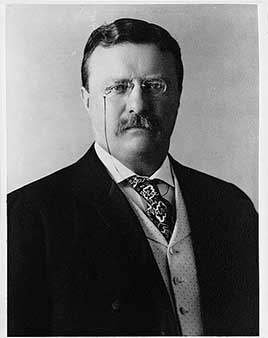
Theodore Roosevelt
This presidency falls in the realignment era (1896–1932), when the two parties were trading positions and both had progressive and conservative wings.
Became the youngest president, at 42, when William McKinley was assassinated. He broke up big trusts, settled the 1902 coal strike, signed the Pure Food and Drug Act and meat inspection law, protected about 230 million acres of public land, started building the Panama Canal and won the Nobel Peace Prize for ending the Russo-Japanese War.
The economy, first day to last
Shaded areas show the years in office, with a few years before and after for comparison. Budget years ran July to June until 1976 (now October to September), so each year's figures cover parts of two calendar years.
National debt
June 30, 1901 (end of fiscal 1901): $2.14 billion → June 30, 1908 (end of fiscal 1908): $2.63 billion
Daily debt figures don't exist before 1993, so Roosevelt's numbers use the fiscal years closest to his terms, the same rule as every other page.
Debt compared with the economy
Debt as a share of GDP. Above 100% means the debt is bigger than a year of everything the country produces.
Deficits and surpluses
Money borrowed each budget year (below the line) or paid down (above). The White House budget office's yearly figures begin in 1901.
Unemployment
1901: 2.4% → 1908: 8.5%. Yearly averages; monthly figures begin in 1948. Estimates by economist Stanley Lebergott (NBER, 1957).
Inflation
How much prices rose each year (consumer price index).
Cost of living
What everyday prices and paychecks did while in office.
Prices use the consumer price index (MeasuringWorth). The minimum wage is the federal rate set by Congress.
Executive orders
1,081 orders. Count from the American Presidency Project. Many of his orders withdrew public land for forests, parks and wildlife refuges.
Orders signed each year
Yearly counts aren't reliable for this era. Orders were not numbered until 1907, when the State Department numbered the ones already in its files, and many orders were never numbered at all, so only the total is shown.
Source: American Presidency Project: executive orders (full list of every order).
Notable orders
The 'gag order'OrderJanuary 31, 1902
Barred federal employees from lobbying Congress for raises or laws except through their department heads.
Federal RegisterPelican IslandOrderMarch 14, 1903
Made Florida's Pelican Island the first federal bird reservation, the start of the National Wildlife Refuge System.
Federal RegisterEvery executive order we have 104Search, filter by topic or year, and open any order's full text
Incomplete: orders before 1929 were not numbered or collected consistently. This archive has 104 of the roughly 1,081 orders counted for this president.
- OrderSeptember 23, 1901Executive Order
- OrderOctober 1, 1901Executive Order
- OrderOctober 15, 1901Executive Order
- OrderOctober 30, 1901Executive Order
- OrderNovember 9, 1901Executive Order
- OrderNovember 11, 1901Executive Order
- OrderNovember 14, 1901Executive Order
- OrderNovember 15, 1901Executive Order
- OrderNovember 26, 1901Executive Order
- OrderDecember 3, 1901Executive Order
- OrderDecember 9, 1901Executive Order
- OrderDecember 19, 1901Executive Order
- OrderJanuary 17, 1902Executive Order
- OrderJanuary 31, 1902Executive Order
- OrderFebruary 5, 1902Executive Order
- OrderFebruary 15, 1902Executive Order
- OrderMarch 24, 1902Executive Order
- OrderMarch 26, 1902Executive Order
- OrderMarch 27, 1902Executive Order
- OrderApril 29, 1902Executive Order
- OrderApril 29, 1902Executive Order
- OrderApril 30, 1902Executive Order
- OrderMay 12, 1902Executive Order
- OrderMay 12, 1902Executive Order
- OrderJune 13, 1902Executive Order
- OrderJune 13, 1902Executive Order
- OrderJuly 3, 1902Executive Order
- OrderJuly 10, 1902Executive Order
- OrderJuly 19, 1902Executive Order—Issuance of Passports to Residents of the Insular Possessions of the United States
- OrderJuly 22, 1902Executive Order—Reserving Miraflores Island in Puerto Rico
- OrderJuly 25, 1902Executive Order—Mandatory Retirement Age for Officers of the Revenue Cutter Service
- OrderAugust 1, 1902Executive Order—Affecting Rates of Pay of Certain Naval Personnel
- OrderAugust 9, 1902Executive Order—Setting Aside Certain Public Lands for Use in Connection with Experimental Tree Planting
- OrderSeptember 4, 1902Executive Order
- OrderNovember 26, 1902Executive Order—Greenville School, California
- OrderDecember 22, 1902Executive Order
- EO 206March 9, 1903Transfer of Revolutionary Archives
- OrderMarch 26, 1903Executive Order
- OrderMarch 27, 1903Executive Order
- OrderMarch 28, 1903Executive Order
- OrderMay 29, 1903Executive Order
- OrderJuly 3, 1903Executive Order
- OrderJuly 8, 1903Executive Order
- OrderJuly 13, 1903Executive Order
- OrderJuly 29, 1903Executive Order
- OrderJuly 30, 1903Executive Order
- OrderJuly 31, 1903Executive Order
- OrderAugust 9, 1903Executive Order
- OrderAugust 17, 1903Executive Order
- OrderAugust 20, 1903Executive Order
- OrderSeptember 15, 1903Executive Order
- OrderOctober 9, 1903Executive Order
- OrderOctober 23, 1903Executive Order
- OrderNovember 2, 1903Executive Order
- OrderDecember 4, 1903Executive Order
- OrderDecember 28, 1903Executive Order
- OrderJanuary 7, 1904Executive Order
- OrderJanuary 25, 1904Executive Order—Addition to Pine Ridge Reservation
- OrderFebruary 1, 1904Executive Order
- OrderFebruary 5, 1904Executive Order
- OrderFebruary 20, 1904Executive Order—Pine Ridge School Reservation, South Dakota
- OrderFebruary 25, 1904Executive Order
- OrderFebruary 27, 1904Executive Order
- OrderMarch 1, 1904Executive Order
- OrderMarch 4, 1904Executive Order
- OrderMarch 10, 1904Executive Order
- OrderMarch 26, 1904Executive Order
- OrderMay 18, 1904Executive Order
- OrderMay 26, 1904Executive Order
- OrderJune 2, 1904Executive Order
- OrderJune 13, 1904Executive Order
- OrderJune 17, 1904Executive Order
- OrderJune 23, 1904Executive Order
- OrderJune 24, 1904Executive Order
- OrderNovember 15, 1904Executive Order
- OrderNovember 29, 1904Executive Order
- OrderNovember 29, 1904Executive Order
- OrderJanuary 4, 1905Executive Order
- OrderJanuary 9, 1905Executive Order
- OrderJanuary 27, 1905Executive Order
- OrderMarch 10, 1905Executive Order—Navaho Reservation, Utah
- OrderMay 15, 1905Executive Order—Cancellation of Lands Set Apart in Utah
- OrderJune 29, 1905Executive Order
- OrderJuly 21, 1905Executive Order—Fort Shaw School Reservation, Montana
- OrderJuly 22, 1905Executive Order
- OrderJuly 25, 1905Executive Order
- OrderJuly 29, 1905Executive Order—Santa Clara Pueblo, New Mexico
- OrderAugust 26, 1905Executive Order
- OrderAugust 31, 1905Executive Order
- OrderOctober 13, 1905Executive Order
- OrderOctober 17, 1905Executive Order
- OrderNovember 17, 1905Executive Order
- OrderNovember 17, 1905Executive Order
- OrderNovember 18, 1905Executive Order
- OrderJanuary 31, 1906Executive Order—Modification of Executive Order of May 21, 1887
- OrderFebruary 5, 1906Executive Order—Cancellation of Lands Set Apart in Utah
- OrderDecember 19, 1906Executive Order
- EO 709November 9, 1907Camp McDowell Reservation, Arizona
- EO 711November 11, 1907Pine Ridge School Reservation, South Dakota
- OrderJanuary 28, 1908Executive Order—Jicarilla Apache, New Mexico
- EO 743January 28, 1908Pine Ridge School Reservation, South Dakota
- EO 744January 28, 1908Camp McDowell Reservation, Arizona
- EO 1000December 30, 1908Alamo National Forest, New Mexico
- EO 1044February 27, 1909Establishing the Pribilof Reservation, Alaska
Source: Executive Orders Archive, compiled from the American Presidency Project and the Federal Register. Topics are the archive's automated tags; "Revoked" and similar labels come from the Federal Register's records.
Pardons and commutations
A pardon wipes out the punishment for a federal crime; a commutation shortens a sentence but leaves the conviction. Counts are by federal fiscal year (July to June). The Justice Department counts fiscal 1902, which began two months before he took office, and all of fiscal 1909, including Taft's first four months, under Roosevelt.
Granted each year
Source: U.S. Dept. of Justice, clemency statistics, which lists every recipient with the crime and sentence.
Notable grants: tap to see the crime
Filipino resistance fightersAmnestyJuly 4, 1902
The crime: Fighting U.S. rule in the Philippine–American War
Sentence: Various
Why it drew attention: A general amnesty issued as the war was declared over, excluding those convicted of murder, rape, arson or robbery.
SourceInvestigations and legal record
The same checklist for every president. Tap a row for details and sources.
ImpeachedNoNo
No articles of impeachment were voted on.
Criminally chargedNoNo
Never charged.
Aides or cabinet convictedNo — postal officials werePartly
No cabinet member or White House aide was convicted. Several career Post Office officials were convicted of bribery after an investigation Roosevelt ordered in 1903.
SourceSpecial counselsYes — he appointed themYes
He named special prosecutors for the Post Office bribery cases (1903) and the Oregon land fraud cases (1904–10), which convicted a U.S. senator and two congressmen.
SourceMisuse of DOJ, FBI or IRSNo findingNo
His Justice Department created the Bureau of Investigation, forerunner of the FBI, in 1908 after Congress barred it from borrowing Secret Service agents. No official investigation found it was used against his opponents.
People around the president who were charged or penalized
Controversies and scandals
What happened, what was proven, and how it ended.
The Brownsville affairProven1906
After a shooting in Brownsville, Texas, Roosevelt dishonorably discharged all 167 Black soldiers of three companies of the 25th Infantry without a trial, though no evidence tied them to it.
Outcome: The Army reversed the discharges to honorable in 1972; one survivor received a pension.
SourceTaking PanamaDisputed1903
When Colombia rejected a canal treaty, the U.S. backed Panama's revolt, sent warships to block Colombian troops, and recognized the new country within days to sign a canal deal.
Outcome: The U.S. paid Colombia $25 million in 1921.
SourceAbuses in the Philippine–American WarProven1899–1902
U.S. troops used torture such as the 'water cure' and, on Samar, an order to kill all males over ten. Hundreds of thousands of Filipino civilians died from fighting, famine and disease.
Outcome: A Senate committee investigated in 1902; General Jacob Smith was court-martialed and forced to retire.
SourceCorporate money in the 1904 campaignDisputed1904
His campaign took large donations from corporations and insurance companies, which was legal at the time.
Outcome: Roosevelt then pushed Congress to ban corporate contributions, which it did in the Tillman Act of 1907.
SourceIn their own words
Widely quoted remarks, with the context they were said in.
Speak softly and carry a big stick; you will go far.
The men with the muck-rakes are often indispensable to the well-being of society; but only if they know when to stop raking the muck.
I took the Isthmus, started the canal and then left Congress not to debate the canal, but to debate me.