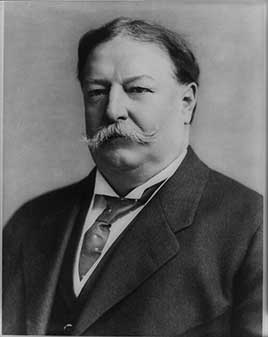
William Howard Taft
This presidency falls in the realignment era (1896–1932), when the two parties were trading positions and both had progressive and conservative wings.
Theodore Roosevelt's hand-picked successor. He brought about 80 antitrust suits, more than Roosevelt, including the case that broke up Standard Oil, and backed the 16th Amendment (income tax) and the 17th (direct election of senators). A tariff fight and the Ballinger–Pinchot affair split his party, and Roosevelt ran against him in 1912. He later became chief justice, the only person to hold both jobs.
The economy, first day to last
Shaded areas show the years in office, with a few years before and after for comparison. Budget years ran July to June until 1976 (now October to September), so each year's figures cover parts of two calendar years.
National debt
June 30, 1908 (end of fiscal 1908): $2.63 billion → June 30, 1912 (end of fiscal 1912): $2.87 billion
Daily debt figures don't exist before 1993, so Taft's numbers use the fiscal years closest to his term, the same rule as every other page.
Debt compared with the economy
Debt as a share of GDP. Above 100% means the debt is bigger than a year of everything the country produces.
Deficits and surpluses
Money borrowed each budget year (below the line) or paid down (above).
Unemployment
1909: 5.2% → 1912: 5.2%. Yearly averages; monthly figures begin in 1948. Estimates by economist Stanley Lebergott.
Inflation
How much prices rose each year (consumer price index).
Cost of living
What everyday prices and paychecks did while in office.
Prices use the consumer price index (MeasuringWorth). The minimum wage is the federal rate set by Congress.
Executive orders
724 orders. Count from the American Presidency Project. Many withdrew public land from sale.
Orders signed each year
Yearly counts aren't reliable for this era. Orders were not numbered until 1907, when the State Department numbered the ones already in its files, and many orders were never numbered at all, so only the total is shown.
Source: American Presidency Project: executive orders (full list of every order).
Notable orders
Withdrawing oil landsOrderSeptember 27, 1909
Pulled about 3 million acres of oil land in California and Wyoming from private claims, without specific authority from Congress. The Supreme Court upheld it in 1915.
Federal RegisterCivil service for postmastersOrderOctober 15, 1912
Put about 36,000 fourth-class postmasters under civil service protection, ending them as patronage jobs.
Federal RegisterEvery executive order we have 75Search, filter by topic or year, and open any order's full text
Incomplete: orders before 1929 were not numbered or collected consistently. This archive has 75 of the roughly 724 orders counted for this president.
- EO 1052March 23, 1909Amending Civil Service Rules in Relation to Proposed Employee Transfers
- EO 1060April 7, 1909Admission of Deaf-Mutes to Examinations for Civil Service
- EO 1061April 8, 1909Ordering Solicitor General to Report to President on Branding Requirements for Whisky
- EO 1062April 14, 1909Directing Heads of Departments to Comply with Congressional Resolutions Requesting Information When in the Public Interest
- EO 1065April 21, 1909Allowing Incidental Assignment of Laborers to Classified Work
- EO 1071May 13, 1909General Supply Committee Created to Systematize Purchases of Common Supplies for Departments
- EO 1072May 14, 1909Modifying Civil Service Restrictions on Political Activity in Navy Yards
- EO 1077May 25, 1909Communications and Reports Relative to Certain Territories and Possessions to be Transmitted through the Interior Department
- EO 1083June 7, 1909Tariff of Consular Fees Amended
- EO 1085June 11, 1909Amending Executive Order Providing that Railroad Cars in Canal Zone Be Equipped With Safety Appliances
- EO 1090June 17, 1909Restoring to Public Domain Certain Lands in Arizona Which Were Reserved for Papago Indians
- EO 1092June 19, 1909Assistant Attorney General for Interior Department Designated to Act as Interior Secretary During Absence of Secretary and First Secretary
- EO 1110July 15, 1909Placing Government of Porto Rico Under the War Department
- EO 1113July 20, 1909Amending Paragraphs 114, 115, 120, and 129 of Consular Regulations of 1896, Regarding Communications
- EO 1115July 30, 1909Amending Section 149 of the Laws of the Canal Zone, Concerning Penalties for Murder in the First Degree
- EO 1116July 30, 1909Providing for Diminution of Time from Sentences of Certain Convicts in the Canal Zone
- EO 1120August 6, 1909Time Limit for Completion of the Work of the Spanish Treaty Claims Commission Extended to March 2, 1910
- EO 1121August 6, 1909Amending Civil Service Rules to Except More General Land Office Special Agents from Examination
- EO 1135November 11, 1909Restoring to the Public Domain Certain Lands in the State of Washington
- EO 1142November 26, 1909Influencing Legislation by Employees of the United States or Military Officers Stationed in Washington
- EO 1143November 26, 1909Regulations Governing Appointments and Promotions in Diplomatic Service and for the Improvement of the Personnel of the Department of State
- EO 1172March 1, 1910Restoring to Public Domain Certain Lands in Mescalero Apache Indian Reservation
- EO 1216June 23, 1910Reserving Certain Described Lands in Montana for the Protection of the Big Hole Battlefield National Monument
- EO 1220July 1, 1910Adding Lands to Duck Valley Indian Reservation
- EO 1221July 1, 1910Reserving Lands in New Mexico as Reservation for Pueblo Indians Belonging to Pueblo Laguna
- EO 1224July 7, 1910Partially Revoking Executive Order of August 25, 1877 which Reserved Lands in California for Indian Use
- EO 1256October 20, 1910Adding Lands to the Salt River Indian Reservation
- EO 1267December 1, 1910Fort Mojave Indian Reservation
- EO 1271December 13, 1910Adding Lands to the Coeur d'Alene Reservation, Idaho
- EO 1284January 16, 1911Restoring to Public Domain Certain Lands in Navajo Indian Reservation
- EO 1296February 1, 1911Fort Mojave Indian Reservation
- EO 1299February 16, 1911Ordering Lands Ceded by Pillager Band of Chippewa Indians No Longer Held as Indian Land
- EO 1300February 16, 1911Authorizing Sales of Liquor on Lands Ceded by Red Lake and Pembina Bands of Chippewa Indians
- EO 1301February 16, 1911Authorizing Sales of Liquor on Lands Ceded by Chippewa Indians of Lake Superior
- EO 1322March 22, 1911Pima and Maricopa Indian Reservation
- EO 1349May 8, 1911Gila River Reservation
- EO 1359May 24, 1911Reserving Land in New Mexico for Indian Purposes
- EO 1368June 2, 1911Reserving Land in Arizona for Use of Walapai Indians
- EO 1374June 16, 1911Reserving Lands for Benefit of Papago Indians
- EO 1379June 28, 1911Reserving Lands in Southern Florida as Reservation for Seminole Indians
- EO 1387July 31, 1911Gila Indian Reservation, Arizona
- EO 1406September 1, 1911Amending Executive Order Reserving Lands in New Mexico for Use by Indians of Jemez Pueblo
- EO 1416September 28, 1911Reserving Additional Land for Use of Pima and Maricopa Indians
- EO 1426October 23, 1911Reserving Additional Land in Arizona for Use of Pima and Maricopa Indians
- EO 1447December 16, 1911Withdrawing Lands Near Gila River Indian Reservation, Arizona, From Settlement
- EO 1465January 17, 1912Reserving Land in Utah for School, Agency, and Other Uses for Benefit of Indians
- EO 1475February 17, 1912Restoring Lands to White Mountain and San Carlos Reservation
- EO 1476February 17, 1912Restoring Lands to Jicarilla Apache Indian Reservation
- EO 1477February 17, 1912Restoring Lands to White Mountain Indian Reservation
- EO 1478February 17, 1912Restoring Lands to Tule River Indian Reservation
- EO 1479February 17, 1912Restoring Lands to White Mountain Indian Reservation
- EO 1480February 17, 1912Restoring Lands to Hoopa Valley Indian Reservation
- EO 1481February 17, 1912Restoring Lands to Mescalero Apache Indian Reservation
- EO 1482February 17, 1912Restoring Lands to Zuni and Navajo Indian Reservations
- EO 1483February 17, 1912Restoring Lands to the Navajo Indians
- EO 1485February 20, 1912Restoring to Public Domain Lands in California Which Were Reserved for Indian Purposes
- EO 1495March 11, 1912Reserving Hunter's Rock or Prince Island in Pacific Ocean for Use of Smith River Indians
- EO 1496March 11, 1912Reserving for Indian Purposes Certain Lands in the State of California
- EO 1517April 13, 1912Reserving for Indian Purposes Certain Lands in the State of California
- EO 1518April 13, 1912Withdrawing Lands from Flathead or Jocko Reservation for Examination and Classification
- EO 1522April 24, 1912Reserving for Indian Purposes Certain Lands in the State of California
- EO 1529May 9, 1912Reserving Lands in California Pending Investigation as to Suitableness for Paiute or Other Indian Use
- EO 1558July 6, 1912Reserving Land in South Dakota for Indian School and Administrative Purposes
- EO 1579August 19, 1912Transferring Certain Lands from Fort Duschesne Military Reservation to Interior Department
- EO 1598September 2, 1912Eliminating Certain Lands from Reservation of Papago Indians
- EO 1603September 7, 1912Reserving Lands in California Pending Investigation as to Suitableness for Paiute or Other Indian Use
- EO 1606September 16, 1912Reserving Land in Nevada for Indian Allotment Purposes
- EO 1621October 8, 1912Altering Lands Composing Reservation of Papago Indians
- EO 1632October 28, 1912Addition of Lands to the Moapa River Indian Reservation
- EO 1649November 26, 1912Altering Lands Composing the Moapa River Indian Reservation
- EO 1655December 5, 1912Altering Lands Composing Reservation of Papago Indians
- EO 1681January 14, 1913Reserving Lands in Nevada for Use of the Paiute and Shoshoni Indians
- EO 1682January 14, 1913Setting Aside Lands in Montana for Administrative Purposes in Connection with Flathead Indians
- EO 1699February 10, 1913Reserving Lands in Arizona for Use of the Navajo Indians
- EO 1700February 10, 1913Reserving Lands in New Mexico for Use of the Navajo Indians
Source: Executive Orders Archive, compiled from the American Presidency Project and the Federal Register. Topics are the archive's automated tags; "Revoked" and similar labels come from the Federal Register's records.
Pardons and commutations
A pardon wipes out the punishment for a federal crime; a commutation shortens a sentence but leaves the conviction. Counts are by federal fiscal year (July to June). The Justice Department counts fiscal 1909, including Taft's first four months, under Roosevelt, and all of fiscal 1913, including Wilson's first four months, under Taft.
Granted each year
Source: U.S. Dept. of Justice, clemency statistics, which lists every recipient with the crime and sentence.
Notable grants: tap to see the crime
Charles W. MorseCommutation1912-01
The crime: Misusing funds of the Bank of North America (convicted 1908)
Sentence: 15 years; served about two
Why it drew attention: The shipping magnate was freed after Army doctors said he was dying. Reports later said he had faked the illness; he lived until 1933.
SourceInvestigations and legal record
The same checklist for every president. Tap a row for details and sources.
ImpeachedNoNo
No articles of impeachment were voted on.
Criminally chargedNoNo
Never charged.
Aides or cabinet convictedNoNo
No member of his cabinet or White House staff was convicted.
Special counselsNoNo
None were appointed. A joint committee of Congress investigated the Ballinger–Pinchot affair in 1910.
Misuse of DOJ, FBI or IRSNo findingNo
No official investigation found he used these agencies against opponents.
People around the president who were charged or penalized
Controversies and scandals
What happened, what was proven, and how it ended.
The Ballinger–Pinchot affairDisputed1909–1910
Taft fired the chief forester after he accused the interior secretary of helping private interests take Alaska coal lands. Hearings revealed that a memo Taft cited to clear Ballinger had been written after the fact and dated earlier; Taft acknowledged it.
Outcome: A committee majority cleared Ballinger. The fight split Republicans and helped drive Roosevelt's 1912 challenge.
SourceThe Payne–Aldrich tariffDisputed1909
Taft promised to lower tariffs but signed a bill that cut them only slightly, then called it the best tariff bill his party ever passed.
Outcome: Progressive Republicans turned against him; Democrats won the House in 1910.
SourceMarines to NicaraguaProven1912
Taft sent about 2,000 Marines to prop up a government friendly to U.S. banks, part of his 'dollar diplomacy'.
Outcome: U.S. forces stayed, with one short break, until 1933.
SourceSuing U.S. SteelDisputed1911
His antitrust suit against U.S. Steel cited its 1907 purchase of a rival, which Roosevelt had approved, and Roosevelt took it as a personal attack.
Outcome: The Supreme Court ruled for U.S. Steel in 1920; the break with Roosevelt became permanent.
SourceIn their own words
Widely quoted remarks, with the context they were said in.
I think the Payne bill is the best bill that the Republican party ever passed.
Even a rat in a corner will fight.