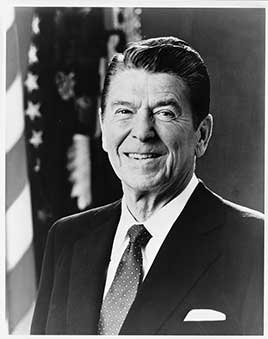
Ronald Reagan
Cut income tax rates sharply, built up the military and pressed the Soviet Union in the last decade of the Cold War. The debt nearly tripled as defense spending and tax cuts outpaced revenue. The Iran-Contra affair, secret arms sales to Iran with profits sent to Nicaraguan rebels, was the major scandal of his second term.
The economy, first day to last
Shaded areas show the years in office, with a few years before and after for comparison. Budget years run October to September, so a new president's first budget year starts the fall after they take office.
National debt
Sept 30, 1980 (end of fiscal 1980): $907.70 billion → Sept 30, 1988 (end of fiscal 1988): $2.60 trillion
Daily debt figures don't exist before 1993, so Reagan's numbers use the fiscal years closest to his term.
Debt compared with the economy
Debt as a share of GDP. Above 100% means the debt is bigger than a year of everything the country produces.
Deficits and surpluses
Money borrowed each budget year (below the line) or paid down (above).
Unemployment
Jan 1981: 7.5% → Jan 1989: 5.4%. Monthly rates; the chart shows yearly averages.
Inflation
How much prices rose each year (consumer price index).
Cost of living
What everyday prices and paychecks did while in office.
Prices use the consumer price index (MeasuringWorth). The minimum wage is the federal rate set by Congress.
Executive orders
381 orders, numbered 12287–12667.
Orders signed each year
Source: National Archives: Reagan executive orders (full list of every order).
Notable orders
Ending oil price controlsEO 12287January 28, 1981
Immediately removed the remaining federal price and allocation controls on crude oil and gasoline.
Federal RegisterCost-benefit review of regulationsEO 12291February 17, 1981
Required major regulations to pass a cost-benefit test reviewed by the White House budget office.
Federal RegisterU.S. intelligence activitiesEO 12333December 4, 1981
Set the rules for the CIA, NSA and other spy agencies. Still in force, as amended.
Federal RegisterClassified national security informationEO 12356April 2, 1982
Expanded what could be classified and ended automatic declassification.
Federal RegisterDrug-free federal workplaceEO 12564September 15, 1986
Required drug testing for federal employees in sensitive jobs.
Federal RegisterFederalismEO 12612October 26, 1987
Required agencies to limit rules that override state authority.
Federal RegisterEvery executive order 381Search, filter by topic or year, and open any order's full text
- EO 12287January 28, 1981Decontrol of Crude Oil and Refined Petroleum Products
- EO 12288January 29, 1981Termination of the Wage and Price Regulatory Program
- EO 12289February 14, 1981Foreign Service Retirement and Disability System
- EO 12290February 17, 1981Federal Exports and Excessive Regulation
- EO 12291February 17, 1981Federal Regulation
- EO 12292February 23, 1981Foreign Service Act of 1980
- EO 12293February 23, 1981Foreign Service of the United StatesAmended
- EO 12294February 24, 1981Suspension of Litigation Against Iran
- EO 12295February 24, 1981Nuclear Cooperation With EURATOM
- EO 12296March 2, 1981President's Economic Policy Advisory Board
- EO 12297March 12, 1981International Coffee Agreement 1976
- EO 12298March 12, 1981Lake Tahoe Region
- EO 12299March 17, 1981Presidential Advisory Board on Ambassadorial Appointments
- EO 12300March 23, 1981Exceptions From the Competitive ServiceSuperseded
- EO 12301March 26, 1981Integrity and Efficiency in Federal ProgramsAmended
- EO 12302April 1, 1981Amending the Generalized System of Preferences
- EO 12303April 8, 1981Presidential Advisory Committee on Federalism
- EO 12304April 29, 1981Seal for the Panama Canal Commission
- EO 12305May 5, 1981Termination of Certain Federal Advisory Committees
- EO 12306June 1, 1981Amendments to the Manual for Courts-Martial, United States, 1969 (Revised Edition)
- EO 12307June 4, 1981President's Commission on Hostage Compensation
- EO 12308June 5, 1981Presidential Task Force on the Arts and Humanities
- EO 12309June 9, 1981President's Economic Policy Advisory Board
- EO 12310June 16, 1981President's Commission on Housing
- EO 12311June 29, 1981Amending the Generalized System of Preferences
- EO 12312July 2, 1981The Meritorious Service Medal
- EO 12313July 13, 1981Specification of Hostage Return Date Under Hostage Relief Act of 1980
- EO 12314July 22, 1981Federal Regional Councils
- EO 12315July 29, 1981Amendments to the Manual for Courts-Martial, United States, 1969 (Revised Edition)
- EO 12316August 14, 1981Responses to Environmental Damage
- EO 12317August 14, 1981President's Commission on Hostage Compensation
- EO 12318August 21, 1981Statistical Policy Functions
- EO 12319September 9, 1981River Basin Commissions
- EO 12321September 14, 1981Foreign Assistance and Arms Export Control
- EO 12320September 15, 1981Historically Black Colleges and Universities
- EO 12322September 17, 1981Water Resources Projects
- EO 12323September 22, 1981Presidential Commission on Broadcasting to Cuba
- EO 12324September 29, 1981Interdiction of Illegal Aliens
- EO 12325September 30, 1981Presidential Task Force on the Arts and Humanities
- EO 12326September 30, 1981Central Intelligence Agency Retirement and Disability System
- EO 12327October 1, 1981Exemption for Fort Allen
- EO 12328October 8, 1981Federal Employees Contracting or Trading With Indians
- EO 12329October 14, 1981President's Task Force on Private Sector Initiatives
- EO 12330October 15, 1981Adjustments of Certain Rates of Pay and Allowances
- EO 12331October 20, 1981President's Foreign Intelligence Advisory Board
- EO 12332November 10, 1981Establishment of the National Productivity Advisory Committee
- EO 12333December 4, 1981United States Intelligence ActivitiesRevoked
- EO 12334December 4, 1981President's Intelligence Oversight Board
- EO 12335December 16, 1981National Commission on Social Security Reform
- EO 12336December 21, 1981Task Force on Legal Equity for Women
- EO 12337January 11, 1982Basic Allowance for Subsistence for Uniformed Services
- EO 12338January 11, 1982Exclusions From the Federal Labor- Management Relations Program
- EO 12339January 13, 1982President's Commission on Housing
- EO 12340January 20, 1982Amendments to the Manual for Courts- Martial, United States, 1969 (Revised Edition)
- EO 12341January 21, 1982Cuban and Haitian EntrantsAmended
- EO 12342January 27, 1982Environmental Safeguards for Animal Damage Control on Federal Lands
- EO 12343January 27, 1982Designation of Certain Officers To Act as Secretary of StateRevoked
- EO 12344February 1, 1982Naval Nuclear Propulsion Program
- EO 12345February 2, 1982Physical Fitness and SportsRevoked
- EO 12346February 8, 1982Synthetic Fuels
- EO 12347February 23, 1982Agreement on Government Procurement
- EO 12348February 25, 1982Federal Real Property
- EO 12349February 26, 1982Amending the Generalized System of Preferences
- EO 12350March 9, 1982Termination of Urban and Community Impact Analyses
- EO 12351March 9, 1982Nuclear Cooperation With EURATOM
- EO 12352March 17, 1982Federal Procurement ReformsRevoked
- EO 12353March 23, 1982Charitable Fund-RaisingAmended
- EO 12354March 30, 1982Amending the Generalized System of Preferences
- EO 12355April 1, 1982The Task Force on Legal Equity for Women
- EO 12356April 2, 1982National Security InformationRevoked
- EO 12357April 6, 1982Sinai Support Mission
- EO 12358April 14, 1982Presidential Commission on Drunk Driving
- EO 12359April 22, 1982Public International Organizations Entitled To Enjoy Privileges, Exemptions, and Immunities
- EO 12360April 23, 1982President's Task Force on Victims of Crime
- EO 12361April 27, 1982Multinational Force and Observers Reports
- EO 12362May 12, 1982Overseas Employment
- EO 12363May 21, 1982The Foreign Service of the United States
- EO 12364May 24, 1982The Presidential Management Intern ProgramSuperseded
- EO 12365May 24, 1982Foreign Assistance and Arms Control
- EO 12366May 25, 1982Presidential Commission on Broadcasting to Cuba
- EO 12367June 15, 1982President's Committee on the Arts and the HumanitiesAmended
- EO 12368June 24, 1982Drug Abuse Policy Functions
- EO 12369June 30, 1982President's Private Sector Survey on Cost Control in the Federal Government
- EO 12370July 8, 1982Establishment of Emergency Board No. 194 To Investigate a Railroad Labor Dispute
- EO 12371July 12, 1982Amending the Generalized System of Preferences
- EO 12372July 14, 1982Intergovernmental Review of Federal Programs
- EO 12373July 21, 1982Establishment of Emergency Board No. 195 To Investigate a Railroad Labor Dispute
- EO 12374July 28, 1982Reports on International Organizations
- EO 12375August 4, 1982Motor Vehicles
- EO 12376August 5, 1982Presidential Commission on Drunk Driving
- EO 12377August 6, 1982Joint Mexican-United States Defense Commission
- EO 12378August 6, 1982President's Committee on the Arts and the Humanities
- EO 12379August 17, 1982Termination of Boards, Committees, and Commissions
- EO 12380August 18, 1982Submarine Duty Incentive Pay
- EO 12381September 8, 1982Delegation of Emergency Management Functions
- EO 12382September 13, 1982President's National Security Telecommunications Advisory CommitteeAmended
- EO 12383September 23, 1982Amendments to the Manual for Courts- Martial, United States, 1969 (Revised Edition)
- EO 12384October 1, 1982Establishment of Emergency Board No. 196 To Investigate a Railroad Labor Dispute
- EO 12385October 1, 1982Establishment of Emergency Board No. 197 To Investigate a Railroad Labor Dispute
- EO 12386October 1, 1982Establishment of Emergency Board No. 198 To Investigate a Railroad Labor Dispute
- EO 12387October 8, 1982Adjustments of Certain Rates of Pay and Allowances
- EO 12388October 14, 1982United States Information Agency
- EO 12389October 25, 1982Amending the Generalized System of Preferences
- EO 12390October 25, 1982Delegation to the Secretary of State
- EO 12391November 4, 1982Partial Suspension of Federal Service Labor-Management Relations
- EO 12392November 15, 1982International Financial Institutions
- EO 12393November 16, 1982Establishment of Emergency Board No. 199 To Investigate a Railroad Labor Dispute
- EO 12394November 18, 1982Incentive Pay for Hazardous Duty
- EO 12395November 20, 1982International Private Enterprise Task Force
- EO 12396December 9, 1982Defense Officer Personnel Management
- EO 12397December 23, 1982National Commission on Social Security Reform
- EO 12398December 31, 1982President's Private Sector Survey on Cost Control in the Federal Government
- EO 12399December 31, 1982Continuance of Certain Federal Advisory Committees
- EO 12400January 3, 1983President's Commission on Strategic Forces
- EO 12401January 14, 1983Presidential Commission on Indian Reservation Economies
- EO 12402January 15, 1983National Commission on Social Security Reform
- EO 12403February 8, 1983African Development Bank
- EO 12404February 10, 1983Charitable Fund-Raising
- EO 12405February 14, 1983Establishment of Emergency Board No. 200 To Investigate a Railroad Labor Dispute
- EO 12406February 18, 1983President's Commission on Strategic Forces
- EO 12407February 22, 1983Federal Regional Councils
- EO 12408February 23, 1983Reports on International Organizations
- EO 12409March 7, 1983Nuclear Cooperation with EURATOM
- EO 12410March 28, 1983Exclusions From the Federal Labor- Management Relations Program
- EO 12411March 29, 1983Government Work Space Management Reforms
- EO 12412March 29, 1983Peace Corps Advisory Council
- EO 12413March 30, 1983Amending the Generalized System of Preferences
- EO 12414April 4, 1983Establishment of Emergency Board No. 201 To Investigate a Railroad Labor Dispute
- EO 12415April 5, 1983Extension of the Presidential Commission on Drunk Driving
- EO 12416April 8, 1983Intergovernmental Review of Federal Programs
- EO 12417May 2, 1983Strategic and Critical Materials
- EO 12418May 5, 1983Transfer of Functions Relating to Financial Responsibility of Vessels for Pollution Liability
- EO 12419May 5, 1983Implementation of the International Convention on Tonnage Measurement of Ships
- EO 12420May 11, 1983Incentive Pay for Hazardous Duty
- EO 12421May 12, 1983Presidential Commission on the Conduct of United States-Japan Relations
- EO 12422May 20, 1983Level IV of the Executive Schedule
- EO 12423May 26, 1983Foreign Assistance and Arms Control
- EO 12424June 10, 1983President's Commission on Strategic Forces
- EO 12425June 16, 1983International Criminal Police OrganizationsAmended
- EO 12426June 22, 1983President's Advisory Committee on Women's Business Ownership
- EO 12427June 27, 1983President's Advisory Council on Private Sector Initiatives
- EO 12428June 28, 1983President's Commission on Industrial Competitiveness
- EO 12429June 28, 1983President's Private Sector Survey on Cost Control in the Federal Government
- EO 12430July 6, 1983Reports of Identical Bids
- EO 12431July 8, 1983Level IV of the Executive Schedule
- EO 12432July 14, 1983Minority Business Enterprise Development
- EO 12433July 19, 1983National Bipartisan Commission on Central America
- EO 12434July 19, 1983Alaska Railroad Rates
- EO 12435July 28, 1983President's Commission on Organized Crime
- EO 12436July 29, 1983Payment of Certain Benefits to Survivors of Persons Who Died in or as a Result of Military Service
- EO 12437August 11, 1983Fuel Use Prohibitions
- EO 12438August 23, 1983Review of Increases in Rates of Basic Pay for Employees of the Veterans' Administration
- EO 12439September 8, 1983President's Task Force on Food Assistance
- EO 12440September 8, 1983President's Commission on Industrial Competitiveness
- EO 12441September 20, 1983Amending the Generalized System of Preferences
- EO 12442September 21, 1983Presidential Commission on Indian Reservation Economies
- EO 12443September 27, 1983Central Intelligence Agency Retirement and Disability System
- EO 12444October 14, 1983Continuation of Export Control Regulations
- EO 12445October 17, 1983Certification of Containers and Vehicles for Use in International Transport
- EO 12446October 17, 1983Foreign Service Retirement and Disability System
- EO 12447October 27, 1983President's Private Sector Survey on Cost Control in the Federal Government
- EO 12448November 4, 1983Regulations Related to Voiding or Rescission of Contracts
- EO 12449November 18, 1983National Bipartisan Commission on Central America
- EO 12450December 9, 1983Interagency Committee on Handicapped Employees
- EO 12451December 20, 1983Continuation of Export Control Regulations
- EO 12452December 22, 1983Revised List of Quarantinable Communicable DiseasesRevoked
- EO 12453December 23, 1983Reports With Respect to Loans and Credits Extended to Poland
- EO 12454December 29, 1983President's National Security Telecommunications Advisory Committee
- EO 12455December 29, 1983President's Private Sector Survey on Cost Control in the Federal Government
- EO 12456December 30, 1983Adjustments of Certain Rates of Pay and Allowances
- EO 12457January 3, 1984President's Commission on Industrial Competitiveness
- EO 12458January 14, 1984Delegation to the Secretary of State Concerning Foreign Assistance
- EO 12459January 16, 1984Amending the Generalized System of Preferences
- EO 12460January 24, 1984Amendments to the Manual for Courts- Martial, United States, 1969 (Revised Edition)
- EO 12461February 17, 1984District of Columbia Police and Firefighters' Retirement and Disability System
- EO 12462February 17, 1984President's Advisory Committee on Mediation and Conciliation
- EO 12463February 23, 1984Nuclear Cooperation With EURATOM
- EO 12464February 23, 1984Award of the Purple Heart
- EO 12465February 24, 1984Commercial Expendable Launch Vehicle Activities
- EO 12466February 27, 1984Reimbursement of Federal Employee Relocation Expenses
- EO 12467March 2, 1984International Boundary and Water Commission, United States and Mexico
- EO 12468March 22, 1984Presidential Advisory Council on the Peace Corps
- EO 12469March 26, 1984East-West Foreign Trade Report
- EO 12470March 30, 1984Continuation of Export Control Regulations
- EO 12471March 30, 1984Amending the Generalized System of Preferences
- EO 12472April 3, 1984Assignment of National Security and Emergency Preparedness Telecommunications FunctionsRevoked
- EO 12473April 13, 1984Manual for Courts-Martial, United States, 1984Amended
- EO 12474April 17, 1984Agreement on Government Procurement
- EO 12475May 9, 1984Textile Import Program Implementation
- EO 12476May 11, 1984Presidential Commission on the Conduct of United States-Japan Relations
- EO 12477May 23, 1984Federal Civilian and Military Pay Increases
- EO 12478May 23, 1984Protection of Foreign Missions to International Organizations
- EO 12479May 24, 1984Management Reform in the Federal Government
- EO 12480June 20, 1984Establishment of Emergency Board No. 202 To Investigate a Railroad Labor Dispute
- EO 12481June 20, 1984Establishment of Emergency Board No. 203 To Investigate a Railroad Labor Dispute
- EO 12482June 21, 1984President's Advisory Committee on Women's Business Ownership
- EO 12483June 25, 1984Amending the Generalized System of Preferences
- EO 12484July 13, 1984Amendments to the Manual for Courts- Martial, United States, 1984
- EO 12485July 13, 1984Central Intelligence Agency Retirement and Disability System
- EO 12486August 24, 1984Establishment of Emergency Board No. 204 To Investigate a Railroad Labor Dispute
- EO 12487September 14, 1984Adjustments of Certain Rates of Pay
- EO 12488September 27, 1984Incentive Pay for Hazardous Duty
- EO 12489September 28, 1984Continuance of Certain Federal Advisory Committees
- EO 12490October 12, 1984National Commission on Space
- EO 12491October 25, 1984Establishment of Emergency Board No. 205 To Investigate a Railroad Labor Dispute
- EO 12492October 25, 1984Establishment of Emergency Board No. 206 To Investigate a Railroad Labor Dispute
- EO 12493December 5, 1984President's Commission on Executive Exchange
- EO 12494December 6, 1984Hazardous Duty Pay
- EO 12495December 21, 1984Establishment of Emergency Board No. 207 To Investigate a Railroad Labor Dispute
- EO 12496December 28, 1984Adjustments of Certain Rates of Pay and Allowances
- EO 12497December 29, 1984President's Advisory Committee on Mediation and Conciliation
- EO 12498January 4, 1985Regulatory Planning Process
- EO 12499January 18, 1985President's Blue Ribbon Task Group on Nuclear Weapons Program Management
- EO 12500January 24, 1985Delegation to the Secretary of State and the Director of the International Development Cooperation Agency Concerning Foreign Assistance
- EO 12501January 28, 1985Arctic ResearchAmended
- EO 12502January 28, 1985Chemical Warfare Review Commission
- EO 12503January 28, 1985Presidential Commission on Outdoor Recreation Resources Review
- EO 12504January 31, 1985Protection of Semiconductor Chip Products
- EO 12505February 12, 1985Conversion of Appointments in the Office of Management and Budget
- EO 12506March 4, 1985Nuclear Cooperation With EURATOM
- EO 12507March 22, 1985Continuance of the President's Commission on Organized Crime
- EO 12508March 22, 1985World Tourism Organization
- EO 12509April 14, 1985Technical Review Group on Inertial Confinement Fusion
- EO 12510April 17, 1985Non-Foreign Area Cost-of-Living Allowances
- EO 12511April 29, 1985President's Child Safety Partnership
- EO 12512April 29, 1985Federal Real Property ManagementRevoked
- EO 12513May 1, 1985Prohibiting Trade and Certain Other Transactions Involving Nicaragua
- EO 12514May 14, 1985Prescribing the Order of Succession of Officers To Act as Secretary of Defense, Secretary of the Army, Secretary of the Navy, and Secretary of the Air Force
- EO 12515May 14, 1985Generalized System of Preferences
- EO 12516May 21, 1985President's Commission on Executive Exchange
- EO 12517May 29, 1985Delegation Concerning the United States- India Fund for Cultural, Educational, and Scientific Cooperation
- EO 12518June 3, 1985Trade in Services
- EO 12519June 13, 1985Amending the Generalized System of Preferences
- EO 12520June 19, 1985Quarters Allowance to Department of Defense Employees In Panama
- EO 12521June 24, 1985Offsets in Military-Related ExportsRevoked
- EO 12522June 24, 1985Reimbursement of Federal Employee Relocation Expenses
- EO 12523June 27, 1985National White House Conference on Small Business
- EO 12524July 1, 1985Amending the Generalized System of Preferences
- EO 12525July 12, 1985Termination of Emergency Authority for Export Controls
- EO 12526July 15, 1985President's Blue Ribbon Commission on Defense Management
- EO 12527August 7, 1985Repealing Provisions Establishing an Administrative Position in the Food-for-Peace Program
- EO 12528August 8, 1985Presidential Board of Advisors on Private Sector Initiatives
- EO 12529August 14, 1985President's Commission on Americans Outdoors
- EO 12530August 29, 1985Establishment of Nicaraguan Humanitarian Assistance Office
- EO 12531August 30, 1985Establishing an Emergency Board To Investigate a Dispute Between the United Transportation Union and Certain Railroads Represented by the National Carriers' Conference Committee of the National Railway Labor Conference
- EO 12532September 9, 1985Prohibiting Trade and Certain Other Transactions Involving South Africa
- EO 12533September 30, 1985President's Advisory Committee on Mediation and Conciliation
- EO 12534September 30, 1985Continuance of Certain Federal Advisory Committees
- EO 12535October 1, 1985Prohibition of the Importation of the South African Krugerrand
- EO 12536October 9, 1985Board of the Foreign Service
- EO 12537October 28, 1985President's Foreign Intelligence Advisory Board
- EO 12538November 15, 1985Imports of Refined Petroleum Products From LibyaRevoked
- EO 12539December 3, 1985President's Council on Physical Fitness and Sports
- EO 12540December 30, 1985Adjustments of Certain Rates of Pay and Allowances
- EO 12541December 30, 1985Amending Executive Order 11157 as It Relates to a Basic Allowance for Quarters While on Sea Duty
- EO 12542December 30, 1985President's Blue Ribbon Commission on Defense Management
- EO 12543January 7, 1986Prohibiting Trade and Certain Transactions Involving LibyaRevoked
- EO 12544January 8, 1986Blocking Libyan Government Property in the United States or Held by U.S. PersonsRevoked
- EO 12545January 14, 1986National Commission on Space
- EO 12546February 3, 1986Presidential Commission on the Space Shuttle Challenger Accident
- EO 12547February 6, 1986Establishing Procedures for Facilitating Presidential Review of International Aviation Decisions Submitted by the Department of Transportation
- EO 12548February 14, 1986Grazing Fees
- EO 12549February 18, 1986Debarment and Suspension of Participants in Federal Programs
- EO 12550February 19, 1986Amendments to the Manual for Courts- Martial, United States, 1984
- EO 12551February 21, 1986The President's Export Council
- EO 12552February 25, 1986Productivity Improvement Program for the Federal GovernmentRevoked
- EO 12553February 25, 1986Revocation of Various Executive Orders
- EO 12554February 28, 1986Nuclear Cooperation With EURATOM
- EO 12555March 10, 1986Protection of Cultural PropertyAmended
- EO 12556April 16, 1986Mailing Privileges of Members of Armed Forces of the United States and of Friendly Foreign Nations
- EO 12557May 16, 1986Establishment of Emergency Board No. 209 To Investigate a Railroad Labor Dispute
- EO 12558May 16, 1986Establishing an Emergency Board To Investigate a Dispute Between the Long Island Rail Road and Certain Labor Organizations Representing Its Employees
- EO 12559May 20, 1986Exclusions From the Federal Labor- Management Relations Program
- EO 12560May 24, 1986Administration of Foreign Relations and Related Functions
- EO 12561July 1, 1986Delegating Certain Functions of the President Relating to Federal Civilian Employee and Contractor Travel Expenses
- EO 12562July 15, 1986Establishment of an Emergency Board To Investigate Railroad Labor Disputes
- EO 12563September 12, 1986Establishing an Emergency Board To Investigate a Dispute Between the Long Island Rail Road and Certain Labor Organizations Representing Its Employees
- EO 12564September 15, 1986Drug-Free Federal Workplace
- EO 12565September 25, 1986Prescribing a Comprehensive System of Financial Reporting for Officers and Employees in the Executive Branch
- EO 12566September 26, 1986Safety Belt Use Requirements for Federal EmployeesRevoked
- EO 12567October 2, 1986Designation of the Inter-American Investment Corporation, the Commission for the Study of Alternatives to the Panama Canal, and the Pacific Salmon Commission as Public International Organizations
- EO 12568October 2, 1986Employment Opportunities for Military Spouses at Nonappropriated Fund Activities
- EO 12569October 16, 1986Compact of Free Association With the Republic of the Marshall Islands, the Federated States of Micronesia, and the Republic of Palau
- EO 12570October 24, 1986Delegating Authority To Implement Assistance for Central American Democracies and the Nicaraguan Democratic Resistance
- EO 12571October 27, 1986Implementation of the Comprehensive Anti-Apartheid Act
- EO 12572November 3, 1986Relations With the Northern Mariana Islands
- EO 12573November 6, 1986Amending Executive Order No. 11157 as It Relates to Incentive Pay for Hazardous Duty
- EO 12574November 20, 1986Establishing an Experimental Program Within the President's Commission on Executive Exchange
- EO 12575December 1, 1986President's Special Review Board
- EO 12576December 2, 1986Victims of Terrorism Compensation
- EO 12577December 22, 1986Closing of Government Departments and Agencies on Friday, December 26, 1986
- EO 12578December 31, 1986Adjustments of Certain Rates of Federal Pay and Allowances
- EO 12579December 31, 1986President's Advisory Committee on Mediation and Conciliation
- EO 12580January 23, 1987Superfund ImplementationAmended
- EO 12581January 28, 1987President's Special Review Board
- EO 12582February 2, 1987Naturalization Requirements Exceptions for Aliens and Non-Citizen Nationals of the United States Who Served in the Grenada CampaignRevoked
- EO 12583February 19, 1987Food for Progress
- EO 12584February 19, 1987President's Special Review Board
- EO 12585March 3, 1987Eligibility of Overseas Employees for Noncompetitive Appointment
- EO 12586March 3, 1987Amendments to the Manual for Courts-Martial, United States, 1984
- EO 12587March 9, 1987Nuclear Cooperation With EURATOM
- EO 12588March 18, 1987Haitian Assets Title Dispute
- EO 12589March 18, 1987Transfer of Annual and Sick Leave of Federal Employees
- EO 12590March 26, 1987National Drug Policy BoardAmended
- EO 12591April 10, 1987Facilitating Access to Science and Technology
- EO 12592April 10, 1987President's Commission on Compensation of Career Federal Executives
- EO 12593April 21, 1987President's Committee on the Arts and the Humanities
- EO 12594April 28, 1987President's Volunteer Action Award
- EO 12595May 5, 1987White House Conference for a Drug Free America
- EO 12596May 7, 1987Career Status of Federal EmployeesRevoked
- EO 12597May 13, 1987Establishing Procedures for Facilitating Presidential Review of International Aviation Decisions by the Department of Transportation
- EO 12598June 17, 1987Victims of Terrorism Compensation
- EO 12599June 23, 1987Coordination of Economic Policies for Sub-Saharan AfricaRevoked
- EO 12600June 23, 1987Predisclosure Notification Procedures for Confidential Commercial Information
- EO 12601June 24, 1987Presidential Commission on the Human Immunodeficiency Virus Epidemic
- EO 12602July 15, 1987President's Commission on Executive Exchange
- EO 12603July 16, 1987Presidential Commission on the Human Immunodeficiency Virus Epidemic
- EO 12604August 5, 1987Presidential Board of Advisors on Private Sector Initiatives
- EO 12605August 12, 1987Navy and Marine Corps Reserve Officer Promotions
- EO 12606September 2, 1987The Family
- EO 12607September 2, 1987President's Commission on Privatization
- EO 12608September 9, 1987Elimination of Unnecessary Executive Orders and Technical Amendments to OthersPartially revoked
- EO 12609September 23, 1987President's Commission on Compensation of Career Federal Executives
- EO 12610September 30, 1987Continuance of Certain Federal Advisory Committees
- EO 12611October 15, 1987Delegating Authority To Implement Assistance for Central American Democracies and the Nicaraguan Democratic Resistance
- EO 12612October 26, 1987FederalismRevoked
- EO 12613October 29, 1987Prohibiting Imports from IranPartially revoked
- EO 12614November 5, 1987Presidential Task Force on Market Mechanisms
- EO 12615November 19, 1987Performance of Commercial Activities
- EO 12616November 24, 1987Providing for the Restoration of Law and Order in the State of Georgia
- EO 12617December 17, 1987President's Advisory Committee on Mediation and Conciliation
- EO 12618December 22, 1987Uniform Treatment of Federally Funded Inventions
- EO 12619December 24, 1987Half-Day Closing of Government Departments and Agencies on Thursday,
- EO 12620December 24, 1987Delegation of Authority With Respect to the Administration of Justice Program
- EO 12621December 29, 1987President's Task Force on Market Mechanisms
- EO 12622December 31, 1987Adjustments of Certain Rates of Pay and Allowances
- EO 12623January 6, 1988Delegating Authority To Implement Assistance to the Nicaraguan Democratic Resistance
- EO 12624January 6, 1988Increasing the Number of Members on the President's Foreign Intelligence Advisory Board
- EO 12625January 27, 1988Integrity and Efficiency in Federal Programs
- EO 12626February 25, 1988National Defense Stockpile Manager
- EO 12627February 29, 1988Amending the President's Commission on Privatization
- EO 12628March 8, 1988United Nations Industrial Development Organization
- EO 12629March 9, 1988Nuclear Cooperation With EURATOM
- EO 12630March 16, 1988Governmental Actions and Interference With Constitutionally Protected Property Rights
- EO 12631March 18, 1988Working Group on Financial Markets
- EO 12632March 23, 1988Exclusions From the Federal Labor- Management Relations Program
- EO 12633March 28, 1988Amending the Code of Conduct for Members of the Armed Forces of the United States
- EO 12634April 1, 1988Delegating Authority to Provide Assistance and Support for Peace, Democracy, and Reconciliation in Central America
- EO 12635April 8, 1988Prohibiting Certain Transactions With Respect to Panama
- EO 12636April 20, 1988Establishment of Emergency Board No. 213 To Investigate a Railroad Labor Dispute
- EO 12637April 27, 1988Productivity Improvement Program for the Federal GovernmentRevoked
- EO 12638April 28, 1988Delegation of Functions Relating to the Implementation of the Inter-American Convention on Letters Rogatory and Additional Protocol
- EO 12639May 6, 1988Administration of Foreign Relations and Related Functions
- EO 12640May 10, 1988The President's Committee on Employment of People With DisabilitiesRevoked
- EO 12641May 20, 1988John C. Stennis Space Center
- EO 12642June 8, 1988Designation of the Secretary of Defense as the Presidential Designee Under Title I of the Uniformed and Overseas Citizens Absentee Voting Act
- EO 12643June 23, 1988International Committee of the Red Cross
- EO 12644July 9, 1988Establishment of Emergency Board No. 214 To Investigate a Railroad Labor Dispute
- EO 12645July 12, 1988Amending Executive Order 12364, Relating to the Presidential Management Intern Program
- EO 12646July 13, 1988Establishment of Emergency Board No. 215 To Investigate a Railroad Labor Dispute
- EO 12647August 2, 1988Multilateral Investment Guarantee Agency
- EO 12648August 11, 1988Relating to the Implementation of the Convention on the Civil Aspects of International Child Abduction
- EO 12649August 11, 1988Offsets in Military-Related ExportsRevoked
- EO 12650September 9, 1988Establishing an Emergency Board To Investigate a Railway Labor Dispute
- EO 12651September 9, 1988Offices of the Commission of the European Communities
- EO 12652September 19, 1988Return of Authority To Administer Federal Employees' Compensation Act to the Department of Labor From the Panama Canal Commission
- EO 12653September 29, 1988Amending Executive Order 11183, Relating to the President's Commission on White House Fellowships
- EO 12654October 7, 1988Delegating Authority to Provide Assistance for the Nicaraguan Resistance
- EO 12655November 7, 1988Establishment of an Emergency Board To Investigate a Railroad Labor Dispute
- EO 12656November 18, 1988Assignment of Emergency Preparedness ResponsibilitiesAmended
- EO 12657November 18, 1988Federal Emergency Management Agency Assistance in Emergency Preparedness Planning at Commercial Nuclear Power PlantsAmended
- EO 12658November 18, 1988President's Commission on Catastrophic Nuclear Accidents
- EO 12659December 15, 1988Delegation of Authority Regarding the Naval Petroleum and Oil Shale Reserves
- EO 12660December 16, 1988National Microgravity Research Board
- EO 12661December 27, 1988Implementing the Omnibus Trade and Competitiveness Act of 1988 and Related International Trade Matters
- EO 12662December 31, 1988Implementing the United States-Canada Free-Trade Implementation Act
- EO 12663January 6, 1989Adjustments of Certain Rates of Pay and Allowances
- EO 12664January 6, 1989Establishment of Emergency Board No. 218 To Investigate a Railroad Labor Dispute
- EO 12665January 12, 1989Amending Executive Order No. 12658, President's Commission on Catastrophic Nuclear Accidents
- EO 12666January 12, 1989Exclusions From the Federal Labor- Management Relations Program
- EO 12667January 18, 1989Presidential RecordsRevoked
Source: Executive Orders Archive, compiled from the American Presidency Project and the Federal Register. Topics are the archive's automated tags; "Revoked" and similar labels come from the Federal Register's records.
Pardons and commutations
A pardon wipes out the punishment for a federal crime; a commutation shortens a sentence but leaves the conviction. Counts are by federal fiscal year. Reagan issued no pardons in the Iran-Contra affair; his successor pardoned six people involved.
Granted each year
Source: U.S. Dept. of Justice, clemency statistics, which lists every recipient with the crime and sentence.
Notable grants: tap to see the crime
W. Mark Felt and Edward MillerPardonApril 15, 1981
The crime: Conspiracy to violate civil rights by authorizing illegal FBI break-ins at homes of relatives and friends of Weather Underground members (convicted 1980)
Sentence: Fines of $5,000 and $3,500
Why it drew attention: Senior FBI officials. Felt was revealed in 2005 as 'Deep Throat', the Watergate source.
SourceGeorge SteinbrennerPardonJanuary 19, 1989
The crime: Illegal contributions to Nixon's 1972 campaign and obstruction of justice (pleaded guilty 1974)
Sentence: $15,000 fine
Why it drew attention: Owner of the New York Yankees; pardoned on Reagan's last full day.
SourceJunior JohnsonPardonDecember 26, 1986
The crime: Operating an illegal moonshine still (1956)
Sentence: Two years (11 months served)
Why it drew attention: NASCAR legend.
SourceInvestigations and legal record
The same checklist for every president. Tap a row for details and sources.
ImpeachedNoNo
Impeachment was discussed during Iran-Contra but no articles were voted on.
Criminally chargedNoNo
Independent counsel Lawrence Walsh found no credible evidence that Reagan broke a criminal law, but concluded he 'created the conditions which made possible the crimes committed by others'.
SourceAides or cabinet convictedYes — manyYes
Iran-Contra: 14 people charged and 11 convicted, though the convictions of Oliver North and John Poindexter were overturned on appeal. Defense Secretary Caspar Weinberger was indicted and pardoned before trial. Separate scandals at HUD, the EPA and the Wedtech defense contractor led to further convictions of officials.
Independent counselsYes — severalYes
Lawrence Walsh (Iran-Contra), James McKay (Attorney General Edwin Meese and Wedtech), Arlin Adams (HUD) and Whitney North Seymour (Michael Deaver), among others.
SourceMisuse of DOJ, FBI or IRSNo findingNo
No official finding that the president used these agencies against opponents. National Security Council staff did hide Iran-Contra from Congress and shred documents while Attorney General Meese was conducting an inquiry.
People around the president who were charged or penalized
Controversies and scandals
What happened, what was proven, and how it ended.
Iran-Contra affairProven1985–1987
Officials secretly sold weapons to Iran, which was under an arms embargo, hoping to free hostages, and diverted the profits to Contra rebels in Nicaragua despite a law barring such aid.
Outcome: Reagan admitted trading arms for hostages; 11 officials convicted (two overturned); six pardoned by his successor.
SourceHUD scandalProven1981–1989
Housing Department officials steered federal subsidies to developers who hired well-connected Republicans as consultants.
Outcome: An independent counsel won 16 convictions.
SourceEPA Superfund scandalProven1982–1983
Officials were accused of mismanaging the toxic-waste cleanup fund and favoring polluters.
Outcome: EPA head Anne Gorsuch Burford was held in contempt of Congress and resigned; an assistant administrator was convicted of perjury.
SourceWedtechProven1986–1988
A Bronx defense contractor won no-bid contracts through bribery and political connections.
Outcome: About 20 convictions, including two congressmen; Attorney General Meese was investigated and resigned.
SourceFiring the air traffic controllersDisputedAugust 1981
He fired more than 11,000 striking air traffic controllers, whose strike was illegal under federal law, and banned them from rehiring.
Outcome: Admired as decisive by supporters; blamed by unions for weakening organized labor.
SourceResponse to AIDSDisputed1981–1987
He did not speak publicly at length about AIDS until 1987, by which time more than 20,000 Americans had died.
Outcome: Critics say the delay cost lives; defenders point to rising research funding.
SourceIn their own words
Widely quoted remarks, with the context they were said in.
Government is not the solution to our problem; government is the problem.
A few months ago I told the American people I did not trade arms for hostages. My heart and my best intentions still tell me that's true, but the facts and the evidence tell me it is not.
Mr. Gorbachev, tear down this wall!