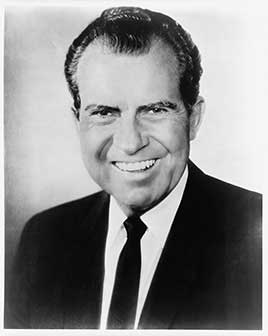
Richard Nixon
Ended the draft and U.S. combat in Vietnam, opened relations with China, created the EPA and took the dollar off gold. Resigned over the Watergate cover-up before the House could vote to impeach him.
The economy, first day to last
Shaded areas show the years in office, with a few years before and after for comparison. Budget years ran July to June until 1976 (now October to September), so each year's figures cover parts of two calendar years.
National debt
June 30, 1968 (end of fiscal 1968): $347.58 billion → June 30, 1974 (end of fiscal 1974): $475.06 billion
Daily debt figures don't exist before 1993, so Nixon's numbers use the fiscal years closest to his term.
Debt compared with the economy
Debt as a share of GDP. Above 100% means the debt is bigger than a year of everything the country produces.
Deficits and surpluses
Money borrowed each budget year (below the line) or paid down (above).
Unemployment
Jan 1969: 3.4% → Aug 1974: 5.5%. Monthly rates; the chart shows yearly averages.
Inflation
How much prices rose each year (consumer price index).
Cost of living
What everyday prices and paychecks did while in office.
Prices use the consumer price index (MeasuringWorth). The minimum wage is the federal rate set by Congress.
Executive orders
346 orders, numbered 11452–11797.
Orders signed each year
Source: National Archives: Nixon executive orders (full list of every order).
Notable orders
Equal employment opportunity in the federal governmentEO 11478August 8, 1969
Banned discrimination in federal hiring based on race, color, religion, sex, national origin, disability or age, and required every agency to run an affirmative program.
Federal RegisterProtecting historic placesEO 11593May 13, 1971
Ordered federal agencies to inventory and protect historic buildings and sites on federal land.
Federal Register90-day wage and price freezeEO 11615August 15, 1971
The 'Nixon shock': froze wages, prices and rents nationwide to fight inflation, announced alongside ending the dollar's link to gold.
Federal RegisterMinority business enterpriseEO 11625October 13, 1971
Created a national program to help minority-owned businesses win federal contracts and financing.
Federal RegisterOff-road vehicles on public landsEO 11644February 8, 1972
Set the first federal rules limiting off-road vehicles on public lands to protect land and wildlife.
Federal RegisterClassifying national security informationEO 11652March 8, 1972
Rewrote the rules for classifying government secrets and set schedules for declassifying them.
Federal RegisterEvery executive order 346Search, filter by topic or year, and open any order's full text
- EO 11452January 23, 1969Establishing the Council for Urban Affairs
- EO 11453January 24, 1969Establishing the Cabinet Committee on Economic Policy
- EO 11454February 7, 1969Inspection of Income, Excess-Profits, Estate, and Gift Tax Returns by the Senate Committee on Government Operations
- EO 11455February 14, 1969Establishing an Office of Intergovernmental Relations
- EO 11456February 14, 1969Providing For a Special Assistant to the President for Liaison With Former Presidents
- EO 11457March 4, 1969Inspection of Income, Excess-Profits, Estate, and Gift Tax Returns by the Committee on Government Operations, House of Representatives
- EO 11458March 5, 1969Prescribing Arrangements for Developing and Coordinating a National Program For Minority Business Enterprise
- EO 11459March 7, 1969Designation of the Secretary of Transportation to Approve and Certificate Containers and Vehicles For Use in International Transport
- EO 11460March 20, 1969Establishing the President's Intelligence Advisory Board
- EO 11461March 27, 1969Inspection of Income, Estate, and Gift Tax Returns by the Committee on Public Works, House of Representatives
- EO 11462March 28, 1969Providing for the Closing of Government Departments and Agencies on March 31, 1969, and For the Granting of Administrative Leave on March 28, 1969
- EO 11463April 1, 1969Placing an Additional Position in Level V of the Federal Executive Salary Schedule
- EO 11464April 3, 1969Modifying Rates of Interest Equalization Tax
- EO 11465April 10, 1969Inspection of Income, Excess-Profits, Estate, and Gift Tax Returns by the Committee on Internal Security, House of Representatives
- EO 11466April 18, 1969Administration of Certain Jointly Funded Projects
- EO 11467May 1, 1969Delegating to the Secretary of State Authority to Approve or Reject Recommendations and Actions of Certain Fisheries Commissions
- EO 11468May 10, 1969Amending Executive Order No. 11248, Placing Certain Positions in Levels IV and V of the Federal Executive Salary Schedule
- EO 11469May 23, 1969Extending the life of the National Commission on the Causes and Prevention of Violence
- EO 11470May 26, 1969Prescribing Arrangements for the Structure and Conduct of a National Program for Voluntary Action
- EO 11471May 28, 1969Relating to the Implementation of the Convention on the Service Abroad of Judicial and Extrajudicial Documents in Civil or Commercial Matters
- EO 11472May 29, 1969Establishing the Environmental Quality Council and the Citizens' Advisory Committee on Environmental Quality
- EO 11473June 14, 1969Amending Executive Order No. 11157 as it Relates to Incentive Pay for Hazardous Duty Involving Participation in Flight Operations on the Flight Deck of an Aircraft Carrier
- EO 11474June 16, 1969Adjusting Rates of Pay for Certain Statutory Schedules
- EO 11475June 16, 1969Adjusting the Rates of Monthly Basic Pay for Members of the Uniformed Services
- EO 11476June 19, 1969Prescribing the Manual for Courts-Martial, United States, 1969 (Revised edition)
- EO 11477August 7, 1969Authorizing the Atomic Energy Commission to Make Certain Awards Without the Approval of the President
- EO 11478August 8, 1969Equal Employment Opportunity in the Federal GovernmentAmended
- EO 11479September 8, 1969The Honorable Everett McKinley Dirksen
- EO 11480September 9, 1969The President's Committee on Employment of the Handicapped
- EO 11481September 10, 1969The Honorable Everett McKinley Dirksen
- EO 11482September 22, 1969Establishing a Construction Industry Collective Bargaining Commission
- EO 11483September 23, 1969Inspection of Income Tax Returns by the Select Committee on Crime, House of Representatives
- EO 11484September 29, 1969Designating the United International Bureaux for the Protection of Intellectual Property (BIRPI) as a Public International Organization Entitled to Enjoy Certain Privileges, Exemptions, and Immunities
- EO 11485October 1, 1969Supervision and Control of the National Guard of the District of Columbia
- EO 11486October 3, 1969Creating an Emergency Board to Investigate Disputes Between the Carriers Represented by the National Railway Labor Conference and Certain of Their Employees
- EO 11487October 6, 1969Designation of Officers of the Department of the Interior to act as Secretary of the InteriorRevoked
- EO 11488October 13, 1969Including Certain Lands in the Cherokee National Forest
- EO 11489October 27, 1969Amending Executive Order No. 11248, Placing Certain Positions in Levels IV and V of the Federal Executive Salary Schedule
- EO 11490October 28, 1969Assigning Emergency Preparedness Functions to Federal Departments and Agencies
- EO 11491October 29, 1969Labor-Management Relations in the Federal Service
- EO 11492October 30, 1969Amending Executive Order No. 11398 with Respect to the Citizens Advisory Committee on Physical Fitness and Sports
- EO 11493November 13, 1969Establishing the Council for Rural Affairs
- EO 11494November 13, 1969Establishing the Presidential Citizens Medal
- EO 11495November 18, 1969Providing for the Administration of the Disaster Relief Act of 1969
- EO 11496November 21, 1969Regulation Governing the Entry or Withdrawal From Warehouse of Certain Meat With Respect to Which an Agreement Has Been Concluded
- EO 11497November 26, 1969Amending the Selective Service Regulations to Prescribe Random Selection
- EO 11498December 1, 1969Delegating to the Secretary of Defense the Authority to Approve Regulations Governing the Early Discharge of Enlisted Members
- EO 11499December 11, 1969Amending Executive Order No. 11248, Placing Certain Positions in Levels IV and V of the Federal Executive Salary Schedule
- EO 11500December 12, 1969Amending Executive Order No. 11452, Establishing the Council for Urban Affairs
- EO 11501December 22, 1969Administration of Foreign Military Sales
- EO 11502December 22, 1969Enlarging the Membership of the President's Committee on the National Medal of Science
- EO 11503December 23, 1969Excusing Federal Employees From Duty on December 26, 1969
- EO 11504January 14, 1970Amending Executive Order No. 11248, Placing Certain Positions in Levels IV and V of the Federal Executive Salary Schedule
- EO 11505January 21, 1970Providing for Inspection of Certain Tax Returns by the Senate Committee on the Judiciary
- EO 11506February 2, 1970Further Amending Executive Order No. 11211, Relating to the Exclusion for Original or New Japanese Issues as Required for International Monetary Stability
- EO 11507February 4, 1970Prevention, Control, and Abatement of Air and Water Pollution at Federal Facilities
- EO 11508February 10, 1970Providing for the Identification of Unneeded Federal Real Property
- EO 11509February 11, 1970Establishing the President's Advisory Council on Management Improvement
- EO 11510February 16, 1970Amending Executive Order No. 11248, Placing Certain Positions in Level IV and V of the Federal Executive Salary Schedule
- EO 11511February 27, 1970Amending Executive Order No. 11157 as it Relates to Basic Allowances for Quarters for Members Without Dependents
- EO 11512February 27, 1970Planning, Acquisition, and Management of Federal Space
- EO 11513March 3, 1970Establishing the President's Commission on School Finance
- EO 11514March 5, 1970Protection and Enhancement of Environmental Quality
- EO 11515March 13, 1970Terminating Certain Bodies Established by the President
- EO 11516March 19, 1970Amending Executive Order No. 11248, Placing Certain Positions in Levels IV and V of the Federal Executive Salary Schedule
- EO 11517March 19, 1970Providing for the Issuance and Signature by the Secretary of State of Warrants Appointing Agents to Return Fugitives From Justice Extradited to the United States
- EO 11518March 20, 1970Providing for the Increased Representation of the Interests of Small Business Concerns Before Departments and Agencies of the United States Government
- EO 11519March 23, 1970Calling Into Service Members and Units of the National Guard
- EO 11520March 25, 1970Amending Executive Order No. 11407, Relating to the Presidential Service Certificate and the Presidential Service Badge
- EO 11521March 26, 1970Authorizing Veterans Readjustment Appointments for Veterans of the Vietnam Era
- EO 11522April 6, 1970Assigning Emergency Preparedness Functions to the United States Information Agency
- EO 11523April 9, 1970Establishing the National Industrial Pollution Control Council
- EO 11524April 15, 1970Adjusting rates of Pay for Certain Statutory Schedules
- EO 11525April 15, 1970Adjusting Rates of Monthly Basic Pay for Members of the Uniformed Services
- EO 11526April 22, 1970Establishing the National Council on Federal Disaster Assistance
- EO 11527April 23, 1970Amending the Selective Service Regulations
- EO 11528April 24, 1970Changing the Jurisdiction and Membership of the New England River Basins Commission
- EO 11529April 24, 1970Terminating Obsolete Bodies Established by Executive Order
- EO 11530May 26, 1970Amending Executive Order No. 10624, as Amended, Providing for Regulations Relating to Personnel of the Department of Agriculture Assigned to Service Abroad
- EO 11531May 26, 1970Delegating Authority of the President Under Section 4102(a)(2)(B) of Title 5, United States Code, to Designate U.S. Marshals and U.S. Attorneys for Training
- EO 11532June 2, 1970Establishing the Interdepartmental Committee for (the) Voluntary Payroll Savings Plan for the Purchase of United States Savings Bonds
- EO 11533June 4, 1970Administration of the Export Administration Act of 1969
- EO 11534June 4, 1970Establishing the National Council on Organized Crime
- EO 11535June 12, 1970Providing for Inspection of Certain Tax Returns by the House Committee on the Judiciary
- EO 11536June 13, 1970Establishing the President's Commission on Campus Unrest
- EO 11537June 16, 1970Amending the Selective Service Regulations Concerning the Ordering of Registrants for Induction
- EO 11538June 29, 1970Delegating to the Secretary of Transportation the Authority of the President to Establish and Conduct an International Aeronautical Exposition
- EO 11539June 30, 1970Delegations of Authority to Negotiate Agreements and Issue Regulations Limiting Imports of Certain Meats
- EO 11540July 1, 1970Amending Executive Order No. 11248, Placing Certain Positions in Levels IV and V of the Federal Executive Salary Schedule
- EO 11541July 1, 1970Prescribing the Duties of the Office of Management and Budget and the Domestic Council in the Executive Office of the President
- EO 11542July 2, 1970Amending Executive Order No. 11248, Placing Certain Positions in Levels IV and V of the Federal Executive Salary Schedule
- EO 11543July 7, 1970Creating an Emergency Board to Investigate Disputes Between the Carriers Represented by the National Railway Labor Conferences and Certain of Their Employees
- EO 11544July 8, 1970Establishing the Vice Presidential Service Certificate and the Vice Presidential Service Badge
- EO 11545July 9, 1970Establishing the Defense Distinguished Service MedalAmended
- EO 11546July 9, 1970Establishing the President's Commission for the Observance of the Twenty-Fifth Anniversary of the United Nations
- EO 11547July 10, 1970Amending Executive Order No. 11330 With Respect to Membership and Chairmanship
- EO 11548July 20, 1970Delegating Functions of the President Under the Federal Water Pollution Control Act, as Amended
- EO 11549July 28, 1970Revoking Executive Order No. 10361 of June 11, 1952, Establishing the Whittier Defensive Sea Area, Alaska
- EO 11550July 30, 1970Amending Executive Order No. 11248, Placing Certain Positions in Levels IV and V of the Federal Executive Salary Schedule
- EO 11551August 11, 1970Amending Executive Order No. 11399 With Respect to the Membership of the National Council on Indian Opportunity
- EO 11552August 24, 1970Providing for Details and Transfers of Federal Employees to International Organizations
- EO 11553August 26, 1970Amending the Selective Service Regulations
- EO 11554August 29, 1970Suspending the Provisions of Section 5707(c) of Title 10, United States Code, Which Relate to the Establishment of a Maximum Percentage of Navy Officers Who May Be Recommended for Promotion From Below the Appropriate Promotion Zone
- EO 11555September 2, 1970Amending the Selective Service Regulations
- EO 11556September 4, 1970Assigning Telecommunications Functions
- EO 11557September 10, 1970Enlarging the Membership of the President's Commission for the Observance of the Twenty-Fifth Anniversary of the United Nations
- EO 11558September 18, 1970Creating an Emergency Board to Investigate Disputes Between the Carriers Represented by the National Railway Labor Conference and Certain of Their Employees
- EO 11559September 18, 1970Creating an Emergency Board to Investigate Disputes Between the Carriers Represented by the National Railway Labor Conference and Certain of Their Employees
- EO 11560September 23, 1970Amending Executive Order No. 11508 With Respect to the Membership of the Property Review Board
- EO 11561September 25, 1970Delegation of Certain Authority Under Title VIII of the Economic Opportunity Act
- EO 11562September 25, 1970Developing and Coordinating a National Program for Physical Fitness and Sports
- EO 11563September 26, 1970Amending the Selective Service Regulations
- EO 11564October 6, 1970Transfer of Certain Programs and Activities to the Secretary of Commerce
- EO 11565October 13, 1970Amending Executive Order No. 11145 With Respect to the Membership of the Committee for the Preservation of the White House
- EO 11566October 26, 1970Consumer Product Information
- EO 11567November 16, 1970Prescribing the Compensation of Certain Officials in the Bureau of Domestic Commerce, Department of Commerce
- EO 11568November 16, 1970Exempting A. Everette MacIntyre From Compulsory Retirement for Age
- EO 11569November 24, 1970Amending the Selective Service Regulations
- EO 11570November 24, 1970Providing for the Regulation of Conduct for the Postal Rate Commission and its Employees
- EO 11571December 8, 1970Modifying Executive Order No. 6868 of October 9, 1934, as Amended, Designating the Authority to Carry out the Provisions of the District of Columbia Alley Dwelling Act
- EO 11572December 10, 1970Providing for the Use of Transportation Priorities and Allocations During the Current Railroad Strike
- EO 11573December 21, 1970Excusing Federal Employees From Duty for One-Half Day on December 24, 1970
- EO 11574December 23, 1970Administration of Refuse Act Permit Program
- EO 11575December 31, 1970Providing for the Administration of the Disaster Relief Act of 1970
- EO 11576January 8, 1971Adjusting Rates of Pay for Certain Statutory Pay Systems
- EO 11577January 8, 1971Adjusting the Rates of Monthly Basic Pay for Members of the Uniformed Services
- EO 11578January 13, 1971Establishment of the Ohio River Basin Commission
- EO 11579January 19, 1971Overseas Private Investment Corporation
- EO 11580January 20, 1971Establishing a Seal for the National Credit Union AdministrationRevoked
- EO 11581January 20, 1971Amending Executive Order No. 11248, Placing Certain Positions in Levels IV and V of the Federal Executive Salary Schedule
- EO 11582February 11, 1971Observance of Holidays by Government Agencies
- EO 11583February 24, 1971Office of Consumer Affairs
- EO 11584March 3, 1971Inspection of Income, Excess-Profits, Estate, and Gift Tax Returns by the Senate Committee on Government Operations
- EO 11585March 4, 1971Creating an Emergency Board to Investigate Disputes Between Certain Carriers Represented by the National Railway Labor Conference and the Eastern, Western and Southeastern Carriers' Conference Committees and Certain of Their Employees Represented by the Brotherhood of Railroad Signalmen
- EO 11586March 10, 1971Amending the Selective Service Regulations
- EO 11587March 15, 1971Amending Executive Order No. 11248, Placing Certain Positions in Levels IV and V of the Federal Executive Salary Schedule
- EO 11588March 29, 1971Providing for the Stabilization of Wages and Prices in the Construction Industry
- EO 11589April 1, 1971Delegating to the Office of Personnel Management Certain Authorities of the President Under the Intergovernmental Personnel Act of 1970 and the Federal Civil Defense Act of 1950
- EO 11590April 23, 1971Applicability of Executive Order No. 11222 and Executive Order 11478 to the United States Postal Service and of Executive Order No. 11478 to the Postal Rate Commission
- EO 11591April 23, 1971Amending Executive Order No. 11157 as it Relates to Basic Allowances for Quarters for Members with Dependents
- EO 11592May 6, 1971Delegating Certain Authority of the President to the Director of the Office of Management and Budget
- EO 11593May 13, 1971Protection and Enhancement of the Cultural Environment
- EO 11594May 17, 1971Providing for the Use of Transportation Priorities and Allocations During the Current Railroad Strike
- EO 11595May 26, 1971Amending Executive Order 11583, Establishing the Office of Consumer Affairs
- EO 11596June 5, 1971Designating the Customs Cooperation Council as a Public International Organization Entitled to Enjoy Certain Privileges, Exemptions, and Immunities
- EO 11597June 11, 1971Amendment to Executive Order No. 11513 Increasing the Membership of the President's Commission on School Finance
- EO 11598June 16, 1971To Provide for the Listing of Certain Job Vacancies by Federal Agencies and Government Contractors and Subcontractors
- EO 11599June 17, 1971Establishing a Special Action Office for Drug Abuse Prevention
- EO 11600June 29, 1971Establishing a Seal for the Office of Management and Budget
- EO 11601June 29, 1971Amending Executive Order No. 11390, Providing for the Delegation of Certain Functions of the President to the Secretary of Defense
- EO 11602June 29, 1971Providing for Administration of the Clean Air Act with Respect to Federal Contracts, Grants, or Loans
- EO 11603June 30, 1971Assigning Additional Functions to the Director of ACTION
- EO 11604July 2, 1971Amending Executive Order No. 11248, Placing Certain Positions in Levels IV and V of the Federal Executive Salary Schedule
- EO 11605July 2, 1971Amendment of Executive Order No. 10450 of April 27, 1953, Relating to Security Requirements for Government Employment
- EO 11606July 10, 1971Amending the Selective Service Regulations
- EO 11607July 19, 1971Establishing the Advisory Council on Intergovernmental Personnel Policy
- EO 11608July 19, 1971Termination of Federal Field Committee for Development Planning in Alaska
- EO 11609July 22, 1971Delegating Certain Functions Vested in the President to Other Officers of the Government
- EO 11610July 22, 1971Further Amending Executive Order 10789 Authorizing Agencies of the Government to Exercise Certain Contracting Authority in Connection with National Defense Functions and Prescribing Regulations Governing the Exercise of Such Authority
- EO 11611July 26, 1971Inspection of Income, Excess Profits, Estate, and Gift Tax Returns by the Committee on Internal Security, House of Representatives
- EO 11612July 26, 1971Occupational Safety and Health Programs for Federal Employees
- EO 11613August 2, 1971Membership of Environmental Protection Agency on Established River Basin Commissions
- EO 11614August 5, 1971Establishing the National Business Council for Consumer Affairs
- EO 11615August 15, 1971Providing for Stabilization of Prices, Rents, Wages, and Salaries
- EO 11616August 26, 1971Amending Executive Order No. 11491, Relating to Labor-Management Relations in the Federal Service
- EO 11617September 2, 1971Amending Executive Order No. 11615, Providing for Stabilization of Prices, Rents, Wages, and Salaries
- EO 11618September 10, 1971Further Amending Executive Order No. 10713, Providing for Administration of the Ryukyu Islands
- EO 11619September 22, 1971Exemption of Rose A. Conway From Mandatory Retirement
- EO 11620September 25, 1971The Honorable Hugo L. Black
- EO 11621October 4, 1971Creating a Board of Inquiry to Report on Certain Labor Disputes Affecting the Maritime Industry of the United States
- EO 11622October 5, 1971Amending Executive Order 11621 Creating a Board of Inquiry
- EO 11623October 12, 1971Delegating to the Director of Selective Service Authority to Issue Rules and Regulations Under the Military Selective Service ActAmended
- EO 11624October 12, 1971Inspection of Income, Excess Profits, Estate, Gift, and Excise Tax Returns by the Senate Committee on Commerce
- EO 11625October 13, 1971Prescribing Additional Arrangements for Developing and Coordinating a National Program for Minority Business Enterprise
- EO 11626October 13, 1971The Honorable Dean Acheson
- EO 11627October 15, 1971Further Providing for the Stabilization of the Economy
- EO 11628October 18, 1971Establishing a Seal for the Environmental Protection Agency
- EO 11629October 26, 1971Delegation of Authority to the Secretary of State to Perform the Function Vested in the President by Article IV of the Convention Between the United States of America and Mexico for the Protection of Migratory Birds and Game Mammals (50 Stat. 1311; TS 912)
- EO 11630October 30, 1971Amending Executive Order No. 11627 of October 15, 1971, Further Providing for the Stabilization of the Economy
- EO 11631November 9, 1971Inspection of Income, Estate, and Gift Tax Returns by the Committee on Public Works, House of Representatives
- EO 11632November 22, 1971Amending Executive Order No. 11627 of October 15, 1971, Further Providing for the Stabilization of the Economy
- EO 11633December 3, 1971Security Clearance Program for United States Citizens Employed Directly by the North Atlantic Treaty Organization, the South-East Asia Treaty Organization, and the Central Treaty Organization
- EO 11634December 6, 1971Amending Executive Order No. 11248, Placing Certain Positions in Levels IV and V of the Federal Executive Salary Schedule
- EO 11635December 9, 1971Continuation of Souris-Red-Rainy-River Basins Commission
- EO 11636December 17, 1971Employee-Management Relations in the Foreign Service of the United States
- EO 11637December 22, 1971Adjusting Rates of Pay for Certain Statutory Pay Systems
- EO 11638December 22, 1971Adjusting the Rates of Monthly Basic Pay for Members of the Uniformed Services
- EO 11639January 11, 1972Providing for Pay Adjustments for Federal Prevailing Rate Systems
- EO 11640January 26, 1972Further Providing for the Stabilization of the Economy
- EO 11641January 28, 1972Concentration of Law Enforcement Activities Relating to Drug Abuse
- EO 11642February 1, 1972Further Exempting A. Everette MacIntyre from Compulsory Retirement for Age
- EO 11643February 8, 1972Environmental Safeguards on Activities for Animal Damage Control on Federal Lands
- EO 11644February 8, 1972Use of Off-Road Vehicles on the Public LandsRevoked
- EO 11645February 8, 1972Authority of the Secretary of Transportation to Prescribe Certain Regulations Relating to Coast Guard HousingAmended
- EO 11646February 8, 1972Membership of Department of State on the Great Lakes Basin Commission
- EO 11647February 10, 1972Federal Regional Councils
- EO 11648February 16, 1972Amendment of Executive Order No. 11183 Which Established the President's Commission on White House Fellowships
- EO 11649February 16, 1972Regulations Governing the Seals of the President and the Vice President of the United States
- EO 11650February 16, 1972Inspection by Certain Classes of Persons and State and Federal Government Establishments of Returns Made in Respect of Certain Taxes Imposed by the Internal Revenue Code of 1954
- EO 11651March 3, 1972Textile Trade Agreements
- EO 11652March 8, 1972Classification and Declassification of National Security Information and Material
- EO 11653March 9, 1972Exemption of Jack T. Stuart from Compulsory Retirement for Age
- EO 11654March 13, 1972Transfer of the Federal Fire Council to the Department of Commerce
- EO 11655March 14, 1972Inspection of Income, Excess-Profits, Estate, and Gift Tax Returns by the Committee on Government Operations, House of Representatives
- EO 11656March 14, 1972Inspection of Income, Estate, and Gift Tax Returns by the Select Committee on Crime, House of Representatives
- EO 11657March 22, 1972Exemption of C. Everette Spangler from Compulsory Retirement for Age
- EO 11658March 22, 1972Establishment of the Missouri River Basin Commission
- EO 11659March 22, 1972Establishment of the Upper Mississippi River Basin Commission
- EO 11660March 23, 1972Amending Executive Order No. 11640, Further Providing for the Stabilization of the Economy
- EO 11661March 24, 1972Relating to Facilitating Coordination of Federal Education Programs
- EO 11662March 29, 1972Further Providing for the Administration of the Disaster Relief Act of 1970, as Amended
- EO 11663March 31, 1972Creating an Emergency Board to Investigate Disputes Between the Carriers Represented by the National Railway Labor Conference and Certain of Their Employees
- EO 11664March 31, 1972Creating an Emergency Board to Investigate a Dispute Between the Penn Central Transportation Company and Certain of Its Employees
- EO 11665April 10, 1972James F. Byrnes
- EO 11666April 11, 1972Qualification for the Investment Credit on Certain Articles and Classes of Articles of Predominantly Foreign Origin
- EO 11667April 19, 1972Establishing the President's Advisory Committee on the Environmental Merit Awards Program
- EO 11668April 21, 1972Providing for a National Center for Housing Management
- EO 11669May 2, 1972J. Edgar Hoover
- EO 11670May 20, 1972Providing for the Return of Certain Lands to the Yakima Indian Reservation
- EO 11671June 5, 1972Committee Management
- EO 11672June 6, 1972Providing for the Transfer or Furnishing of Property Under the Postal Reorganization Act
- EO 11673June 6, 1972Amending Executive Order No. 8684 to Redefine the Culebra Island Naval Defensive Sea Area
- EO 11674June 29, 1972Amending Executive Order No. 11640, as Amended, Further Providing for the Stabilization of the Economy
- EO 11675July 26, 1972Exemption of John S. Patterson from Mandatory Retirement for Age
- EO 11676July 27, 1972Providing for the Establishment of an Office of National Narcotics Intelligence Within the Department of Justice
- EO 11677August 1, 1972Continuing the Regulation of Exports
- EO 11678August 16, 1972Providing for the Repair and Restoration of Nonprofit Private Educational Institutions Damaged by Hurricane and Tropical Storm Agnes
- EO 11679August 19, 1972Creating an Emergency Board to Investigate a Dispute Between the Long Island Rail Road Company and Certain of Its Employees
- EO 11680August 21, 1972Designation of Certain Officers To Act as Secretary of the Treasury
- EO 11681August 21, 1972Revoking Executive Order No. 5221 of November 11, 1929, Establishing a Limitation on Non-Official Employment of Officers or Employees of the American Government
- EO 11682August 29, 1972Inspection by the Department of the Treasury of Tax Returns Made Under the Internal Revenue Code of 1954 for Economic Stabilization Purposes
- EO 11683August 29, 1972Revoking Executive Order No. 11677 of August 1, 1972, and Continuing in Effect Executive Order No. 11533 of June 4, 1970, Relating to the Administration of Export Controls
- EO 11684August 30, 1972Amendment of Executive Order No. 11554, Suspending the Provisions of Section 5707(c) of Title 10, United States Code, Which Relate to Promotion of Navy and Marine Corps Officers
- EO 11685September 25, 1972Amending Executive Order No. 10973, Relating to Administration of Foreign Assistance and Related Functions, and Executive Order No. 11501, Relating to Administration of Foreign Military Sales
- EO 11686October 7, 1972Committee Management
- EO 11687October 11, 1972Delegating Functions Conferred Upon the President by Section 1455 of Title 10 of the United States Code, Establishing the Retired Serviceman's Survivor Benefit Plan
- EO 11688December 1, 1972Amending Executive Order No. 11399 with Respect to the Membership of the National Council on Indian Opportunity
- EO 11689December 5, 1972Extending Diplomatic Privileges and Immunities to the Mission to the United States of America of the Commission of the European Communities and to Certain Members Thereof
- EO 11690December 14, 1972Delegation of Certain Functions to the Executive Director of the Domestic Council
- EO 11691December 15, 1972Adjusting Rates of Pay for Certain Statutory Pay Systems
- EO 11692December 15, 1972Adjusting the Rates of Monthly Basic Pay for Members of the Uniformed Services
- EO 11693December 26, 1972Providing for the Closing of Government Departments and Agencies on December 28, 1972
- EO 11694January 2, 1973Creating an Emergency Board to Investigate a Dispute Between the Port Authority Trans-Hudson Corporation and Certain of its Employees
- EO 11695January 11, 1973Further Providing for the Stabilization of the Economy
- EO 11696January 17, 1973Excusing Federal Employees in the Washington, D.C. Metropolitan Area From Duty for One-Half Day on Friday, January 19, 1973
- EO 11697January 17, 1973Inspection by Department of Agriculture of Income Tax Returns Made Under the Internal Revenue Code of 1954 of Persons Having Farm Operations
- EO 11698January 19, 1973Relating to the Implementation of the Convention on the Taking of Evidence Abroad in Civil or Commercial Matters
- EO 11699January 22, 1973Amending Executive Order No. 11248, Placing Certain Positions in Levels IV and V of the Federal Executive Salary
- EO 11700January 23, 1973Providing for the Closing of Government Departments and Agencies on Thursday, January 25, 1973
- EO 11701January 24, 1973Employment of Veterans by Federal Agencies and Government Contractors and Subcontractors
- EO 11702January 25, 1973Relative to the Executive Office of the President
- EO 11703February 7, 1973Assigning Policy Development and Direction Functions With Respect to the Oil Import Control Program
- EO 11704February 28, 1973Further Exempting A. Everett MacIntyre from Compulsory Retirement for Age
- EO 11705March 6, 1973The Honorable Cleo A. Noel, Junior, George Curtis Moore
- EO 11706March 8, 1973Inspection of Returns by U.S. Attorneys and Attorneys of Department of Justice and Use of Returns in Grand Jury Proceedings and in Litigation
- EO 11707March 12, 1973Change in Boundaries of New England River Basins Commission
- EO 11708March 23, 1973Placing Certain Positions in Levels IV and V of the Executive Schedule
- EO 11709March 27, 1973Inspection by Department of Agriculture of Income Tax Returns Made Under the Internal Revenue Code of 1954 of Persons Having Farm Operations
- EO 11710April 4, 1973National Commission for Industrial Peace
- EO 11711April 13, 1973Inspection of Income, Excess-Profits, Estate, and Gift Tax Returns by the Senate Committee on Government Operations
- EO 11712April 18, 1973Special Committee on Energy and National Energy Office
- EO 11713April 21, 1973Delegation of Functions Concerning Canal Zone Property
- EO 11714April 24, 1973Amending Executive Order No. 11652 on Classification and Declassification of National Security Information and Material
- EO 11715April 24, 1973Amending Executive Order No. 11708, Placing Certain Positions in Levels IV and V of the Executive Schedule
- EO 11716April 26, 1973Amending Executive Order No. 11157 as it Relates to Incentive Pay for Hazardous Duty
- EO 11717May 9, 1973Transferring Certain Functions from the Office of Management and Budget to the General Services Administration and the Department of Commerce
- EO 11718May 14, 1973Designating the International Telecommunications Satellite Organization (INTELSAT) as an International Organization Entitled to Enjoy Certain Privileges, Exemptions, and Immunities
- EO 11719May 17, 1973Inspection of Income, Estate, and Gift Tax Returns by the Committee on Public Works, House of Representatives
- EO 11720May 17, 1973Inspection of Income, Excess-Profits, Estate, Gift, and Excise Tax Returns by the Senate Committee on Commerce
- EO 11721May 23, 1973Providing for Federal Pay Administration
- EO 11722June 9, 1973Inspection of Income, Estate, and Gift Tax Returns by the Committee on Internal Security, House of Representatives
- EO 11723June 13, 1973Further Providing for the Stabilization of the Economy
- EO 11724June 25, 1973Federal Property Council
- EO 11725June 27, 1973Transfer of Certain Functions of the Office of Emergency Preparedness
- EO 11726June 29, 1973Energy Policy Office
- EO 11727July 6, 1973Drug Law Enforcement
- EO 11728July 12, 1973Amending Section 104(b)(1) of Executive Order No. 11157, as it Relates to Incentive Pay for Hazardous Duty Involving Aerial Flight
- EO 11729July 12, 1973Amending Executive Order No. 11710 of April 4, 1973, Relative to the National Commission for Industrial Peace
- EO 11730July 18, 1973Further Providing for the Stabilization of the Economy
- EO 11731July 23, 1973Amending Executive Order No. 11647 Relating to Federal Regional Councils
- EO 11732July 30, 1973Delegating Certain Authority of the President to the Secretary of Housing and Urban Development
- EO 11733July 30, 1973Further Amending Executive Order No. 10122 of April 14, 1950, Entitled "Regulations Governing Payment of Disability Retirement Pay Hospitalization, and Re-Examination of Members and Former Members of the Uniformed Services"
- EO 11734July 30, 1973Revising the Membership of the President's Committee on the National Medal of Science
- EO 11735August 3, 1973Assignment of Functions Under Section 311 of the Federal Water Pollution Control Act, as Amended
- EO 11736August 6, 1973Amending Executive Order No. 11708, Placing Certain Positions in Levels IV and V of the Executive Schedule
- EO 11737September 7, 1973Enlargement of the Upper Mississippi River Basin Commission
- EO 11738September 10, 1973Providing for Administration of the Clean Air Act and the Federal Water Pollution Control Act with Respect to Federal Contracts, Grants, or Loans
- EO 11739October 3, 1973Adjusting Rates of Pay for Certain Statutory Pay Systems
- EO 11740October 3, 1973Adjusting the Rates of Monthly Basic Pay for Members of the Uniformed Services
- EO 11741October 15, 1973Federal Agency Use of the Official American Revolution Bicentennial Symbol
- EO 11742October 23, 1973Delegating to the Secretary of State Certain Functions with Respect to the Negotiation of International Agreements Relating to the Enhancement of the Environment
- EO 11743October 23, 1973Modifying Proclamation 3279, as Amended, With Respect to the Oil Policy Committee
- EO 11744October 24, 1973Cost-of-Living Allowance Provided to Employees of the Joint Federal-State Land Use Planning Commission for Alaska
- EO 11745November 1, 1973Creating an Emergency Board to Investigate a Dispute Between the Long Island Rail Road and Certain of its Employees
- EO 11746November 7, 1973Assigning Emergency Preparedness Functions to the United States Treasury Department
- EO 11747November 7, 1973Delegating Certain Authority of the President Under the Water Resources Planning Act, as Amended
- EO 11748December 4, 1973Federal Energy Office
- EO 11749December 10, 1973Consolidating Disaster Relief Functions Assigned to the Secretary of Housing and Urban Development
- EO 11750December 13, 1973Providing for the Closing of Government Departments and Agencies on Monday, December 24, 1973 and Monday, December 31, 1973
- EO 11751December 15, 1973Authorizing the Secretary of Transportation to Grant Exemptions From Daylight Saving Time and Realignments of Time Zone Limits
- EO 11752December 17, 1973Prevention, Control, and Abatement of Environmental Pollution at Federal Facilities
- EO 11753December 20, 1973Establishing the President's Export Council and for Other Purposes
- EO 11754December 26, 1973Modifying Rates of Interest Equalization Tax
- EO 11755December 29, 1973Relating to Prison LaborAmended
- EO 11756December 30, 1973Exemption of Whitney Gillilland from Mandatory Retirement
- EO 11757December 30, 1973Exemption of Lawrence Quincy Mumford from Mandatory Retirement
- EO 11758January 15, 1974Delegating Authority of the President Under the Rehabilitation Act of 1973
- EO 11759January 15, 1974Prescribing the Compensation of Certain Officials in the Domestic and International Business Administration, Department of Commerce
- EO 11760January 17, 1974Designating the European Space Research Organization (ESRO) as a Public International Organization Entitled to Enjoy Certain Privileges, Exemptions, and Immunities
- EO 11761January 17, 1974To Facilitate Coordination of Federal Education Programs
- EO 11762January 17, 1974Delegating to the Administrator of Veterans' Affairs Certain Authority Relating to Grants-in-Aid to the Republic of the Philippines for Medical Care and Treatment of Veterans
- EO 11763January 17, 1974Establishing a National Commission for the Observance of World Population Year
- EO 11764January 21, 1974Nondiscrimination in Federally Assisted Programs
- EO 11765January 21, 1974Sale of Vessels of the Navy
- EO 11766January 29, 1974Modifying Rates of Interest Equalization Tax
- EO 11767February 19, 1974Designating the Organization of African Unity as a Public International Organization Entitled to Enjoy Certain Privileges, Exemptions, and ImmunitiesRevoked
- EO 11768February 20, 1974Placing Certain Positions in Levels IV and V of the Executive Schedule
- EO 11769February 21, 1974Advisory Committee Management
- EO 11770February 21, 1974International Symposium on Geothermal Energy-1975
- EO 11771March 18, 1974Extending Diplomatic Privileges and Immunities to the Liaison Office of the People's Republic of China in Washington, DC and to Members Thereof
- EO 11772March 21, 1974Delegating Certain Authority of the President to the Secretary of State
- EO 11773March 21, 1974Revoking the Authority of the Department of Agriculture to Inspect Income Tax Returns
- EO 11774March 26, 1974Amending Executive Order No. 11768, Placing Certain Positions in Levels IV and V of the Executive Schedule
- EO 11775March 26, 1974Abolishing the Energy Policy Office
- EO 11776March 28, 1974Continuing the President's Committee on Mental Retardation and Broadening its Membership and Responsibilities
- EO 11777April 12, 1974Amending Executive Order No. 11691, Adjusting Rates of Pay for Certain Statutory Pay Systems
- EO 11778April 12, 1974Amending Executive Order No. 11692, Adjusting the Rates of Monthly Basic Pay for Members of the Uniformed Services
- EO 11779April 19, 1974Delegating the Authority of the President Under Section 9 of the United Nations Participation Act, as Amended, to the Secretary of State
- EO 11780April 22, 1974Amending Executive Order No. 11768, Placing Certain Positions in Levels IV and V of the Executive Schedule
- EO 11781May 1, 1974Providing for an Orderly Termination of the Economic Stabilization Program
- EO 11782May 6, 1974Establishing the Federal Financing Bank Advisory Council
- EO 11783May 21, 1974Creating an Emergency Board to Investigate a Dispute Between the Carriers Represented by the National Railway Labor Conference and Certain of Their Employees
- EO 11784May 30, 1974Delegating to the Administrator of General Services Certain Authority to Issue Regulations Relating to Joint Funding
- EO 11785June 4, 1974Amending Executive Order No. 10450, as Amended, Relating to Security Requirements for Government Employment, and for Other Purposes
- EO 11786June 7, 1974Inspection of Tax Returns by the Committee on the Judiciary, House of Representatives
- EO 11787June 11, 1974Revoking Executive Order No. 10987, Relating to Agency Systems for Appeals From Adverse Actions
- EO 11788June 18, 1974Providing for the Orderly Termination of Economic Stabilization Activities
- EO 11789June 25, 1974President's Committee on East-West Trade Policy
- EO 11790June 25, 1974Providing for the Effectuation of the Federal Energy Administration Act of 1974Amended
- EO 11791June 25, 1974Exemption of Kenneth H. Tuggle From Mandatory Retirement
- EO 11792June 25, 1974Abolishing the Advisory Council on Intergovernmental Personnel Policy
- EO 11793July 10, 1974Designation of Certain Officers of the Department of Agriculture to Act as Secretary of Agriculture
- EO 11794July 11, 1974Revoking Executive Order No. 10958, Relating to the Civil Defense Medical and Food Stockpiles
- EO 11795July 11, 1974Delegating Disaster Relief Functions Pursuant to the Disaster Relief Act of 1974
- EO 11796July 30, 1974Continuing the Regulation of Exports
- EO 11797July 31, 1974Delegating to the Secretary of Agriculture the Function of Submitting an Annual Report to the Congress Concerning the Location of New Federal Facilities in Rural Areas
Source: Executive Orders Archive, compiled from the American Presidency Project and the Federal Register. Topics are the archive's automated tags; "Revoked" and similar labels come from the Federal Register's records.
Pardons and commutations
A pardon wipes out the punishment for a federal crime; a commutation shortens a sentence but leaves the conviction. Counts are by federal fiscal year. Nixon himself was pardoned by President Ford on September 8, 1974.
Granted each year
Source: U.S. Dept. of Justice, clemency statistics, which lists every recipient with the crime and sentence.
Notable grants: tap to see the crime
Jimmy HoffaCommutationDecember 23, 1971
The crime: Jury tampering, and fraud involving the Teamsters pension fund (convicted 1964)
Sentence: 13 years in federal prison
Why it drew attention: The Teamsters union later endorsed Nixon in 1972. The release came with a condition barring Hoffa from union leadership until 1980.
SourceAngelo "Gyp" DeCarloCommutationDecember 20, 1972
The crime: Extortion (convicted 1970)
Sentence: 12 years in federal prison
Why it drew attention: A reputed New Jersey mob figure released on the grounds that he was terminally ill; he died in 1973. The release drew criticism and later scrutiny.
SourceInvestigations and legal record
The same checklist for every president. Tap a row for details and sources.
ImpeachedNo — resigned firstPartly
The House Judiciary Committee approved three articles of impeachment (obstruction of justice, abuse of power, contempt of Congress) on July 27–30, 1974. Nixon resigned on August 9, before the full House voted.
SourceCriminally chargedNo — named an unindicted co-conspiratorPartly
The Watergate grand jury named Nixon an unindicted co-conspirator in 1974. Special prosecutors believed a sitting president could not be indicted. Ford's pardon ended any case after he left office.
SourceConvictedNoNo
Never charged, because of the pardon.
PardonedYes, by Gerald FordYes
Ford granted a 'full, free, and absolute pardon' for any federal crimes Nixon may have committed as president, on September 8, 1974.
SourceAides or cabinet convictedYes — dozensYes
Watergate investigations charged 69 people and convicted 48, including Attorney General John Mitchell, chief of staff H.R. Haldeman and domestic adviser John Ehrlichman. Vice President Spiro Agnew resigned in 1973 and pleaded no contest to tax evasion in a separate bribery investigation.
SourceSpecial prosecutorYes — Cox, then JaworskiYes
Archibald Cox was fired on Nixon's orders on October 20, 1973. Leon Jaworski replaced him and won United States v. Nixon (8–0, July 24, 1974), forcing release of the White House tapes.
SourceMisuse of DOJ, FBI, IRS or CIAYes — documentedYes
The tapes show Nixon approving a plan to have the CIA block the FBI's Watergate investigation (June 23, 1972). The second article of impeachment cited attempts to use the IRS, FBI and Secret Service against political opponents.
SourcePeople around the president who were charged or penalized
Controversies and scandals
What happened, what was proven, and how it ended.
WatergateProven1972–1974
Operatives of Nixon's re-election campaign were arrested breaking into Democratic headquarters on June 17, 1972. Nixon then directed a cover-up, including hush money and trying to use the CIA to halt the FBI. Taped conversations proved it, and he resigned.
Outcome: Resigned; 48 people convicted; pardoned by Ford.
SourceThe Saturday Night MassacreProvenOctober 20, 1973
Nixon ordered the firing of special prosecutor Archibald Cox, who had subpoenaed the tapes. Attorney General Elliot Richardson and his deputy William Ruckelshaus resigned rather than carry out the order. Solicitor General Robert Bork fired Cox.
Outcome: Public outrage led to the first impeachment resolutions; a court later ruled the firing illegal.
SourceThe enemies listProven1971–1973
The White House kept lists of political opponents, journalists and celebrities, and discussed using the IRS and other agencies against them.
Outcome: Cited in the second article of impeachment.
SourceThe White House 'Plumbers'Proven1971
A secret White House unit broke into the office of Daniel Ellsberg's psychiatrist, looking for material to discredit the leaker of the Pentagon Papers.
Outcome: Ehrlichman, Colson, Liddy and others were convicted.
SourceSecret bombing of CambodiaDisputed1969–1970
The U.S. bombed Cambodia for over a year while falsifying records to hide it from Congress and the public.
Outcome: A proposed article of impeachment over it was rejected by the House Judiciary Committee, 26–12.
SourceIn their own words
Widely quoted remarks, with the context they were said in.
People have got to know whether or not their president is a crook. Well, I'm not a crook.
Well, when the president does it, that means that it is not illegal.