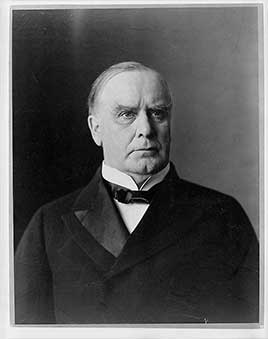
William McKinley
This presidency falls in the realignment era (1896–1932), when the two parties were trading positions and both had progressive and conservative wings.
Won in 1896 on the gold standard and high tariffs. He signed the Dingley Tariff, which raised rates to record levels, led the country through the Spanish–American War in 1898, and took Puerto Rico, Guam and the Philippines, where U.S. troops then fought a long war against Filipino independence forces. He annexed Hawaii and signed the Gold Standard Act. He was shot in Buffalo six months into his second term.
The economy, first day to last
Shaded areas show the years in office, with a few years before and after for comparison. Budget years ran July to June until 1976 (now October to September), so each year's figures cover parts of two calendar years.
National debt
June 30, 1896 (end of fiscal 1896): $1.77 billion → June 30, 1901 (end of fiscal 1901): $2.14 billion
Daily debt figures don't exist before 1993, so McKinley's numbers use the fiscal years closest to his terms, the same rule as every other page. Most of the rise paid for the Spanish–American War.
Debt compared with the economy
Debt as a share of GDP. Above 100% means the debt is bigger than a year of everything the country produces.
Deficits and surpluses
Money borrowed each budget year (below the line) or paid down (above). The White House budget office's yearly figures begin in 1901.
Unemployment
1897: 14.5% → 1901: 2.4%. Yearly averages; monthly figures begin in 1948. Estimates by economist Stanley Lebergott.
Inflation
How much prices rose each year (consumer price index).
Cost of living
What everyday prices and paychecks did while in office.
Prices use the consumer price index (MeasuringWorth). The minimum wage is the federal rate set by Congress.
Executive orders
185 orders. Count from the American Presidency Project.
Orders signed each year
Yearly counts aren't reliable for this era. Orders were not numbered until 1907, when the State Department numbered the ones already in its files, and many orders were never numbered at all, so only the total is shown.
Source: American Presidency Project: executive orders (full list of every order).
Notable orders
Rolling back the civil serviceOrderMay 29, 1899
Removed about 4,000 federal jobs from civil service rules, letting them be filled by patronage again.
Federal RegisterEvery executive order we have 117Search, filter by topic or year, and open any order's full text
Incomplete: orders before 1929 were not numbered or collected consistently. This archive has 117 of the roughly 185 orders counted for this president.
- OrderMarch 28, 1898Executive Order
- OrderMay 7, 1898Executive Order
- OrderMay 19, 1898Executive Order
- OrderMay 19, 1898Executive Order
- OrderMay 19, 1898Executive Order
- OrderJuly 4, 1898Executive Order
- OrderJuly 8, 1898Executive Order
- OrderJuly 13, 1898Executive Order
- OrderJuly 16, 1898Executive Order
- OrderJuly 21, 1898Executive Order
- OrderJuly 27, 1898Executive Order
- OrderAugust 6, 1898Executive Order
- OrderAugust 6, 1898Executive Order
- OrderAugust 17, 1898Executive Order
- OrderAugust 21, 1898Executive Order
- OrderAugust 21, 1898Executive Order
- OrderDecember 4, 1898Executive Order
- OrderDecember 9, 1898Executive Order
- OrderDecember 21, 1898Executive Order
- OrderDecember 21, 1898Executive Order
- OrderDecember 22, 1898Executive Order
- OrderDecember 22, 1898Executive Order
- OrderJanuary 1, 1899Executive Order
- OrderJanuary 20, 1899Executive Order
- OrderJanuary 31, 1899Executive Order
- OrderFebruary 3, 1899Executive Order
- OrderApril 1, 1899Executive Order
- OrderApril 1, 1899Executive Order
- OrderApril 1, 1899Executive Order
- OrderApril 3, 1899Executive Order
- OrderApril 6, 1899Executive Order
- OrderMay 6, 1899Executive Order
- OrderMay 6, 1899Executive Order
- OrderMay 10, 1899Executive Order
- OrderMay 13, 1899Executive Order
- OrderMay 23, 1899Executive Order
- EO 119May 29, 1899Amendments to the Civil-Service Rules
- OrderJune 10, 1899Executive Order
- OrderJune 16, 1899Executive Order
- OrderJune 27, 1899Executive Order
- OrderJuly 3, 1899Executive Order
- OrderJuly 3, 1899Executive Order
- OrderJuly 24, 1899Executive Order
- OrderAugust 17, 1899Executive Order
- OrderSeptember 2, 1899Executive Order
- OrderSeptember 11, 1899Executive Order
- OrderSeptember 18, 1899Executive Order
- OrderSeptember 29, 1899Executive Order
- OrderNovember 4, 1899Executive Order
- OrderNovember 10, 1899Executive Order
- OrderDecember 1, 1899Executive Order
- OrderJanuary 3, 1900Executive Order
- OrderJanuary 5, 1900Executive Order
- OrderJanuary 8, 1900Executive Order—Withdrawn Navajo Lands
- OrderJanuary 8, 1900Executive Order
- OrderJanuary 19, 1900Executive Order
- OrderFebruary 12, 1900Executive Order
- OrderMarch 7, 1900Executive Order
- OrderMarch 19, 1900Executive Order—Northern Cheyenne Reserve, Montana
- OrderMarch 19, 1900Executive Order—Establishment of Northern Cheyenne Indian Reservation
- OrderMarch 20, 1900Executive Order
- OrderMarch 21, 1900Executive Order
- OrderMay 1, 1900Executive Order
- OrderMay 14, 1900Executive Order—Hualpai (Walapai) Reserve, Arizona
- OrderMay 14, 1900Executive Order—Expansion of Hualapai Indian School Reserve
- OrderMay 26, 1900Executive Order
- OrderMay 26, 1900Executive Order
- OrderJune 12, 1900Executive Order
- OrderJune 22, 1900Executive Order
- OrderJune 27, 1900Executive Order
- OrderJune 29, 1900Executive Order
- OrderAugust 2, 1900Executive Order
- OrderAugust 2, 1900Executive Order
- OrderAugust 23, 1900Executive Order
- OrderSeptember 3, 1900Executive Order
- OrderSeptember 19, 1900Executive Order
- OrderSeptember 20, 1900Executive Order
- OrderOctober 10, 1900Executive Order
- OrderOctober 10, 1900Executive Order
- OrderOctober 13, 1900Executive Order
- OrderOctober 29, 1900Executive Order
- OrderNovember 30, 1900Executive Order
- OrderDecember 7, 1900Executive Order
- OrderDecember 13, 1900Executive Order
- OrderDecember 14, 1900Executive Order
- OrderDecember 19, 1900Executive Order
- OrderFebruary 2, 1901Executive Order
- OrderMarch 8, 1901Executive Order
- OrderMarch 9, 1901Executive Order
- OrderMarch 9, 1901Executive Order
- OrderMarch 11, 1901Executive Order
- OrderMarch 12, 1901Executive Order
- OrderMarch 14, 1901Executive Order
- OrderMarch 22, 1901Executive Order
- OrderMarch 25, 1901Executive Order
- OrderMarch 26, 1901Executive Order
- OrderMarch 30, 1901Executive Order
- OrderApril 2, 1901Executive Order
- OrderApril 5, 1901Executive Order
- OrderApril 6, 1901Executive Order
- OrderApril 15, 1901Executive Order
- OrderApril 23, 1901Executive Order
- OrderApril 29, 1901Executive Order
- OrderJune 7, 1901Executive Order
- OrderJune 7, 1901Executive Order
- OrderJune 10, 1901Executive Order
- OrderJune 21, 1901Executive Order
- OrderJune 21, 1901Executive Order
- OrderJune 21, 1901Executive Order
- OrderJune 25, 1901Executive Order
- OrderJune 25, 1901Executive Order
- OrderJune 29, 1901Executive Order
- OrderJuly 24, 1901Executive Order
- OrderAugust 19, 1901Executive Order
- OrderAugust 20, 1901Executive Order
- OrderAugust 27, 1901Executive Order
- OrderAugust 29, 1901Executive Order
Source: Executive Orders Archive, compiled from the American Presidency Project and the Federal Register. Topics are the archive's automated tags; "Revoked" and similar labels come from the Federal Register's records.
Pardons and commutations
A pardon wipes out the punishment for a federal crime; a commutation shortens a sentence but leaves the conviction. The Justice Department's published counts begin in fiscal 1900 (July 1899), so only his last two years are shown.
Granted each year
Source: U.S. Dept. of Justice, clemency statistics, which lists every recipient with the crime and sentence.
Notable grants: tap to see the crime
No individual grants from this presidency are highlighted yet.
Investigations and legal record
The same checklist for every president. Tap a row for details and sources.
ImpeachedNoNo
No articles of impeachment were voted on.
Criminally chargedNoNo
Never charged.
Aides or cabinet convictedNo — one general court-martialedPartly
No cabinet member was convicted. The Army's commissary general, Charles Eagan, was court-martialed in 1899 for his public attack on General Nelson Miles during the 'embalmed beef' dispute.
SourceSpecial counselsNoNo
None were appointed. A presidential commission (the Dodge Commission) investigated the War Department in 1898–99.
Misuse of DOJ, FBI or IRSNo findingNo
No official investigation found he used federal agencies against opponents.
People around the president who were charged or penalized
Controversies and scandals
What happened, what was proven, and how it ended.
The Philippine–American WarProven1899–1902
After buying the Philippines from Spain, the U.S. fought Filipino forces seeking independence. About 4,200 U.S. soldiers and 20,000 Filipino fighters were killed, and at least 200,000 Filipino civilians died from violence, famine and disease. U.S. troops used torture, including the 'water cure'.
Outcome: A Senate committee held hearings on abuses in 1902, after McKinley's death.
SourceAnnexing HawaiiDisputed1898
American businessmen had overthrown Hawaii's queen in 1893. When a treaty could not get two-thirds of the Senate, McKinley annexed the islands by a simple majority vote of both houses.
Outcome: Congress formally apologized to Native Hawaiians in 1993.
SourceThe 'embalmed beef' scandalDisputed1898–1899
General Nelson Miles charged that canned and refrigerated beef supplied to troops in the war was chemically treated and made soldiers sick.
Outcome: A court of inquiry found the beef was poor but not chemically treated; Secretary of War Alger resigned amid the fallout.
SourceSilence on the Wilmington coupDisputedNovember 1898
White supremacists overthrew the elected, biracial government of Wilmington, North Carolina, killing dozens of Black residents. Black leaders appealed to McKinley, who did not intervene.
Outcome: No one was prosecuted; North Carolina's 2006 commission called it a coup.
SourceRecord corporate money in 1896Disputed1896
Campaign manager Mark Hanna raised an estimated $3.5 million, much of it assessed from banks and corporations, which was legal at the time.
Outcome: Corporate contributions to federal campaigns were banned in 1907.
SourceIn their own words
Widely quoted remarks, with the context they were said in.
There was nothing left for us to do but to take them all, and to educate the Filipinos, and uplift and civilize and Christianize them.
Expositions are the timekeepers of progress.