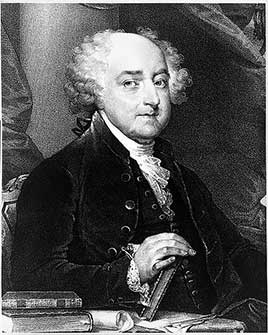
John Adams
A leader of independence and Washington's vice president. He fought an undeclared naval war with France and built up the Navy, then made peace against the wishes of his own party. He signed the Alien and Sedition Acts, which made it a crime to criticize the government, and put down a tax revolt. Before leaving he appointed John Marshall chief justice. He never owned enslaved people.
The economy, first day to last
Shaded areas show the years in office, with a few years before and after for comparison. Until 1842 the federal budget year matched the calendar year and debt figures are dated January 1; from 1843 to 1976 budget years ran July to June.
National debt
January 1, 1797: $82.06 million → January 1, 1801: $83.04 million
Until 1842 the Treasury's debt figures are dated January 1, so these are the closest readings to the start and end of the term.
Debt compared with the economy
Debt as a share of GDP. Above 100% means the debt is bigger than a year of everything the country produces.
Deficits and surpluses
Money borrowed each budget year (below the line) or paid down (above). The White House budget office's yearly figures begin in 1901.
Unemployment
No national estimates before 1890. Economist Stanley Lebergott's yearly estimates, the earliest national series, begin in 1890
Inflation
How much prices rose each year (consumer price index).
Cost of living
What everyday prices and paychecks did while in office.
Prices use the consumer price index (MeasuringWorth). The minimum wage is the federal rate set by Congress.
Executive orders
1 orders. Count from the American Presidency Project.
Orders signed each year
Yearly counts aren't reliable for this era. Orders were not numbered until 1907, when the State Department numbered the ones already in its files, and many orders were never numbered at all, so only the total is shown.
Source: American Presidency Project: executive orders (full list of every order).
Notable orders
Most orders in this era were routine, such as setting aside public land or exempting jobs from civil service rules.
Pardons and commutations
A pardon wipes out the punishment for a federal crime; a commutation shortens a sentence but leaves the conviction. The Justice Department's published counts begin in 1900.
Granted each year
The Justice Department's published clemency counts begin in fiscal 1900, so there are no reliable yearly totals for this presidency.
Source: U.S. Dept. of Justice, clemency statistics, which lists every recipient with the crime and sentence.
Notable grants: tap to see the crime
John FriesPardonMay 21, 1800
The crime: Treason, for leading armed resistance to a federal property tax in Pennsylvania (Fries's Rebellion, 1799)
Sentence: Death
Why it drew attention: Adams pardoned Fries and two others sentenced to hang, against his cabinet's advice, and issued a general amnesty for the rebellion.
SourceInvestigations and legal record
The same checklist for every president. Tap a row for details and sources.
ImpeachedNoNo
No articles of impeachment were voted on.
Criminally chargedNoNo
Never charged.
Aides or cabinet convictedNoNo
No member of his cabinet or White House staff was convicted.
Special counselsNoNo
None were appointed.
Misuse of DOJ, FBI or IRSYes — Sedition Act prosecutionsYes
Under the Sedition Act, his administration prosecuted newspaper editors and a sitting congressman, Matthew Lyon, for criticizing the government; about ten were convicted. Congress later repaid Lyon's fine as unconstitutional.
SourcePeople around the president who were charged or penalized
Controversies and scandals
What happened, what was proven, and how it ended.
The Alien and Sedition ActsDisputed1798–1801
The laws let the president deport foreigners deemed dangerous and made it a crime to publish 'false, scandalous and malicious' writing about the government. Prosecutions targeted Jefferson's supporters.
Outcome: The Sedition Act expired in 1801 and Jefferson pardoned those convicted. In 1964 the Supreme Court said it had been struck down 'in the court of history'.
SourceThe 'midnight judges'DisputedFebruary–March 1801
In his final weeks, Adams filled dozens of new judgeships with Federalists under a law passed by the outgoing Congress.
Outcome: Jefferson's Congress repealed the law; one undelivered commission led to Marbury v. Madison (1803).
SourceIn their own words
Widely quoted remarks, with the context they were said in.
May none but honest and wise men ever rule under this roof.
Our Constitution was made only for a moral and religious people. It is wholly inadequate to the government of any other.