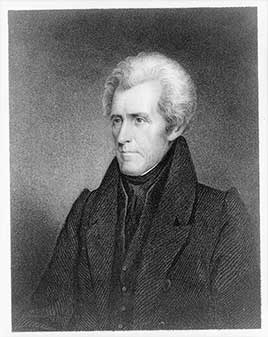
Andrew Jackson
The hero of the Battle of New Orleans and the first president from west of the Appalachians. He signed the Indian Removal Act, which led to the forced removal of the Southeastern tribes, vetoed the renewal of the Second Bank of the United States and pulled federal money out of it, faced down South Carolina's attempt to nullify federal tariffs, and paid off the entire national debt in 1835, the only time that has happened. His policies helped set off the Panic of 1837.
The economy, first day to last
Shaded areas show the years in office, with a few years before and after for comparison. Until 1842 the federal budget year matched the calendar year and debt figures are dated January 1; from 1843 to 1976 budget years ran July to June.
National debt
January 1, 1829: $58.42 million → January 1, 1837: $336,958
The debt hit about $34,000 in January 1835, essentially zero, and was gone by 1836. Until 1842 the Treasury's debt figures are dated January 1, so these are the closest readings to the start and end of the term.
Debt compared with the economy
Debt as a share of GDP. Above 100% means the debt is bigger than a year of everything the country produces.
Deficits and surpluses
Money borrowed each budget year (below the line) or paid down (above). The White House budget office's yearly figures begin in 1901.
Unemployment
No national estimates before 1890. Economist Stanley Lebergott's yearly estimates, the earliest national series, begin in 1890
Inflation
How much prices rose each year (consumer price index).
Cost of living
What everyday prices and paychecks did while in office.
Prices use the consumer price index (MeasuringWorth). The minimum wage is the federal rate set by Congress.
Executive orders
12 orders. Count from the American Presidency Project.
Orders signed each year
Yearly counts aren't reliable for this era. Orders were not numbered until 1907, when the State Department numbered the ones already in its files, and many orders were never numbered at all, so only the total is shown.
Source: American Presidency Project: executive orders (full list of every order).
Notable orders
Most orders in this era were routine, such as setting aside public land or exempting jobs from civil service rules.
Every executive order we have 7Search, filter by topic or year, and open any order's full text
Incomplete: orders before 1929 were not numbered or collected consistently. This archive has 7 of the roughly 12 orders counted for this president.
- OrderApril 8, 1829Executive Order
- OrderJune 12, 1830Executive Order
- OrderAugust 6, 1831Executive Order
- OrderJune 21, 1834Executive Order
- OrderAugust 7, 1836Executive Order
- OrderFebruary 15, 1837Executive Order
- OrderFebruary 18, 1837Executive Order
Source: Executive Orders Archive, compiled from the American Presidency Project and the Federal Register. Topics are the archive's automated tags; "Revoked" and similar labels come from the Federal Register's records.
Pardons and commutations
A pardon wipes out the punishment for a federal crime; a commutation shortens a sentence but leaves the conviction. The Justice Department's published counts begin in 1900.
Granted each year
The Justice Department's published clemency counts begin in fiscal 1900, so there are no reliable yearly totals for this presidency.
Source: U.S. Dept. of Justice, clemency statistics, which lists every recipient with the crime and sentence.
Notable grants: tap to see the crime
George WilsonPardon (refused)1830
The crime: Robbing the U.S. mail
Sentence: Death
Why it drew attention: Jackson pardoned the death sentence but Wilson refused to accept it. The Supreme Court ruled in 1833 that a pardon has no effect unless accepted.
SourceInvestigations and legal record
The same checklist for every president. Tap a row for details and sources.
ImpeachedNo — censured by the SenatePartly
In 1834 the Senate censured him for removing federal deposits from the national bank, the only time it has censured a president. His allies had the censure expunged in 1837.
SourceCriminally chargedNoNo
Never charged.
Aides or cabinet convictedNoNo
No member of his cabinet or White House staff was convicted.
Special counselsNoNo
None were appointed.
Misuse of DOJ, FBI or IRSDisputed — abolitionist mailPartly
In 1835 his postmaster general let Southern postmasters refuse to deliver antislavery mail, and Jackson asked Congress for a law banning it. Congress refused.
SourcePeople around the president who were charged or penalized
Controversies and scandals
What happened, what was proven, and how it ended.
Indian removalProven1830–1837
Jackson pushed through the Indian Removal Act and pressed the Choctaw, Creek, Chickasaw, Cherokee and Seminole to give up their lands in the Southeast. He did not enforce the Supreme Court's 1832 ruling that Georgia had no authority over Cherokee land.
Outcome: Tens of thousands were forced west; thousands died, including about 4,000 Cherokee on the Trail of Tears under Van Buren.
SourceSlaveholdingProven1788–1845
Jackson traded in enslaved people early in his career and owned about 150 at The Hermitage by the end of his life.
Outcome: He never freed them.
SourceThe Bank War and the Senate censureDisputed1832–1834
Jackson vetoed the bank's recharter and moved federal money into state banks, firing a treasury secretary who refused to do it.
Outcome: The Senate censured him in 1834; the censure was expunged in 1837. The easy credit that followed fed the Panic of 1837.
SourceKilling a man in a duelProven1806
Before his presidency, Jackson shot and killed Charles Dickinson in a duel after a dispute over a horse race bet.
Outcome: He was never charged.
SourceIn their own words
Widely quoted remarks, with the context they were said in.
It is to be regretted that the rich and powerful too often bend the acts of government to their selfish purposes.
Our Federal Union: It must be preserved.
What good man would prefer a country covered with forests and ranged by a few thousand savages to our extensive Republic?