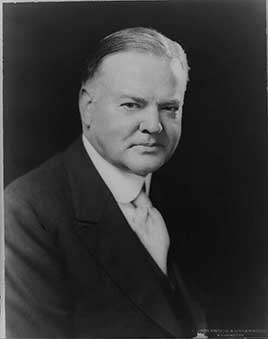
Herbert Hoover
This presidency falls in the realignment era (1896–1932), when the two parties were trading positions and both had progressive and conservative wings.
A mining engineer famous for organizing food relief in World War I. The stock market crashed seven months into his term. He signed the Smoot–Hawley tariff, created the Reconstruction Finance Corporation to lend to banks and businesses, and raised taxes sharply in 1932. Unemployment rose from about 3% to nearly 25%, and he lost to Franklin Roosevelt in a landslide.
The economy, first day to last
Shaded areas show the years in office, with a few years before and after for comparison. Budget years ran July to June until 1976 (now October to September), so each year's figures cover parts of two calendar years.
National debt
June 30, 1928 (end of fiscal 1928): $17.60 billion → June 30, 1932 (end of fiscal 1932): $19.49 billion
Daily debt figures don't exist before 1993, so Hoover's numbers use the fiscal years closest to his term, the same rule as every other page. By June 30, 1933, after fiscal 1933 (mostly his budget year), the debt was $22.5 billion.
Debt compared with the economy
Debt as a share of GDP. Above 100% means the debt is bigger than a year of everything the country produces.
Deficits and surpluses
Money borrowed each budget year (below the line) or paid down (above).
Unemployment
1929: 3.2% → 1932: 23.6%. Yearly averages; monthly figures begin in 1948. Estimates by economist Stanley Lebergott.
Inflation
How much prices rose each year (consumer price index).
Cost of living
What everyday prices and paychecks did while in office.
Prices use the consumer price index (MeasuringWorth). The minimum wage is the federal rate set by Congress.
Executive orders
995 orders, numbered 5076–6070. The American Presidency Project counts 1,003, including lettered orders. Many were routine, such as setting aside public land.
Orders signed each year
Source: Wikipedia: list of Hoover's executive actions (full list of every order).
Notable orders
Creating the Veterans AdministrationEO 5398July 21, 1930
Merged the agencies serving veterans into one Veterans Administration, the forerunner of today's VA.
Federal RegisterEvery executive order 1,001Search, filter by topic or year, and open any order's full text
- EO 5076March 7, 1929Designating Helen V. McLeod to Sign the Pressident's Name to Land Patents During the Absence of the Clerk
- EO 5077March 7, 1929Designating Viola B. Pugh to Sign the Pressident's Name to Land Patents
- EO 5078March 12, 1929Establishing Lincoln, Nebraska as a Customs Port of Entry
- EO 5079March 14, 1929Publication of Internal Revenue Tax Refund Decisions
- EO 5080March 19, 1929Transferring Certain Described Lands from the Missoula National Forest to the Helena Missoula National Forest, Montana
- EO 5081March 22, 1929Abolishing Roche Harbor, Washington as a Customs Port of Entry
- EO 5082March 22, 1929Reserving Certain Described Lands for Classification and Pending Legislation, Oregon
- EO 5083March 23, 1929Authorizing the Reinstatement of Emma E. Kennedy Without Regard to Civil Service Rules
- EO 5084March 28, 1929Making Lessie L. Schaefer Eligible for Examination Without Regard to Age
- EO 5085March 28, 1929Reserving Certain Described Lands Pending Resurvey, Wyoming
- EO 5086March 30, 1929Restoring Certain Reserved Lands in New Mexico Pending Resurvey and Such Lands Opened to Entry
- EO 5087April 1, 1929Extension of Trust Period on Allotments Made to Indians of the Siletz Reservation, Oregon
- EO 5088April 8, 1929Directing Certain Appropriations for the Virgin Islands be Accredited to and Expended by the Governor
- EO 5089April 9, 1929Reserving Certain Described Lands for Resurvey, Colorado
- EO 5090April 9, 1929Restoring Certain Described Lands Pending Resurvey, Wyoming
- EO 5091April 9, 1929Reserving Certain Lands Pending Resurvey, New Mexico
- EO 5092April 9, 1929Modifying Boundaries of Crook National Forest, Arizona
- EO 5093April 9, 1929Authorizing the Appointment of Ida Strong Without Regard to Civil Service Rules
- EO 5094April 12, 1929Authorizing the Appointment of William A. Kennedy Without Regard to Civil Service Rules
- EO 5095April 15, 1929Reserving Certain Described Lands for Agricultural Experimentation Station Purposes and for Establishment of Nunivak Island Reservation, Alaska
- EO 5096April 19, 1929Extending Port Limits of Boston, Massachusetts for Customs Port of Entry Purposes
- EO 5097April 20, 1929Permitting the Leasing of Certain Lands Reserved to Department of Commerce for Lighthouse Purposes in Alaska by the Department of Interior for Farming Purposes
- EO 5098April 23, 1929Reserving Certain Described Lands in Wyoming for Resurvey
- EO 5099April 26, 1929Ordering Rates of Rental and Subsistence Allowances of Officers of the Various Services into Effect
- EO 5100April 27, 1929Authorizing the Appointment of Jean N. Edington Without Regard to Civil Service Rules
- EO 5101April 29, 1929Approving Recommendation for Appointment of Mrs. Mary Elizabeth Porterfield Without Regard to Civil Service Rules
- EO 5102April 30, 1929Restoring Certain Reserved Lands Withdrawn for the Extension of Chugach National Forest, Alaska
- EO 5103May 1, 1929Authorizing the Appointment of Lottie C. Moyer Without Regard to Civil Service Rules
- EO 5104May 1, 1929Prescribing Regulations Governing the Appointment of Postmasters of the 1st, 2nd and 3rd Class
- EO 5105May 3, 1929Reserving Certain Described Lands for Possible Inclusion in a National Monument, Nevada
- EO 5106May 4, 1929Excluding the Territory of Alaska from Operation of Public Water Reserve No. 107
- EO 5107May 8, 1929Amendment to Schedule A of the Civil Service Rules
- EO 5108May 10, 1929Reserving Certain Described Lands for a Lookout Station, Washington
- EO 5109May 13, 1929Reserving Certain Described Lands Pending Resurvey, Colorado
- EO 5110May 13, 1929Amending Consular Regulations
- EO 5111May 13, 1929Amending Civil Service Rules, Regulation VIII Pertaining to Reinstatement
- EO 5112May 14, 1929Approving Recommendation for Appointment of Mrs. Juliette V. Harring Without Regard to Civil Service Rules
- EO 5113AMay 14, 1929Delegating Further Authority to the Alien Property Custodian Under the Trading with the Enemy Act
- EO 5113May 14, 1929Approving Recommendation for Appointment of Mrs. Marie Crossette Without Regard to Civil Service Rules
- EO 5114May 15, 1929Designating Horace Paul Bestor as Commissioner of the Federal Farm Loan Board
- EO 5115May 15, 1929Reserving Certain Described Lands Pending Resurvey, Oregon
- EO 5116May 15, 1929Reserving Certain Described Lands Pending Resurvey, Arkansas
- EO 5117May 16, 1929Reserving Certain Described Lands in California Pending Authorization for Sale to Los Angeles for Protection of Their Watershed
- EO 5118May 16, 1929Reserving Certain Described Lands for a Lookout Station, Oregon
- EO 5119May 17, 1929Reserving Certain Described Lands in Hawaii for Military Purposes
- EO 5120May 17, 1929Reserving Certain Described Lands Pending Archaeological Investigation by the Smithsonian Institution, New Mexico
- EO 5121May 18, 1929Reserving Certain Described Lands in California for Resurvey
- EO 5122May 18, 1929Establishing Fort Keogh Bird Refuge, Montana
- EO 5123May 21, 1929Amending Schedule A, Subdivision IX of the Civil Service Rules
- EO 5124May 23, 1929Amending Civil Service Rules, Schedule A, Subdivision I, Paragraph 6
- EO 5125May 23, 1929Reserving Certain Described Lands for Railroad Purposes, Alaska
- EO 5126May 24, 1929Amendment to the Instructions to Diplomatic Officers of 1927 Pertaining to Leave of Absence
- EO 5127May 24, 1929Amendment to the Consular Regulations
- EO 5128May 27, 1929Authorizing the Appointment of Joseph B. White Without Regard to Civil Service Rules
- EO 5129May 28, 1929Reserving Certain Described Lands in the Philippine Islands for Military Purposes
- EO 5130May 29, 1929Extension of Customs Collection District No. 20 to Include Portions of Plaquemines Parish, New Orleans
- EO 5131May 31, 1929Authorizing the Appointment of George Henry Malone Without Regard to Civil Service Rules
- EO 5132June 6, 1929Restoring Certain Reserved Lands in Hawaii Withdrawn for Kahuaiki [Fort Shafter] Military Reservation to Territory of Hawaii Government
- EO 5133June 7, 1929Exempting Percy W. Phillips from Civil Service Rules Prohibiting Federal Employees from Holding Office Under State, Territorial, or Municipal Government
- EO 5134June 12, 1929Authorizing the Appointment of Mary V. Kehoe Without Regard to Civil Service Rules
- EO 5135June 12, 1929Authorizing the Appointment of Walter K. Liscombe Without Regard to Civil Service Rules
- EO 5136June 12, 1929Amending Alaska Railroad Townsite Regulations
- EO 5137June 17, 1929Establishing Carbury, North Dakota as a Customs Port of Entry
- EO 5138June 17, 1929Reserving Certain Described Lands for Classification and Pending Legislation, Wisconsin
- EO 5139June 19, 1929Reserving Certain Described Lands in Philippine Islands for Naval Reservations
- EO 5140June 20, 1929Reserving Certain Described Lands Pending Resurvey, Wyoming
- EO 5141June 20, 1929Reserving Certain Described Lands for Classification as to Suitability for a Game Refuge, Nevada
- EO 5142June 20, 1929Authorizing the Reinstatement of Ralph Ely Stedman Without Regard to Civil Service Rules
- EO 5143June 21, 1929Restricting for the Time Being the Transportation of Passengers from Certain Ports in the Orient to a United States Port
- EO 5144June 25, 1929Reserving Certain Described Lands Pending Resurvey, New Mexico
- EO 5145June 29, 1929Authorizing the Appointment of Ida A. Coffey Without Regard to Civil Service Rules
- EO 5146June 29, 1929Authorizing the Appointment of Edna May Without Regard to Civil Service Rules
- EO 5147July 1, 1929Revoking Executive Order No. 4246
- EO 5148July 3, 1929Extension of Trust Period on Allotments Made to Indians on the Omaha Reservation, Nebraska
- EO 5149July 5, 1929Authorizing the Reinstatement of Frances D. Haldeman Without Regard to Civil Service Rules
- EO 5150July 5, 1929Authorizing the Reinstatement of Mae A. Krigbaum Without Regard to Civil Service Rules
- EO 5151AJuly 8, 1929Assignment of Frequencies to Government Radio Stations
- EO 5152July 8, 1929Authorizing the Reinstatement of Lulu M. Davis Without Regard to Civil Service Rules
- EO 5153July 9, 1929Amendment of Civil Service Rule IX Pertaining to Reinstatement
- EO 5154July 9, 1929Authorizing the Reinstatement of Birdie E. Gordon Without Regard to Civil Service Rules
- EO 5155July 11, 1929Restoring a Portion of Fort DeRussy Military Reservation, Hawaii, for Widening Ena Road
- EO 5156July 13, 1929Designating Harvey M. Hutchison as Acting Judge of the District Court of the United States for Porto Rico
- EO 5157July 16, 1929Restoring Certain Reserved Lands in Hawaii Withdrawn for Punchbowl Hill Military Reservation to Territory of Hawaii Government
- EO 5158July 16, 1929Establishing Cedar Keys Bird Refuge, Florida
- EO 5159July 18, 1929Establishing Reidsville, North Carolina as a Customs Port of Entry
- EO 5160July 19, 1929Restoring Certain Reserved Lands Withdrawn for Railway Grants to Permit Use in Maintenance of Air Navigation Facilities, Oregon and California
- EO 5161July 23, 1929Authorizing the Appointment of Louis Bulicek Without Regard to Civil Service Rules
- EO 5162July 24, 1929Restoring Certain Reserved Lands Withdrawn for Airplane Landing Field, Wyoming
- EO 5163July 25, 1929Authorizing Appointment of Mr. Howard Fyfe to Classified Status as Assistant Despatch Agent, U.S. Despatch Agency, New York
- EO 5164July 25, 1929Authorizing the Appointment of James Lawrence Bent Without Regard to Civil Service Rules
- EO 5165July 26, 1929Reserving Certain Described Lands for Resurvey, Colorado
- EO 5166July 26, 1929Reserving Certain Described Lands for Resurvey, California
- EO 5167July 29, 1929Authorizing the Appointment of Robert F. Kerkam Without Regard to Civil Service Rules
- EO 5168July 29, 1929Authorizing the Appointment of Myrtle B. Shely Without Regard to Civil Service Rules
- EO 5151July 30, 1929Amending Executive Order No. 1713 Reserving Certain Described Islands in Washington for Public Purposes
- EO 5169August 7, 1929Abolishing Souris, North Dakota as a Customs Port of Entry
- EO 5170August 8, 1929Amending Schedule B of the Civil Service Rules
- EO 5171August 8, 1929Amending Schedule A and Schedule B of the Civil Service Rules
- EO 5172August 9, 1929Reserving Certain Described Lands for Resurvey, Montana
- EO 5173August 9, 1929Extension of Trust Period on Allotments Made to Indians on the Yankton Sioux Reservation in South Dakota
- EO 5174August 21, 1929Amending Executive Order No. 4679 of June 29, 1927, Describing the Boundaries of Pupukea Military Reservation, Territory of Hawaii
- EO 5175August 21, 1929Authorizing the Appointment of Marjorie M. Noone Without Regard to Civil Service Rules
- EO 5176August 23, 1929Reserving Certain Described Lands for Classification and Pending Legislation, Oregon
- EO 5177August 23, 1929Restoring Certain Reserved Lands Pending Resurvey and Opening Such Lands to Entry, New Mexico
- EO 5178August 28, 1929Restoring Certain Reserved Lands Pending Resurvey and Opening Such Lands to Entry, New Mexico
- EO 5179August 28, 1929Restoring Certain Reserved Lands Pending Resurvey and Opening Such Lands to Entry, New Mexico
- EO 5180August 29, 1929Authorizing the Appointment of Jeanette C. Vaughan Without Regard to Civil Service Rules
- EO 5181August 29, 1929Restoring Certain Reserved Lands Pending Resurvey and Opening Such Lands to Entry, Wyoming
- EO 5182August 29, 1929Reserving Certain Described Lands for Classification, California and Nevada
- EO 5183August 30, 1929Restoring Certain Reserved Lands Pending Resurvey and Opening Such Lands to Entry, Wyoming
- EO 5184September 6, 1929Restoring Certain Reserved Lands Pending Resurvey and Opening Such Lands to Entry, Wyoming
- EO 5185September 6, 1929Establishing Colon Naval Radio Station, Canal Zone
- EO 5186September 7, 1929Authorizing the Appointment of Ida Elizabeth Henning Without Regard to Civil Service Rules
- EO 5187September 9, 1929Exempting Census Supervisors from Civil Service Rules Prohibiting Federal Employees from Holding Office Under State, County, or Municipal Government
- EO 5188September 10, 1929Exempting Indian Service Employees from Civil Service Rules Prohibiting Federal Employees from Holding Office Under State, County, or Municipal Government
- EO 5189September 11, 1929Prescribing Regulations Governing the Administration of the Foreign Service
- EO 5190September 11, 1929Reserving Certain Described Lands for Classification and Pending Legislation, Oregon
- EO 5191September 13, 1929Restoring Certain Reserved Lands Withdrawn for Classification and Legislation to Permit Homestead Entry, Florida
- EO 5192September 14, 1929Abolishing Lewiston, New York, as a Customs Port of Entry
- EO 5193September 14, 1929Extending Limits of Customs Ports of Entry of Astoria, Portland, and Marshfield, Oregon, and Longview, Washington, for Incorporation in Customs Collection District No. 29
- EO 5194September 16, 1929Reserving Certain Described Lands for Classification, Arkansas
- EO 5195September 16, 1929Restoring Certain Reserved Lands Pending Resurvey and Opening Such Lands to Entry, Colorado
- EO 5196September 21, 1929Reserving Certain Described Lands for the Purpose of a Fire Patrol Headquarters, Oregon
- EO 5197September 21, 1929Restoring Certain Reserved Lands Withdrawn for Power Site Reserve No. 421, California and Nevada
- EO 5197ASeptember 30, 1929Assignment of Frequencies to Government Radio Stations
- EO 5198September 30, 1929Amendment to Schedule A, Subdivision IX of the Civil Service Rules
- EO 5199October 1, 1929Restoring Certain Portions of Tongass National Forest, Alaska, for Entry Purposes
- EO 5200October 1, 1929Transferring the Division of Cooperative Marketing to the Federal Farm Board
- EO 5201October 3, 1929Reserving Certain Described Lands for Classification and Pending Advisability to Add to Hovenweep National Monument, Colorado
- EO 5202October 7, 1929Reserving Certain Described Lands for Resurvey, California
- EO 5203October 8, 1929Reserving Certain Described Lands for Classification and Pending Legislation, Oregon
- EO 5204October 9, 1929Authorizing the Appointment of Estelle Roberts Without Regard to Civil Service Rules
- EO 5205October 9, 1929Authorizing the Appointment of Erwin G. May Without Regard to Civil Service Rules
- EO 5206October 11, 1929Establishing Oroville, Washington as a Customs Port of Entry
- EO 5207October 12, 1929Restoring Certain Reserved Lands Along the Unalaklik River and on Norton Bay in Alaska and Opening Such Lands to Entry
- EO 5208October 12, 1929Reserving Certain Described Lands for Resurvey, Nevada
- EO 5209October 12, 1929Authorizing the Appointment of Guilia P. Burke Without Regard to Civil Service Rules
- EO 5210October 17, 1929Authorizing the Appointment of Josephine Jackley Without Regard to Civil Service Rules
- EO 5211October 19, 1929Reserving Certain Described Lands for Airspace Reservation Purposes, Maryland
- EO 5212October 25, 1929Restoring Certain Reserved Lands for Resurvey and Opening Such Lands to Entry, Washington
- EO 5213October 28, 1929Amending Schedule A, Subdivision VIII of the Civil Service Rules
- EO 5214October 30, 1929Reserving Certain Described Lands for Naval Purposes, Alaska
- EO 5215November 1, 1929Restoring Certain Reserved Lands Pending Resurvey and Opening Such Lands to Entry, Wyoming
- EO 5216November 2, 1929Restoring Certain Reserved Lands for Resurvey and Opening Such Lands to Entry, South Dakota
- EO 5217November 4, 1929Restoring Certain Reserved Lands for Public Water Reserves and Such Lands Restored to Public Domain, Washington
- EO 5218November 4, 1929Reserving Certain Described Lands for Resurvey, California
- EO 5219November 5, 1929Reserving Certain Described Lands for Alaska Reindeer Service Purposes, Alaska
- EO 5220November 8, 1929Uniform Style and Safeguarding of Proclamations and Executive Orders
- EO 5221November 11, 1929Limitation on Non-Official Employment of Officers or Employees of the American Government
- EO 5222November 12, 1929Reserving Certain Described Lands Pending Authorization for Sale to the City of Napa for Protection of Their Watershed, California
- EO 5223November 12, 1929Restoring Certain Reserved Lands for Air Navigation Facilities and Opening Such Lands to Entry, Idaho
- EO 5224November 15, 1929Authorizing the Reinstatement of Mrs. Alice Tasker
- EO 5225November 15, 1929Authorizing the Appointment of Mrs. Eliza C. O'Reilly Without Regard to Civil Service Rules
- EO 5226November 18, 1929Prescribing Regulations Governing Diplomatic Visas in the Foreign Service
- EO 5227November 18, 1929Restoring Certain Reserved Lands Occupied as a Home Site or for Fish Cannery Purposes in Tongass National Forest, Alaska and Opening Such Lands to Entry
- EO 5228November 21, 1929Establishing Benton Lake Bird Refuge, Montana
- EO 5229November 25, 1929Los Angeles Water Supply
- EO 5230November 25, 1929Amendment of Schedule A, Positions Excepted from Examination Under the Civil Service Rules
- EO 5231November 25, 1929Authorizing the Appointment of Germaine M. Finley Without Regard to Civil Service Rules
- EO 5232November 25, 1929Authorizing the Appointment of Mrs. Maude Williams Without Regard to Civil Service Rules
- EO 5233December 4, 1929Reserving Certain Described Lands Pending Authorization of Sale to the City of Napa for Watershed Protection Purposes, California
- EO 5234December 4, 1929Reserving Certain Described Lands for Resurvey, New Mexico
- EO 5235December 6, 1929Authorizing the Reinstatement of Mrs. Marguerite Barrett Without Regard to Civil Service Rules
- EO 5236December 9, 1929Amendment of Schedule A, of Positions Excepted from Examination Under Civil Service Rules
- EO 5237December 10, 1929Reserving Certain Described Lands for Classification, California
- EO 5238December 12, 1929Christmas, 1929
- EO 5239December 12, 1929Expenditures in Connection with Matters Affecting Oil Lands on Former Naval Reserves
- EO 5240December 14, 1929Correction in Description of Pupukea Military Reservation, Territory of Hawaii
- EO 5241December 16, 1929Reserving Certain Described Lands for Resurvey, Colorado
- EO 5242December 16, 1929Designating Clarence M. Young as Acting Secretary of Commerce Under Certain Conditions
- EO 5243December 19, 1929Restoring Certain Reserved Lands Affecting Amaknak Island, Alaska, and Opening Such Lands to Entry
- EO 5244December 23, 1929Reserving Certain Described Lands for Use as an Administrative Site for the Columbia National Forest, Washington
- EO 5245December 23, 1929To Permit Approval of an Application for Right of Way for a Gas Pipe Line Within Public Water Reserve No. 36, Wyoming
- EO 5246December 23, 1929To Permit Approval of an Application for Right of Way for a Gas Pipe Line Within Power Site Reserve No. 377, Utah
- EO 5247December 23, 1929Retention of Edwin V. Morgan in the Foreign Service
- EO 5248December 28, 1929Proposed Amendment of Schedule B to Provide for Appointments of Attorneys and Experts in the Federal Farm Board Without Competitive Examination Under the Civil Service Rules
- EO 5249December 31, 1929Reserving Certain Described Lands for Classification and Pending Inclusion in a National Forest, Michigan
- EO 5250December 31, 1929Establishing a Pardon Board for the Panama Canal Zone
- EO 5251December 31, 1929Reserving Certain Described Lands for Target Range Purposes, Colorado
- EO 5252December 31, 1929Restoring Certain Reserved Lands Withdrawn for Petroleum Reserve No. 61, Colorado No. 2, to Public Domain
- EO 5253December 31, 1929Extension of Trust Period on Allotments Made to Indians of the Omaha Reservation, Nebraska
- EO 5254December 31, 1929Restoring Certain Reserved Lands for Target Range Purposes and Opening Such Lands to Entry, New Mexico
- EO 5255December 31, 1929Reserving Certain Described Lands for National Guard Use as a Target Range, New Mexico
- EO 5256January 3, 1930Commutation of Rations and Quarters to Enlisted Men
- EO 5257January 9, 1930Withdrawal of Land for Target Range, Colorado
- EO 5258January 9, 1930Withdrawal of Public Lands for Classification, North Dakota
- EO 5259January 10, 1930Authorizing the Appointment of Mrs. Mary Bernadine Partridge
- EO 5260January 10, 1930To Form a Commission for the More Economical and Effective Conduct of Business in the Territory of Alaska
- EO 5261January 20, 1930Withdrawal of Land for Resurvey, New Mexico
- EO 5262January 20, 1930Revoking Withdrawal of Land for Resurvey, Arizona
- EO 5263January 22, 1930Authorizing the Alien Property Custodian to Sell at Private Sale Certain Shares of Stock of the United States Metals Refining Co.
- EO 5264January 24, 1930Restricting for the Time Being the Introduction of Parrots into the United States
- EO 5265January 24, 1930Restoring to the Territory of Hawaii a Part of the Military Reservation of Punchbowl Hill
- EO 5266January 24, 1930Restoring to the Territory of Hawaii a Part of the Fort Ruger Military Reservation
- EO 5267January 25, 1930Fixing the Salary of the War Claims Arbiter
- EO 5268January 25, 1930Amending the Composition of the Board of Surveys and Maps
- EO 5269February 1, 1930Classification of Jose T. Casanovas
- EO 5270February 4, 1930Withdrawal of Land for Public Water Reserve, Colorado
- EO 5271February 7, 1930Restoration of Lands Withdrawn for Power Site Reserve No. 435, Colorado
- EO 5272February 7, 1930Public Water Restoration No. 62, New Mexico No. 7
- EO 5273February 7, 1930Public Water Reserve No. 129, New Mexico No. 13
- EO 5274February 7, 1930Public Water Reserve No. 127, Utah No. 19
- EO 5275February 7, 1930Withdrawal of Public Land for Classification
- EO 5276February 7, 1930Withdrawal of Public Lands for Classification
- EO 5277February 7, 1930Withdrawal of Public Lands for Agricultural Experiment Purposes
- EO 5278February 7, 1930Withdrawal of Public Lands for Classification
- EO 5279February 8, 1930Revoking Withdrawals for Classification
- EO 5280February 17, 1930Deep Creek Administrative Site Addition
- EO 5281February 17, 1930To Establish Air Space Reservations Over Certain Harbors as Prohibited Areas for Civil Aircraft
- EO 5282February 19, 1930Withdrawal of Public Lands for a National Monument
- EO 5283February 21, 1930Appointment of Mrs. Mabel V. Birch
- EO 5284February 21, 1930Designation of Fort Pierce, Florida, as a Customs Port of Entry
- EO 5285February 25, 1930Classification of Eustaquio Vallecer for Faithful and Meritorious Service
- EO 5286February 25, 1930Reinstatement of H. Percival Dodge as a Foreign Service Officer
- EO 5287February 25, 1930Withdrawal of Public Lands for Resurvey
- EO 5288February 26, 1930Commutation of Rations and Quarters to Enlisted Men
- EO 5289March 4, 1930Reservation of Lands in Native Villages for Educational Purposes
- EO 5290March 5, 1930Accounts and Returns of Consular Officers
- EO 5291March 5, 1930Abolishment of New Bern and Manteo, North Carolina, as Customs Ports of Entry
- EO 5292March 5, 1930Public Water Reserve No. 130, Nevada No. 21
- EO 5293March 5, 1930Public Water Restoration No. 63, Montana No. 11
- EO 5294March 5, 1930Withdrawal of Public Lands for Resurvey Partially Revoked
- EO 5295March 6, 1930Accounts and Returns of Diplomatic Officers
- EO 5296March 8, 1930Partial Revocation of Withdrawals of Public Lands for Classification
- EO 5297March 10, 1930Withdrawal of Public Lands for Resurvey
- EO 5298March 10, 1930Licensing of Motor Vehicles in the Canal Zone, and Other Related Matters
- EO 5299March 10, 1930Extension of Trust Period on Allotments Made to Members of the Prairie Band of Potawatomi Indians, Kansas
- EO 5300March 11, 1930Withdrawal of Public Lands for Resurvey
- EO 5301March 12, 1930Extension of Trust Period on Certain Allotments Made to Indians of the Crow Reservation, Montana
- EO 5302March 12, 1930Extension of Trust Period on Certain Allotments Made to Indians of the Rosebud Reservation, South Dakota
- EO 5303March 12, 1930Extension of Trust Period on Certain Allotments Made to Indians of the Devils Lake Reservation, North Dakota
- EO 5304March 14, 1930Withdrawal of Public Lands for Resurvey
- EO 5305March 18, 1930Extension of Trust Period on Certain Allotments Made to Indians of the Nez Perce Tribe, Idaho
- EO 5306March 18, 1930Extension of Trust Period on Certain Allotments Made to Indians of the Seneca Tribe, Oklahoma
- EO 5307March 20, 1930Fishlake National Forest Enlarged
- EO 5308March 20, 1930Lands Reserved for Military Purposes in Municipality of Malabang, Province of Lanao, Philippine Islands
- EO 5309March 24, 1930Withdrawal of Public Lands for Resurvey
- EO 5310March 25, 1930Appointment of H. Charles Spruks
- EO 5311March 25, 1930Appointment of Mrs. Mabel P. Hollister to the Position of Stenographer and Typist in the Division of Plants of the Smithsonian Institution
- EO 5312March 26, 1930Power-Site Restoration No. 436
- EO 5313March 26, 1930Withdrawal of Public Lands in Aid of Legislation
- EO 5314March 26, 1930Salt Plains Wild Life Refuge
- EO 5315March 26, 1930Withdrawal of Public Lands for Resurvey
- EO 5316April 3, 1930Wolf Island Wild Life Refuge
- EO 5317April 3, 1930Suspension of Executive Order Abolishing New Bern and Manteo, North Carolina, as Customs Ports of Entry
- EO 5318April 7, 1930Aleutian Islands Reservation in Alaska Enlarged
- EO 5319April 7, 1930Withdrawal of Land Pending Authorization for Sale to Los Angeles for Protection of Their Watershed, California
- EO 5320April 7, 1930Extension of the Limits of the Port of Niagara Falls, New York, to Include Lewiston, New York
- EO 5321April 8, 1930Inspection of Tax Returns by Department of Commerce for Statistical Purposes
- EO 5322April 9, 1930Designating San Luis, Arizona as a Customs Port of Entry
- EO 5323April 10, 1930Withdrawal of Public Lands for Resurvey, Wyoming
- EO 5324April 10, 1930Designating Leopoldville, Belgian Congo, as an Unhealthful Post in the Foreign Service
- EO 5325April 12, 1930Authorizing the Appointment of Mrs. Liza B. Moncure
- EO 5326April 14, 1930Withdrawal of Islands, Rocks, and Pinnacles
- EO 5327April 15, 1930Withdrawal of Public Oil-Shale Deposits and Lands Containing Same for Classification
- EO 5328April 15, 1930Withdrawal of Public Lands for Resurvey
- EO 5329April 16, 1930Appointment of Mrs. Laura Mae Decker
- EO 5330April 16, 1930Appointment of Mrs. Helen Laddbush
- EO 5331April 17, 1930Withdrawal of Public Lands for Townsite Purposes
- EO 5332April 22, 1930Temporarily Changing the Order of Precedence of the Assistant Secretaries of War
- EO 5333April 22, 1930Appointment of Miss Mary Edwina Coons
- EO 5334April 22, 1930Appointment of Mrs. Selma F. Dinger
- EO 5335April 22, 1930Appointment of Mrs. Thelma D. Roy
- EO 5336April 23, 1930Coal Land Restoration, Utah No. 48
- EO 5337April 23, 1930Change of Limitation on the Army Ration
- EO 5338April 23, 1930Employment of Lieut. Ewile K. Jett, Andrew D. Ring, and Eugene Cogley by the Federal Radio Commission
- EO 5339April 25, 1930Withdrawal of Public Lands for Classification
- EO 5340April 25, 1930Appointment of Mrs. Ida K. Marsh
- EO 5341May 2, 1930Withdrawal of Public Lands for Resurvey
- EO 5342May 6, 1930Withdrawal of Public Lands for Resurvey
- EO 5343May 6, 1930Withdrawal of Public Lands for Resurvey
- EO 5344May 8, 1930Public Water Reserve No. 131, Montana, Nevada, Oregon, and Utah
- EO 5345May 8, 1930Amendments to Consular Regulations
- EO 5346May 9, 1930Withdrawal of Public Lands for Resurvey
- EO 5347May 12, 1930Appointment of Mrs. Florence R. Hopkins
- EO 5348May 12, 1930Appointment of Mrs. Helen Hall York
- EO 5349May 12, 1930Bird Island Wild Life Refuge
- EO 5350May 22, 1930San Diego and Imperial Counties, California, Established as Customs Collection District No. 25
- EO 5351May 23, 1930Phosphate Restoration No. 52
- EO 5352May 23, 1930Withdrawal of Public Lands for Agricultural Experiment Station
- EO 5353May 27, 1930Excusing Clerks and Employees, May 31, 1930
- EO 5354May 27, 1930Withdrawal of Public Lands for Resurvey
- EO 5355May 28, 1930Rental and Subsistence Allowances of Officers
- EO 5356May 28, 1930Extension of Trust Period on Certain Allotments Made to Members of the Prairie Band of Potawatomi Indians, Kansas
- EO 5357May 29, 1930Extension of Trust Period on Allotments of the Uncompahgre, Unitah, and White River Bands of Ute Indians, Utah
- EO 5358June 3, 1930Disbursement of Funds, Committee on the Administration and Conservation of the Public Domain
- EO 5359June 3, 1930Withdrawal of Coal Lands in Alaska
- EO 5360June 3, 1930Power-Site Restoration No. 438
- EO 5361June 4, 1930Withdrawal of Public Land for Alaska Road Commission
- EO 5362June 4, 1930Withdrawal of Public Lands Containing Mineral Spring
- EO 5363June 4, 1930Power-Site Restoration No. 440
- EO 5364June 5, 1930Withdrawal of Public Land for Naval Purposes
- EO 5365June 10, 1930Withdrawal of Public Lands for Vocational Training
- EO 5366June 13, 1930Restoration of Public Lands for Homestead Entry, Michigan
- EO 5367June 14, 1930Power-Site Restoration No. 441, Idaho
- EO 5368June 16, 1930Revocation of Withdrawal of Public Lands for Resurvey, Michigan
- EO 5369June 16, 1930Establishing the Cerro Tigre Ordnance Depot Military Reservation
- EO 5370June 17, 1930Withdrawal of Public Lands for Classification, New Mexico
- EO 5371June 19, 1930Order of Precedence of the Assistant Secretaries of War
- EO 5372June 20, 1930Power-Site Restoration No. 439, Oregon
- EO 5373June 20, 1930Appropriations Credited to the Governor of the Virgin Islands
- EO 5374June 20, 1930Appointment of Mrs. Mary R. Martin
- EO 5375June 23, 1930Minidoka Bird Reservation Enlarged
- EO 5376June 23, 1930Salaries of American Members, International Joint Commission
- EO 5377June 23, 1930Appointment of Miss Patia Smith
- EO 5378June 24, 1930Power-Site Restoration No. 442
- EO 5379June 24, 1930Public Water Restoration No. 64, Arizona, California, and Colorado
- EO 5380June 24, 1930Withdrawal of Public Lands to Protect Los Angeles Water Supply System
- EO 5381June 24, 1930Transfer of Operation of the Hotel Tivoli, Canal Zone
- EO 5382June 24, 1930Authorizing the Paymaster of the Panama Canal to Advance Funds to Bonded Employees
- EO 5383June 26, 1930Extension of Trust Period on Allotments of Red Lake Indians, Minnesota
- EO 5384June 27, 1930Reservation of Public Land for Department of Agriculture
- EO 5385June 27, 1930St. Michael, Alaska, Abolished as a Customs Port of Entry
- EO 5386June 30, 1930Restoring Lands to Exchange Under the Act of July 31, 1912
- EO 5387July 2, 1930Appointment of Mrs. Mildred E. Vincent
- EO 5388July 2, 1930Amendment of Schedule A, Subdivision VIII, Paragraph 5, of the Civil Service Rules
- EO 5389July 7, 1930Withdrawal of Public Lands Containing Medicinal Springs
- EO 5390July 7, 1930Appointment of Mrs. A. Louise Gilbert
- EO 5391July 8, 1930Reservation of Public Lands for Educational Purposes
- EO 5392July 9, 1930Extension of Limits of Customs Collection District No. 21
- EO 5393July 10, 1930Power-Site Restoration No. 444
- EO 5394July 14, 1930Designating Honorable Pedro de Aldrey to Perform Temporarily the Duties of the Judge of the District Court of the United States for Porto Rico
- EO 5395July 16, 1930Withdrawal of Public Lands for Resurvey
- EO 5396July 17, 1930Special Leaves of Absence to be Given Disabled Veterans in Need of Medical Treatment
- EO 5397July 18, 1930Withdrawal of Public Lands for a Lookout Station, Washington
- EO 5398July 21, 1930Consolidation and Coordination of Governmental Activities Affecting Veterans
- EO 5399July 22, 1930Authorizing the Appointment of Mrs. Bell Scarburgh Joynes
- EO 5400July 22, 1930Regulations Governing Representation Allowances
- EO 5401July 23, 1930Withdrawal of Public Lands to Protect and Augment Los Angeles Water Supply System
- EO 5402July 24, 1930Chugach National Forest
- EO 5403July 25, 1930Power-Site Restoration No. 443, Pit River, California
- EO 5404July 25, 1930Exclusion of Public Lands from the Crook National Forest and Withdrawal for Townsite Purposes, Arizona
- EO 5405July 25, 1930Restoring Portion of Puolo Point Military Reservation to the Territory of Hawaii
- EO 5406July 25, 1930Restoring Portion of Upolu Point Military Reservation to the Territory of Hawaii
- EO 5407July 25, 1930Public Water Reserve No. 132, Oregon and Wyoming
- EO 5408July 25, 1930Withdrawal of Public Lands for Classification, California
- EO 5409July 28, 1930Tongass National Forest, Alaska
- EO 5410July 29, 1930Revocation of Withdrawal of Public Lands for Resurvey, Utah
- EO 5411July 29, 1930Revocation of Withdrawal of Public Lands for Resurvey
- EO 5412July 29, 1930Revocation of Withdrawal of Public Lands for Resurvey
- EO 5413July 29, 1930Revocation of Withdrawal of Public Lands for Resurvey
- EO 5414July 31, 1930Correction in Description of the Waianae-Kai Military Reservation
- EO 5415August 4, 1930Extension of Trust Period on Allotments of Kickapoo Indians, Kansas
- EO 5416August 4, 1930Extension of Trust Period on Allotments of Klamath River Indians of California
- EO 5417August 4, 1930Amendments to Consular Regulations
- EO 5418August 4, 1930Revocation of Withdrawal of Public Lands for Resurvey
- EO 5419August 5, 1930Ketchikan Radio Station
- EO 5420August 5, 1930Revocation of Withdrawal of Public Lands for Resurvey
- EO 5421August 5, 1930Revocation of Withdrawal of Public Lands for Resurvey
- EO 5422August 7, 1930Revocation of Administrative Site Withdrawal
- EO 5423August 8, 1930Revocation of Withdrawal of Public Lands for Resurvey
- EO 5424August 15, 1930Withdrawal of Public Lands for Classification
- EO 5425August 20, 1930Tongass National Forest
- EO 5426August 20, 1930Documents Required of Aliens Entering the United States
- EO 5427August 20, 1930Waiver or Reduction of Application and Visa Fees for Nonimmigrants
- EO 5428August 20, 1930Withdrawal of Public Lands for Classification
- EO 5429August 25, 1930Charges at Army and Navy General Hospital, Hot Springs, Arkansas
- EO 5430August 26, 1930Power-Site Restoration No. 445, Clark Fork, Montana
- EO 5431August 27, 1930Appointment of Mrs. Robert D. Freeman
- EO 5432August 28, 1930Public Water Restoration No. 65, California
- EO 5433August 28, 1930Revocation of Withdrawals of Public Lands
- EO 5434August 28, 1930Partial Revocation of Withdrawal of Public Lands for Classification
- EO 5435September 2, 1930Diplomatic Visas for Reentry into the United States
- EO 5436September 2, 1930Withdrawal of Public Lands for Classification
- EO 5437September 4, 1930Appointment of Mrs. Frances Kearney
- EO 5438September 5, 1930Withdrawal of Public Lands for Classification
- EO 5439September 5, 1930Tongass National Forest
- EO 5440September 5, 1930Revocation of Withdrawal of Public Lands for Resurvey
- EO 5441September 8, 1930Reservation of Lots in Nenana for the Alaska Railroad
- EO 5442September 11, 1930Appointment of Mrs. James R. Bennett
- EO 5443September 12, 1930Power-Site Restoration No. 446
- EO 5444September 16, 1930Lawrence, Massachusetts, Designated a Customs Port of Entry
- EO 5445September 16, 1930Extension of Port Limits of Marshfield, Oregon
- EO 5446September 18, 1930Revocation of Withdrawal of Public Lands for Resurvey
- EO 5447September 22, 1930Reservation of Lots in Seward for the Department of Agriculture
- EO 5448September 23, 1930Power-Site Restoration No. 447, White River, Arkansas
- EO 5449September 25, 1930Tongass National Forest
- EO 5450September 25, 1930Withdrawal of Public Lands for Radio Station
- EO 5451September 25, 1930Withdrawal of Public Land for Lookout Station
- EO 5452September 25, 1930Withdrawal of Public Lands for Resurvey
- EO 5453September 25, 1930Wichita, Kansas, Designated a Customs Port of Entry
- EO 5454September 30, 1930Power-Site Restoration No. 450, Lake Fork, Utah
- EO 5455October 1, 1930Extension of the Limits of Customs Collection District No. 8
- EO 5456October 1, 1930Power-Site Restoration No. 449, Blacksmith Fork, Utah
- EO 5457October 1, 1930Partial Restoration of Public Lands on Amaknak Island
- EO 5458October 1, 1930Amending an Executive Order for the Withdrawal of Public Lands
- EO 5459October 4, 1930Placing the Position of Shipping Commissioner in the Classified Service
- EO 5460October 8, 1930Petroleum Restoration No. 59, Colorado
- EO 5461October 14, 1930Power-Site Restoration No. 451, Solomon Creek and Uno Creek, Alaska
- EO 5462October 14, 1930Withdrawal of Public Land for Customs and Immigration Inspection Purposes, Arizona
- EO 5463October 15, 1930Amendment to the Instructions to Diplomatic Officers
- EO 5464October 17, 1930Facilitating the Consideration of Applications for Plant Patents
- EO 5465October 20, 1930Withdrawal of Public Land for Addition to the Benicia Arsenal Military Reservation, California
- EO 5466October 22, 1930Extension of Trust Period on Allotments of Certain Bands of Chippewa Indians, Minnesota
- EO 5467October 22, 1930Reservoir-Site Restoration No. 10, California
- EO 5468October 22, 1930Amendment to Instructions to Diplomatic Officers on Inventory of Government Property
- EO 5469October 22, 1930Amendments to Consular Regulations
- EO 5470October 22, 1930Nunivak Island Reservation Enlarged
- EO 5471October 24, 1930Amending Schedule A of the Civil Service Rules
- EO 5472October 27, 1930Withdrawal of Public Lands to Protect Los Angeles Water Supply System
- EO 5473October 30, 1930Procedure Pertaining to Changes by the Personnel Classification Board in Existing Allocations of Positions
- EO 5474October 31, 1930Extension of Trust Period on Homesteads Made to Indians of the Niobrara or Santee Reservation, Nebraska
- EO 5475November 3, 1930Lake Charles, Louisiana, Designated a Customs Port of Entry
- EO 5476November 4, 1930Transfer to and Consolidation in the Veterans' Administration of Certain Duties Heretofore Performed by the War Department
- EO 5477November 4, 1930To Permit Approval of an Application for Right of Way for a Telephone and Telegraph Line Within Power-Site Reserve No. 377
- EO 5478November 8, 1930Public Water Reserve No. 133
- EO 5479November 11, 1930Amendment of Civil Service Rule X, Section 6, Transfers in the Nonapportioned Service
- EO 5480November 13, 1930Withdrawal of Public Lands for Classification
- EO 5481November 14, 1930Withdrawal of Public Lands for Agricultural Experiment Purposes
- EO 5482November 14, 1930Withdrawal of Public Lands Pending Legislation
- EO 5483November 14, 1930Withdrawal of Public Lands for Resurvey
- EO 5484November 14, 1930Withdrawal of Public Lands for Resurvey
- EO 5485November 14, 1930Revocation of Withdrawal of Public Lands for Resurvey
- EO 5486November 14, 1930Power-Site Restoration No. 452
- EO 5487November 14, 1930Description of the Fort Armstrong Military Reservation
- EO 5488November 15, 1930Revocation of Withdrawal of Public Land Pending Resurvey
- EO 5489November 15, 1930Public Water Reserve No. 134
- EO 5490November 15, 1930Power-Site Restoration No. 453
- EO 5491November 18, 1930Use of Eligible Registers Established Primarily for the Executive Civil Service of the United States for Filling Vacancies in the Municipal Service of the District of Columbia
- EO 5492November 18, 1930Public Water Restoration No. 66
- EO 5493November 18, 1930Restoring to the Government of the Philippine Islands a Part of the Military Reservation of Augur Barracks
- EO 5494November 18, 1930Revocation of Withdrawal of Public Lands Pending Resurvey
- EO 5495November 22, 1930Public Water Reserve No. 136
- EO 5496November 22, 1930Public Water Restoration No. 67
- EO 5497November 24, 1930Power-Site Restoration No. 454
- EO 5498November 25, 1930Salton Sea Wild Life Refuge
- EO 5499November 28, 1930Coal-Land Restoration, Utah No. 49
- EO 5500December 2, 1930Withdrawal of Public Lands for Alaska Road Commission
- EO 5501December 2, 1930Reinstatement of Mrs. Eva MacFate
- EO 5502December 2, 1930Rules Governing the Dispensation of Narcotic Drugs in the Virgin Islands
- EO 5503December 4, 1930Appointment of Mrs. Pearl McIntosh
- EO 5504December 4, 1930Withdrawal of Public Land for Target Range
- EO 5505December 8, 1930Transferring Control of Certain Land to the Secretary of the Interior
- EO 5506December 8, 1930Revocation of Withdrawal of Public Lands Pending Resurvey
- EO 5507December 8, 1930Paducah, Kentucky, Abolished as a Customs Port of Entry
- EO 5508December 10, 1930Withdrawal of Public Lands for Classification
- EO 5509December 10, 1930Revocation of Withdrawal of Public Lands Pending Resurvey
- EO 5510December 10, 1930Power-Site Restoration No. 456
- EO 5511December 11, 1930Withdrawal of Public Lands for Classification
- EO 5512December 11, 1930Withdrawal of Public Lands to Protect Los Angeles Water Supply System
- EO 5513December 13, 1930Amendment of Schedule B, Positions Which May Be Filled Upon Noncompetitive Examinations Under the Civil Service Rules
- EO 5514December 15, 1930Christmas, 1930
- EO 5515December 15, 1930Revocation of Bird Island Wild Life Refuge
- EO 5516December 17, 1930Extension of Trust Period on Allotments to Indians on the Umatilla Reservation, Oregon
- EO 5517December 17, 1930Chugach National Forest, Alaska
- EO 5518December 19, 1930Revocation of Withdrawal of Public Lands for Resurvey, New Mexico
- EO 5519December 23, 1930Retention of Robert Peet Skinner in the Foreign Service
- EO 5520December 23, 1930Authorizing the Appointment of Mrs. Lulie Hunt Turnipseed
- EO 5521December 26, 1930Restoring to the Government of the Territory of Hawaii Portions of the Military Reservations of Fort Shafter and Hawaii Arsenal
- EO 5522December 31, 1930Withdrawal of Public Lands in Aid of Legislation, Arizona
- EO 5523December 31, 1930Classification of Mr. John W. Martyn
- EO 5524January 5, 1931Revocation of Withdrawal of Public Land Pending Resurvey, Colorado
- EO 5525January 5, 1931Withdrawal of Public Lands for Classification, Utah
- EO 5526January 7, 1931Amendments to Consular Regulations
- EO 5527January 7, 1931Authorizing the Appointment of Mrs. Mildred Barnes Mclnturff
- EO 5528January 7, 1931Restoring Portion of Upolu Airplane Landing Field to the Territory of Hawaii
- EO 5529January 8, 1931Designating Mrs. Leafie E. Dietz to Sign Land Patents
- EO 5530January 9, 1931Two Harbors, Minnesota, Abolished as a Customs Port of Entry
- EO 5531January 13, 1931Withdrawal of Public Lands for Resurvey, New Mexico
- EO 5532January 15, 1931Modification of Reservoir-Site Reserve No. 1, Wenatchee Lake Reservoir, Washington
- EO 5533January 16, 1931Modification of Reservoir-Site Reserve No. 16, Deschutes River, Oregon
- EO 5534January 21, 1931Public Water Reserve No. 137, Montana and Nevada
- EO 5535January 21, 1931Power-Site Restoration No. 455, Montana
- EO 5536January 21, 1931Power-Site Restoration No. 457, Montana
- EO 5537January 21, 1931Potash Restoration No. 9, California
- EO 5538January 23, 1931Withdrawal of Public Lands for Resurvey, Colorado
- EO 5539January 23, 1931Extension of Trust Period on Allotments on Ponca Indians of Oklahoma
- EO 5540January 26, 1931Establishing the Charles Sheldon Wild Life Refuge, Nevada
- EO 5541January 27, 1931Power-Site Restoration No. 458, John Day River, Oregon
- EO 5542January 27, 1931Withdrawal of Public Lands for Resurvey, California
- EO 5543January 30, 1931Power-Site Restoration No. 459, Idaho
- EO 5544January 30, 1931Amendment of Schedule A, Subdivision III, of the Civil Service Rules, Research Associates, Public Health Service
- EO 5545January 30, 1931Revocation of Schedule B, Subdivision I, Paragraph 7 of the Civil Service Rules, Allowing Noncompetitive Appointments of Advisers (Disciplinarians) in the Indian Service
- EO 5546January 31, 1931Extension of Trust Period on Allotments of Indians on the Cheyenne River Reservation, South Dakota
- EO 5547January 31, 1931Withdrawal of Public Lands for Resurvey, New Mexico
- EO 5548January 31, 1931Withdrawal of Public Lands for Resurvey, New Mexico
- EO 5549February 5, 1931Amendment to the Instructions to Diplomatic Officers Respecting Citizenship
- EO 5550February 6, 1931Withdrawal of Public Lands for Classification, California
- EO 5551February 7, 1931Withdrawal of Public Lands for Resurvey, New Mexico
- EO 5552February 9, 1931Revocation of Withdrawal of Public Lands Containing Oil Shale, Utah
- EO 5553February 9, 1931Authorizing the Appointment of Mrs. Nixon S. Plummer
- EO 5554February 9, 1931Authorizing the Appointment of Mrs. Helen R. Witt
- EO 5555February 11, 1931Withdrawal of Public Lands for Resurvey, New Mexico
- EO 5556February 11, 1931Extension of Trust Period on Allotments of Potawatomi Indians of Kansas
- EO 5557February 13, 1931Extension of Trust Period on Allotments of Indians on the Pine Ridge Reservation, South Dakota
- EO 5558February 16, 1931Withdrawal of Public Lands for Resurvey, New Mexico
- EO 5559February 16, 1931Withdrawal of Public Lands in Aid of Legislation, Colorado
- EO 5560February 16, 1931Amendment of Schedule A, Positions Excepted from Examination Under the Civil Service Rules
- EO 5561February 18, 1931Restoration of United States Agricultural Experiment Station Lands in the Territory of Hawaii
- EO 5562February 20, 1931Withdrawal of Additional Public Lands for Lighthouse Purposes, Mississippi
- EO 5563February 23, 1931Authorizing the Appointment of Mrs. Margaret Kane
- EO 5564February 25, 1931Power-Site Restoration No. 460, Oregon
- EO 5565February 25, 1931Amending Regulations for Appointments to the Foreign Service
- EO 5566February 27, 1931Placing the Government of the Virgin Islands Under the Supervision of the Department of the Interior
- EO 5567February 28, 1931Power-Site Restoration No. 461, Montana
- EO 5568March 3, 1931Chugach National Forest, Alaska
- EO 5569March 3, 1931Revocation of Withdrawal of Public Lands for Survey, Florida
- EO 5570March 3, 1931Reinstatement of Probationer in Any Part of the Service
- EO 5571March 5, 1931Withdrawal of Public Lands for Resurvey, Arizona
- EO 5572March 7, 1931Modification of Withdrawal of Public Lands for Classification, Idaho
- EO 5573March 7, 1931Withdrawal of Public Lands for Classification, Utah
- EO 5574March 11, 1931Chugach National Forest, Alaska
- EO 5575March 12, 1931Extension of Trust Period on Allotments of Fond du Lac Indians of Minnesota
- EO 5576March 13, 1931Revocation of Withdrawal of Public Land for Resurvey, New Mexico
- EO 5577March 13, 1931Oakland, California, Abolished as a Customs Port of Entry
- EO 5578March 13, 1931Change of Designation of the Port of San Francisco, California, and Extension of Limits of Said Port
- EO 5579March 16, 1931Establishing the Crescent Lake Wild Life Refuge, Nebraska
- EO 5580March 16, 1931Extension of Trust Period on Lands of Agua Caliente Band of Indians, California
- EO 5581March 17, 1931Withdrawal of Public Land for Classification, California
- EO 5582March 18, 1931Withdrawal of Coal Lands, Alaska
- EO 5583March 30, 1931Rental and Subsistence Allowances of Officers
- EO 5584March 30, 1931Amendment of Schedule A, Section VIII, Paragraph 5(d), of the Civil Service Rules, to Except Part-Time Dentists in the Indian Service
- EO 5585March 30, 1931Withdrawal of Public Lands for Resurvey, California
- EO 5586March 30, 1931Withdrawal of Public Lands for Classification, North Dakota
- EO 5587March 30, 1931Revocation of Withdrawal of Public Land Pending Resurvey, Colorado
- EO 5588March 31, 1931Amendment of Schedule A of the Civil Service Rules in Relation to Appointment of Private Secretaries without Examination Under Rule II, Section 3
- EO 5589April 1, 1931Withdrawal of Public Lands for Town-Site Purposes, Idaho
- EO 5590April 1, 1931Petroleum Restoration No. 60, Montana
- EO 5591April 1, 1931Authorizing the Appointment of Mrs. Grace McMahan Tyndall
- EO 5592April 3, 1931Transfer of Control and Administration of Lands to the War Department for Military Purposes, Wyoming
- EO 5593April 4, 1931Public Water Reserve No. 139, Colorado
- EO 5594April 6, 1931Public Water Reserve No. 138, Nevada and Wyoming
- EO 5595April 9, 1931Death of Nicholas Longworth, Speaker of the House of Representatives
- EO 5596April 9, 1931Withdrawal of Public Lands for Resurvey, Nevada
- EO 5597April 9, 1931Public Water Restoration No. 68, New Mexico
- EO 5598April 10, 1931Coal Land Restoration, New Mexico No. 48
- EO 5599April 13, 1931Inclusion of Captain Washington C. McCoy in the Classified Service
- EO 5600April 16, 1931Withdrawal of Public Lands to Form Agricultural Field Station, Oregon
- EO 5601April 16, 1931Withdrawal of Public Lands for Classification, Oregon
- EO 5602April 20, 1931Placing Certain Government Property in the Virgin Islands Under the Control and Jurisdiction of the Department of the Interior
- EO 5603April 20, 1931Withdrawal of Public Lands for Resurvey, Wyoming
- EO 5604April 20, 1931Authorizing the Appointment of Mrs. Cecil Alexander
- EO 5605AApril 21, 1931Radio Frequencies
- EO 5605April 21, 1931Actual Expenses and Per Diem Allowances for Civilian Officers and Employees While Traveling
- EO 5606April 22, 1931Establishing the Fallon Wild-Life Refuge
- EO 5607April 22, 1931Correction in Description of Land Restored to the Territory of Hawaii
- EO 5608April 22, 1931Designation of Sasabe, Arizona, as a Customs Port of Entry
- EO 5609April 23, 1931Civil-Service Status for Former Employees of the National Home for Disabled Volunteer Soldiers, Now Employees of the Veterans' Administration
- EO 5610April 24, 1931Amendment of the Civil-Service Rules Relating to Veterans' Preference
- EO 5611April 24, 1931Withdrawal of Public Lands for Use in Connection with San Carlos Indian Irrigation Project, Arizona
- EO 5612April 25, 1931Establishing a Council of Personnel Administration
- EO 5613April 28, 1931Withdrawal of Lands for Addition to Bishops Point Military Reservation, Territory of Hawaii
- EO 5614May 1, 1931Reporting of Expenditures for Use in the Budget
- EO 5615May 1, 1931Transfer of Lands from the St. Joe to the Clearwater National Forest, Idaho
- EO 5616May 2, 1931Transfer of Lands Between the Pend Oreille and Kootenai National Forests, Idaho-Montana
- EO 5617May 4, 1931Authorizing the Appointment of Mrs. Elsie K. Demshock
- EO 5618May 11, 1931Exclusion of Public Lands from the Crook National Forest, Arizona for Town-Site Purposes
- EO 5619May 11, 1931Deerlodge National Forest, Montana
- EO 5620May 13, 1931Authorizing the Appointment of Mrs. Dorothy I. Sinnott
- EO 5621May 13, 1931Amendment of Article X of Consular Regulations
- EO 5622May 15, 1931Classification of Federal Employees in the Philippines
- EO 5623May 15, 1931Withdrawal of Public Lands for Resurvey, California
- EO 5624May 15, 1931Regulations Governing the Occupation and Maintenance of Certain Foreign Service Quarters
- EO 5625May 18, 1931Saturday Working Hours, Field Service, Department of the Interior
- EO 5626May 18, 1931Extension of Trust Period on Allotments of Kickapoo Indians of Kansas
- EO 5627May 20, 1931Participation in the Government of Arlington County, Virginia, by Federal Employees Permanently Residing Therein
- EO 5628May 20, 1931Authorizing the Appointment of Mrs. Amy Cowing
- EO 5629May 21, 1931Public Water Reserve No. 141, Montana
- EO 5630May 25, 1931Transferring Control and Administration of Public Lands to the Secretary of the Interior and Reserving a Part for Lighthouse Purposes, Washington
- EO 5631May 26, 1931Withdrawal of Public Lands for Municipal Water Supply, California
- EO 5632May 27, 1931Revocation of Withdrawal of Public Lands for Classification, North Dakota
- EO 5633May 28, 1931Withdrawal of Public Lands for Resurvey, California
- EO 5634June 1, 1931Transfer of Lands from the Mount Baker to the Snoqualmie National Forest, Washington
- EO 5635June 2, 1931Authorizing the Appointment of Arthur B. Landt
- EO 5636June 3, 1931Classification of Attorney Positions in the Veterans' Administration by Revocation of Paragraph 1 of Section IX, Schedule B, Civil-Service Rules
- EO 5637June 4, 1931Restoring to the Territory of Hawaii a Part of the Keaahala Military Reservation
- EO 5638AJune 8, 1931Assignment of Frequencies to Government Radio Stations
- EO 5638June 8, 1931Assignment of Frequencies to Government Radio Stations
- EO 5639June 8, 1931Transfer of Land for Aviation Field, Wyoming
- EO 5640June 8, 1931Withdrawal of Public Lands for Resurvey, California
- EO 5641June 8, 1931Restoration of Certain Lands from Salmon Hatchery Reservation, Alaska
- EO 5642June 8, 1931Administration of the Foreign Service
- EO 5643June 8, 1931Regulations Governing Representation and Post Allowances in the Foreign Service
- EO 5644June 8, 1931Designation of Unhealthful Posts in the Foreign Service
- EO 5645June 8, 1931Vesting Certain Power and Authority in the Alien Property Custodian
- EO 5646June 9, 1931Transfer of Lands from the Selway to the Bitterroot National Forest, Idaho
- EO 5647June 9, 1931Inspection of Income-Tax Returns
- EO 5648June 11, 1931Regulations Governing Accounts and Returns in the Foreign Service
- EO 5649June 12, 1931Authorizing the Appointment of Mrs. Helen Terrill Mays
- EO 5650June 18, 1931Public Water Reserve No. 142, Oregon
- EO 5651June 18, 1931Partial Revocation of Withdrawal of Public Lands, Minnesota
- EO 5652June 18, 1931Withdrawal of Public Lands for Resurvey, Colorado
- EO 5653June 20, 1931Power-Site Restoration No. 462, Colorado
- EO 5654June 20, 1931Duck Creek Administrative-Site Addition, Montana
- EO 5655June 22, 1931Public Water Restoration No. 69, Arizona
- EO 5656June 22, 1931Withdrawal of Public Lands for Resurvey, Wyoming
- EO 5657June 24, 1931Amending Schedule A of the Civil-Service Rules
- EO 5658June 24, 1931Form, Style, and Safeguarding of Executive Orders and Proclamations
- EO 5659June 25, 1931Authorizing the Appointment of Mrs. Florence R. Hopkins
- EO 5660June 26, 1931Transferring Control and Administration of Certain Land to the Secretary of the Interior, Nevada
- EO 5661July 1, 1931Amendments to the Consular Regulations
- EO 5662July 1, 1931Exception from Examination of Cooperative Employees Enforcing the Plant Quarantine Act, Department of Agriculture
- EO 5663July 1, 1931Designating Horace Paul Bestor as Farm Loan Commissioner
- EO 5664July 2, 1931Withdrawal of Public Lands for Use as Naval Ammunition Depot, Nevada
- EO 5665July 2, 1931Authorizing the Appointment of A. D. Forsythe
- EO 5666July 3, 1931Permitting Persons Holding Certain Positions to Receive Appointments Under the Department of Commerce
- EO 5667July 6, 1931Withdrawal of Public Lands for Resurvey, Oregon
- EO 5668July 6, 1931Withdrawal of Public Land for Target Range, Wyoming
- EO 5669July 14, 1931Public Water Restoration No. 70, Montana and Utah
- EO 5670July 22, 1931Transfer of Certain Land from Military Reservation to Siuslaw National Forest, Oregon
- EO 5671July 29, 1931Withdrawal of Public Lands in Aid of Legislation, Wisconsin, Minnesota, North Dakota, Montana, Wyoming, Idaho, Washington, and Oregon
- EO 5672August 3, 1931Public Water Reserve No. 143, Colorado and Wyoming
- EO 5673August 4, 1931Tongass National Forest, Alaska
- EO 5674August 7, 1931Revocation of Withdrawal of Public Lands Pending Resurvey, California
- EO 5675August 7, 1931Revocation of Withdrawal of Public Lands Pending Resurvey, Utah
- EO 5676August 7, 1931Modification of Reservoir-Site Reserve No. 1, Wenatchee Lake Reservoir, Washington
- EO 5677August 10, 1931Revocation of Withdrawal of Public Land Pending Resurvey, New Mexico
- EO 5678August 10, 1931Revocation of Withdrawal of Public Lands Pending Resurvey, Utah
- EO 5679August 10, 1931Revocation of Withdrawal of Public Lands Pending Resurvey, Wyoming
- EO 5680August 10, 1931Amendment of Schedule A, to Include Superintendents or Officers in Charge of National Parks or Reservations, with Their Positions, in the Classified Service
- EO 5681August 12, 1931Withdrawal of Public Lands for Resurvey, California
- EO 5682August 12, 1931Withdrawal of Public Lands for Resurvey, New Mexico
- EO 5683August 12, 1931Withdrawal of Public Lands for Lookout Station, Oregon
- EO 5684August 12, 1931Withdrawal of Public Lands for Classification, Utah
- EO 5685August 12, 1931Revocation of Withdrawal of Public Lands Pending Resurvey, New Mexico
- EO 5686August 12, 1931Modification of Reservoir-Site Reserve No. 17, Pacific Slope Basin, California
- EO 5687August 18, 1931Withdrawal of Public Lands for Resurvey, Wyoming
- EO 5688August 18, 1931Revocation of Withdrawal of Public Lands Pending Resurvey, Colorado
- EO 5689August 18, 1931Right of Way for Gas Pipe Line, International Boundary Strip, United States and Mexico, Arizona
- EO 5690August 20, 1931Withdrawal of Public Lands in the Province of Zambales, Luzon, Philippine Islands
- EO 5691August 21, 1931Amendment of Schedule A of the Civil-Service Rules to Except Certain Positions in the Veterans' Administration from Examination
- EO 5692August 24, 1931Description of Aiea Military Reservation, Hawaii
- EO 5693August 24, 1931Description of the Punchbowl Hill Military Reservation, Hawaii
- EO 5694August 25, 1931Withdrawal of Public Land in Aid of Legislation, Oregon
- EO 5695August 27, 1931Authorizing the Appointment of Mrs. Marie V. Abernethy
- EO 5696August 27, 1931Amendment of Schedule B, of the Civil-Service Rules, to Permit Appointment of Headquarters Messenger, Philippine Department, Upon Noncompetitive Examination
- EO 5697August 28, 1931Authorizing the Appointment of Mrs. Caroline J. Skilton
- EO 5698August 31, 1931Revocation of Withdrawal of Public Lands Pending Resurvey, Colorado
- EO 5699August 31, 1931Revocation of Withdrawal of Public Lands for Resurvey, Oregon
- EO 5700August 31, 1931Permitting Public Health Service Officers to Serve in State, etc., Health Organizations, and Permitting Certain Appointments Under the Public Health Service
- EO 5701August 31, 1931Authorizing the Appointment of Mr. John W. Harrison
- EO 5702September 1, 1931Withdrawal of Public Lands, Oregon
- EO 5703September 1, 1931Power-Site Restoration No. 463, Wyoming
- EO 5704September 2, 1931Delimiting Canal Zone Judicial Districts
- EO 5705September 3, 1931Designating Honorable Adolph G. Wolf to Perform Temporarily the Duties of the Judge of the District Court of the United States for Porto Rico
- EO 5706September 4, 1931Authorizing the Appointment of Mrs. Mary J. A. Hangliter, Mrs. Margaret B. Hillyard, Mrs. Catherine Lehmkuhl, and Miss Frances N. Kane
- EO 5707September 4, 1931Amendments to Regulations Governing the Occupation and Maintenance of Certain Foreign Service Quarters
- EO 5708September 8, 1931To Permit Approval of Application for Railroad Right of Way, Utah
- EO 5709September 11, 1931Withdrawal of Public Lands for Resurvey, California
- EO 5710September 14, 1931Naval Air-Space Reservation and Defensive Sea Area
- EO 5711September 14, 1931Withdrawal of Public Lands for Classification, Montana
- EO 5712September 14, 1931Withdrawal of Public Lands Pending Legislation, Arizona
- EO 5713September 14, 1931Order of Modification, Coal Withdrawal Wyoming No. 1
- EO 5714September 15, 1931Administrative-Site Withdrawal, California
- EO 5715September 16, 1931Restoring to the Territory of Hawaii a Part of the Military Reservation Known as "Barracks Lot"
- EO 5716September 16, 1931Transfer of Records, etc., of the National Commission on Law Observance and Enforcement to the Department of Justice
- EO 5717September 17, 1931Modification of Public Water Reserve No. 116, California
- EO 5718September 17, 1931Revocation of Withdrawals of Public Lands for Classification, California
- EO 5719September 17, 1931Withdrawal of Land for Lighthouse Purposes, Michigan
- EO 5720September 18, 1931Authorizing the Appointment of Mrs. Gladys W. Eldridge
- EO 5721September 19, 1931Addition to Upper Mississippi River Wild Life and Fish Refuge
- EO 5722September 22, 1931Acceptance of Title to Land on Government Island, City of Alameda, California
- EO 5723September 22, 1931To Permit Approval of Application for Railroad Right of Way, Utah
- EO 5724September 22, 1931Amendment of Schedule A, Civil-Service Rules, to Permit Employment of Members of National Homes in Certain Positions
- EO 5725September 24, 1931Interpretation of Boundaries of Toiyabe National Forest, Nevada
- EO 5726September 26, 1931Willow Administrative Site, Prescott National Forest, Arizona
- EO 5727September 29, 1931Establishing the Locomotive Springs Migratory Bird Refuge, Utah
- EO 5728September 29, 1931Extension of Trust Period on Allotments of Otoe and Missouria Indians, Oklahoma
- EO 5729October 2, 1931Withdrawal of Public Lands for Resurvey, California
- EO 5730October 8, 1931Extension of Trust Period on Allotments of the Walker River Reservation, Nevada
- EO 5731October 13, 1931Amending Schedule A, Subdivision VII, of the Civil-Service Rules
- EO 5732October 14, 1931Withdrawal of Public Land for Lookout Station, California
- EO 5733October 16, 1931Order of Modification, Coal Withdrawal Wyoming No. 1
- EO 5734October 17, 1931Extension of Trust Period on Allotments of the Warm Springs Reservation, Oregon
- EO 5735October 20, 1931Revocation of Withdrawal of Public Lands for Resurvey, New Mexico
- EO 5736October 20, 1931Withdrawal of Public Lands in the Philippine Islands for Military Purposes
- EO 5737October 22, 1931Amendments to the Consular Regulations
- EO 5738October 29, 1931Authorizing the Appointment of Mrs. Louise A. Gallivan
- EO 5739October 30, 1931Power-Site Restoration No. 464, Idaho
- EO 5740October 31, 1931Establishing the St. Marks Migratory Bird Refuge, Florida
- EO 5741November 2, 1931Revocation of Withdrawal of Public Lands Pending Resurvey, Wyoming
- EO 5742November 3, 1931Authorizing the Appointment of Mr. William C. White
- EO 5743November 7, 1931Partial Revocation of Withdrawal of Public Lands, Arkansas
- EO 5744November 7, 1931Power-Site Restoration No. 465, Colorado
- EO 5745November 7, 1931Power-Site Restoration No. 466, Wyoming
- EO 5746November 10, 1931Extension of Trust Period on Allotments of the Yakima Indian Reservation, Washington
- EO 5747November 11, 1931Big Lake Reservation, Arkansas
- EO 5748November 12, 1931Savannah River Wild Life Refuge, Georgia and South Carolina
- EO 5749November 20, 1931Partial Revocation of Withdrawal of Public Lands Pending Resurvey, Colorado
- EO 5750November 23, 1931Revocation of Withdrawal of Lands for Lighthouse Purposes, California
- EO 5751December 3, 1931Withdrawal of Public Lands for Classification, Colorado
- EO 5752December 3, 1931Transfer of Lands from the Datil to the Cibola, Formerly Manzano, National Forest, New Mexico
- EO 5753December 7, 1931Amendment of Civil-Service Rule VII in Relation to the Apportionment
- EO 5754December 7, 1931Public Water Reserve No. 144, Alaska
- EO 5755December 10, 1931Withdrawal of Public Lands for Classification, Mississippi
- EO 5756December 16, 1931Transfer of Lands from the Lewis and Clark to the Helena National Forest, Montana
- EO 5757December 16, 1931Transfer of Lands from the Madison and the Deerlodge to the Beaverhead National Forest, Montana
- EO 5758December 16, 1931Transfer of Lands from the Lolo to the Cabinet National Forest, Montana
- EO 5759December 16, 1931Transfer of Lands from the Madison, Missoula, and Helena to the Deerlodge National Forest, and Elimination of Lands Therefrom, Montana
- EO 5760December 16, 1931Transfer of Lands from the Madison to the Gallatin National Forest, Montana
- EO 5761December 16, 1931Transfer of Lands from the Bitterroot and the Missoula to the Lolo National Forest, Montana
- EO 5762December 18, 1931Authorizing the Appointment of Mrs. Florence F. Burton
- EO 5763December 22, 1931Christmas, 1931
- EO 5764December 22, 1931Amendment of Civil-Service Rule V
- EO 5765December 24, 1931Transfer of Lands from the Datil to the Gila National Forest, New Mexico
- EO 5766December 30, 1931Authorizing the Appointment of Mrs. Yetta B. Floyd
- EO 5767December 30, 1931Authorizing the Appointment of Mrs. Hallie D. Stotleb
- EO 5768December 30, 1931Extension of Trust Period on Indian Reservation Allotments
- EO 5769December 30, 1931Phosphate Restoration No. 53, Idaho
- EO 5770December 30, 1931Port Everglades, Florida Designated a Customs Port of Entry
- EO 5771January 4, 1932Road Right of Way, Schofield Barracks Military Reservation, Hawaii
- EO 5772January 11, 1932To Permit Approval of Application Salt Lake City 049347 for a Railroad Right of Way
- EO 5773January 11, 1932Amendments to the Consular Regulations
- EO 5774January 13, 1932Amendment of Schedule A, Civil-Service Rules, to Permit Appointment of Members of National Homes Without Examination
- EO 5775January 15, 1932Transfer of Miners in the Bureau of Mines, with Their Positions, from the Noncompetitive to the Competitive Service
- EO 5776January 18, 1932Amendment of the Civil-Service Rules Relating to Veterans' Preference
- EO 5777January 19, 1932Amendment of Schedule B of the Civil-Service Rules to Increase the Number of Positions of Headquarters Messenger, Philippine Department
- EO 5778January 19, 1932Stipulations for the Payment of Prevailing Rate of Wages in Public Building Contracts
- EO 5779January 21, 1932Tongass National Forest, Alaska
- EO 5780January 25, 1932Public Water Restoration No. 71, Arizona and Utah
- EO 5781January 28, 1932Authorizing the Appointment of Mrs. Florence C. Brock
- EO 5782January 28, 1932Enlarging the Hutton Lake Migratory Bird Refuge, Wyoming
- EO 5783January 29, 1932Enlarging the Bamforth Lake Migratory Bird Refuge, Wyoming
- EO 5784January 29, 1932Withdrawal of Lands for Use of Alaska Road Commission
- EO 5785January 29, 1932Revocation of Withdrawal of Public Lands Pending Resurvey, New Mexico
- EO 5786January 30, 1932Defensive Sea Area Off the Coast of North Carolina
- EO 5787February 2, 1932Amendment of Schedule A of the Civil-Service Rules, Excepting Positions in the Department of Justice
- EO 5788February 2, 1932Size, Weight, and Speed of Motor Vehicles Using the Public Highways of the Canal Zone
- EO 5789February 2, 1932Withdrawal of Public Lands for Resurvey, California
- EO 5790February 2, 1932Withdrawal of Public Lands for Resurvey, New Mexico
- EO 5791February 2, 1932Withdrawal of Public Lands for Resurvey, Colorado
- EO 5792February 2, 1932Withdrawal of Public Lands for Resurvey, Nevada
- EO 5793February 3, 1932Revocation of Withdrawal of Public Lands for Resurvey, Wyoming
- EO 5794February 5, 1932Withdrawal of Public Lands for Lookout Station, California
- EO 5795February 9, 1932Power-Site Restoration No. 468, Wyoming
- EO 5796February 10, 1932Withdrawal of Public Lands for Classification, Illinois and Wisconsin
- EO 5797February 11, 1932Revocation of Withdrawal of Public Lands Pending Resurvey, Wyoming
- EO 5798February 11, 1932Power-Site Restoration No. 467, Oregon
- EO 5799February 15, 1932Withdrawal of Lands for McClellan Peak Administrative Site, Nevada
- EO 5800February 17, 1932Transfer of Lands from the Gallatin and Beartooth National Forests to the Absaroka National Forest, Montana
- EO 5801February 17, 1932Transfer of Lands from the Absaroka and Beartooth National Forests to the Custer National Forest, Montana and South Dakota
- EO 5802February 17, 1932Authorizing the Appointment of Mr. Sinclair A. Wilson
- EO 5803February 19, 1932Withdrawal of Public Land for Fish-Cultural Station, Oregon
- EO 5804February 23, 1932Authorizing the Appointment of Miss Ann Halloran
- EO 5805February 23, 1932Withdrawal of Public Lands for Resurvey, New Mexico
- EO 5806February 25, 1932Partial Restoration of Public Land for Airport, Alaska
- EO 5807February 25, 1932Withdrawal of Public Lands for Resurvey, Colorado
- EO 5808February 25, 1932Long Lake Migratory Bird Refuge in North Carolina, Enlarged
- EO 5809February 27, 1932Revocation of Withdrawal of Public Lands Pending Resurvey, New Mexico
- EO 5811February 27, 1932Authorizing the Appointment of Mrs. Wanda Coolidge Carver
- EO 5812February 29, 1932Amendment to the Consular Regulations
- EO 5813February 29, 1932Withdrawal of Coal Lands, Alaska
- EO 5814March 1, 1932Addition of Lands to the Ocala National Forest and the Ocala National Game Refuge, Florida
- EO 5815March 9, 1932Withdrawal of Coal Lands, Alaska
- EO 5816March 9, 1932Power-Site Restoration No. 469, Montana
- EO 5817March 10, 1932Amendment of Schedule B of the Civil-Service Rules, Affecting the Bureau of Foreign and Domestic Commerce
- EO 5818March 10, 1932Withdrawal of Public Lands for Classification, Washington
- EO 5819March 12, 1932Revocation of Withdrawal of Public Lands Pending Resurvey, Colorado
- EO 5820March 16, 1932Revocation of Withdrawal of Public Lands Pending Resurvey, Arkansas
- EO 5821March 17, 1932Waiver of Age Limit to Permit Appointment of Joseph H. Hopkins
- EO 5822March 19, 1932Authorizing the Appointment of Fred Scott
- EO 5823March 21, 1932Revocation of Withdrawal of Public Lands Pending Resurvey, Colorado
- EO 5824March 22, 1932Inspection of Income Tax Returns
- EO 5825March 26, 1932Leaves of Absence, Foreign Service
- EO 5826March 28, 1932Roosevelt National Forest, Colorado
- EO 5827March 28, 1932Withdrawal of Public Lands for Military Purposes, California
- EO 5828March 30, 1932Withdrawal of Public Lands for Naval Ammunition Depot, Nevada
- EO 5829March 30, 1932Withdrawal of Public Lands for Resurvey, New Mexico
- EO 5830April 4, 1932Appointments Under War Minerals Relief Act
- EO 5831April 4, 1932Authorizing the Appointment of Mrs. Ruth Bascot Dartt
- EO 5832April 7, 1932Reserving Lands and Buildings for the Use of the Department of Justice, Alaska
- EO 5833April 8, 1932Withdrawal of Public Lands for Classification, Minnesota
- EO 5834April 8, 1932Transfer of Lands from the Jefferson to the Lewis and Clark National Forest, Montana
- EO 5835April 13, 1932Extension of the Limits of Certain Customs Ports of Entry
- EO 5836April 13, 1932Temporarily Withdrawing Certain Lands Pending Definite Location of Right of Way for Transmission Line, California and Nevada
- EO 5837April 13, 1932Amendment to Tariff of United States Consular Fees
- EO 5838April 18, 1932Withdrawal of Public Lands in Aid of Legislation, Oregon
- EO 5839April 19, 1932Authorizing the Appointment of Mr. Ralph A. Vestal
- EO 5840April 21, 1932Revocation of Withdrawal of Public Lands Pending Resurvey, New Mexico
- EO 5841April 23, 1932Siuslaw National Forest, Oregon
- EO 5842April 28, 1932Designating the Honorable Emilio del Toro to Perform Temporarily the Duties of the Judge of the District Court of the United States for Porto Rico
- EO 5843April 28, 1932Withdrawal of Public Lands in Aid of Legislation and Revocation of Executive Order No. 1529 of May 9, 1912
- EO 5844April 28, 1932Revocation of Withdrawal of Public Lands Pending Resurvey, Michigan
- EO 5845April 28, 1932Revocation of Withdrawal of Public Lands Pending Resurvey, Minnesota
- EO 5846May 2, 1932Withdrawal of Public Lands for Classification, Colorado
- EO 5847May 7, 1932Authorizing the Appointment of Warren Benjamin
- EO 5848May 16, 1932Amendments to Tariff of United States Consular Fees
- EO 5849May 19, 1932Transferring to Control and Jurisdiction of the Secretary of the Navy Certain Lands Opposite Balboa, and Establishing Thereon a Naval Base in the Canal Zone
- EO 5850May 25, 1932Assuming Control, for Military Purposes, of the Municipal Aviation Field, Tucson, Arizona
- EO 5851May 28, 1932Authorizing the Appointment of Mrs. Nesta Stephens Long
- EO 5852June 1, 1932Authorizing the Appointment of Mrs. Gladys L. Knight
- EO 5853June 3, 1932Waiver of Maximum Age Limit, George H. Rolfe
- EO 5854June 3, 1932Protection of the Northern Pacific Halibut Fishery
- EO 5855AJune 6, 1932Assignment of Frequencies to Government Radio Stations
- EO 5855June 6, 1932Assignment of Frequencies to Government Radio Stations
- EO 5856June 11, 1932Tongass National Forest, Alaska
- EO 5857June 16, 1932Amendments to the Consular Regulations
- EO 5858June 17, 1932Establishing the Semidi Islands Wild Life Refuge, Alaska
- EO 5859June 21, 1932Revocation of Schedule A, Subdivision III, Paragraph 10, of the Civil-Service Rules
- EO 5860June 22, 1932Rules Governing the Granting and Issuing of Passports in the United States
- EO 5861June 23, 1932Authorizing the Appointment of Eugene R. Capozio
- EO 5862June 23, 1932Withdrawal of Public Lands for Resurvey, Colorado
- EO 5863June 23, 1932Transfer of Lands from the Toiyabe to the Nevada National Forest
- EO 5864June 23, 1932Withdrawal of Public Lands for Lookout Station, Oregon
- EO 5865June 27, 1932Regulations Relating to Aerial Flights—Army, Navy, Marine Corps, Coast Guard, and National Guard
- EO 5866June 28, 1932Pay and Allowances, Enlisted Personnel—Marine Corps
- EO 5867June 28, 1932George Washington National Forest, Virginia and West Virginia
- EO 5868June 28, 1932Reservoir-Site Restoration No. 11, California
- EO 5869June 30, 1932Documents Required of Aliens Entering the United States
- EO 5870June 30, 1932Continuing Temporarily the Present Standardized Government Travel Regulations, Subject to Certain Modifications
- EO 5871June 30, 1932Regulations Governing Sick Leave of Absence Authorized by Law
- EO 5872June 30, 1932Exemption of Persons from Compulsory Retirement for Age
- EO 5873June 30, 1932Temporary Exemption of Persons from Compulsory Retirement for Age
- EO 5874June 30, 1932Temporary Exemption of Persons from Compulsory Retirement for Age in Order to Afford Time for Filling Vacancies
- EO 5875June 30, 1932Temporary Exemption op Persons from Compulsory Retirement for Age
- EO 5876June 30, 1932Coal Land Restoration, Montana No. 87
- EO 5877July 6, 1932Revocation of Withdrawal of Public Lands Pending Resurvey, Colorado
- EO 5878July 6, 1932Rental and Subsistence Allowances of Officers
- EO 5879July 7, 1932Authorizing the Appointment of Mrs. A. Blondell Howe
- EO 5880July 9, 1932Delimiting Canal Zone Judicial Districts
- EO 5881July 9, 1932Further Temporary Exemption of Certain Persons from Compulsory Retirement for Age in Order to Afford Time for Filling Vacancies
- EO 5882July 9, 1932Rogue River National Forest, Oregon
- EO 5883July 11, 1932Revocation of Withdrawal of Public Lands Pending Resurvey, Colorado
- EO 5884July 11, 1932Revocation of Withdrawal of Public Lands Pending Resurvey, Wyoming
- EO 5885July 12, 1932Mendocino National Forest, California
- EO 5886July 12, 1932Withdrawal of Public Lands for Resurvey, Wyoming
- EO 5887July 14, 1932Administrative Furloughs
- EO 5888July 16, 1932Regulating the Transportation of Liquors over the Highways and Waterways of the Canal Zone
- EO 5889July 16, 1932Withdrawal of Public Lands for Use in Connection with San Carlos Indian Irrigation Project
- EO 5890July 16, 1932Partial Revocation of Withdrawal of Public Lands, California
- EO 5891July 16, 1932Withdrawal of Public Lands for Classification, Oregon
- EO 5892July 20, 1932Transfer of Radio Division of the Department of Commerce to the Federal Radio Commission
- EO 5893July 26, 1932Authorizing the Appointment of Mr. Lamar Costello
- EO 5894July 26, 1932Withdrawal of Public Lands for Resurvey, Colorado
- EO 5895July 26, 1932Revocation of Withdrawal of Public Lands Pending Resurvey, Florida
- EO 5896July 29, 1932Exemption of Persons from Compulsory Retirement for Age
- EO 5897July 30, 1932Temporary Exemption of William Bertrand Acker from Compulsory Retirement for Age
- EO 5898August 2, 1932Withdrawal of Public Lands in Aid of Legislation, Arizona
- EO 5899August 2, 1932Public Water Restoration No. 73, Wyoming
- EO 5900August 10, 1932Withdrawal of Public Land for Classification, Oregon
- EO 5901August 18, 1932Amendment of Schedule A, Subdivision IX, of the Civil Service Rules
- EO 5902August 18, 1932Public Water Reserve No. 145, California
- EO 5903August 18, 1932Withdrawal of Public Lands for Classification, Nevada
- EO 5904August 18, 1932Withdrawal of Land for Use of the Navy Department, Wyoming
- EO 5905August 18, 1932Authorizing the Appointment of Mrs. Sarah L. Curtiss
- EO 5906August 18, 1932Modification of Reservoir-Site Reserve No. 17, Pacific Slope Basins, California
- EO 5907August 18, 1932Public Water Reserve No. 146, Montana, New Mexico, Oregon, and Wyoming
- EO 5908August 22, 1932Public Water Restoration No. 12, California
- EO 5910August 23, 1932Amendments to Tariff of United States Consular Fees
- EO 5911August 24, 1932Exemption of John W. Ginder from Compulsory Retirement for Age
- EO 5912August 24, 1932Exemption of John P. McDowell from Compulsory Retirement for Age
- EO 5913August 25, 1932Reserving Certain Lots for Hot Springs National Park, Arkansas
- EO 5914August 26, 1932Long Lake Migratory Bird Refuge in North Dakota Enlarged
- EO 5915August 31, 1932Power-Site Restoration No. 470, California
- EO 5916September 2, 1932Power-Site Restoration No. 471, California
- EO 5917September 2, 1932Exemption of Albert D. Davis from Compulsory Retirement for Age
- EO 5918September 7, 1932Examination for Designation for Appointment to United States Military and Naval Academies
- EO 5919September 8, 1932Power-Site Restoration No. 472, Oregon
- EO 5920September 15, 1932Withdrawal of Public Lands for Resurvey, New Mexico
- EO 5921September 15, 1932Exemption of Persons from Compulsory Retirement for Age
- EO 5922September 17, 1932Amendment of Schedule B of the Civil-Service Rules
- EO 5923September 20, 1932Withdrawal of Public Lands for Resurvey, Oregon
- EO 5924September 20, 1932Authorizing Priority to Employees Dropped or Furloughed in Reduction of Force
- EO 5925September 21, 1932Transfer of Lands from the Boise and Challis National Forests to the Sawtooth National Forest, and from the Sawtooth National Forest to the Boise National Forest, Idaho
- EO 5926September 23, 1932Power-Site Restoration No. 474, Idaho
- EO 5927September 28, 1932Power-Site Restoration No. 475, California
- EO 5928September 29, 1932LaPine Administrative Site, Oregon
- EO 5929October 1, 1932Withdrawal of Public Lands for Classification, Wisconsin
- EO 5930October 6, 1932Amendment of Schedule A, Subdivision VII, of the Civil-Service Rules
- EO 5931October 8, 1932Rights of Way, Round Top Military Reservation, Hawaii
- EO 5932October 10, 1932Revocation of Withdrawal of Public Lands Pending Resurvey, New Mexico
- EO 5933October 10, 1932Revocation of Withdrawal of Public Lands Pending Resurvey, Wyoming
- EO 5934October 12, 1932Revocation of Withdrawal of Public Lands Pending Resurvey, Colorado
- EO 5935October 14, 1932Revocation of Withdrawal of Public Lands Pending Resurvey, Wyoming
- EO 5936October 18, 1932Withdrawal of Public Lands for Classification, California
- EO 5937October 18, 1932Power-Site Restoration No. 476, Idaho
- EO 5938October 24, 1932Enlarging the Harney National Forest, South Dakota
- EO 5939October 25, 1932Revocation of Withdrawal of Public Lands Pending Resurvey, New Mexico
- EO 5940October 26, 1932Exemption of William Bertrand Acker from Compulsory Retirement for Age
- EO 5941October 26, 1932Public Water Restoration No. 74, New Mexico
- EO 5942October 29, 1932Withdrawal of Public Lands for Resurvey, New Mexico
- EO 5943October 29, 1932Revocation of Withdrawal of Public Lands Pending Resurvey, Colorado
- EO 5944November 1, 1932Revocation of Withdrawal of Public Lands Pending Resurvey, Nevada
- EO 5945November 3, 1932Establishing the Tule Lake Wild Life Refuge, California
- EO 5946November 16, 1932Exemption of Persons from Compulsory Retirement for Age
- EO 5947November 16, 1932Tongass National Forest, Alaska
- EO 5948November 16, 1932Modification of Withdrawal of Lands in Aid of Legislation, Michigan
- EO 5949November 16, 1932Withdrawal of Public Land, Montana and Wyoming
- EO 5950November 19, 1932Tongass National Forest, Alaska
- EO 5951November 22, 1932Exemption of Person from Compulsory Retirement for Age
- EO 5952November 23, 1932Army Ration
- EO 5953November 23, 1932Extension of Trust Period on Indian Reservation Allotments
- EO 5954November 26, 1932Exemption of Persons from Compulsory Retirement for Age
- EO 5955November 30, 1932Extension of Trust Period on Wichita Allotment No. 582-A
- EO 5956December 1, 1932Unsanctioned Asylum
- EO 5957December 7, 1932Power-Site Restoration No. 473, New Mexico
- EO 5958December 8, 1932Withdrawal of Public Lands for Resurvey, Arizona
- EO 5959December 9, 1932Consolidation and Coordination of Governmental Activities Affecting Administrative Accounting, Audit, and Business Methods
- EO 5960December 9, 1932Consolidation and Coordination of Governmental Activities Affecting United States Commerce
- EO 5961December 9, 1932Consolidation and Coordination of Governmental Activities Affecting Labor
- EO 5962December 9, 1932Consolidation and Grouping of Education, Health and Recreation Activities in the Department of the Interior
- EO 5963December 9, 1932Consolidation and Grouping of Land Utilization Agencies in the Department of Agriculture
- EO 5964December 9, 1932Consolidation and Grouping of Public Works Activities in the Department of the Interior
- EO 5965December 9, 1932Consolidation and Grouping of Merchant-Marine Activities in the Department of Commerce
- EO 5966December 9, 1932Establishing a Unified Border Patrol in the Coast Guard Service, Treasury Department
- EO 5967December 9, 1932Transfer to the Department of Justice of Certain Functions Now Performed by the Veterans' Administration
- EO 5968December 9, 1932Transfer of the Duties, Powers, and Functions of the Alien Property Custodian to the Department of Justice
- EO 5969December 9, 1932Transfer to the Civil Service Commission of Certain Functions Now Performed by the Employees' Compensation Commission
- EO 5970December 13, 1932Inspection of Income Tax Returns
- EO 5971December 14, 1932Revocation of Withdrawal of Public Lands in Utah
- EO 5972December 15, 1932Authorizing the Appointment of Miss Geraldine Rollins
- EO 5973December 15, 1932Amendments to the Consular Regulations
- EO 5974December 16, 1932Amendment of Schedule A, Subdivision III, of the Civil-Service Rules
- EO 5975December 16, 1932Setting Aside Certain Lands as a Site for a Federal Building, Oklahoma
- EO 5976December 16, 1932Withdrawal of Land for Greenleaf Mountain Administrative Site, Washington
- EO 5977December 19, 1932Excusing Employees of the Government December 24 and 31, 1932
- EO 5978December 19, 1932Revocation of Withdrawal of Public Lands Pending Resurvey, California
- EO 5979December 19, 1932Revocation of Withdrawal of Public Lands Pending Resurvey, New Mexico
- EO 5980December 22, 1932Modification of Withdrawal of Oregon and California Railroad Grant Lands
- EO 5981December 22, 1932Exemption of John T. Crowley from Compulsory Retirement for Age
- EO 5982December 22, 1932Exemption of Charles J. Harlow from Compulsory Retirement for Age
- EO 5983December 23, 1932Partial Revocation of Withdrawal of Public Lands, California
- EO 5984December 23, 1932Amendment of Civil-Service Rule VII
- EO 5985January 3, 1933Coal Land Restoration, Montana No. 88
- EO 5986January 3, 1933Authorizing the Appointment of James W. Higgins, Jr.
- EO 5987January 4, 1933Revocation of Withdrawal of Public Lands in California
- EO 5988January 5, 1933Exemption of Persons from Compulsory Retirement for Age
- EO 5989January 5, 1933Exemption of Dr. Charles Orrin Townsend from Compulsory Retirement for Age
- EO 5990January 9, 1933Withdrawal of Public Land for Forest Administrative Site, Colorado
- EO 5991January 12, 1933Transfer of Lands between the Deschutes and Fremont National Forests, Oregon
- EO 5992January 12, 1933Authorizing the Appointment of Charles Carran
- EO 5993January 13, 1933Baton Rouge, La., Designated a Customs Port of Entry
- EO 5994January 13, 1933Withdrawal of Land Pending Legislation, Minnesota
- EO 5995January 13, 1933Revocation of Withdrawal of Public Lands Pending Resurvey, Wyoming
- EO 5996January 13, 1933Revocation of Withdrawal of Public Lands Pending Resurvey, Wyoming
- EO 5997January 17, 1933Classification of Dirrelle Chaney
- EO 5998January 17, 1933Classification of Charles Gallagher
- EO 5999January 17, 1933Authorizing the Appointment of Martha Owczarzak
- EO 6000January 18, 1933Authorizing the Appointment of Mrs. Josephine Horigan
- EO 6001January 18, 1933Discontinuing Certain Land Offices
- EO 6002January 18, 1933Withdrawal of Land for Administrative Site, Arizona
- EO 6003January 18, 1933Classification of Miss Paula Gillespie
- EO 6004January 19, 1933Exemption of Oliver M. Maxam from Compulsory Retirement for Age
- EO 6005AJanuary 21, 1933Revocation of Executive Order No. 3360
- EO 6005January 21, 1933Authorizing the Appointment of Mrs. Kathleen M. Glancy
- EO 6006January 23, 1933Public Water Reserve No. 147, Alaska
- EO 6007January 26, 1933Authorizing the Appointment of Carl R. Shepard
- EO 6008January 30, 1933Revocation of Withdrawal of Public Lands Pending Resurvey, Colorado
- EO 6009January 31, 1933Transferring to Control and Jurisdiction of the Secretary of the Navy Certain Lands off the Southern Coast of California for Naval Uses
- EO 6010January 31, 1933Revised Boundaries of Fort Randolph and France Field, Canal Zone
- EO 6011February 1, 1933Tongass National Forest, Alaska
- EO 6012February 1, 1933Agricultural Range Experiment Station, Utah
- EO 6013February 3, 1933Exemption of Persons from Compulsory Retirement for Age
- EO 6014February 6, 1933Withdrawal of Public Lands for Resurvey, Oregon
- EO 6015February 6, 1933Coal Land Restoration, Montana No. 89
- EO 6016February 6, 1933To Authorize Oil and Gas Permits and Leases on Withdrawn Oil-Shale Lands
- EO 6017February 7, 1933Amendments to the Consular Regulations
- EO 6018February 7, 1933Vesting Certain Power in the Alien Property Custodian
- EO 6019February 7, 1933Public Water Reserve No. 148, Oregon and Utah
- EO 6020February 9, 1933Reinstatement of Richard H. Knight
- EO 6021February 9, 1933Sick Leave Regulations
- EO 6022February 10, 1933Exemption of Ernest F. Moessner from Compulsory Retirement for Age
- EO 6022AFebruary 10, 1933Classification of Mr. Harry A. McBride
- EO 6023February 11, 1933Air-Space Reservation, District of Columbia
- EO 6024February 11, 1933Reinstatement of Edward N. Dingley, Jr.
- EO 6025February 14, 1933Public Water Reserve No. 149, Montana and Wyoming
- EO 6026February 14, 1933Authorizing the Appointment of Mr. Sterling L. Morelock
- EO 6027February 14, 1933Exemption of John Storey from Compulsory Retirement for Age
- EO 6028February 16, 1933Authorizing the Appointment of Special Investigators in the Immigration Service, Department of Labor
- EO 6029February 16, 1933Authorizing the Appointment of Miss Mary Stewart
- EO 6030February 17, 1933Exemption of Charles J. James from Compulsory Retirement for Age
- EO 6031February 18, 1933Authorizing the Appointment of Miss Alice W. Goodwin
- EO 6032February 18, 1933Authorizing the Appointment of Mr. Isaac Gregg
- EO 6033February 18, 1933Authorizing the Appointment of Mrs. Ann F. Kammerer
- EO 6034February 18, 1933Authorizing the Appointment of Mr. Joseph A. Kinnahan
- EO 6035February 18, 1933Authorizing the Appointment of Mr. Kenneth C. Macpherson
- EO 6036February 18, 1933Authorizing the Appointment of Mr. Edmond M. Martin
- EO 6037February 18, 1933Authorizing the Appointment of Miss Alice Mummenhoff
- EO 6038February 20, 1933Authorizing the Appointment of Laurence Gouverneur Hoes
- EO 6039February 20, 1933Revocation of Withdrawal of Public Lands in Alaska and Reservation of a Part for the War Department and Alaska Game Commission
- EO 6040February 20, 1933Public Water Reserve No. 150, Oregon
- EO 6041February 21, 1933Authorizing the Appointment of Mrs. Adelle B. Freeman
- EO 6042February 21, 1933Authorizing the Appointment of Mrs. Grace F. Smythe
- EO 6043February 23, 1933Amendment of Civil Service Rule IX
- EO 6044February 23, 1933Withdrawal of Lands to Protect Fishing Rights of Alaska Natives
- EO 6045February 24, 1933Sitka Dock Site, Alaska
- EO 6046February 24, 1933Amendment of Schedule A, Subdivision IV, of the Civil-Service Rules
- EO 6047February 25, 1933Revocation of Schedule A, Subdivision III, Paragraph 1, of the Civil Service Rules
- EO 6048February 25, 1933Authorizing the Appointment of Harry E. Timmis
- EO 6049February 27, 1933Authorizing the Appointment of Milton Harold Powell
- EO 6050February 27, 1933Exclusion of Lands in the Tongass National Forest, Alaska for an Army Radio Station
- EO 6051February 27, 1933Federal Employees in the Virgin Islands Permitted to Hold Positions in Local Colonial Councils
- EO 6052February 27, 1933Authorizing the Appointment of Mrs. Marie K. Kaley
- EO 6053February 28, 1933Modification of Reservoir-Site Reserve No. 17, Pacific Slope Basins, California
- EO 6054February 28, 1933Withdrawal of Public Lands for Resurvey, Colorado
- EO 6055February 28, 1933Withdrawal of Public Lands for Resurvey, Colorado
- EO 6056February 28, 1933Classification of Mr. G. Harold Keatley
- EO 6057March 1, 1933Authorizing the Appointment of Clara L. Hess
- EO 6058March 1, 1933Authorizing the Appointment of Mrs. Jessie N. Barber
- EO 6059March 2, 1933Authorizing the Appointment of Irvin S. Goldbarth
- EO 6060March 2, 1933Transfer of Records, Etc., of the President's Emergency Committee and the President's Organization for Unemployment Relief
- EO 6061March 2, 1933Authorizing the Appointment of Special Investigators in the Immigration Service, Department of Labor
- EO 6062March 2, 1933Authorizing the Appointment of Ruby Mae Webb
- EO 6063March 2, 1933Authorizing the Appointment of Miss Ellen T. Purcell and Miss J. Elizabeth Williams
- EO 6064March 3, 1933Rescinding the Executive Order Restricting the Transportation of Passengers from Certain Ports in the Orient to a United States Port
- EO 6065March 3, 1933Establishing the Boulder Canyon Wild Life Refuge, Nevada and Arizona
- EO 6066March 3, 1933Retention of Edwin Sheddan Cunningham in the Foreign Service
- EO 6067March 3, 1933Authorizing the Appointment of Thomas H. Allen
- EO 6068March 3, 1933Authorizing the Appointment of Mrs. Daphne Mary Byrne
- EO 6069March 3, 1933Authorizing the Appointment of John M. Hooe
- EO 6070March 3, 1933Authorizing the Appointment of Mrs. Mary A. McClung
Source: Executive Orders Archive, compiled from the American Presidency Project and the Federal Register. Topics are the archive's automated tags; "Revoked" and similar labels come from the Federal Register's records.
Pardons and commutations
A pardon wipes out the punishment for a federal crime; a commutation shortens a sentence but leaves the conviction. Counts are by federal fiscal year (July to June). The Justice Department counts fiscal 1929, including Hoover's first four months, under Coolidge, and all of fiscal 1933, including Roosevelt's first four months, under Hoover.
Granted each year
Source: U.S. Dept. of Justice, clemency statistics, which lists every recipient with the crime and sentence.
Notable grants: tap to see the crime
Warren McCrayPardon1930
The crime: Mail fraud involving his failing cattle business (convicted 1924)
Sentence: Ten years; paroled after about three
Why it drew attention: A former Republican governor of Indiana who resigned when convicted.
SourceInvestigations and legal record
The same checklist for every president. Tap a row for details and sources.
ImpeachedNo — resolution tabledNo
Rep. Louis McFadden, a fellow Republican, introduced impeachment resolutions in 1932 and 1933; the House tabled the first one, 361–8.
SourceCriminally chargedNoNo
Never charged.
Aides or cabinet convictedNoNo
No member of his cabinet or White House staff was convicted.
Special counselsNoNo
None were appointed.
Misuse of DOJ, FBI or IRSNo findingNo
No congressional or official investigation found he used these agencies against opponents.
People around the president who were charged or penalized
Controversies and scandals
What happened, what was proven, and how it ended.
Routing the Bonus ArmyProvenJuly 1932
Thousands of World War I veterans camped in Washington to demand early payment of a promised bonus. After police killed two veterans, Hoover ordered the Army to clear the area; troops under MacArthur used tanks, cavalry and tear gas and burned the camp.
Outcome: No one was charged; the scene hurt Hoover badly in the 1932 election.
SourceThe Smoot–Hawley tariffDisputedJune 1930
More than 1,000 economists urged him to veto the tariff increases; he signed them, and trading partners retaliated.
Outcome: World trade fell sharply; how much the tariff deepened the Depression is debated.
SourceMexican repatriationProven1929–1933
Labor Department raids and local pressure drove hundreds of thousands of Mexicans and Mexican Americans, many of them U.S. citizens, to leave the country. The effort continued after Hoover left office.
Outcome: California formally apologized in 2005.
SourceRaising taxes in a depressionDisputedJune 1932
The Revenue Act of 1932 raised the top income tax rate from 25% to 63% to close the deficit.
Outcome: Supporters called it responsible; many economists say it made the downturn worse.
SourceIn their own words
Widely quoted remarks, with the context they were said in.
We in America today are nearer to the final triumph over poverty than ever before in the history of any land.
Economic depression cannot be cured by legislative action or executive pronouncement.
The grass will grow in the streets of a hundred cities, a thousand towns.