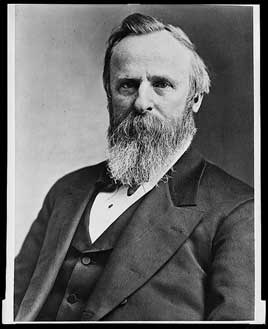
Rutherford B. Hayes
Won the disputed 1876 election by one electoral vote after a special commission gave him all 20 contested votes. He then withdrew the last federal troops from the South, ending Reconstruction. He used federal troops against the Great Railroad Strike of 1877, returned the dollar to gold in 1879, pushed civil service reform, and vetoed a bill to bar Chinese immigrants.
The economy, first day to last
Shaded areas show the years in office, with a few years before and after for comparison. Budget years ran July to June until 1976 (now October to September), so each year's figures cover parts of two calendar years.
National debt
June 30, 1876 (end of fiscal 1876): $2.18 billion → June 30, 1880 (end of fiscal 1880): $2.12 billion
Daily debt figures don't exist before 1993, so Hayes's numbers use the fiscal years closest to his term, the same rule as every other page.
Debt compared with the economy
Debt as a share of GDP. Above 100% means the debt is bigger than a year of everything the country produces.
Deficits and surpluses
Money borrowed each budget year (below the line) or paid down (above). The White House budget office's yearly figures begin in 1901.
Unemployment
No national estimates before 1890. Economist Stanley Lebergott's yearly estimates, the earliest national series, begin in 1890
Inflation
How much prices rose each year (consumer price index).
Cost of living
What everyday prices and paychecks did while in office.
Prices use the consumer price index (MeasuringWorth). The minimum wage is the federal rate set by Congress.
Executive orders
92 orders. Count from the American Presidency Project.
Orders signed each year
Yearly counts aren't reliable for this era. Orders were not numbered until 1907, when the State Department numbered the ones already in its files, and many orders were never numbered at all, so only the total is shown.
Source: American Presidency Project: executive orders (full list of every order).
Notable orders
Keeping federal workers out of politicsOrderJune 22, 1877
Barred federal employees from managing political campaigns and banned political assessments on their salaries.
Federal RegisterEvery executive order we have 37Search, filter by topic or year, and open any order's full text
Incomplete: orders before 1929 were not numbered or collected consistently. This archive has 37 of the roughly 92 orders counted for this president.
- OrderMarch 16, 1877Executive Order—Establishing Zuni Pueblo Reserve
- OrderMarch 31, 1877Executive Order—Revocation of Portion of White Mountain Indian Reservation
- OrderApril 16, 1877Executive Order—Defining Duck Valley Reserve Boundaries
- OrderMay 3, 1877Executive Order—Rescinding Reservation of Lands for Mission Indians
- OrderMay 9, 1877Executive Order
- OrderMay 10, 1877Executive Order—Defining Carlin Farms Boundaries
- OrderMay 26, 1877Executive Order ["The Civil Service Order"]
- OrderJune 22, 1877Executive Order
- OrderAugust 7, 1877Executive Order
- OrderAugust 25, 1877Executive Order—Reservation of Lands in California for Indian Purposes
- OrderAugust 25, 1877Executive Order—Canceling Hot Springs Reservation
- OrderSeptember 29, 1877Executive Order—Reserving California Land for Indian Purposes
- OrderNovember 2, 1877Executive Order
- OrderDecember 31, 1877Executive Order
- OrderMay 27, 1878Executive Order
- OrderAugust 3, 1878Executive Order—Restoration of Portion of Tule River Indian Reservation to Public Domain
- OrderOctober 29, 1878Executive Order—Defining Boundaries for Navajo Indians
- OrderJanuary 10, 1879Executive Order—Expansion of Pima and Maricopa Indian Reservation
- OrderJanuary 16, 1879Executive Order—Cancelling Carlin Farms
- OrderFebruary 4, 1879Executive Order
- OrderFebruary 7, 1879Executive Order—Establishment of Ute Indian Reservation in Colorado
- OrderMarch 18, 1879Executive Order—Establishment of Otter Tail and Pillager Chippewa Reservation
- OrderApril 19, 1879Executive Order—Approving Land for Chief Moses
- OrderMay 28, 1879Executive Order
- OrderJune 14, 1879Executive Order—Expansion of Pima and Maricopa Indian Reservation
- OrderAugust 9, 1879Executive Order—Returning Sioux Land in Dakota to Public Domain
- OrderJanuary 6, 1880Executive Order—Withdrawing Navajo Territories
- OrderJanuary 17, 1880Executive Order—Revision of Agua Caliente and Santa Ysabel Indian Reservations
- OrderMarch 6, 1880Executive Order—Adding Land to Territory for Chief Moses
- OrderMay 27, 1880Executive Order
- OrderJune 8, 1880Executive Order—Establishment of Suppai (Havasupai) Reserve
- OrderJuly 13, 1880Executive Order—Restoration of Tract in Montana to Public Domain
- OrderJuly 23, 1880Executive Order—Canceling Fort Harney Military Reservation
- OrderSeptember 21, 1880Executive Order—Defining Boundaries for Jicarilla Apache Indians
- OrderNovember 23, 1880Executive Order—Withdrawal of Land for Suppai (Havasupai) Indians
- OrderFebruary 22, 1881Executive Order
- OrderMarch 2, 1881Executive Order—Reservation of Land for Mission Indians in California
Source: Executive Orders Archive, compiled from the American Presidency Project and the Federal Register. Topics are the archive's automated tags; "Revoked" and similar labels come from the Federal Register's records.
Pardons and commutations
A pardon wipes out the punishment for a federal crime; a commutation shortens a sentence but leaves the conviction. The Justice Department's published counts begin in 1900.
Granted each year
The Justice Department's published clemency counts begin in fiscal 1900, so there are no reliable yearly totals for this presidency.
Source: U.S. Dept. of Justice, clemency statistics, which lists every recipient with the crime and sentence.
Notable grants: tap to see the crime
Ezra HeywoodPardon1878
The crime: Mailing 'obscene' material under the Comstock Act: a pamphlet arguing against marriage laws (convicted 1878)
Sentence: Prison; served six months
Why it drew attention: Free-speech advocates petitioned for his release; the case was an early test of the Comstock law.
SourceInvestigations and legal record
The same checklist for every president. Tap a row for details and sources.
ImpeachedNoNo
No articles of impeachment were voted on.
Criminally chargedNoNo
Never charged.
Aides or cabinet convictedNoNo
No member of his cabinet or White House staff was convicted.
Special counselsNoNo
None were appointed. A House committee (the Potter Committee) investigated the 1876 election in 1878–79.
Misuse of DOJ, FBI or IRSNo findingNo
No official investigation found he used federal agencies against opponents.
People around the president who were charged or penalized
Controversies and scandals
What happened, what was proven, and how it ended.
The Compromise of 1877Disputed1877
A 15-member commission voted 8–7, along party lines, to give Hayes all 20 disputed electoral votes. Southern Democrats accepted the result, and Hayes withdrew federal troops from Louisiana and South Carolina.
Outcome: Reconstruction ended; within two decades Southern states had stripped most Black citizens of the vote.
SourceFraud in the 1876 countDisputed1876–1877
Republican-run election boards in Florida, Louisiana and South Carolina threw out enough votes to give Hayes those states; Democrats had used violence to keep Black Republicans from voting.
Outcome: A House investigation in 1878–79 found wrongdoing on both sides, including coded telegrams from Tilden allies offering bribes.
SourceTroops against the railroad strikeDisputedJuly 1877
After wage cuts set off the first nationwide strike, Hayes sent federal troops at governors' requests. About 100 people were killed in clashes across the country.
Outcome: The strike collapsed within weeks.
SourceIn their own words
Widely quoted remarks, with the context they were said in.
He serves his party best who serves his country best.
The strikers have been put down by force; but now for the real remedy.