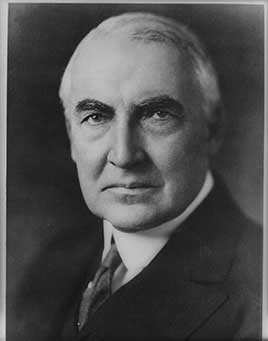
Warren G. Harding
This presidency falls in the realignment era (1896–1932), when the two parties were trading positions and both had progressive and conservative wings.
Won the 1920 election in a landslide promising a 'return to normalcy' after World War I. He signed the law creating the federal budget process, cut taxes and spending, hosted the Washington Naval Conference that limited warships, and freed the Socialist Eugene Debs from prison. His administration was one of the most corrupt in U.S. history; most of the scandals, including Teapot Dome, came out after he died of a heart attack in 1923.
The economy, first day to last
Shaded areas show the years in office, with a few years before and after for comparison. Budget years ran July to June until 1976 (now October to September), so each year's figures cover parts of two calendar years.
National debt
June 30, 1920 (end of fiscal 1920): $25.95 billion → June 30, 1923 (end of fiscal 1923): $22.35 billion
Daily debt figures don't exist before 1993, so Harding's numbers use the fiscal years closest to his term, the same rule as every other page.
Debt compared with the economy
Debt as a share of GDP. Above 100% means the debt is bigger than a year of everything the country produces.
Deficits and surpluses
Money borrowed each budget year (below the line) or paid down (above).
Unemployment
1921: 11.9% → 1923: 3.2%. Yearly averages; monthly figures begin in 1948. Estimates by economist Stanley Lebergott (NBER, 1957).
Inflation
How much prices rose each year (consumer price index).
Cost of living
What everyday prices and paychecks did while in office.
Prices use the consumer price index (MeasuringWorth). The minimum wage is the federal rate set by Congress.
Executive orders
522 orders. Count from the American Presidency Project.
Orders signed each year
Yearly counts aren't reliable for this era. Orders were not numbered until 1907, when the State Department numbered the ones already in its files, and many orders were never numbered at all, so only the total is shown.
Source: American Presidency Project: executive orders (full list of every order).
Notable orders
Handing naval oil reserves to InteriorEO 3474May 31, 1921
Moved control of the Navy's oil reserves, including Teapot Dome in Wyoming, to Interior Secretary Albert Fall, who then leased them to oil men who had paid him.
Federal RegisterEvery executive order we have 27Search, filter by topic or year, and open any order's full text
Incomplete: orders before 1929 were not numbered or collected consistently. This archive has 27 of the roughly 522 orders counted for this president.
- EO 3439April 21, 1921Record of War Agencies Transferred
- EO 3452May 3, 1921Chuckekanzie
- EO 3455May 10, 1921Civil Service in Postmaster Appointments
- EO 3457May 12, 1921Temporary Stop-Overs at Ports of the United States Without Visaed Passports
- EO 3464May 17, 1921Uintah Indian Reservation, Utah
- EO 3466May 19, 1921Death of Chief Justice White
- EO 3474May 31, 1921Transferring Naval Petroleum Reserves in California and Wyoming, and Naval Shale Reserves in Colorado and Utah, Under the Control of the Interior Secretary, Under Supervision of the President
- EO 3489June 10, 1921Alaskan Railroad Townsite Regulations
- EO 3524July 28, 1921Advisory Authority of Fine Arts Commission
- EO 3550September 21, 1921The Budget
- EO 3560October 14, 1921World War Veterans' Preference in Civil Service Examinations
- EO 3577November 8, 1921Manner of Dating Proclamations, Commissions, and Similar Executive Documents
- EO 3578November 8, 1921Preparation and Submission of the Budget
- EO 3594December 19, 1921Transfer of Certain Historical Papers From the Department of State to the Library of Congress
- EO 3601December 24, 1921Relief for Russia
- EO 3623January 24, 1922Relief for Russia
- EO 3637February 16, 1922Zia Pubelo, New Mexico
- EO 3657March 31, 1922Removing and Replacing Certain Officers of the Bureau of Engraving and Printing
- EO 3714August 1, 1922Civil Service Preference to War Veterans
- EO 3721August 9, 1922Interdepartmental Patents Board
- EO 3744October 4, 1922Fort Apache, Arizona
- EO 3759December 1, 1922Navajo Indian Reservation, Arizona
- EO 3773January 12, 1923Federal Council of Citizenship Training
- EO 3788February 14, 1923Reinstatement of Dismissed Employees
- EO 3844May 16, 1923Powers of Alien Property Custodian
- EO 3861June 8, 1923Secretary of Interior to Operate Alaskan Railroad
- EO 3871June 19, 1923Secretary of Navy to Enforce Prohibition in Virgin Islands
Source: Executive Orders Archive, compiled from the American Presidency Project and the Federal Register. Topics are the archive's automated tags; "Revoked" and similar labels come from the Federal Register's records.
Pardons and commutations
A pardon wipes out the punishment for a federal crime; a commutation shortens a sentence but leaves the conviction. Counts are by federal fiscal year (July to June). The Justice Department counts fiscal 1921, including Harding's first four months, under Wilson.
Granted each year
Source: U.S. Dept. of Justice, clemency statistics, which lists every recipient with the crime and sentence.
Notable grants: tap to see the crime
Eugene V. DebsCommutationDecember 23, 1921
The crime: A speech urging resistance to the World War I draft (Espionage Act, convicted 1918)
Sentence: Ten years; served about two and a half
Why it drew attention: The Socialist Party leader had won about 900,000 votes for president in 1920 while in prison. Wilson had refused to release him; Harding freed him at Christmas and received him at the White House.
SourceInvestigations and legal record
The same checklist for every president. Tap a row for details and sources.
ImpeachedNoNo
No articles of impeachment were voted on. He died before most of the scandals came out.
Criminally chargedNoNo
Never charged.
Aides or cabinet convictedYes — including a cabinet secretaryYes
Interior Secretary Albert Fall became the first cabinet member sent to prison. Veterans Bureau director Charles Forbes and Alien Property Custodian Thomas Miller were also convicted.
SourceSpecial counselsYes — after his deathYes
Coolidge appointed two special counsels in 1924 to prosecute the Teapot Dome cases.
SourceMisuse of DOJ, FBI or IRSYes — documentedYes
A 1924 Senate investigation found Attorney General Harry Daugherty's Justice Department and Bureau of Investigation spied on senators investigating the scandals. Senator Burton Wheeler was indicted on charges a jury later rejected.
SourcePeople around the president who were charged or penalized
Controversies and scandals
What happened, what was proven, and how it ended.
Teapot DomeProven1921–1924
Interior Secretary Albert Fall leased federal oil reserves in Wyoming and California to Harry Sinclair and Edward Doheny without competitive bidding after they gave him about $400,000.
Outcome: Fall was convicted of bribery; the Supreme Court canceled the leases in 1927; Sinclair went to prison for contempt and jury tampering; Doheny was acquitted.
SourceFraud at the Veterans BureauProven1921–1923
Director Charles Forbes took kickbacks on hospital construction and sold off medical supplies meant for wounded veterans at a fraction of their value.
Outcome: Forbes was convicted in 1925.
SourceThe 'Ohio Gang' at the Justice DepartmentCharged1921–1923
Attorney General Harry Daugherty and his associate Jess Smith were accused of selling favors, including liquor permits and protection from prosecution. Smith died by suicide in 1923.
Outcome: Daugherty was tried twice; both juries deadlocked.
SourceHidden affairsProven1905–1923
Harding had long affairs with Carrie Phillips, whom the Republican Party paid to stay quiet during the 1920 campaign, and with Nan Britton, who said he fathered her daughter.
Outcome: DNA testing confirmed Harding was the father in 2015.
SourceIn their own words
Widely quoted remarks, with the context they were said in.
America's present need is not heroics, but healing; not nostrums, but normalcy.
My God, this is a hell of a job! I have no trouble with my enemies ... But my damned friends, my God-damned friends ... they're the ones that keep me walking the floor nights!