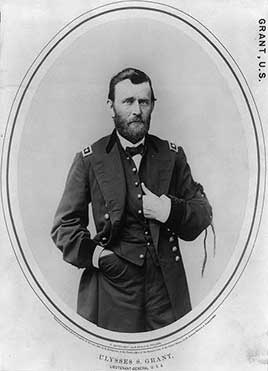
Ulysses S. Grant
The general who won the Civil War. As president he enforced Reconstruction, created the Justice Department, and used it and federal troops to break up the Ku Klux Klan. He signed laws committing the country to pay its war debts in gold, vetoed a bill to print more paper money after the Panic of 1873, created Yellowstone, the first national park, and settled war claims with Britain. His administration was rocked by corruption scandals among the people around him.
The economy, first day to last
Shaded areas show the years in office, with a few years before and after for comparison. Budget years ran July to June until 1976 (now October to September), so each year's figures cover parts of two calendar years.
National debt
June 30, 1868 (end of fiscal 1868): $2.61 billion → June 30, 1876 (end of fiscal 1876): $2.18 billion
Daily debt figures don't exist before 1993, so Grant's numbers use the fiscal years closest to his term, the same rule as every other page.
Debt compared with the economy
Debt as a share of GDP. Above 100% means the debt is bigger than a year of everything the country produces.
Deficits and surpluses
Money borrowed each budget year (below the line) or paid down (above). The White House budget office's yearly figures begin in 1901.
Unemployment
No national estimates before 1890. Economist Stanley Lebergott's yearly estimates, the earliest national series, begin in 1890
Inflation
How much prices rose each year (consumer price index).
Cost of living
What everyday prices and paychecks did while in office.
Prices use the consumer price index (MeasuringWorth). The minimum wage is the federal rate set by Congress.
Executive orders
217 orders. Count from the American Presidency Project.
Orders signed each year
Yearly counts aren't reliable for this era. Orders were not numbered until 1907, when the State Department numbered the ones already in its files, and many orders were never numbered at all, so only the total is shown.
Source: American Presidency Project: executive orders (full list of every order).
Notable orders
Most orders in this era were routine, such as setting aside public land or exempting jobs from civil service rules.
Every executive order we have 112Search, filter by topic or year, and open any order's full text
Incomplete: orders before 1929 were not numbered or collected consistently. This archive has 112 of the roughly 217 orders counted for this president.
- OrderMarch 5, 1869Executive Order
- OrderMarch 8, 1869Executive Order
- OrderMarch 9, 1869Executive Order
- OrderMarch 16, 1869Executive Order
- OrderMarch 26, 1869Executive Order
- OrderMarch 31, 1869Executive Order
- OrderJune 3, 1869Executive Order
- OrderAugust 31, 1869Executive Order—Approving Secretary of Interior for Santee Sioux Changes
- OrderSeptember 7, 1869Executive Order
- OrderOctober 9, 1869Executive Order [on the death of Franklin Pierce]
- OrderOctober 9, 1869Executive Order
- OrderOctober 19, 1869Executive Order
- OrderDecember 24, 1869Executive Order
- OrderDecember 24, 1869Executive Order
- OrderJanuary 4, 1870Executive Order
- OrderJanuary 29, 1870Executive Order
- OrderJanuary 31, 1870Executive Order—Establishing Mission Indian Reserves in California
- OrderFebruary 26, 1870Executive Order
- OrderMarch 31, 1870Executive Order
- OrderApril 12, 1870Executive Order—Approving Secretary Letter on Arickaree, Gross Ventre, and Mandan Indians
- OrderMarch 14, 1871Executive Order—Approving Interior Request of Oregon Land
- OrderMarch 31, 1871Executive Order
- OrderNovember 14, 1871Executive Order—Evaluation and Indian Relocation of Bitter Root Valley Reserve
- OrderApril 16, 1872Executive Order
- OrderMay 27, 1872Executive Order
- OrderSeptember 12, 1872Executive Order—Approving Lands for Snake or Piute Indians
- OrderOctober 11, 1872Executive Order
- OrderOctober 26, 1872Executive Order—Drawing Boundaries for Makah Indians
- OrderDecember 14, 1872Executive Order—Establishment and Modification of Apache and White Mountain Indian Reservations in Arizona
- OrderJanuary 2, 1873Executive Order—Adding Land to Makah Reserve
- OrderJanuary 9, 1873Executive Order—Establishment of Yuma Indian Reservation in California
- OrderJanuary 17, 1873Executive Order
- OrderJanuary 28, 1873Executive Order
- OrderMarch 12, 1873Executive Order—Establishment of Moapa River Reservation
- OrderMarch 14, 1873Executive Order
- OrderApril 8, 1873Executive Order—Withdrawal of Lands from Sale on Round Valley Indian Reservation in California
- OrderMay 9, 1873Executive Order
- OrderMay 21, 1873Executive Order
- OrderMay 29, 1873Executive Order—Fort Stanton Indian Reserve
- OrderJuly 5, 1873Executive Order—Establishing Blackfeet Reserve in Montana
- OrderAugust 5, 1873Executive Order—Restoring Land in Arizona to Public Domain
- OrderAugust 5, 1873Executive Order
- OrderSeptember 6, 1873Executive Order—Approving Interior Request to Expand the Puyallup Reservation
- OrderSeptember 9, 1873Executive Order—Defining Northern Boundary Of Swinomish Reservation
- OrderOctober 3, 1873Executive Order—Establishing Tule River Indian Reservation in California
- OrderOctober 10, 1873Executive Order
- OrderOctober 29, 1873Executive Order—Establishment of Winnebagoshish Reserve in Minnesota
- OrderNovember 4, 1873Executive Order—Defining Quinaielt Reserve Boundaries
- OrderNovember 4, 1873Executive Order—Amendment and Reservation of Land for Leech Lake Bands of Chippewa
- OrderNovember 8, 1873Executive Order—Establishment of Coeur d’Alene Indian Reservation in Idaho
- OrderNovember 22, 1873Executive Order—Expanding the Colorado River Reservation
- OrderNovember 22, 1873Executive Order—Establishing Land for Dwamish Tribe
- OrderDecember 23, 1873Executive Order—Defining Boundaries for Tulalip Indian Reservation
- OrderDecember 31, 1873Executive Order—Expanding Santee Sioux Land
- OrderJanuary 23, 1874Executive Order
- OrderJanuary 31, 1874Executive Order—Establishing the Judith Basin Reserve for the Crow Tribe
- OrderFebruary 4, 1874Executive Order—Nullifying Reservation of Lands in Michigan
- OrderFebruary 12, 1874Executive Order—Establishment of Pah-Ute Reservation
- OrderFebruary 25, 1874Executive Order—Defining Land for Skokomish Reserve
- OrderMarch 9, 1874Executive Order [on the death of Millard Fillmore]
- OrderMarch 19, 1874Executive Order— Establishment of Walker River Indian Reservation
- OrderMarch 23, 1874Executive Order— Establishment of Pyramid Lake Indian Reservation
- OrderMarch 25, 1874Executive Order—Jicarilla Apache Indian Reservation Withdrawn
- OrderApril 9, 1874Executive Order—Hot Springs Reserve Boundaries
- OrderApril 9, 1874Executive Order—Approving Territory for Muckleshoot Reservation
- OrderMay 26, 1874Executive Order—Reserving Land for Pillager and Lake Winnebagoshish Bands
- OrderMay 27, 1874Executive Order
- OrderMay 29, 1874Executive Order
- OrderJune 21, 1874Executive Order—Restoring Portion of White Mountain Indian Reservation to Public Domain
- OrderJuly 1, 1874Executive Order—Establishing Papago Indian Reserve
- OrderAugust 19, 1874Executive Order—Restoring Tract of Land in Montana Territory to Public Domain
- OrderAugust 31, 1874Executive Order
- OrderNovember 16, 1874Executive Order—Expanding Reservation for Indians of the Colorado River and its Tributaries
- OrderNovember 24, 1874Executive Order—Returning Tulerosa Indian Land to Public Domain
- OrderFebruary 12, 1875Executive Order—Establishing Lemhi Valley Indian Reservation
- OrderMarch 9, 1875Executive Order
- OrderMarch 9, 1875Executive Order
- OrderMarch 16, 1875Executive Order—Adding Territory for Sioux Indians
- OrderMarch 25, 1875Executive Order—Cancelling Reservation for Crow Indians
- OrderMarch 25, 1875Executive Order
- OrderApril 13, 1875Executive Order—Expanding Reservation for Various Native American Tribes
- OrderMay 15, 1875Executive Order—Adding to the Malheur Indian Reservation
- OrderMay 18, 1875Executive Order—Establishing Boundaries for Round Valley Indian Reservation
- OrderMay 24, 1875Executive Order
- OrderJuly 3, 1875Executive Order
- OrderJuly 27, 1875Executive Order
- OrderAugust 2, 1875Executive Order [on death of Andrew Johnson]
- OrderAugust 2, 1875Executive Order
- OrderAugust 21, 1875Executive Order
- OrderOctober 20, 1875Executive Order—Fort Stanton Reduced Military Reservation
- OrderOctober 20, 1875Executive Order—Expanding Crow Indian Reservation Boundaries
- OrderNovember 22, 1875Executive Order—Expansion of Ute Indian Reservation Territory
- OrderNovember 22, 1875Executive Order
- OrderNovember 23, 1875Executive Order
- OrderDecember 21, 1875Executive Order—Hot Springs Reservation to Public Domain
- OrderDecember 27, 1875Executive Order—Establishment of Mission Indian Reserves in California
- OrderJanuary 28, 1876Executive Order—Restoring Malheur Indian Reservation to Public Domain
- OrderMarch 8, 1876Executive Order—Revoking Order of October 20, 1875 Establishing Crow Tribe Reservation in Montana Territory
- OrderApril 27, 1876Executive Order—Modification of White Mountain Indian Reservation Boundary in Arizona Territory
- OrderMay 15, 1876Executive Order—Reaffirmation of Boundaries for the Colorado River Indian Reservation
- OrderMay 20, 1876Executive Order
- OrderJune 23, 1876Executive Order—Establishment of Hoopa Valley Indian Reservation Boundaries
- OrderJune 23, 1876Executive Order—Creating the Hoopa Valley Indian Reservation
- OrderJuly 18, 1876Executive Order—Canceling Jicarilla Apache Reserve
- OrderJuly 26, 1876Executive Order—Revocation of Camp Wright Military Reservation
- OrderAugust 10, 1876Executive Order
- OrderAugust 17, 1876Executive Order—Revocation of Uncompahgre Park Portion
- OrderAugust 31, 1876Executive Order—Pima and Maricopa or Gila River Reserve
- OrderOctober 30, 1876Executive Order—Revocation of Chiricahua Reserve
- OrderNovember 23, 1876Executive Order
- OrderNovember 28, 1876Executive Order—Additional Territory for Sioux Indians
- OrderJanuary 26, 1877Executive Order—Revocation of Portion of White Mountain Indian Reservation
Source: Executive Orders Archive, compiled from the American Presidency Project and the Federal Register. Topics are the archive's automated tags; "Revoked" and similar labels come from the Federal Register's records.
Pardons and commutations
A pardon wipes out the punishment for a federal crime; a commutation shortens a sentence but leaves the conviction. The Justice Department's published counts begin in 1900.
Granted each year
The Justice Department's published clemency counts begin in fiscal 1900, so there are no reliable yearly totals for this presidency.
Source: U.S. Dept. of Justice, clemency statistics, which lists every recipient with the crime and sentence.
Notable grants: tap to see the crime
John McDonaldPardonJanuary 26, 1877
The crime: Leading the Whiskey Ring, which stole millions in federal liquor taxes (convicted 1875)
Sentence: 18 months and a $5,000 fine
Why it drew attention: McDonald was the Grant-appointed tax supervisor in St. Louis at the center of the biggest scandal of Grant's presidency. Grant pardoned him five weeks before leaving office.
SourceInvestigations and legal record
The same checklist for every president. Tap a row for details and sources.
ImpeachedNoNo
No articles of impeachment were voted on.
Criminally chargedNo — one speeding stopNo
Never charged with a crime. A Washington police officer stopped him in 1872 for racing his horse carriage, and he paid a $20 penalty.
Aides or cabinet convictedYes — officials; cabinet member impeachedYes
More than 100 people were convicted in the Whiskey Ring, including Treasury tax official John McDonald. War Secretary William Belknap was impeached by the House. Grant's private secretary, Orville Babcock, was indicted and acquitted.
SourceSpecial counselsYes — one, firedYes
Grant appointed John Henderson as special prosecutor for the Whiskey Ring in 1875, then fired him after Henderson criticized Grant in court over Babcock.
SourceMisuse of DOJ, FBI or IRSNo findingNo
No official investigation found he used federal agencies against opponents. His Justice Department's use of force against the Klan was authorized by Congress.
People around the president who were charged or penalized
Controversies and scandals
What happened, what was proven, and how it ended.
The Whiskey RingProven1871–1875
Distillers and Treasury officials, mostly in St. Louis, conspired to skim millions of dollars in liquor taxes.
Outcome: More than 100 convictions. Grant's secretary was acquitted after Grant testified for him, and Grant pardoned the ring's leader.
SourceThe Belknap briberyCharged1870–1876
The secretary of war and his wives received about $20,000 from a man who held a lucrative Army trading post.
Outcome: Impeached unanimously by the House; acquitted by the Senate.
SourceBlack FridayProvenSeptember 1869
Financiers Jay Gould and Jim Fisk tried to corner the gold market, using Grant's brother-in-law to get inside information. When Grant ordered the Treasury to sell gold, the price collapsed and many investors were ruined.
Outcome: A congressional investigation in 1870 cleared Grant of wrongdoing.
SourceCrédit MobilierProvenRevealed 1872
A railroad construction company had given its stock to members of Congress, including Grant's vice president, Schuyler Colfax, while they oversaw its government funding.
Outcome: The House censured two congressmen; Colfax was dropped from the 1872 ticket.
SourceSlaveholdingProven1859
Grant owned one enslaved man, William Jones, whom he acquired from his father-in-law. His wife's family's enslaved servants also worked for the household before the war.
Outcome: Grant freed Jones in 1859 rather than sell him, though he was deeply in debt at the time.
SourceGeneral Order No. 11ProvenDecember 1862
Before his presidency, as a Union general, Grant ordered all Jews expelled from his military district.
Outcome: Lincoln revoked it within weeks. Grant later called it wrong, and as president appointed more Jewish officials than any predecessor.
SourceIn their own words
Widely quoted remarks, with the context they were said in.
Let us have peace.
Let no guilty man escape.
Failures have been errors of judgment, not of intent.