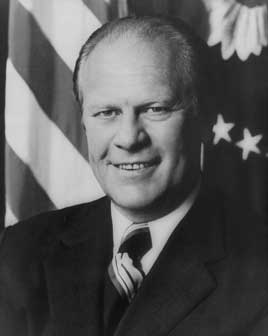
Gerald Ford
The only president never elected president or vice president. He took office when Nixon resigned, pardoned him a month later, and governed through high inflation, the deep 1974–75 recession, the fall of Saigon and two attempts on his life. He lost narrowly to Jimmy Carter in 1976.
The economy, first day to last
Shaded areas show the years in office, with a few years before and after for comparison. Budget years ran July to June until 1976 (now October to September), so each year's figures cover parts of two calendar years.
National debt
June 30, 1974 (end of fiscal 1974): $475.06 billion → June 30, 1976 (end of fiscal 1976): $620.43 billion
Daily debt figures don't exist before 1993, so Ford's numbers use the fiscal years closest to his term.
Debt compared with the economy
Debt as a share of GDP. Above 100% means the debt is bigger than a year of everything the country produces.
Deficits and surpluses
Money borrowed each budget year (below the line) or paid down (above).
Unemployment
Aug 1974: 5.5% → Jan 1977: 7.5%. Monthly rates; the chart shows yearly averages.
Inflation
How much prices rose each year (consumer price index).
Cost of living
What everyday prices and paychecks did while in office.
Prices use the consumer price index (MeasuringWorth). The minimum wage is the federal rate set by Congress.
Executive orders
169 orders, numbered 11798–11966. The split between 1974 and 1975 may be off by one order.
Orders signed each year
Source: National Archives: Ford executive orders (full list of every order).
Notable orders
Presidential Clemency BoardEO 11803September 16, 1974
Set up a board to review cases of draft evaders and deserters who agreed to do alternative service.
Federal RegisterRockefeller Commission on the CIAEO 11828January 4, 1975
Created a commission to investigate illegal CIA spying on Americans, after press reports.
Federal RegisterScreening foreign investment (CFIUS)EO 11858May 7, 1975
Created the committee that reviews foreign purchases of U.S. companies for national security risks.
Federal RegisterRules for intelligence agenciesEO 11905February 18, 1976
The first presidential ban on political assassination by U.S. government employees, after revelations of plots against foreign leaders.
Federal RegisterEvery executive order 169Search, filter by topic or year, and open any order's full text
- EO 11798August 14, 1974Revoking Executive Order No. 11796 of July 30, 1974, and Continuing in Effect Executive Order No. 11533 of June 4, 1970, Relating to the Administration of Export Controls
- EO 11799August 17, 1974Amending Executive Order No. 11554 as it Relates to the Establishment of a Maximum Percentage of Navy and Marine Corps Officers Who May be Recommended for Promotion from Below the Appropriate Promotion Zone
- EO 11800August 17, 1974Delegating Certain Authority Vested in the President by the Aviation Career Incentive Act of 1974Revoked
- EO 11801August 21, 1974The Honorable Rodger P. Davies
- EO 11802September 4, 1974General Creighton W. Abrams, Chief of Staff, United States Army
- EO 11803September 16, 1974Establishing a Clemency Board to Review Certain Convictions of Persons Under Section 12 or 6 (j) of the Military Selective Service Act and Certain Discharges Issued Because of, and Certain Convictions for, Violations of Article 85, 86, or 87 of the Uniform Code of Military Justice and to Make Recommendations for Executive Clemency with Respect Thereto
- EO 11804September 16, 1974Delegation of Certain Functions Vested in the President to the Director of Selective Service
- EO 11805September 20, 1974Inspection by President and Certain Designated Employees of the White House Office of Tax Returns Made Under the Internal Revenue Code of 1954
- EO 11806September 25, 1974Amending Executive Order No. 11763 of January 17, 1974, to Extend the Life of the National Commission for the Observance of World Population Year
- EO 11807September 28, 1974Occupational Safety and Health Programs for Federal Employees
- EO 11808September 30, 1974Establishing the President's Economic Policy Board, and for Other Purposes
- EO 11809September 30, 1974Establishing the President's Labor-Management Committee
- EO 11810September 30, 1974Continuing the Regulation of Exports
- EO 11811October 7, 1974Adjusting Rates of Pay for Certain Statutory Pay Systems
- EO 11812October 7, 1974Adjusting the Rates of Basic Pay, Basic Allowance for Subsistence and Basic Allowance for Quarters for Members of the Uniformed Services
- EO 11813October 7, 1974Permitting Cooperative Education Students to be Given Career or Career-Conditional Appointments
- EO 11814October 11, 1974Activation of the Energy Resources Council
- EO 11815October 23, 1974Delegating to the National Capital Planning Commission the Function of Establishing the Metes and Bounds of the National Capital Service Area
- EO 11816October 23, 1974Delegation of Certain Reporting Functions Under the Foreign Assistance Act to the Secretary of the Treasury
- EO 11817November 5, 1974Delegating the United States Civil Service Commission as the Agent to Concur With Agency Determinations Fixing the Age Limits Within Which Original Appointments May be Made With Respect to Law Enforcement Officer and Firefighters Positions
- EO 11818November 5, 1974Revoking Executive Order No. 11810 of September 30, 1974, and Continuing in Effect Executive Order No. 11533 of June 4, 1970, Relating to the Administration of Export Control
- EO 11819November 16, 1974Membership of the Energy Resources Council
- EO 11820November 27, 1974International Council on Archives-Bicentennial Year Meeting
- EO 11821November 27, 1974Inflation Impact Statements
- EO 11822December 10, 1974Designation of Certain Officers To Act as Secretary of the TreasuryRevoked
- EO 11823December 12, 1974Abolishing the National Commission for Industrial Peace
- EO 11824December 28, 1974Exemption of Whitney Gillilland From Mandatory Retirement
- EO 11825December 31, 1974Revocation of Executive Orders Pertaining to the Regulation of the Acquisition of, Holding of, or Other Transactions in Gold
- EO 11826December 31, 1974Exemption of Willard Deason From Mandatory Retirement
- EO 11827January 4, 1975Continuance of Certain Federal Advisory Committees
- EO 11828January 4, 1975Establishing a Commission on CIA Activities Within the United States
- EO 11829January 6, 1975The Hopi-Navajo Land Settlement Interagency Committee
- EO 11830January 9, 1975Enlarging the Membership of the Interagency Committee on Handicapped Employees
- EO 11831January 9, 1975Amending Executive Order No. 11768, Placing Certain Positions in Levels IV and V of the Executive Schedule
- EO 11832January 9, 1975Establishing a National Commission on the Observance of International Women's Year, 1975
- EO 11833January 13, 1975Withholding of City Income or Employment Taxes by Federal Agencies
- EO 11834January 15, 1975Activation of the Energy Research and Development Administration and the Nuclear Regulatory Commission
- EO 11835January 27, 1975Prescribing Amendments to the Manual for Courts-Martial, United States, 1969 (Revised Edition)
- EO 11836January 27, 1975Increasing the Effectiveness of the Transportation Cargo Security Program
- EO 11837January 30, 1975Amending Executive Order No. 11803 of September 16, 1974, to Extend the Period for Application for Clemency Board Review of Certain Convictions and Military Service Discharges
- EO 11838February 6, 1975Amending Executive Order No. 11491, as Amended by Executive Orders 11616 and 11636, Relating to Labor-Management Relations in the Federal Service
- EO 11839February 15, 1975Amending the Civil Service Rules to Except Certain Positions in Regional Offices from the Career Service
- EO 11840February 18, 1975Waiver of Certain Provisions of Law and Limitations of Authority
- EO 11841February 28, 1975Amending Executive Order No. 10973, Relating to Administration of Foreign Assistance and Related Functions, to Provide for a Development Coordination Committee
- EO 11842February 28, 1975Amending Executive Order Nos. 11803 and 11837 to Further Extend the Period for Application for Clemency Board Review of Certain Convictions and Military Service Discharges
- EO 11843March 18, 1975Amending Executive Order No. 11768, Placing Certain Positions in Levels IV and V of the Executive Schedule
- EO 11844March 24, 1975Designation of Beneficiary Developing Countries for the Generalized System of Preferences Under the Trade Act of 1974
- EO 11845March 24, 1975Delegating Certain Reporting Functions to the Director of the Office of Management and Budget
- EO 11846March 27, 1975Administration of the Trade Agreements ProgramAmended
- EO 11847March 28, 1975Exemption of Walter C. Sauer From Mandatory Retirement
- EO 11848March 29, 1975Extending the Reporting Date for the Commission on CIA Activities Within the United States
- EO 11849April 1, 1975Establishing the Collective Bargaining Committee in Construction
- EO 11850April 8, 1975Renunciation of Certain Uses in War of Chemical Herbicides and Riot Control Agents
- EO 11851April 10, 1975Delegation of Authority to Issue Regulations Limiting Imports of Certain Cheeses
- EO 11852April 16, 1975Creating an Emergency Board to Investigate a Dispute Between the Carriers Represented by the National Railway Labor Conference and Certain of Their Employees
- EO 11853April 17, 1975Amending Executive Order No. 11829, Relating to the Hopi-Navajo Land Settlement Interagency Committee
- EO 11854April 24, 1975Waiver Under the Trade Act of 1974 With Respect to the Socialist Republic of Romania
- EO 11855May 1, 1975Membership of the Energy Resources Council
- EO 11856May 7, 1975Amending the Civil Service Rules to Except Certain Positions From the Career Service
- EO 11857May 7, 1975Amending Executive Order Nos. 11803, 11837, and 11842 to Provide Authority to Increase the Number of Members of the Presidential Clemency Board
- EO 11858May 7, 1975Foreign Investment in the United StatesAmended
- EO 11859May 7, 1975Inspection of Income, Estate, and Gift Tax Returns by the Senate Committee on Government Operations
- EO 11860May 19, 1975Establishing the President's Advisory Committee on Refugees
- EO 11861May 21, 1975Placing Certain Positions in Levels IV and V of the Executive Schedule
- EO 11862June 11, 1975Amending Executive Order No. 11652 Relating to Classification and Declassification of National Security Information and Material
- EO 11863June 12, 1975Withholding of City Income or Employment Taxes by Federal Agencies
- EO 11864June 13, 1975Amending Executive Order No. 11861, Placing Certain Positions in Levels IV and V of the Executive Schedule
- EO 11865June 16, 1975Amending Executive Order No. 11808 of September 30, 1974 to Increase the Membership of the Executive Committee of the Economic Policy Board
- EO 11866June 18, 1975Designating the World Intellectual Property Organization (WIPO) as a Public International Organization Entitled to Enjoy Certain Privilages, Exemptions, and Immunities
- EO 11867June 19, 1975Delegating to the Administrator of General Services Authority to Issue Joint Funding Regulations
- EO 11868June 19, 1975President's Commission on Olympic Sports
- EO 11869June 24, 1975Exemption of Arthur S. Fleming From Mandatory Retirement
- EO 11870July 18, 1975Environmental Safeguards on Activities for Animal Damage Control on Federal Lands
- EO 11871July 18, 1975Transferring the SCORE and ACE Programs from the ACTION Agency to the Small Business Administration
- EO 11872July 21, 1975Amending Executive Order No. 11861, Placing Certain Positions in Levels IV and V of the Executive Schedule
- EO 11873July 21, 1975Amending Executive Order No. 11868, on the President's Commission on Olympic Sports
- EO 11874July 25, 1975Delegation of Functions to the Director of the Office of Management and Budget
- EO 11875August 9, 1975Delegating Certain Functions to the Secretary of Transportation
- EO 11876September 2, 1975Creating an Emergency Board to Investigate a Dispute Between the Carriers Represented by the National Railway Labor Conference and Certain of Their Employees
- EO 11877September 2, 1975Amending Executive Order No. 11861, as Amended, Placing Certain Positions in Levels IV and V of the Executive Schedule
- EO 11878September 10, 1975Assigning Responsibilities Relating to Activities of the Presidential Clemency Board
- EO 11879September 17, 1975Delegating to the Secretary of Commerce Functions Relating to Orders for the Provision of Chemicals or Substances Necessary for Treatment of Water
- EO 11880October 2, 1975Designation of Officers of the Department of Commerce to Act as Secretary of CommerceRevoked
- EO 11881October 3, 1975Delegation of Authority to Issue Regulations With Respect to Section 459 of the Social Security Act
- EO 11882October 6, 1975Membership of Energy Research and Development Administration on Established River Basin Commissions
- EO 11883October 6, 1975Adjustments of Certain Rates of Pay and Allowances
- EO 11884October 7, 1975Prescribing the Official Coat of Arms, Seal, and Flag of the Vice President of the United States
- EO 11885October 15, 1975Amending Executive Order No. 11861, as Amended, Placing Certain Positions in Levels IV and V of the Executive Schedule
- EO 11886October 17, 1975Abolishing the Culebra Island Naval Defensice Sea Area Established by Executive Order No. 8684
- EO 11887November 4, 1975Amending the Civil Service Rules to Except Certain Positions from the Career Service
- EO 11888November 24, 1975Implementing the Generalized System of Preferences
- EO 11889November 25, 1975Amending Executive Order No. 11832 of January 9, 1975, to Extend the Existence of the National Commission On the Observance of International Women's Year, 1975
- EO 11890December 10, 1975Amending Executive Order No. 10422, as Amended, Prescribing Procedures for Making Available to the Secretary General of the United Nations Certain Information Concerning United States Citizens Employed or Being Considered for Employment on the Secretariat of the United Nations
- EO 11891December 15, 1975Providing for the Closing of Government Departments and Agencies on Friday, December 26, 1975
- EO 11892December 31, 1975Amending Executive Order No. 11746 Relating to Federal Regional Councils
- EO 11893December 31, 1975Transferring Certain Functions From the General Services Administration to the Office of Management and Budget
- EO 11894January 3, 1976Adding to the Membership of the East-West Foreign Trade Board
- EO 11895January 6, 1976Delegating Authority of the President to Designate Individuals Appointed by the President to Receive Training
- EO 11896January 13, 1976Establishing the United States Sinai Support Mission
- EO 11897January 13, 1976Amending Executive Order No. 11157 as It Relates to Special Pay While on Sea Duty or Duty at Certain Places
- EO 11898January 14, 1976Amending Executive Order No. 11861, as Amended, Placing Certain Positions in Levels IV and V of the Executive Schedule
- EO 11899January 22, 1976Providing for the Protection of Certain Civil Service Employment Rights of Federal Personnel Who Leave Federal Employment to be Employed by Tribal Organizations Pursuant to the Indian Self-Determination and Education Assistance Act
- EO 11900January 22, 1976Inspection of Income, Estate and Gift Tax Returns by the Committee on Government Operations, House of Representatives
- EO 11901January 30, 1976Amending Executive Order No. 11491, as Amended by Executive Orders 11616, 11636, and 11838, Relating to Labor-Management Relations in the Federal Service
- EO 11902February 2, 1976Procedures for an Export Licensing Policy as to Nuclear Materials and Equipment
- EO 11903February 2, 1976Membership of the Economic Policy Board
- EO 11904February 6, 1976Establishing the Defense Superior Service Medal
- EO 11905February 18, 1976United States Foreign Intelligence Activities
- EO 11906February 26, 1976Amending the Generalized System of Preferences
- EO 11907March 1, 1976Relating to the Administration of the Export Administration Act of 1969
- EO 11908March 18, 1976Amending Executive Order No. 11861 as Amended, Placing Certain Positions in Levels IV and V of the Executive Schedule
- EO 11909March 31, 1976Exemption of Walter C. Sauer From Mandatory Retirement
- EO 11910April 13, 1976Delegating-Legal Services Functions Pursuant to the Disaster Relief Act of 1974
- EO 11911April 13, 1976Preservation of Endangered Species
- EO 11912April 13, 1976Delegation of Authorities Relating to Energy Policy and ConservationPartially revoked
- EO 11913April 26, 1976Collection of Information for Import Relief and Adjustment Assistance
- EO 11914April 28, 1976Nondiscrimination With Respect to the Handicapped in Federally Assisted Programs
- EO 11915May 10, 1976Abolishing the Energy Research and Development Advisory Council
- EO 11916May 28, 1976Amending Executive Order No. 11649, Regulations Governing the Seals of the President and the Vice President of the United States
- EO 11917May 28, 1976Amending Executive Order No. 11643 of February 8, 1972, Relating to Environmental Safeguards on Activities for Animal Damage Control on Federal Lands
- EO 11918June 1, 1976Compensation for Damages Involving Nuclear Reactors of United States Warships
- EO 11919June 9, 1976Delegating Authority of the President to Concur in Designations of Commissioners, United States Parole Commission
- EO 11920June 10, 1976Establishing Executive Branch Procedures Solely for the Purpose of Facilitating Presidential Review of Decisions Submitted to the President by the Civil Aeronautics Board
- EO 11921June 11, 1976Adjusting Emergency Preparedness Assignments to Organizational and Functional Changes in Federal Departments and Agencies
- EO 11922June 16, 1976Amending Executive Order No. 11077 of January 22, 1963, Entitled "Administration of the Migration and Refugee Assistance Act of 1962"
- EO 11923June 17, 1976The Honorable Francis E. Meloy, Jr. and Robert O. Waring
- EO 11924June 29, 1976Exemption of Arthur S. Flemming From Mandatory Retirement
- EO 11925June 29, 1976Promotion of Navy and Marine Corps Officers From Below the Appropriate Promotion Zone
- EO 11926July 19, 1976The Vice Presidential Service BadgeAmended
- EO 11927July 22, 1976Amending Executive Order No. 11861, as Amended, Placing Certain Positions in Levels IV and V of the Executive Schedule
- EO 11928July 26, 1976Exemption of Harold Council From Mandatory Retirement
- EO 11929July 26, 1976Incentive Pay for Enlisted Members of the Uniformed Services Who Are Involuntarily Removed From Aerial Flight Duties
- EO 11930July 30, 1976Performance by the Federal Energy Office of Energy Functions of the Federal Energy Administration
- EO 11931August 3, 1976Extending Diplomatic Privileges and Immunities to Permanent Observers to the Organization of American States and to Members of Their Diplomatic Staffs
- EO 11932August 4, 1976Classification of Certain Information and Material Obtained From Advisory Bodies Created to Implement the International Energy Program
- EO 11933August 25, 1976Termination of the Federal Energy Office
- EO 11934August 30, 1976Amending the Generalized System of Preferences
- EO 11935September 2, 1976Citizenship Requirements for Federal Employment
- EO 11936September 8, 1976The President's Commission on Olympic Sports
- EO 11937September 10, 1976Relating to Appointments to the Quetico-Superior Committee
- EO 11938September 29, 1976Relating to Adjustment of Cost of Living Allowances and Post Differentials
- EO 11939September 30, 1976Basic Allowances for Quarters
- EO 11940September 30, 1976Continuing the Regulation of Exports
- EO 11941October 1, 1976Adjustments of Certain Rates of Pay and Allowances
- EO 11942October 22, 1976Exemption of Ashton C. Barrett From Mandatory Retirement
- EO 11943October 25, 1976Amendment of Adjustments of Certain Rates of Pay and Allowances
- EO 11944October 25, 1976Authorizing Delegation of Authority to the Secretary of the Treasury With Respect to the Northern Mariana Islands
- EO 11945October 25, 1976Physical Fitness and Sports
- EO 11946October 25, 1976White House Fellowships
- EO 11947November 8, 1976Reports and Investigations Relating to the Administration of the Trade Agreements Program
- EO 11948December 20, 1976Continuance of Certain Federal Advisory Committees
- EO 11949December 31, 1976Economic Impact Statements
- EO 11950January 6, 1977Conforming the Central Intelligence Agency and Civil Service Retirement and Disability Systems With Respect to Cost of Living Adjustments
- EO 11951January 6, 1977Relating to the Arrangement Regarding International Trade in Textiles
- EO 11952January 7, 1977Conforming the Foreign Service and Civil Service Retirement and Disability Systems
- EO 11953January 7, 1977Assigning Emergency Preparedness Functions to the Energy Research and Development Administration and Nuclear Regulatory Commission
- EO 11954January 7, 1977Federal Property Review
- EO 11955January 10, 1977Permitting Certain Qualified Employees of the National Aeronautics and Space Administration to be Given Career or Career-Conditional Appointment
- EO 11956January 13, 1977Relating to Voluntary Agreements
- EO 11957January 13, 1977Designation of Certain Officers to Act as Secretary of AgricultureRevoked
- EO 11958January 18, 1977Administration of Arms Export ControlsAmended
- EO 11959January 18, 1977Administration of Foreign Assistance and Related Functions
- EO 11960January 19, 1977Amending the Generalized System of Preferences
- EO 11961January 19, 1977Administration of the International Investment Survey Act of 1976
- EO 11962January 19, 1977Establishing the President's Advisory Board on International Investment
- EO 11963January 19, 1977Delegating Reporting Functions Under the Agricultural Trade Development and Assistance Act of 1954, as Amended
- EO 11964January 19, 1977Implementation of the Convention on the International Regulations for Preventing Collisions at Sea, 1972
- EO 11965January 19, 1977Establishing the Humanitarian Service MedalAmended
- EO 11966January 19, 1977Designating Certain Public International Organizations Entitled to Enjoy Certain Privileges, Exemptions, and Immunities
Source: Executive Orders Archive, compiled from the American Presidency Project and the Federal Register. Topics are the archive's automated tags; "Revoked" and similar labels come from the Federal Register's records.
Pardons and commutations
A pardon wipes out the punishment for a federal crime; a commutation shortens a sentence but leaves the conviction. Counts are by federal fiscal year (fiscal 1976 ran 15 months). They leave out Nixon's pardon and the roughly 14,000 draft evaders and deserters granted clemency through his Clemency Board.
Granted each year
Source: U.S. Dept. of Justice, clemency statistics, which lists every recipient with the crime and sentence.
Notable grants: tap to see the crime
Richard NixonPardonSeptember 8, 1974
The crime: Any federal crimes he committed or may have committed as president (the Watergate cover-up)
Sentence: Never charged
Why it drew attention: A month after taking office. Ford said the country needed to move on; critics suspected a deal. His approval rating fell about 20 points almost overnight.
SourceVietnam draft evaders and desertersConditional clemencySeptember 16, 1974
The crime: Evading the draft or deserting the military during the Vietnam War
Sentence: Prison or exile
Why it drew attention: Offered in exchange for up to two years of alternative service. About 22,500 of an eligible 113,000 applied.
SourceIva Toguri ('Tokyo Rose')PardonJanuary 19, 1977
The crime: Treason for making Japanese propaganda radio broadcasts in World War II (convicted 1949)
Sentence: 10 years; about six served
Why it drew attention: Later evidence showed key witnesses had been pressured to lie; she is the only American convicted of treason to be pardoned.
SourceInvestigations and legal record
The same checklist for every president. Tap a row for details and sources.
ImpeachedNoNo
No articles of impeachment were voted on.
Criminally chargedNoNo
In 1976 the Watergate special prosecutor investigated claims about Ford's campaign funds as a congressman and cleared him.
Testified to CongressYes — about the pardonPartly
On October 17, 1974 he became the first sitting president to testify before a congressional committee, telling a House panel there was no deal behind Nixon's pardon.
SourceAides or cabinet convictedNoNo
No member of his administration was convicted.
Misuse of DOJ, FBI or IRSNoNo
No official finding. His administration's commissions exposed past abuses by the CIA and FBI under earlier presidents.
People around the president who were charged or penalized
Controversies and scandals
What happened, what was proven, and how it ended.
Pardoning NixonDisputedSeptember 1974
He pardoned his predecessor for any Watergate crimes before charges were filed.
Outcome: Hugely unpopular at the time and likely cost him the 1976 election; later widely seen as an act of courage (he won the JFK Profile in Courage Award in 2001).
SourceClaims of a pardon dealAlleged1974
Critics alleged Nixon's team offered Ford the presidency in exchange for a pardon.
Outcome: Ford denied it under oath to Congress; no evidence of a deal has been found.
SourceThe Mayaguez rescueDisputedMay 1975
Marines stormed a Cambodian island to rescue the crew of a seized U.S. cargo ship; the crew had already been released.
Outcome: 41 U.S. servicemen died, more than the 39 crew members rescued.
SourceRefusing New York City a bailoutDisputedOctober 1975
He threatened to veto federal help for a nearly bankrupt New York City.
Outcome: A newspaper headline, 'Ford to City: Drop Dead', stuck to him; he later agreed to federal loans.
SourceIn their own words
Widely quoted remarks, with the context they were said in.
My fellow Americans, our long national nightmare is over.
There was no deal, period, under no circumstances.
There is no Soviet domination of Eastern Europe, and there never will be under a Ford administration.