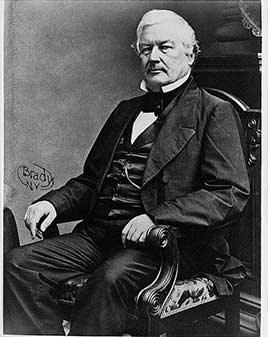
Millard Fillmore
Became president when Zachary Taylor died. Unlike Taylor, he backed Henry Clay's Compromise of 1850: California joined as a free state and the slave trade was banned in Washington, D.C., but a harsh new Fugitive Slave Act required Northerners to help return people who had escaped slavery. He sent Commodore Perry's fleet to open Japan to trade. In 1856 he ran again as the candidate of the anti-immigrant Know-Nothing party.
The economy, first day to last
Shaded areas show the years in office, with a few years before and after for comparison. Budget years ran July to June until 1976 (now October to September), so each year's figures cover parts of two calendar years.
National debt
June 30, 1850 (end of fiscal 1850): $63.45 million → June 30, 1852 (end of fiscal 1852): $66.20 million
Daily debt figures don't exist before 1993, so Fillmore's numbers use the fiscal years closest to his term, the same rule as every other page.
Debt compared with the economy
Debt as a share of GDP. Above 100% means the debt is bigger than a year of everything the country produces.
Deficits and surpluses
Money borrowed each budget year (below the line) or paid down (above). The White House budget office's yearly figures begin in 1901.
Unemployment
No national estimates before 1890. Economist Stanley Lebergott's yearly estimates, the earliest national series, begin in 1890
Inflation
How much prices rose each year (consumer price index).
Cost of living
What everyday prices and paychecks did while in office.
Prices use the consumer price index (MeasuringWorth). The minimum wage is the federal rate set by Congress.
Executive orders
12 orders. Count from the American Presidency Project.
Orders signed each year
Yearly counts aren't reliable for this era. Orders were not numbered until 1907, when the State Department numbered the ones already in its files, and many orders were never numbered at all, so only the total is shown.
Source: American Presidency Project: executive orders (full list of every order).
Notable orders
Most orders in this era were routine, such as setting aside public land or exempting jobs from civil service rules.
Every executive order we have 7Search, filter by topic or year, and open any order's full text
Incomplete: orders before 1929 were not numbered or collected consistently. This archive has 7 of the roughly 12 orders counted for this president.
- OrderJuly 10, 1850Order of the President [on death of Zachary Taylor]
- OrderNovember 6, 1850Executive Order—Reserving From Sale for Public Purposes Certain Lands in the Bay of San Francisco, California
- OrderDecember 31, 1851Executive Order—Modifying and Reducing the Reservation at Port Point and Point Jose, San Francisco Harbor, California
- OrderMay 17, 1852Executive Order
- OrderJune 29, 1852Executive Order
- OrderSeptember 13, 1852Executive Order
- OrderOctober 25, 1852Executive Order
Source: Executive Orders Archive, compiled from the American Presidency Project and the Federal Register. Topics are the archive's automated tags; "Revoked" and similar labels come from the Federal Register's records.
Pardons and commutations
A pardon wipes out the punishment for a federal crime; a commutation shortens a sentence but leaves the conviction. The Justice Department's published counts begin in 1900.
Granted each year
The Justice Department's published clemency counts begin in fiscal 1900, so there are no reliable yearly totals for this presidency.
Source: U.S. Dept. of Justice, clemency statistics, which lists every recipient with the crime and sentence.
Notable grants: tap to see the crime
Daniel Drayton and Edward SayresPardon1852-08
The crime: Helping 77 enslaved people try to escape from Washington, D.C., on the schooner Pearl (1848)
Sentence: Fines they could not pay, keeping them in jail more than four years
Why it drew attention: Senator Charles Sumner and other antislavery leaders pressed for their release.
SourceInvestigations and legal record
The same checklist for every president. Tap a row for details and sources.
ImpeachedNoNo
No articles of impeachment were voted on.
Criminally chargedNoNo
Never charged.
Aides or cabinet convictedNoNo
No member of his cabinet or White House staff was convicted.
Special counselsNoNo
None were appointed.
Misuse of DOJ, FBI or IRSNo findingNo
No official investigation found he used federal law enforcement against opponents.
People around the president who were charged or penalized
No one in the administration was charged or formally penalized.
Controversies and scandals
What happened, what was proven, and how it ended.
The Fugitive Slave ActDisputed1850
Fillmore signed a law requiring citizens to help capture people who had escaped slavery, denying them a jury trial, and paying federal commissioners $10 for returning a person to slavery but $5 for freeing them.
Outcome: It held the Union together for a decade by some accounts, but turned many Northerners against slavery; Congress repealed it in 1864.
SourceTreason charges after ChristianaCharged1851
After a Maryland slaveholder was killed trying to recapture four men in Christiana, Pennsylvania, his administration had 38 people charged with treason.
Outcome: The first defendant, a white miller named Castner Hanway, was acquitted, and the other cases were dropped.
SourceThe Know-Nothing campaignDisputed1856
After leaving office he ran for president as the nominee of the American Party, a movement against immigrants and Catholics.
Outcome: He won 22% of the vote and one state, Maryland. Historians debate how much he shared the party's nativism.
SourceIn their own words
Widely quoted remarks, with the context they were said in.
God knows that I detest slavery, but it is an existing evil, for which we are not responsible, and we must endure it, and give it such protection as is guaranteed by the Constitution.