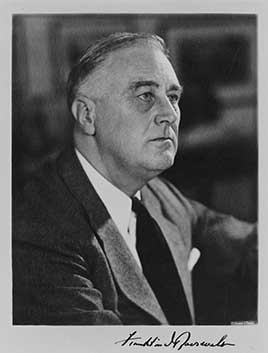
Franklin D. Roosevelt
Elected four times, more than any other president. He took office at the bottom of the Great Depression and launched the New Deal: bank reform, Social Security, the WPA, union rights and the first federal minimum wage. His 1937 plan to add justices to the Supreme Court failed. He led the country through most of World War II and died in office in April 1945.
The economy, first day to last
Shaded areas show the years in office, with a few years before and after for comparison. Budget years ran July to June until 1976 (now October to September), so each year's figures cover parts of two calendar years.
National debt
June 30, 1932 (end of fiscal 1932): $19.49 billion → June 30, 1944 (end of fiscal 1944): $201.00 billion
Daily debt figures don't exist before 1993, so Roosevelt's numbers use the fiscal years closest to his term, the same rule as every other page. About $152 billion of the increase came during World War II (fiscal 1942 to 1944). By June 30, 1945, 11 weeks after his death, the debt was $258.7 billion.
Debt compared with the economy
Debt as a share of GDP. Above 100% means the debt is bigger than a year of everything the country produces.
Deficits and surpluses
Money borrowed each budget year (below the line) or paid down (above).
Unemployment
1933: 24.9% → 1945: 1.9%. Yearly averages; monthly figures begin in 1948. Estimates by economist Stanley Lebergott, which count people in New Deal work programs as unemployed.
Inflation
How much prices rose each year (consumer price index).
Cost of living
What everyday prices and paychecks did while in office.
Prices use the consumer price index (MeasuringWorth). The minimum wage is the federal rate set by Congress.
Executive orders
3,467 orders, numbered 6071–9537. The most of any president. The American Presidency Project counts 3,726 by including lettered orders such as 6467-A. The split between 1935 and 1936 may be off by up to five orders.
Orders signed each year
Source: National Archives: executive order tables (full list of every order).
Notable orders
Reopening the banksEO 6073March 10, 1933
Rules for reopening banks after the national bank holiday he declared on his second day in office.
Federal RegisterBanning private goldEO 6102April 5, 1933
Required Americans to turn in gold coins, bullion and certificates at $20.67 an ounce. The dollar was then devalued to $35 an ounce in 1934.
Federal RegisterWorks Progress AdministrationEO 7034May 6, 1935
Created the WPA, which employed about 8.5 million people on public works over eight years.
Federal RegisterFair employment in defense industriesEO 8802June 25, 1941
Banned discrimination by race, creed, color or national origin in defense industries and government, after A. Philip Randolph threatened a march on Washington.
Federal RegisterJapanese American incarcerationEO 9066February 19, 1942
Let the military exclude people from 'military areas', leading to the incarceration of about 120,000 people of Japanese ancestry, two-thirds of them U.S. citizens. Formally rescinded in 1976.
Federal RegisterWartime wage and price controlsEO 9250October 3, 1942
Created the Office of Economic Stabilization to freeze wages, prices and farm prices during the war.
Federal RegisterEvery executive order 3,701Search, filter by topic or year, and open any order's full text
- EO 6071March 8, 1933Appointment of August A. Gennerich
- EO 6072March 8, 1933Transfer of Control and Jurisdiction of Certain Buildings at Cristobal to the Navy Department
- EO 6073March 10, 1933Regulations Concerning the Operation of Banks
- EO 6074March 13, 1933Amendment of Schedule A, Subdivision VII, of the Civil-Service Rules
- EO 6075March 15, 1933Withdrawal of Public Lands for Resurvey
- EO 6076March 15, 1933Withdrawal of Public Lands for Resurvey
- EO 6077March 15, 1933Withdrawal of Public Lands for Resurvey
- EO 6078March 18, 1933Designation of Mrs. Leafie E. Dietz to Sign Land Patents
- EO 6079March 18, 1933Designation of Mbs. Helen V. McLeod to Sign Land Patents
- EO 6080March 18, 1933Regulations Concerning Appointment of Conservators for State Banks, Members of Federal Reserve System
- EO 6081March 24, 1933Withdrawal of Public Land for Camp-Ground Purposes
- EO 6082March 25, 1933Withdrawal of Public Lands for Resurvey
- EO 6083March 25, 1933Amendment of Schedule A of the Civil Service Rules
- EO 6084March 27, 1933Reorganizing Agricultural Credit Agencies of the United States
- EO 6085March 28, 1933Announcing the Index Figures for the Cost of Living for the Six Months Periods Ending June 30, 1928, and December 31, 1932
- EO 6086March 28, 1933Rio Grande Wild Life Refuge
- EO 6087March 28, 1933Withdrawal of Public Lands for Resurvey
- EO 6088March 29, 1933Exemption of Harry O. Bailey from Compulsory Retirement for Age
- EO 6089March 31, 1933Veterans Regulation No. 1
- EO 6090March 31, 1933Veterans Regulation No. 2
- EO 6091March 31, 1933Veterans Regulation No. 3
- EO 6092March 31, 1933Veterans Regulation No. 4
- EO 6093March 31, 1933Veterans Regulation No. 5
- EO 6094March 31, 1933Veterans Regulation No. 6
- EO 6095March 31, 1933Veterans Regulation No. 7
- EO 6096March 31, 1933Veterans Regulation No. 8
- EO 6097March 31, 1933Veterans Regulation No. 9
- EO 6098March 31, 1933Veterans Regulation No. 10
- EO 6099March 31, 1933Veterans Regulation No. 11
- EO 6100March 31, 1933Veterans Regulation No. 12
- EO 6101April 5, 1933Relief of Unemployment Through the Performance of Useful Public Work
- EO 6102April 5, 1933Forbidding the Hoarding of Gold Coin, Gold Bullion and Gold Certificates
- EO 6103April 5, 1933Exemption of Banking Emergency Employes from Civil Service Rules
- EO 6104April 6, 1933Transfer of Lands from the Cascade and Santiam National Forests to the Willamette National Forest
- EO 6105April 6, 1933Appointment of Miss Jessie B. Saunders
- EO 6106AApril 10, 1933Relief of Unemployment Through the Performance of Useful Public Work
- EO 6106April 10, 1933Exemption of Persons from Compulsory Retirement for Age
- EO 6107April 11, 1933Exemption of Reuben Perry from Compulsory Retirement for Age
- EO 6108April 12, 1933Waiver of Provisions of Executive Order of January 17, 1873, for Raymond Moley
- EO 6109April 12, 1933Relief of Unemployment Through the Performance of Useful Public Work
- EO 6110April 15, 1933Modification of Public Water Reserve No. 52
- EO 6111April 20, 1933Relating to Foreign Exchange and the Earmarking and Export of Gold Coin or Bullion or Currency
- EO 6112April 22, 1933Partial Revocation of Withdrawal of Certain Lands for Transmission-Line Right-of-Way
- EO 6113April 22, 1933Withdrawing Lands for Right-of-Way for Transmission Line to Convey Power from Boulder Canyon Project to the City of Los Angeles
- EO 6114April 22, 1933Appointment of Mrs. May Cairns Aimone
- EO 6115April 25, 1933Revision and Codification of the Nationality Laws of the United States
- EO 6116April 29, 1933Public Water Reserve No. 151
- EO 6117May 2, 1933Harney National Forest
- EO 6118May 2, 1933Transferring Control of Certain Land to the Secretary of War
- EO 6119May 2, 1933Withdrawal of Public Lands for Resurvey
- EO 6120May 2, 1933Withdrawal of Public Lands for Resurvey
- EO 6121May 2, 1933Partial Revocation of Withdrawal of Public Lands
- EO 6122May 2, 1933Withdrawal of Public Lands for Resurvey
- EO 6123May 2, 1933Withdrawal of Public Lands for Resurvey
- EO 6124May 2, 1933Withdrawal of Public Lands for Resurvey
- EO 6125May 2, 1933Public Water Restoration No. 75
- EO 6126May 8, 1933Administration of the Emergency Conservation Work
- EO 6127May 8, 1933Reimbursement for Supplies Furnished the Emergency Conservation Work
- EO 6128May 10, 1933Amendment of Rules Governing Navigation of the Panama Canal and Adjacent Waters
- EO 6129May 11, 1933Administration of the Emergency Conservation Work
- EO 6130May 11, 1933Reserving Certain Lands for Federal Buildings
- EO 6131May 12, 1933Relief of Unemployment Through the Performance of Useful Public Work (Indian Reservations)
- EO 6131AMay 13, 1933Relief of Unemployment Through the Performance of Useful Public Work
- EO 6132May 15, 1933Withdrawing Land for Army Radio Station
- EO 6133May 15, 1933Appointment of Mrs. Elizabeth Horter
- EO 6134May 18, 1933Amendment of Schedules A and B, Civil-Service Rules, Positions Under Farm Credit Administration
- EO 6135May 20, 1933Purchase of National-Forest Lands
- EO 6136May 20, 1933Extending the Application of the Act for the Relief of Unemployment Through the Performance of Useful Public Work to County Parks and Metropolitan Sections of Municipal Parks
- EO 6137May 22, 1933Revocation of Withdrawal of Public Lands Pending Resurvey
- EO 6138May 22, 1933Revocation of Withdrawal of Public Lands Pending Resurvey
- EO 6139May 22, 1933Revocation of Withdrawal of Public Lands Pending Resurvey
- EO 6140May 22, 1933Revocation of Administrative-Site Withdrawals
- EO 6141May 23, 1933Amendment of Schedule B of the Civil-Service Rules
- EO 6142May 23, 1933Amending Executive Order No. 5872, of June 30, 1932, so as to Terminate on May 31, 1933, the Exemption of Pickens Neagle, of the Navy Department, from Compulsory Retirement for Age
- EO 6143May 23, 1933Withdrawal of Public Lands to Aid the State in Making Exchange Selections
- EO 6144May 24, 1933Amendment of Executive Order No. 6129 Entitled "Administration of the Emergency Conservation Work"
- EO 6145May 25, 1933Abolition of Board of Indian Commissioners and Transfer of the Records, Property, and Personnel of Said Board to the Secretary of the Interior
- EO 6146May 26, 1933Exemption of Walter L. G. Perry from Compulsory Retirement for Age
- EO 6147May 26, 1933Emergency Conservation Work Upon Indian Reservations
- EO 6148May 31, 1933Relief of Unemployment Through the Performance of Useful Public Work
- EO 6149May 31, 1933Revocation of Withdrawal of Public Lands Pending Resurvey
- EO 6150May 31, 1933Revocation of Withdrawal of Public Lands Pending Resurvey
- EO 6151June 1, 1933Revocation of Withdrawal of Public Lands Pending Resurvey
- EO 6152June 1, 1933Withdrawal of Public Lands for Classification
- EO 6153June 3, 1933Withdrawal of Public Lands for Resurvey
- EO 6154June 5, 1933Revocation of Administrative-Site Withdrawals
- EO 6155June 5, 1933Revocation of Withdrawal of Public Lands Pending Resurvey
- EO 6156June 6, 1933Veterans Regulation No. 1(a)
- EO 6157June 6, 1933Veterans Regulation No. 3(a)
- EO 6158June 6, 1933Veterans Regulation No. 9(a)
- EO 6159June 6, 1933Veterans Regulation No. 10(a)
- EO 6160June 7, 1933Administration of the Emergency Conservation Work
- EO 6161June 8, 1933Conservation and Development of the Natural Resources of the Tennessee River Drainage Basin
- EO 6162June 8, 1933Construction of Cove Creek Dam on Clinch River
- EO 6163June 8, 1933Revocation of Withdrawal of Public Lands Pending Resurvey
- EO 6164June 8, 1933Transfer of Land at Army Supply Base, Charleston, South Carolina
- EO 6167June 9, 1933Amendment to Regulations Governing Foreign Service Accounting
- EO 6165June 10, 1933Tongass National Forest
- EO 6166June 10, 1933Organization of Executive Agencies
- EO 6168June 13, 1933Exemption of William A. Taylor from Compulsory Retirement for Age
- EO 6169June 15, 1933Relief of Unemployment Through the Performance of Useful Public Works
- EO 6170June 15, 1933Assistant Secretary of the Interior Authorized to Perform the Duties of the Secretary
- EO 6171June 15, 1933Revocation of Withdrawal of Public Lands Pending Resurvey
- EO 6172June 15, 1933Cache National Forest
- EO 6173June 16, 1933Administration for Industrial Recovery
- EO 6174June 16, 1933Administration of Public Work
- EO 6175June 16, 1933Separation Ratings of Departmental Employees
- EO 6176June 16, 1933Allowance to Rural Carriers for Equipment Maintenance
- EO 6177June 16, 1933Revocation of Withdrawal of Public Lands Pending Resurvey
- EO 6178June 16, 1933Carson National Forest
- EO 6179June 16, 1933Withdrawal of Public Lands for Resurvey
- EO 6179AJune 16, 1933Revocation of Appointment to Classified Positions in the Department of Labor
- EO 6179CJune 16, 1933Designation of South Trimble, Jr., as Acting Secretary of Commerce
- EO 6179BJune 16, 1933Abolition of the National Committee on Wood Utilization
- EO 6180June 21, 1933Withdrawing Land for a Target Range
- EO 6181June 24, 1933Purchases of Land for National Forests
- EO 6182June 26, 1933Delegation of Certain Functions and Powers Under the National Industrial Recovery Act to the Secretary of Agriculture
- EO 6183June 26, 1933Revocation of Withdrawal of Public Lands Pending Resurvey
- EO 6184June 26, 1933Helium Reserve No. 2
- EO 6185June 26, 1933Revocation of Withdrawal of Public Lands Pending Resurvey
- EO 6186June 26, 1933Revocation of Withdrawal of Public Lands Pending Resurvey
- EO 6187June 26, 1933Revocation of Withdrawal of Public Lands Pending Resurvey
- EO 6188July 3, 1933Announcing the Index Figures for the Cost of Living for the Six Months Periods Ending June 30, 1928, and June 30, 1933
- EO 6189July 3, 1933Withdrawal of Lands for Dock Site
- EO 6190July 3, 1933Partial Revocation of Withdrawal of Certain Lands for Transmission-Line Right-of-Way
- EO 6191July 3, 1933Revocation of Withdrawal of Public Lands
- EO 6192July 3, 1933Withdrawal of Public Lands for Resurvey
- EO 6193July 3, 1933Revocation of Withdrawal of Public Lands Pending Resurvey
- EO 6194July 3, 1933Revocation of Withdrawal of Public Lands Pending Resurvey
- EO 6195July 3, 1933Revocation of Withdrawal of Public Lands Pending Resurvey
- EO 6196July 6, 1933Administration Under the Emergency Railroad Transportation Act, 1933
- EO 6197July 6, 1933Revocation of Administrative-Site Withdrawal
- EO 6198July 8, 1933Administration of Public Work
- EO 6199July 11, 1933Prohibition of Transportation in Interstate and Foreign Commerce of Petroleum and the Products Thereof Unlawfully Produced or Withdrawn from Storage
- EO 6200July 11, 1933Administration of the Emergency Conservation Work
- EO 6201July 11, 1933Puerto Rico Attached to Internal Revenue Collection District of Maryland
- EO 6201AJuly 11, 1933Designation of Miss Louise Polk Wilson to Sign Land Patents
- EO 6202July 11, 1933Phosphate Restoration No. 54
- EO 6202AJuly 11, 1933Executive Council
- EO 6202BJuly 11, 1933Providing for the Order of Succession of Officers to Act as Secretary of Treasury
- EO 6203July 12, 1933Appointment of Postmasters
- EO 6204July 14, 1933Prohibition of Transportation in Interstate and Foreign Commerce of Petroleum and the Products Thereof Unlawfully Produced or Withdrawn from Storage
- EO 6204AJuly 14, 1933Code of Fair Competition for the Rayon Weaving Industry
- EO 6204BJuly 14, 1933Code of Fair Competition for the Throwing Industry
- EO 6205July 14, 1933Reservoir Site Reserve No. 19
- EO 6205CJuly 15, 1933Code of Fair Competition for the Silk Association of America
- EO 6205BJuly 15, 1933Codes of Fair Competition
- EO 6205AJuly 15, 1933Administration for Industrial Recovery
- EO 6206July 16, 1933Withdrawal of Lands in Aid of Legislation for the Protection of the Water Supply of the City of Los Angeles
- EO 6206AJuly 16, 1933Code of Fair Competition for the Cotton Textile Industry
- EO 6206BJuly 16, 1933Code of Fair Competition for the Cotton Thread Industry
- EO 6206CJuly 19, 1933Appointment of Mrs. Bertha Wetherton
- EO 6207July 21, 1933Continuing in Effect the Authority Delegated to the Secretary of Agriculture by Executive Order No. 6182
- EO 6208July 21, 1933Purchase of Forest Lands for Emergency Conservation Work
- EO 6209July 21, 1933Redistribution of the Overbalance of Population in Industrial Centers by Means of Making Loans for and Otherwise Aiding in the Purchase of Subsistence Homesteads
- EO 6209AJuly 21, 1933Code of Fair Competition for the Textile Finishing Industry
- EO 6209BJuly 21, 1933Code of Fair Competition for the Underwear and Allied Products Industry
- EO 6210July 22, 1933Consolidating the Natural Bridge National Forest with the George Washington National Forest
- EO 6210AJuly 22, 1933Code of Fair Competition for the Silk and Rayon Dyeing and Printing Industry
- EO 6211July 24, 1933Administration of Public Work
- EO 6212July 25, 1933Withdrawal of Public Lands for Classification
- EO 6213July 25, 1933Rental and Subsistence Allowances of Officers
- EO 6214July 25, 1933Exemption of Curtis F. Marbut from Compulsory Retirement for Age
- EO 6214BJuly 25, 1933Executive Council
- EO 6214AJuly 25, 1933Amendment of Schedule B of the Civil-Service Rules
- EO 6215July 26, 1933Amendment of Schedule A of the Civil Service Rules
- EO 6216July 26, 1933Code of Fair Competition for the Shipbuilding and Shiprepairing Industry
- EO 6217July 26, 1933Appointments of James J. Maloney, John E. Murphy, Roy G. Perry, and Albert R. Vaughan as Operatives in the Secret Service Division of the Treasury Department
- EO 6218July 26, 1933Appointment of David A. Gates
- EO 6219July 26, 1933Healing Arts Practice Regulations for the Canal Zone
- EO 6220July 26, 1933Authorizing Appointment of Louis R. Glavis to Any Position in the Classified Civil Service
- EO 6221July 26, 1933Organization of Executive Agencies
- EO 6221DJuly 26, 1933Code of Fair Competition for the National Council of Pajama Manufacturers
- EO 6221AJuly 26, 1933Code of Fair Competition for the Wool Textile Industry
- EO 6221CJuly 26, 1933Code of Fair Competition for the International Association of Garment Manufacturers and Subdivisional Industries Thereof
- EO 6221BJuly 26, 1933Code of Fair Competition for the National Association of Hosiery Manufacturers
- EO 6222July 27, 1933Postponing Effective Date of Transfer of Legal Work, Veterans' Administration to Department of Justice
- EO 6223July 27, 1933Administration of the Emergency Conservation Work
- EO 6224July 27, 1933Postponement of Certain Provisions of Executive Order No. 6166, of June 10, 1933
- EO 6225July 27, 1933Central Statistical Board
- EO 6226July 27, 1933Providing for Current Encumbrance Reports
- EO 6227July 27, 1933Employees of Certain Executive Agencies Continued in the Service of the United States Temporarily
- EO 6227AJuly 27, 1933Code of Fair Competition for the Cordage and Twine Industry
- EO 6228July 28, 1933Organization of Executive Agencies
- EO 6229July 28, 1933Veterans Regulation No. 1(b)
- EO 6230July 28, 1933Veterans Regulation No. 2(a)
- EO 6231July 28, 1933Veterans Regulation No. 3(b)
- EO 6232July 28, 1933Veterans Regulation No. 6(a)
- EO 6233July 28, 1933Veterans Regulation No. 7(a)
- EO 6234July 28, 1933Veterans Regulation No. 10(b)
- EO 6235July 28, 1933Power-Site Restoration No. 477
- EO 6236July 28, 1933Appointment of Henry Roe Cloud
- EO 6237July 28, 1933Purchase of National Park Lands
- EO 6237AJuly 30, 1933Vesting Certain Power and Authority in the Alien Property Custodian
- EO 6238July 31, 1933Establishment of Science Advisory Board Under the National Research Council
- EO 6239August 2, 1933Organization of Executive Agencies
- EO 6240August 3, 1933Central Statistical Board
- EO 6241August 3, 1933Inspection of Tax Returns by Special Committee to Investigate Foreign and Domestic, Ocean and Air Mail Contracts, United States Senate
- EO 6242EAugust 4, 1933In the Matter of the Application of Dwight Manufacturing Co. for Certain Exemptions from the Cotton Textile Code
- EO 6242August 4, 1933Designation of Mrs. Alice M. Grove to Sign Land Patents
- EO 6242DAugust 4, 1933In the Matter of the Application of Crystal Springs Bleachery Incorporated for Certain Stay of Application and Exemptions from the Cotton Textile Code
- EO 6242AAugust 4, 1933Code of Fair Competition for the Coat and Suit Industry
- EO 6242CAugust 4, 1933In the Matter of the Application of Alabama Mills Company, a Bankrupt, by Paul A. Redmond, Trustee, for Certain Exemptions from the Cotton Textile Code
- EO 6242BAugust 4, 1933Code of Fair Competition for the Electrical Manufacturing Industry
- EO 6243August 5, 1933Postponing Effective Date Transfer of the District Court of the United States for the Panama Canal Zone to Department of Justice
- EO 6244August 8, 1933Postponement of Certain Provisions of Executive Order No. 6166 of June 10, 1933
- EO 6245August 9, 1933Employees of Certain Executive Agencies Continued in the Service of the United States Temporarily
- EO 6246August 10, 1933Administration of the National Industrial Recovery Act
- EO 6247August 10, 1933Preparation, Form, Style, and Safeguarding of Executive Orders and Proclamations
- EO 6248August 14, 1933Code of Fair Competition for the Corset and Brassiere Industry
- EO 6249August 14, 1933Code of Fair Competition for the Lace Manufacturing Industry
- EO 6250August 16, 1933Code of Fair Competition for the Legitimate Full Length Dramatic and Musical Theatrical Industry
- EO 6251August 19, 1933Designating the Federal Power Commission as an Agency to Aid the Federal Emergency Administrator of Public Works
- EO 6252August 19, 1933Federal Emergency Administration of Public Works
- EO 6253August 19, 1933Code of Fair Competition for the Fishing Tackle Industry
- EO 6254August 19, 1933Code of Fair Competition for the Iron and Steel Industry
- EO 6255August 19, 1933Code of Fair Competition for the Lumber and Timber Products Industries
- EO 6256August 19, 1933Code of Fair Competition for the Petroleum Industry
- EO 6257August 19, 1933Code of Fair Competition for the Photographic Manufacturing Industry
- EO 6258August 22, 1933Withdrawal of Public Lands for Resurvey
- EO 6258DAugust 26, 1933Code of Fair Competition for the Men's Clothing Industry
- EO 6258AAugust 26, 1933Code of Fair Competition for the Automobile Manufacturing Industry
- EO 6258CAugust 26, 1933Code of Fair Competition for the Hosiery Industry
- EO 6258BAugust 26, 1933Code of Fair Competition for the Rayon and Synthetic Yarn Producing Industry
- EO 6259August 27, 1933Amendment of Executive Order of January 28, 1873, Relating to the Holding of State, Municipal, or Other Local Office by Federal Officers and Employees
- EO 6260August 28, 1933Relating to the Hoarding, Export, and Earmarking of Gold Coin, Bullion, or Currency and to Transactions in Foreign Exchange
- EO 6260AAugust 28, 1933Administration of the Petroleum Industry
- EO 6261August 29, 1933Relating to the Sale and Export of Gold Recovered from Natural Deposits
- EO 6262August 29, 1933Amendments to Regulations Governing Foreign Service Accounting
- EO 6263August 30, 1933Exemption of Joe Smith from Compulsory Retirement for Age
- EO 6264August 31, 1933Exemption of George P. Metzger from Compulsory Retirement for Age
- EO 6265September 5, 1933Purchase of Forest Lands for Emergency Conservation Work
- EO 6266September 6, 1933Withdrawal of Public Lands for Resurvey
- EO 6267September 6, 1933Withdrawal of Public Lands for Resurvey
- EO 6268September 6, 1933Withdrawal of Public Lands for Resurvey
- EO 6269September 6, 1933Withdrawal of Land for Use by the Washington-Alaska Military Cable and Telegraph System
- EO 6270September 7, 1933Code of Fair Competition for the Motion Picture Laboratory Industry
- EO 6271September 7, 1933Code of Fair Competition for the Wall Paper Manufacturing Industry
- EO 6272September 7, 1933Code of Fair Competition for the Salt Producing Industry
- EO 6273September 7, 1933Code of Fair Competition for the Leather Industry
- EO 6274September 7, 1933In the Matter of the Application of Connecticut Garment Manufacturers Association, for Certain Exemptions from the Coat and Suit Code
- EO 6275September 7, 1933Code of Fair Competition for the Cast Iron Soil Pipe Industry
- EO 6276September 8, 1933Withdrawal of Public Lands to Aid the State in Making Exchange Selections
- EO 6277September 8, 1933Public Water Reserve No. 152, Colorado, Oregon, and Utah
- EO 6278September 12, 1933Partial Revocation of Withdrawal of Certain Lands for Transmission-Line Right of Way, California
- EO 6279September 12, 1933Sturgeon Bay, Wis., Abolished as a Customs Port of Entry
- EO 6280September 13, 1933Revocation of Withdrawal of Public Lands Pending Resurvey, New Mexico
- EO 6281September 13, 1933Knoxville, Tennessee, Abolished as a Customs Port of Entry
- EO 6282September 13, 1933Lincoln, Nebraska, Abolished as a Customs Port of Entry
- EO 6283September 13, 1933New Bern, North Carolina, and Manteo, North Carolina, Abolished as Customs Ports of Entry
- EO 6284ASeptember 13, 1933Modifications of Code of Fair Competition for the Petroleum Industry
- EO 6285September 14, 1933Withdrawal of Public Lands for Classification, California
- EO 6286September 14, 1933Withdrawal of Public Lands for Resurvey, New Mexico
- EO 6287September 14, 1933Withdrawal of Public Lands for Resurvey, New Mexico
- EO 6288September 14, 1933Withdrawal of Public Lands for Resurvey, Wyoming
- EO 6284September 18, 1933Robbinston, Maine, Abolished as a Customs Port of Entry, Limits of Customs Port of Calais, Maine, Extended
- EO 6289September 18, 1933Code of Fair Competition for the Flower and Feather Industry
- EO 6289ASeptember 18, 1933Code of Fair Competition for the Bituminous Coal Industry
- EO 6290September 18, 1933Code of Fair Competition for the Gasoline Pump Manufacturing Industry
- EO 6291September 18, 1933Code of Fair Competition for the Linoleum and Felt Base Manufacturing Industry
- EO 6292September 18, 1933Code of Fair Competition for the Oil Burner Industry
- EO 6293September 18, 1933Code of Fair Competition for the Textile Bag Industry
- EO 6294September 18, 1933Code of Fair Competition for the Transit Industry
- EO 6295September 18, 1933Code of Fair Competition for the Underwear and Allied Products Manufacturing Industry
- EO 6296September 18, 1933In the Matter of the Application of Gem-Dandy Garter Company for Certain Exemptions from the Corset and Brassiere Code
- EO 6296ASeptember 22, 1933Government Contracts
- EO 6297September 25, 1933Modification of Reservoir-Site Reserve No. 17, Pacific Slope Basins, California
- EO 6298September 29, 1933Authorizing the Appointment of Hugh S. Johnson to Serve Temporarily as a Member of Each Code Authority
- EO 6299September 29, 1933Revised Code of Fair Competition for the Bituminous Coal Industry
- EO 6300September 30, 1933Chincoteague, Virginia, Abolished as a Customs Port of Entry
- EO 6301September 30, 1933Further Postponing Effective Date of Transfer of the District Court of the United States for the Panama Canal Zone to the Department of Justice
- EO 6302September 30, 1933Exemption of Clayborn L. Gatewood from Compulsory Retirement for Age
- EO 6303September 30, 1933Consolidating the Kaniksu National Forest with the Pend Oreille National Forest, and Transferring Lands from the Pend Oreille National Forest to the Coeur d'Alene National Forest, Idaho and Washington
- EO 6304October 3, 1933Concerning the President's Reemployment Agreement
- EO 6305October 3, 1933Code of Fair Competition for Bankers
- EO 6306October 3, 1933Code of Fair Competition for the Lime Industry
- EO 6307October 3, 1933Code of Fair Competition for the Farm Equipment Industry
- EO 6308October 3, 1933Code of Fair Competition for the Boiler Manufacturing Industry
- EO 6309October 3, 1933Code of Fair Competition for the Electric Storage and Wet Primary Battery Industry
- EO 6310October 3, 1933Code of Fair Competition for the Textile Machinery Manufacturing Industry
- EO 6311October 3, 1933Code of Fair Competition for the Knitting, Braiding and Wire Covering Machine Industries
- EO 6312October 3, 1933Code of Fair Competition for the Builders Supplies Trade
- EO 6313October 3, 1933Code of Fair Competition for the Boot and Shoe Manufacturing Industry
- EO 6314October 3, 1933Code of Fair Competition for the Laundry and Dry Cleaning Machinery Manufacturing Industry
- EO 6315October 3, 1933Code of Fair Competition for the Saddlery Manufacturing Industry
- EO 6316October 3, 1933Code of Fair Competition for the Ice Industry
- EO 6317October 3, 1933Code of Fair Competition for the Retail Lumber, Lumber Products, Building Materials and Building Specialties Trade
- EO 6318October 3, 1933Code of Fair Competition for the Luggage and Fancy Leather Goods Industry
- EO 6319October 3, 1933Code of Fair Competition for the Women's Belt Industry
- EO 6320October 3, 1933Amending Code of Fair Competition for Oil Burner Industry
- EO 6321October 3, 1933Code of Fair Competition for the Motor Vehicle Retailing Trade
- EO 6322October 3, 1933Code of Fair Competition for the Glass Container Industry
- EO 6324October 5, 1933Authorizing the Appointment of David H. Morton
- EO 6323October 9, 1933Amendment of Code of Fair Competition for the Lumber and Timber Products Industries
- EO 6325October 9, 1933Code of Fair Competition for the Optical Manufacturing Industry
- EO 6326October 9, 1933Code of Fair Competition for the Umbrella Manufacturing Industry
- EO 6327October 9, 1933Code of Fair Competition for the Handkerchief Industry
- EO 6328AOctober 9, 1933Code of Fair Competition for the Automatic Sprinkler Industry
- EO 6328October 9, 1933Code of Fair Competition for Mutual Savings Banks
- EO 6329October 10, 1933Amendment of Code of Fair Competition for the Ship Building and Ship Repairing Industry
- EO 6330October 10, 1933Code of Fair Competition for the Silk Textile Industry
- EO 6331October 11, 1933Withdrawal of Public Land for Conservation Camp, California
- EO 6331AOctober 11, 1933In the Matter of the Application of Associated Cloak and Suit Manufacturers of Portland, Oregon, for Certain Exemptions from the Coat and Suit Code
- EO 6331EOctober 11, 1933Code of Fair Competition for the Throwing Industry
- EO 6331DOctober 11, 1933Code of Fair Competition for the Pump Manufacturing Industry
- EO 6331COctober 11, 1933Code of Fair Competition for the Heat Exchange Industry
- EO 6331BOctober 11, 1933Code of Fair Competition for the Compressed Air Industry
- EO 6332October 12, 1933Allowance to Rural Carriers for Equipment Maintenance
- EO 6333October 13, 1933Transfer of Lands from the Rainier National Forest to the Columbia National Forest, Washington
- EO 6334October 13, 1933Transfer of Lands from the Rainier National Forest to the Snoqualmie National Forest, Washington
- EO 6335October 13, 1933Transfer of Lands from the Rainier National Forest to the Wenatchee National Forest, Washington
- EO 6336October 13, 1933Transfer of Lands From the Snoqualmie National Forest to the Mount Baker National Forest
- EO 6337October 14, 1933Rules and Regulations Under Section 10(a) and Delegation of Authority Under Section 2(b) of the National Industrial Recovery Act
- EO 6338October 14, 1933Exemption of James S. Goldsmith and George G. Hedgcock from Compulsory Retirement for Age
- EO 6339October 14, 1933Michigan City, Indiana, Abolished as a Customs Port of Entry
- EO 6340October 16, 1933Authorizing the Formation of a Corporation to be Known as the Commodity Credit Corporation
- EO 6341October 17, 1933Extension of Trust Period on Lands of the Morongo Band of Mission Indians, California
- EO 6342October 18, 1933Inspection of Tax Returns by Special Committee to Investigate Receivership and Bankruptcy Proceedings and Appointment of Receivers and Trustees, United States Senate, Authorized
- EO 6343October 18, 1933Designation of and Authorization to the Secretary of the Interior to Acquire Certain Property
- EO 6344October 20, 1933Authorization and Allocation of Funds for Purchase of Lands for Forest Research in Connection with National Arboretum
- EO 6345October 20, 1933Amendment of Executive Order No. 6182 as Supplemented by Executive Order No. 6207, Which Delegated to the Secretary of Agriculture Certain Authority Under the National Industrial Recovery Act
- EO 6346October 20, 1933In the Matter of the Application of the Greensboro Lumber Company and H. A. Taylor, for Certain Exemptions from the Code of Fair Competition for the Lumber and Timber Products Industries
- EO 6347October 20, 1933Further Stay of Part I, Section 1(c) of Code of Fair Competition for the Underwear and Allied Products Manufacturing Industry
- EO 6348October 20, 1933Modifying Agreement Approved July 27, 1933, Between the President of the United States and the Code Committee of the Cordage and Twine Industry
- EO 6349October 20, 1933Code of Fair Competition for the Marking Devices Industry
- EO 6350October 20, 1933Code of Fair Competition for the Cap and Closure Industry
- EO 6351October 21, 1933Code of Fair Competition for the Retail Trade
- EO 6352October 23, 1933Amending Paragraph 6, Subdivision VII, Schedule A of the Civil-Service Rules
- EO 6353October 23, 1933To Effectuate the Provisions of Section 3(e) of Title I of the National Industrial Recovery Act
- EO 6354October 23, 1933Rules and Regulations Under the National Industrial Recovery Act
- EO 6355October 23, 1933Defining Effect of Certain Provisions in Codes of Fair Competition Upon Cooperative Organizations
- EO 6356October 23, 1933Code of Fair Competition for the Industrial Supplies and Machinery Distributors' Trade
- EO 6357October 23, 1933Code of Fair Competition for the Plumbago Crucible Industry
- EO 6358October 23, 1933Code of Fair Competition for the Steel Tubular and Firebox Boiler Industry
- EO 6359October 25, 1933Relating to Gold Recovered from Natural Deposits
- EO 6360October 25, 1933Authorization to Appoint Mr. Wade Crawford
- EO 6361October 25, 1933Withdrawal of Public Lands for Classification, California
- EO 6362October 25, 1933Partial Revocation of Executive Order No. 6143 Withdrawing Certain Lands in New Mexico
- EO 6363October 25, 1933Revocation of Withdrawal of Public Lands Pending Classification as to Coal
- EO 6364October 26, 1933Authorization to Appoint Mrs. Jean Springstead Whittemore
- EO 6365October 26, 1933Greenwich, Middletown, Norwalk, South Manchester, and Stamford, Connecticut, Abolished as Customs Ports of Entry
- EO 6366October 27, 1933Labor Provisions for the Beet Sugar Industry
- EO 6367October 31, 1933Public Water Restoration No. 76, Wyoming
- EO 6368October 31, 1933Code of Fair Competition for the Advertising Specialty Industry
- EO 6369October 31, 1933Code of Fair Competition for the Dress Manufacturing Industry
- EO 6370October 31, 1933Code of Fair Competition for the Fertilizer Industry
- EO 6371October 31, 1933Code of Fair Competition for the Gas Cock Industry
- EO 6372October 31, 1933Code of Fair Competition for the Millinery and Dress Trimming, Braid and Textile Industry
- EO 6373October 31, 1933Code of Fair Competition for the Motor Bus Industry
- EO 6374October 31, 1933Code of Fair Competition for the Packaging Machinery Industry and Trade
- EO 6375October 31, 1933Code of Fair Competition for the Road Machinery Manufacturing Industry
- EO 6376October 31, 1933Code of Fair Competition for the Hair and Jute Felt Industry
- EO 6377October 31, 1933Code of Fair Competition for the Terra Cotta Industry
- EO 6378October 31, 1933Code of Fair Competition for the Canning and Packing Machinery Industry
- EO 6379October 31, 1933Code of Fair Competition for the Paint, Varnish and Lacquer Manufacturing Industry
- EO 6380November 1, 1933Code of Fair Competition for the Nottingham Lace Curtain Industry
- EO 6381November 1, 1933Code of Fair Competition for the Asbestos Industry
- EO 6382November 1, 1933Code of Fair Competition for the Rock Crusher Manufacturing Industry
- EO 6383November 1, 1933Code of Fair Competition for the Novelty Curtains, Draperies, Bedspreads, and Novelty Pillow Industry
- EO 6384November 1, 1933Code of Fair Competition for the Crown Manufacturing Industry
- EO 6385November 2, 1933Code of Fair Competition for the American Petroleum Equipment Industry and Trade
- EO 6386November 2, 1933Code of Fair Competition for the Steel Casting Industry
- EO 6387November 2, 1933Code of Fair Competition for the Copper and Brass Mill Products Industry
- EO 6388November 2, 1933Code of Fair Competition for the Fabricated Metal Products Manufacturing and Metal Finishing and Metal Coating Industry
- EO 6389November 2, 1933Code of Fair Competition for the Soap and Glycerine Manufacturing Industry
- EO 6390November 3, 1933Designation of Marshal as Officer to Disburse Funds for Maintenance and Operation of District Court of the United States for Panama Canal Zone, Etc.
- EO 6391November 4, 1933Code of Fair Competition for the Men's Garter, Suspender, and Belt Manufacturing Industry
- EO 6392November 4, 1933Code of Fair Competition for Stock Exchange Firms
- EO 6393November 4, 1933Code of Fair Competition for the Tot and Playthings Industry
- EO 6394November 4, 1933Code of Fair Competition for the Funeral Supply Industry
- EO 6395November 4, 1933Code of Fair Competition for the Business Furniture, Storage Equipment, and Filing Supply Industry
- EO 6396November 4, 1933Code of Fair Competition for the Office Equipment Manufacturers Industry
- EO 6397November 4, 1933Code of Fair Competition for the Buffing and Polishing Composition Industry
- EO 6398November 4, 1933Code of Fair Competition for the Buff and Polishing Wheel Industry
- EO 6399November 4, 1933Code of Fair Competition for the Piano Manufacturing Industry
- EO 6400November 4, 1933Code of Fair Competition for the Floor and Wall Clay Tile Manufacturing Industry
- EO 6401November 4, 1933Code of Fair Competition for the Washing and Ironing Machine Manufacturing Industry
- EO 6402November 4, 1933Code of Fair Competition for the Leather and Woolen Knit Glove Industry
- EO 6403November 4, 1933In the Matter of the Application of Kaplan Brothers for Certain Exemptions from the Code of Fair Competition for the Artificial Flower and Feather Industry
- EO 6403ANovember 4, 1933Code of Fair Competition for the Fire Extinguishing Appliance Manufacturing Industry
- EO 6404November 4, 1933Oil-Shale Restoration No. 2, Nevada
- EO 6405November 4, 1933Power-Site Restoration No. 478, Utah
- EO 6406November 6, 1933Code of Fair Competition for the Asphalt Shingle and Roofing Manufacturing Industry
- EO 6407November 6, 1933Terminating Stay of the Provisions of the Cotton Textile Industry Code
- EO 6408November 7, 1933Corrected Description of the Boundaries of Fort Ruger Military Reservation, Hawaii
- EO 6409November 7, 1933Transfer of Lands from and to the Ashley and Wasatch National Forests, Utah and Wyoming
- EO 6410November 8, 1933Code of Fair Competition for the Printers' Rollers Industry
- EO 6411November 8, 1933Code of Fair Competition for the Motor Fire Apparatus Manufacturing Industry
- EO 6412November 8, 1933Code of Fair Competition for the Ladder Manufacturing Industry
- EO 6413November 8, 1933Code of Fair Competition for the Shovel, Dragline and Crane Industry
- EO 6414November 8, 1933Code of Fair Competition for the Paperboard Industry
- EO 6415November 8, 1933Code of Fair Competition for the Liquefied Gas Industry
- EO 6416November 8, 1933Code of Fair Competition for the Machine Tool and Forging Machinery Industry
- EO 6416ANovember 8, 1933Code of Fair Competition for the Cleaning and Dyeing Trade
- EO 6417November 8, 1933Supplement to Code of Fair Competition for the Automobile Manufacturing Industry Covering Fair Trade Practices for the Funeral Vehicle and Ambulance Subdivision
- EO 6418November 8, 1933Code of Fair Competition for the Automotive Parts and Equipment Manufacturing Industry
- EO 6419November 9, 1933Exemption of James A. Wetmore from Compulsory Retirement for Age
- EO 6420ANovember 9, 1933Modifications of the Code of Fair Competition for the Cotton Textile Industry
- EO 6420BNovember 9, 1933Establishing the Federal Civil Works Administration
- EO 6420November 9, 1933Authorization to Appoint Mrs. Mary M. Flanagan
- EO 6421November 10, 1933Coal-Land Restoration, New Mexico No. 50
- EO 6422November 10, 1933Code of Fair Competition for the Hardwood Distillation Industry
- EO 6423November 10, 1933Code of Fair Competition for the Crushed Stone, Sand and Gravel, and Slag Industries
- EO 6423ANovember 11, 1933Approval of Code of Fair Competition for the Imported Date Packing Industry
- EO 6424November 13, 1933Code of Fair Competition for the Imported Date Packing Industry
- EO 6425November 14, 1933Code of Fair Competition for the Scientific Apparatus Industry
- EO 6426November 14, 1933Code of Fair Competition for the Air Transport Industry
- EO 6427November 14, 1933Code of Fair Competition for the Gear Manufacturing Industry
- EO 6428November 14, 1933Code of Fair Competition for the Wood Plug Industry
- EO 6429November 14, 1933Code of Fair Competition for the Limestone Industry
- EO 6430November 14, 1933Code of Fair Competition for the All-Metal Insect Screen Industry
- EO 6431November 14, 1933Code of Fair Competition for the Mop Stick Industry
- EO 6431ANovember 15, 1933Code of Labor Provisions for the Retail Food and Grocery Trade
- EO 6431BNovember 15, 1933Code of Labor Provisions for the Wholesale Food and Grocery Trade
- EO 6432November 16, 1933Withdrawal of Public Lands For Resurvey, Wyoming
- EO 6433ANovember 17, 1933Creation of the National Emergency Council
- EO 6433November 17, 1933Authorization to Appoint Mrs. Josephine B. Wales
- EO 6434November 17, 1933Code of Fair Competition for the Cotton Garment Industry
- EO 6435November 17, 1933Code of Fair Competition for the Newsprint Industry
- EO 6436November 17, 1933Code of Fair Competition for the Special Tool, Die, and Machine Shop Industry
- EO 6437November 17, 1933Code of Fair Competition for the Paper and Pulp Industry
- EO 6438November 17, 1933Code of Fair Competition for the Hotel Industry
- EO 6438ANovember 17, 1933Authorization to Appoint Job K. Jones, Allan B. Walsh, Et Al.
- EO 6439November 18, 1933Delegating Authority Under Section 2(b) and Prescribing Rules and Regulations Under Section 10(a) of Title I of the National Industrial Recovery Act
- EO 6440November 18, 1933Rates of Compensation of Government Employees in Emergency Agencies Not Subject to the Classification Act, and Acts Amendatory Thereof
- EO 6441November 21, 1933Withdrawal of Public Lands for Classification
- EO 6441ANovember 21, 1933Approval of Code of Fair Competition for the Southern Rice Milling Industry
- EO 6442November 22, 1933Prescribing Rules and Regulations Under the Federal Emergency Relief Act of 1933
- EO 6443November 22, 1933Authorizing the Administrator for Industrial Recovery to Modify Agreements Entered into or Approved by the President Under Title I of the National Industrial Recovery Act
- EO 6444November 25, 1933Restoring Drill Sites to Naval Petroleum Reserve No. 2, California
- EO 6444ANovember 26, 1933Approval of Code of Fair Competition for the Distilled Spirits Industry
- EO 6445November 27, 1933Code of Fair Competition for the Vitrified Clay Sewer Pipe Manufacturing Industry
- EO 6446November 27, 1933Code of Fair Competition for the Anti-Friction Bearing Industry
- EO 6447November 27, 1933Code of Fair Competition for the Pipe Nipple Manufacturing Industry
- EO 6449November 27, 1933Code of Fair Competition for the Retail Jewelry Trade
- EO 6451November 27, 1933Code of Fair Competition for the Concrete Masonry Industry
- EO 6452November 27, 1933Code of Fair Competition for the Cigar Container Manufacturers Code
- EO 6453November 27, 1933Code of Fair Competition for the Cement Industry
- EO 6454November 27, 1933Code of Fair Competition for the Warm Air Furnace Manufacturing Industry
- EO 6455November 27, 1933Code of Fair Competition for the Reinforcing Materials Fabricating Industry
- EO 6456November 27, 1933Code of Fair Competition for Investment Bankers
- EO 6459November 27, 1933Code of Fair Competition for the Upholstery and Drapery Textile Industry
- EO 6460November 27, 1933Code of Fair Competition for the Wool Felt Manufacturing Industry
- EO 6461November 27, 1933Code of Fair Competition for the Malleable Iron Industry
- EO 6462November 27, 1933Code of Fair Competition for the Gas Appliances and Apparatus Industry
- EO 6463November 27, 1933Extension of Stay of the Provision of the Cotton Textile Code
- EO 6464November 27, 1933Commercial Bribery Provisions in Codes of Fair Competition Interpreted
- EO 6466November 27, 1933Code of Fair Competition for the Waterproofing, Dampproofing, Calking Compounds, and Concrete Floor Treatments Manufacturing Industry
- EO 6467November 27, 1933Code of Fair Competition for the Retail Trade, Order No. 7, Extension of Effective Date of Article IX, Section 4
- EO 6467ANovember 27, 1933Code of Fair Competition for the Radio Broadcasting Industry
- EO 6468November 29, 1933Restoring to the Territory of Hawaii a Part of the Fort Ruger Military Reservation
- EO 6469November 29, 1933Revocation in Part of Executive Order of April 20, 1931, Withdrawing Public Lands Pending Resurvey, Wyoming
- EO 6470November 29, 1933Designating and Establishing the Public Works Emergency Housing Corporation as an Agency Under Title II of the National Industrial Recovery Act
- EO 6471November 29, 1933Authorization to Appoint Miss Maude McGaugh
- EO 6471ADecember 2, 1933Approval of Code of Fair Competition for the Alcoholic Beverages Importing Industry
- EO 6472December 2, 1933Assignment of Frequencies to Government Radio Stations
- EO 6473December 4, 1933Withdrawal of Public Lands for Resurvey, Wyoming
- EO 6473ADecember 4, 1933Approval of Code of Fair Competition for the Brewing Industry
- EO 6474December 4, 1933Establishment of the Federal Alcohol Control Administration, Etc.
- EO 6475December 4, 1933Authorization to Appoint Miss Anne Stevens
- EO 6476December 4, 1933Terminating Stay of Provisions of the Cotton Textile Industry Code
- EO 6477December 6, 1933Withdrawal of Public Lands for Classification, South Dakota
- EO 6478December 6, 1933Revocation in Part of Executive Order of February 7, 1930, Withdrawing Public Lands Pending Classification, Etc., New Mexico
- EO 6479December 7, 1933Providing for the Submission of Statistical Information by Persons Subject to Codes of Fair Competition
- EO 6480December 7, 1933Code of Fair Competition for the Paper Making Machine Builders Industry
- EO 6481December 7, 1933Code of Fair Competition for the Furniture Manufacturing Industry
- EO 6482December 7, 1933Code of Fair Competition for the Excelsior and Excelsior Products Industry
- EO 6483December 7, 1933Code of Fair Competition for the Motor Vehicle Storage and Parking Trade
- EO 6484December 7, 1933Code of Fair Competition for the Pyrotechnic Manufacturing Industry
- EO 6485December 7, 1933Code of Fair Competition for the Machined Waste Manufacturing Industry
- EO 6486December 7, 1933Code of Fair Competition for the Asphalt and Mastic Tile Industry
- EO 6487December 7, 1933Amendments to the Code of Fair Competition for the Lumber and Timber Products Industries
- EO 6487BDecember 9, 1933Approval of Code of Fair Competition for the Distilled Spirits Rectifying Industry
- EO 6487ADecember 9, 1933Approval of Code of Fair Competition for the Alcoholic Beverage Wholesale Industry
- EO 6488December 11, 1933Amendment of Schedule A, Subdivision XIII, of the Civil-Service Rules
- EO 6489December 11, 1933Amendment of Schedule A, Subdivision XIII, of the Civil-Service Rules
- EO 6490December 12, 1933Revocation of Withdrawal of Public Lands Pending Resurvey
- EO 6491December 12, 1933Withdrawal of Public Lands in Connection With Fort Peck Dam, Federal Project No. 30, Federal Emergency Public Works Administration
- EO 6492December 12, 1933Coal Land Restoration, New Mexico No. 51
- EO 6493December 12, 1933Restoring to the Territory of Hawaii for Highway Purposes a Portion of the Site of the Naval Radio Station, Wailupe, Honolulu, Oahu
- EO 6494December 14, 1933Exemption of Charles J. Chamberlain From Compulsory Retirement for Age
- EO 6495December 14, 1933Administrative Furloughs
- EO 6496December 14, 1933Withdrawal of Public Lands for Resurvey
- EO 6497December 15, 1933Amendment of Executive Order No. 6247 of August 10, 1933
- EO 6498December 15, 1933Extension of Trust Period on Indian Lands Expiring During the Year 1934
- EO 6499December 15, 1933Withdrawal of Public Lands for Resurvey
- EO 6500December 15, 1933Revoking in Part Executive Order No. 5462 Withdrawing Public Land for Customs and Immigration Inspection Purposes
- EO 6501December 15, 1933Code of Fair Competition for the Millinery Industry
- EO 6502December 15, 1933Code of Fair Competition for the Can Manufacturers Industry
- EO 6503December 15, 1933Code of Fair Competition for the Valve and Fittings Manufacturing Industry
- EO 6504December 15, 1933Code of Fair Competition for the Metal Tank Industry
- EO 6505December 15, 1933Code of Fair Competition for the Oxy-Acetylene Industry
- EO 6506December 15, 1933Code of Fair Competition for the Rubber Manufacturing Industry
- EO 6507December 15, 1933Code of Fair Competition for the Hair Cloth Manufacturing Industry
- EO 6508December 15, 1933Code of Fair Competition for the Stone Finishing Machinery and Equipment Industry
- EO 6509December 15, 1933Code of Fair Competition for the Dry and Polishing Mop Manufacturing Industry
- EO 6510December 15, 1933Men's Clothing Industry
- EO 6510ADecember 15, 1933Code of Fair Competition for the Fur Trapping Contractors Industry
- EO 6511December 16, 1933Powers of the National Labor Board Are Increased
- EO 6512ADecember 16, 1933Appointing Charles Brenton as a Presidential Member of the Bituminous Coal Labor Board for Division I
- EO 6512December 16, 1933Amendment of Executive Order No. 6433-A, of November 17, 1933
- EO 6513KDecember 18, 1933Amending Code of Fair Competition for the Automobile Manufacturing Industry
- EO 6513JDecember 18, 1933Amendments to Code of Fair Competition for the Men's Clothing Industry and Amendments to Code of Fair Competition for the Cotton Garment Industry
- EO 6513IDecember 18, 1933Code of Fair Competition for the Cast Iron Soil Pipe Industry (Amendment Number I)
- EO 6513HDecember 18, 1933Code of Fair Competition for the Fur Dressing and Fur Dyeing Industry
- EO 6513GDecember 18, 1933Code of Fair Competition for the Refractories Industry
- EO 6513FDecember 18, 1933Code of Fair Competition for the Non-Ferrous Foundry Industry
- EO 6513EDecember 18, 1933Code of Fair Competition for the Wholesale Automotive Trade
- EO 6513DDecember 18, 1933Code of Fair Competition for the Domestic Freight Forwarding Industry
- EO 6513ADecember 18, 1933Code of Fair Competition for the Set Up Paper Box Industry
- EO 6513CDecember 18, 1933Code of Fair Competition for the Waxed Paper Industry
- EO 6513BDecember 18, 1933Code of Fair Competition for the Knitted Outerwear Industry
- EO 6513December 18, 1933Amendment of Executive Order No. 6433-A
- EO 6514December 19, 1933Authorizing the Formation of a Corporation to be Known as Electric Home and Farm Authority, Inc.
- EO 6515December 19, 1933Extension of the President's Reemployment Agreement to April 30, 1934
- EO 6515ADecember 19, 1933Authorizing Charles E. Wyzanski, Jr., to Act as Secretary of Labor
- EO 6516December 20, 1933Excusing Federal Employees in the District of Columbia From Duty December 23 and 30, 1933
- EO 6517December 21, 1933Amendment of Executive Order of December 20, 1933, Excusing Federal Employees in the District of Columbia From Duty December 23 and 30, 1933
- EO 6518December 21, 1933Waiving Provisions of Executive Order of January 17, 1873, Prohibiting Federal Officers and Employees From Holding State or Municipal Offices, as to Martin Conboy
- EO 6519December 21, 1933Code of Fair Competition for Savings, Building and Loan Associations
- EO 6520December 21, 1933Code of Fair Competition for the Grinding Wheel Industry
- EO 6521December 21, 1933Code of Fair Competition for the Rolling Steel Door Industry
- EO 6522December 21, 1933Code of Fair Competition for the Rayon and Silk Dyeing and Printing Industry
- EO 6523December 21, 1933Code of Fair Competition for the Industry Engaged in the Smelting and Refining of Secondary Metals Into Brass and Bronze Alloys in Ingot Form
- EO 6524December 21, 1933Code of Fair Competition for the Rubber Tire Manufacturing Industry
- EO 6525December 21, 1933Modifications of the Code of Fair Competition for the Gasoline Pump Manufacturing Industry
- EO 6526December 21, 1933In the Matter of the Application of the Southern Plow Manufacturers Association and the Blount Plow Works, For Certain Exemptions From the Code of Fair Competition for the Farm Equipment Industry
- EO 6527December 21, 1933Providing for Notice of Proceedings and Matters in the Administration of the National Industrial Recovery Act
- EO 6527ADecember 21, 1933Additions and Amendments to the Code of Fair Competition for the Petroleum Industry
- EO 6528December 23, 1933Revocation in Part of Executive Order of April 20, 1931, Withdrawing Public Lands
- EO 6529December 23, 1933Modifications of Code of Fair Competition for the Textile Bag Industry
- EO 6530December 23, 1933Code of Fair Competition for the Medium and Low Priced Jewelry Manufacturing Industry
- EO 6531December 23, 1933Code of Fair Competition for the Silverware Manufacturing Industry
- EO 6532December 23, 1933Code of Fair Competition for the Photo-Engraving Industry
- EO 6533December 23, 1933Code of Fair Competition for the Electrotyping and Stereotyping Industry
- EO 6534December 23, 1933Code of Fair Competition for the Paper Distributing Trade
- EO 6535December 23, 1933Code of Fair Competition for the Commercial Refrigerator Industry
- EO 6536December 23, 1933Code of Fair Competition for the Watch Case Manufacturing Industry
- EO 6537December 23, 1933Appointing Members of Temporary Code Authority for the Motor Vehicle Storage and Parking Trade
- EO 6538December 23, 1933Code Authority
- EO 6539December 23, 1933Amendment of Code of Fair Competition for the Lace Manufacturing Industry
- EO 6539CDecember 27, 1933Reinstatement of Former Foreign Service Officers
- EO 6539BDecember 27, 1933Approval of Code of Fair Competition for the Commercial and Breeder Hatchery Industry
- EO 6539ADecember 27, 1933Approval of Code of Fair Competition for the Wine Industry
- EO 6540December 28, 1933Postponement of Certain Provisions of Executive Order No. 6166 of June 10, 1933
- EO 6541December 28, 1933Withdrawal of Public Lands for Flood Control Purposes
- EO 6542December 28, 1933Authorizing the Purchase of Land for Emergency Conservation Work
- EO 6543ODecember 30, 1933Amendment to Code of Fair Competition for the Wall Paper Manufacturing Industry
- EO 6543NDecember 30, 1933Code of Fair Competition for the American Match Industry
- EO 6543MDecember 30, 1933Code of Fair Competition for the Blouse and Skirt Manufacturing Industry
- EO 6543LDecember 30, 1933Code of Fair Competition for the Folding Paper Box Industry
- EO 6543KDecember 30, 1933Code of Fair Competition for the Cast Iron Pressure Pipe Industry
- EO 6543JDecember 30, 1933Code of Fair Competition for the Cinders, Ashes, and Scavenger Trade
- EO 6543IDecember 30, 1933Code of Fair Competition for the Paper Stationery and Tablet Manufacturing Industry
- EO 6543HDecember 30, 1933Code of Fair Competition for the Coated Abrasives Industry
- EO 6543GDecember 30, 1933Code of Fair Competition for the Velvet Industry
- EO 6543FDecember 30, 1933Code of Fair Competition for the Cotton Cloth Glove Manufacturing Industry
- EO 6543EDecember 30, 1933Code of Fair Competition for the End Grain Strip Wood Block Industry
- EO 6543ADecember 30, 1933Delegating Further Functions and Powers to the Administrator for Industrial Recovery
- EO 6543DDecember 30, 1933Code of Fair Competition for the Concrete Pipe Manufacturing Industry
- EO 6543December 30, 1933Code of Fair Competition for the Retail Food and Grocery Trade
- EO 6543CDecember 30, 1933Code of Fair Competition for the Shoe and Leather Finish, Polish, and Cement Manufacturing Industry
- EO 6543BDecember 30, 1933Code of Fair Competition for the Household Ice Refrigerator Industry
- EO 6544December 30, 1933Withdrawal of Public Lands for Forest Fire Lookout Sites, Etc.
- EO 6545January 2, 1934Change of Name of Customs Port of Nyando, New York
- EO 6546January 2, 1934Withdrawing Public Lands for Cemetery Purposes, Alaska
- EO 6547January 2, 1934Veterans Regulation No. 2(b)
- EO 6548January 3, 1934Prohibiting the Further Obligation of Emergency Funds Prior to Approval of Estimates of Expenditures by Director of the Bureau of the Budget
- EO 6549January 3, 1934Providing for Audit of Accounts of Emergency Agencies
- EO 6549AJanuary 4, 1934Code of Fair Competition for the Wholesale Food and Grocery Trade
- EO 6550January 6, 1934Regulating the Further Allocation and Obligation of Emergency Funds
- EO 6551January 8, 1934Amendment of Executive Order No. 6182 (As Supplemented by Executive Order No. 6207 and Executive Order No. 6345) Which Delegated to the Secretary of Agriculture Certain Authority Under the National Industrial Recovery Act
- EO 6552January 8, 1934Modification of Executive Order of May 16, 1928, Creating Public Water Reserve No. 116, California
- EO 6553January 9, 1934Announcing the Index Figures for the Cost of Living for the 6 Months' Periods Ending June 30, 1928, and December 31, 1933
- EO 6554January 10, 1934Amendment of Executive Order No. 6440, of November 18, 1933
- EO 6555January 12, 1934Waiver of Civil Service Rule II to Permit the Appointment of Mr. Robert K. McQueen in the War Department
- EO 6556January 12, 1934Amendment of Executive Order No. 6260 of August 28, 1933
- EO 6557January 12, 1934Waiver of Civil-Service Rule IX to Permit the Reinstatement of Mrs. Marie E. Summers in the Government Printing Office
- EO 6557AJanuary 12, 1934Code of Fair Competition for the Wholesaling or Distributing Trade
- EO 6557CJanuary 12, 1934Approval of Code of Fair Competition for the Raw Peanut Milling Industry
- EO 6557BJanuary 12, 1934Code of Fair Competition for the Carpet and Rug Manufacturing Industry
- EO 6558January 15, 1934Relating to Receipt of Gold on Consignment by the Mints and Assay Offices
- EO 6559January 15, 1934Amending the Executive Order of March 10, 1933, and the Proclamation of December 30, 1933, Concerning the Operation of Banks
- EO 6560January 15, 1934Regulating Transactions in Foreign Exchange, Transfers of Credit, and the Export of Coin and Currency
- EO 6560BJanuary 15, 1934Appointing John L. Lewis as a Member of the National Bituminous Coal Industrial Board
- EO 6560AJanuary 15, 1934Appointing F. E. Berquist as a Member of the National Bituminous Coal Industrial Board
- EO 6561January 16, 1934Amendment of Executive Order No. 6433-A, of November 17, 1933, and of Executive Order No. 6512 of December 16, 1933
- EO 6562January 18, 1934Additional Compensation of Enlisted Men of the Army for Special Qualifications in the Use of Arms
- EO 6563January 18, 1934Revocation of Executive Order of February 23, 1932, Withdrawing Public Lands, New Mexico
- EO 6564January 18, 1934Revocation in Part of Executive Order of April 23, 1929, Withdrawing Public Lands, Wyoming
- EO 6564AJanuary 18, 1934Retirement of Alfred Burri, Foreign Service Officer
- EO 6565January 19, 1934Veterans' Regulation No. 1(c)
- EO 6566January 19, 1934Veterans' Regulation No. 6(b)
- EO 6567January 19, 1934Veterans' Regulation No. 9(b)
- EO 6568January 19, 1934Veterans' Regulation No. 10(c)
- EO 6569January 20, 1934Complaints Charging the Pursuit of Monopolistic Practices
- EO 6570January 20, 1934Restoring to the Territory of Hawaii a Part of the Schofield Barracks Military Reservation
- EO 6571January 23, 1934Authorizing the Relief of Certain Medical and Dental Officers of the Navy from Duty with the Civilian Conservation Corps
- EO 6572January 24, 1934Revocation of Executive Order of March 30, 1932, Withdrawing Public Lands, New Mexico
- EO 6573January 24, 1934Revocation in Part of Executive Order No. 5836, of April 13, 1932, Withdrawing Public Lands, California and Nevada
- EO 6574January 24, 1934Withdrawal of Public Lands in Connection with Construction of Dam in the Columbia River Near Bonneville, Oregon, for Development of Power and Navigation: Projects Nos. 27 and 28, Federal Emergency Administration of Public Works
- EO 6575January 24, 1934Revocation of Executive Order No. 6237, of July 28, 1933
- EO 6575AJanuary 24, 1934Designation of and Authorization to the Secretary of State to Acquire and Dispose of Certain Property
- EO 6576January 25, 1934Amendment of Executive Order No. 6474 of December 4, 1933
- EO 6577January 25, 1934Exemption of Carleton W. Sturtevant from Compulsory Retirement for Age
- EO 6577AJanuary 31, 1934Authorization to Appoint Miss Will Harris
- EO 6578January 31, 1934Code of Fair Competition for the Construction Industry
- EO 6578AJanuary 31, 1934Appointing James H. Pierce as a Member of the National Bituminous Coal Industrial Board
- EO 6579February 1, 1934Restoration to Entry of Certain Tracts of Land in Tongass National Forest
- EO 6580February 1, 1934Authorizing the National Labor Board to Conduct Union Representation Elections
- EO 6581February 2, 1934Authorizing the Formation of a Banking Corporation To Be Known as Export-Import Bank of Washington
- EO 6582February 3, 1934Establishing Killcohook Migratory Bird Refuge
- EO 6583February 3, 1934Withdrawal of Public Lands to Aid the State in Making Exchange Selections
- EO 6584February 6, 1934Interdepartmental Transfer of Lands on Sand and Quarantine Islands, Territory of Hawaii
- EO 6585February 6, 1934Deferring Effective Date of Section 18 of Executive Order No. 6166 of June 10, 1933
- EO 6586February 6, 1934Revocation of Section 18 of Executive Order No. 6166 of June 10, 1933
- EO 6587February 6, 1934Public Grazing Withdrawal No. 4, Utah
- EO 6588February 6, 1934Withdrawal of Public Lands for Use of the War Department, California
- EO 6589February 6, 1934Amendment of Section 7 of Executive Order No. 3434, as Amended, Relating to Licensing of Motor Vehicles in the Canal Zone
- EO 6590AFebruary 8, 1934Delegation of Authority to Administrator for Industrial Recovery to Prescribe Rules and Regulations
- EO 6590February 8, 1934Coal-Land Restoration, New Mexico No. 52
- EO 6590BFebruary 8, 1934Delegation of Authority to Administrator for Industrial Recovery to Prescribe Rules and Regulations, Etc.
- EO 6591February 9, 1934Transportation of Air Mail During Emergency Created by Annulment of Domestic Air Mail Contracts
- EO 6592February 9, 1934Withdrawal of Public Land Pending Legislation, Oregon
- EO 6593February 9, 1934Authorizing the Beet Sugar Committee to Accept the Voluntary Services of W. Lewis Abbott
- EO 6594February 9, 1934Transferring to the Control and Jurisdiction of the Treasury Department a Portion of the Site of the Naval Reservation, Ediz Hook, Port Angeles, Washington
- EO 6595February 9, 1934Authorizing the Director of the United States Employment Service to Accept Certain Voluntary Services
- EO 6596February 9, 1934Authorizing Willis R. Gregg to Act as Secretary of Agriculture
- EO 6597February 10, 1934Code of Fair Competition for the Chemical Manufacturing Industry
- EO 6599February 10, 1934Code of Fair Competition for the Gray Iron Foundry Industry
- EO 6600February 10, 1934Code of Fair Competition for the Trucking Industry
- EO 6606FFebruary 11, 1934Prescribing Rules and Regulations for the Interpretation and Application of Certain Labor Provisions of Codes of Fair Competition as They May Affect Handicapped Workers
- EO 6601AFebruary 14, 1934Increasing the Membership of the Board of Trustees of Export-Import Bank of Washington
- EO 6601February 14, 1934Code of Fair Competition for the Retail Solid Fuel Industry
- EO 6602February 15, 1934Allocation of Funds to the Federal Civil Works Administration
- EO 6603AFebruary 15, 1934Authorization of Committee on Naval Affairs of the House of Representatives to Inspect Tax Returns
- EO 6603February 15, 1934Allocation of Funds to the Federal Emergency Relief Administration
- EO 6604February 16, 1934Withdrawal of Public Lands for Soil Classification, Nebraska and South Dakota
- EO 6604AFebruary 16, 1934Code of Fair Competition for the Laundry Trade
- EO 6604BFebruary 16, 1934Code of Fair Competition for the Restaurant Industry
- EO 6605February 17, 1934Amendment of Executive Order No. 4728 Relating to Commutation of Rations and Quarters to Enlisted Men
- EO 6606February 17, 1934Veterans Regulation No. 2(c)
- EO 6606AFebruary 17, 1934Supplement to and Amplification of Executive Order No. 6355 of October 23, 1933
- EO 6606GFebruary 17, 1934Code of Fair Competition for the Daily Newspaper Publishing Business
- EO 6606EFebruary 17, 1934For the Electrotyping and Stereotyping Industry
- EO 6606DFebruary 17, 1934Supplementary Code of Fair Competition for the General Contractors Industry, A Division of the Construction Industry
- EO 6606CFebruary 17, 1934Code of Fair Competition for the Advertising Distributing Trade
- EO 6606BFebruary 17, 1934Code of Fair Competition for the Graphic Arts Industries
- EO 6607February 20, 1934Withdrawal of Public Land for Forest Fire Lookout Site, California
- EO 6608February 20, 1934Amendment of Executive Order No. 3761 Relating to Interest on Deposit Money Orders
- EO 6609February 21, 1934Exemption of John Bach from Compulsory Retirement for Age
- EO 6610February 21, 1934Exemption of C. Frank Wittenauer from Compulsory Retirement for Age
- EO 6611February 22, 1934Transfer of the Bureau of Mines from the Department of Commerce to the Department of the Interior
- EO 6612February 22, 1934Revocation of Executive Order of June 19, 1923, Establishing Certain Procedure Relative to Classification of Army Officers
- EO 6612AFebruary 23, 1934Amendment of Executive Order No. 6580 of February 1, 1934
- EO 6613February 24, 1934Revocation of Executive Order of June 18, 1931, Withdrawing Public Lands, Colorado
- EO 6613AFebruary 24, 1934Amendment to Code of Fair Competition for the Graphic Arts Industries and Daily Newspaper Publishing Business
- EO 6614February 26, 1934Transfer of Functions of the War Department Pertaining to National Cemeteries and Memorials in Europe to the American Battle Monuments Commission
- EO 6615February 26, 1934Exemption of Jacob L. Nuber from Compulsory Retirement for Age
- EO 6616February 26, 1934Withdrawal of Public Lands for Use as an Addition to the Cordova Aviation Landing Field, Alaska
- EO 6617February 26, 1934Withdrawal of Public Lands for Use in Connection with Walker River Indian Irrigation Project, Nevada
- EO 6618February 26, 1934Public Water Reserve No. 154, Oregon
- EO 6619February 26, 1934Public Water Reserve No. 153, Arizona, Utah, and Wyoming
- EO 6620February 26, 1934Public Water Restoration No. 77, Wyoming
- EO 6620AFebruary 26, 1934Code of Fair Competition for the Fishery Industry
- EO 6620BFebruary 26, 1934Code of Fair Competition for the Hotel Industry, Modification of Executive Order of November 17, 1933
- EO 6621February 28, 1934Placing Certain Government Property Under the Control and Jurisdiction of the Department of the Interior, Virgin Islands
- EO 6622March 1, 1934Amendment of Executive Order No. 6440 of November 18, 1933, as Amended by Executive Order No. 6554 of January 10, 1934
- EO 6623March 1, 1934Establishment of the Federal Employment Stabilization Office in the Department of Commerce, Etc.
- EO 6624March 1, 1934Deferring Effective Date of Abolishment of Federal Employment Stabilization Board
- EO 6625March 5, 1934Appointment to the Special Board for Public Works
- EO 6626March 5, 1934Withdrawal of Public Lands for Use of the War Department, Alaska
- EO 6628March 5, 1934Withdrawal of Public Land for Use of the War Department, Washington
- EO 6629March 5, 1934Withdrawal Of Public Lands for Classification
- EO 6627March 6, 1934Modification of Executive Order of May 6, 1930, Withdrawing Public Lands, Nevada
- EO 6630March 6, 1934Restoring to the Territory of Hawaii a Tract of Land for Road Purposes
- EO 6631March 6, 1934Waiver of Civil Service Rule II to Permit the Appointment of Mr. Robert H. Hartenberger and Mr. James B. Morgan, Jr., in the War Department
- EO 6631AMarch 6, 1934Approval of Code of Fair Competition for the Anti Hog Cholera Serum and Hog Cholera Virus Industry
- EO 6632March 7, 1934Creation of the National Recovery Review Board
- EO 6633March 7, 1934Waiver of Civil Service Rule II to Permit the Appointment of Mr. F. Harry Lewis in the Customs Service
- EO 6634March 7, 1934Lawrenceburg, Indiana, Designated as a Customs Port of Entry
- EO 6635March 7, 1934Wichita, Kansas, Abolished as a Customs Port of Entry
- EO 6636March 8, 1934Waiver of Regulations for Appointment of Unclassified Laborers to Permit the Appointment of Mrs. Marion Doody
- EO 6637March 9, 1934National Recovery Review Board
- EO 6638March 9, 1934Authorizing the Formation of a Banking Corporation to Be Known as Second Export-Import Bank of Washington, D.C.
- EO 6639March 10, 1934Consolidation of Executive Agencies Engaged in the Enforcement of the Internal Revenue Laws
- EO 6640March 12, 1934Supplementary Code of Fair Competition for the Painting, Paperhanging and Decorating Division of the Construction Industry
- EO 6641March 12, 1934Code of Fair Competition for the Scrap Tron, Nonferrous Scrap Metals and Waste Materials Trade
- EO 6642March 14, 1934Revocation of Executive Order No. 5202 of October 7, 1929, Withdrawing Public Lands, California
- EO 6643March 14, 1934Revocation in Part of Executive Order No. 5836 or April 13, 1932, Withdrawing Public Lands, California and Nevada
- EO 6644March 14, 1934Withdrawal of Public Lands for Resurvey, Colorado
- EO 6645March 14, 1934Withdrawal of Public Lands to Provide Material for the Construction and Repair of Public Roads, South Dakota
- EO 6646March 14, 1934Government Contracts and Contracts Involving the Use of Government Funds
- EO 6647March 17, 1934Exemption of W. H. Moran from Compulsory Retirement for Age
- EO 6647AMarch 17, 1934Code of Fair Competition for the Bowling and Billiard Operating Trade
- EO 6647BMarch 17, 1934Code of Fair Competition for the Machinery and Allied Products Industry
- EO 6648March 20, 1934Approval of Code of Fair Competition for the Grain Exchanges and Members Thereof
- EO 6649March 23, 1934Waiver of Civil-Service Rule II to Permit the Appointment of Mrs. Elizabeth Bass in the Treasury Department
- EO 6650March 23, 1934Amendment of Executive Order No. 5860 of June 22, 1932, Prescribing Rules Governing the Granting and Issuing of Passports in the United States
- EO 6651March 23, 1934Establishing the Office of Special Adviser on Foreign Trade
- EO 6652March 23, 1934Amendments to Code of Fair Competition for Investment Bankers
- EO 6653March 23, 1934Code of Fair Competition for the Photographic and Photo Finishing Industry
- EO 6654March 23, 1934Amendments to the Code of Fair Competition for the Lumber and Timber Products Industries
- EO 6655March 27, 1934Amendment of Schedule A, Subdivision VII, of the Civil-Service Rules
- EO 6656March 27, 1934Continuing the Functions of the Executive Committee on Commercial Policy
- EO 6657March 27, 1934Regulations for Payment of Losses Sustained by Officers, Enlisted Men, and Employees of the United States in Foreign Countries Due to Appreciation of Foreign Currencies in Their Relation to the American Dollar
- EO 6657AMarch 27, 1934Regulations for Payment of Losses Sustained by Officers, Enlisted Men, and Employees of the United States in Foreign Countries Due to Appreciation of Foreign Currencies in Their Relation to the American Dollar
- EO 6658March 27, 1934Code of Fair Competition for the Shoe Rebuilding Trade
- EO 6659March 27, 1934Code of Fair Competition for the Infants' and Children's Wear Industry
- EO 6660March 27, 1934Authorizing the Heads of Departments, Independent Establishments, and Emergency Agencies to Make Certain Expenditures out of Allocations from the Appropriation for National Industrial Recovery
- EO 6661March 27, 1934Veterans Regulation No. 1 (d)
- EO 6662March 27, 1934Veterans Regulation No. 12 (a)
- EO 6663March 31, 1934Exemption of Luther L. Browning from Compulsory Retirement for Age
- EO 6664March 31, 1934Waiver of Civil-Service Rule IX to Permit the Reinstatement of Miss Irene C. Claveloux in the General Accounting Office
- EO 6665March 31, 1934Waiver of Civil-Service Rule II to Permit the Appointment of Dr. John Bruce Arnold in the Treasury Department
- EO 6666April 5, 1934Revocation of Executive Order No. 4980, of October 20, 1928, Withdrawing Public Lands, Colorado
- EO 6667April 5, 1934Withdrawal Of Public Lands for Resurvey
- EO 6668April 6, 1934Veterans Regulation No. 1 (e)
- EO 6669April 6, 1934Veterans Regulation No. 12 (b)
- EO 6670April 7, 1934Transfer of Functions of the Veterans' Administration Pertaining to Civil Service Retirement Activities to the Civil Service Commission
- EO 6671April 7, 1934Withdrawal of Public Lands for Resurvey, Arizona
- EO 6672April 7, 1934Withdrawal of Public Lands for Resurvey, Wyoming
- EO 6673April 9, 1934Withdrawal of Public Lands for Classification, Oregon
- EO 6674April 13, 1934Beaufort, South Carolina, Abolished as a Customs Port of Entry
- EO 6675AApril 13, 1934Approval of Code of Fair Competition for the Live Poultry Industry of the Metropolitan Area in and About the City of New York
- EO 6675April 13, 1934Allowance to Rural Carriers for Equipment Maintenance
- EO 6676April 14, 1934Amendment of Schedule B, Subdivision I, Paragraph 1, of the Civil-Service Rules
- EO 6677April 14, 1934Revocation in Part of Executive Order No. 5836, of April 13, 1932, Withdrawing Public Lands, California and Nevada
- EO 6678April 14, 1934Making Provision for a Clause in Codes of Fair Competition Relating to Collection of Expenses of Code Administration
- EO 6678AApril 14, 1934Extension of the President's Reemployment Agreement
- EO 6679April 16, 1934Revocation of Executive Order No. 4810, of February 14, 1928, Withdrawing Public Land, Wyoming
- EO 6680April 17, 1934Abolishment of the United States Geographic Board and Transfer of Its Functions to the Department of the Interior
- EO 6681April 17, 1934Withdrawal of Public Lands Pending Legislation, Oklahoma
- EO 6682April 17, 1934Revocation in Part of Executive Order No. 5140, of June 20, 1929, Withdrawing Public Lands Pending Resurvey
- EO 6683April 19, 1934Amendment of Executive Order No. 6474, of December 4, 1933, and of Executive Order No. 6576, of January 25, 1934
- EO 6684FApril 19, 1934Code of Fair Competition for the Barber Shop Trade
- EO 6684EApril 19, 1934Supplementary Code of Fair Competition for the Mason Contractors Division of the Construction Industry
- EO 6684DApril 19, 1934Code of Fair Competition for the Household Goods Storage & Moving Trade
- EO 6684AApril 19, 1934Compact of Fair Competition for the Prison Industries of the United States of America
- EO 6684CApril 19, 1934Supplementary Code of Fair Competition for the Electrical Contracting Division of the Construction Industry
- EO 6684BApril 19, 1934Agreement Among Tire Manufacturers and Distributors
- EO 6684April 19, 1934Authorizing the Purchase or Rental of Land for Emergency Conservation Work
- EO 6685April 20, 1934Amendments to the Code of Fair Competition for the Distilled Spirits Rectifying Industry
- EO 6686April 20, 1934Approval of Code of Fair Competition for the Linseed Oil Manufacturing Industry
- EO 6686AApril 21, 1934Authorization to Appoint Miss Helen Woodrow Bones
- EO 6687April 23, 1934Exemption of Charles H. Deetz from Compulsory Retirement for Age
- EO 6688April 23, 1934Exemption of John L. Crone from Compulsory Retirement for Age
- EO 6689April 24, 1934Transfer of Funds to the Federal Emergency Relief Administration from Funds Allocated to the Federal Civil Works Administration
- EO 6690April 25, 1934Deferring Effective Date of Executive Order No. 6614, of February 26, 1934
- EO 6691April 25, 1934Authorization of the Postmaster General to Submit the Name of Robert Shultice for Nomination as Postmaster
- EO 6692April 27, 1934Establishing a More Appropriate Seal for the Department of Justice
- EO 6693April 28, 1934Creation of the Committee on National Land Problems
- EO 6694AMay 1, 1934Code of Fair Competition for the Retail Rubber Tire and Battery Trade
- EO 6694May 1, 1934Abolishment of the Office of the Alien Property Custodian and Transfer of Its Functions to the Department of Justice
- EO 6695May 2, 1934Veterans' Regulation No. 9(c)
- EO 6696May 2, 1934Withdrawal of Public Lands for Resurvey, California
- EO 6697May 2, 1934Establishing Railroad Valley Migratory Bird Refuge, Nevada
- EO 6698May 2, 1934Withdrawal of Public Land for Lookout Station, California
- EO 6699May 3, 1934Changes in Boundaries of Internal Revenue Collection Districts, Illinois
- EO 6700May 4, 1934Amendment of Executive Order No. 6225, of July 27, 1933, Establishing the Central Statistical Board
- EO 6701May 7, 1934Authorization to Appoint Mrs. Elizabeth W. Herde
- EO 6702May 7, 1934Exemption of Herman M. Underwood from Compulsory Retirement for Age
- EO 6703May 7, 1934Exemption of Theodore A. Hostetler from Compulsory Retirement for Age
- EO 6704May 8, 1934Withdrawal of Public Land for Lookout Station, Washington
- EO 6705May 8, 1934Approval of Code of Fair Competition for the Country Grain Elevator Industry of the United States
- EO 6706May 9, 1934Withdrawal of Public Land for Lookout Station, California
- EO 6707May 9, 1934Withdrawal of Public Lands in Connection with Fort Peck Dam, Federal Project No. 30, Federal Emergency Public Works Administration
- EO 6708May 11, 1934Authorizing and Directing John Dickinson, Assistant Secretary of Commerce, to Perform the Duties of the Director of the Bureau of Foreign and Domestic Commerce, in Case of Absence, Resignation, etc., of the Director of Said Bureau
- EO 6709May 14, 1934Making Certain Funds Available to the Federal Emergency Relief Administration for the Fiscal Year 1934
- EO 6710May 15, 1934Amendment of Executive Order No. 6354 of October 23, 1933, Prescribing Rules and Regulations Under the National Industrial Recovery Act
- EO 6711AMay 15, 1934Prescribing Rules and Regulations for the Interpretation and Application of Certain Labor Provisions of Codes of Fair Competition as They May Affect Certain Homeworkers
- EO 6711May 15, 1934Prescribing a Regulation Prohibiting Dismissal of Employees for Reporting Alleged Violations of Codes of Fair Competition
- EO 6711BMay 15, 1934Supplemental Code of Fair Competition for the Plumbing Contracting Division of the Construction Industry
- EO 6712May 21, 1934Authorization of Committee on the Judiciary of the House of Representatives to Inspect Tax Returns
- EO 6713May 21, 1934Correction of Description of the Corundu Military Reservation, Canal Zone
- EO 6713AMay 22, 1934Code of Labor Provisions for the Alcoholic Beverage Wholesale Industry
- EO 6714May 23, 1934Withdrawal of Public Land for Lookout Station, California
- EO 6715May 23, 1934Filing of Functional Organization Charts with the Director of the Bureau of the Budget
- EO 6716May 23, 1934Approval of Code of Fair Competition for the Feed Manufacturing Industry
- EO 6717May 25, 1934Exemption of Charles Y. Dixon from Compulsory Retirement for Age
- EO 6718May 25, 1934Making Additional Funds Available to the Central Statistical Board
- EO 6719May 25, 1934Modification of Executive Order No. 5082, of March 22, 1929, Withdrawing Public Lands, Oregon
- EO 6720May 25, 1934Revocation in Part of Executive Orders Nos. 5789 and 5792, of February 2, 1932, Withdrawing Public Lands, California and Nevada
- EO 6721May 25, 1934Withdrawal of Public Land for Lookout Station, California
- EO 6722May 26, 1934Documents Required of Bona Fide Alien Seamen Entering the United States
- EO 6723May 26, 1934Authorizing the Administrator for Industrial Recovery to Suspend Certain Provisions of the Codes of Fair Competition
- EO 6724May 28, 1934Authorizing the Purchase or Rental of Land for Emergency Conservation Work
- EO 6725AMay 28, 1934Code of Fair Competition for the Baking Industry
- EO 6725May 28, 1934Appointment of Additional Members to the Science Advisory Board
- EO 6726May 29, 1934Establishing the Division of Territories and Island Possessions in the Department of the Interior and Transferring Thereto the Functions of the Bureau of Insular Affairs, War Department, Pertaining to the Administration of the Government of Puerto Rico
- EO 6727May 29, 1934Postponement of Effective Date of Certain Provisions of Executive Order No. 6166 of June 10, 1933
- EO 6728May 29, 1934Revocation in Part of Section 4 of Executive Order No. 6166 of June 10, 1933
- EO 6729May 29, 1934Code of Fair Competition for the Canning Industry
- EO 6730May 30, 1934Revised Code of Fair Competition of the Iron and Steel Industry
- EO 6731June 5, 1934Postponement of Effective Date of Transfer of Functions of the Veterans' Administration Pertaining to Civil-Service Retirement to the Civil Service Commission
- EO 6731AJune 6, 1934Code of Fair Competition for the Construction Industry
- EO 6732June 7, 1934Amendment of Schedule A, Subdivision XXII, of the Civil-Service Rules
- EO 6733June 7, 1934Withdrawal of Public Land for Classification, Mississippi
- EO 6733AJune 7, 1934Code of Fair Competition for the Bottled Soft Drink Industry
- EO 6734June 8, 1934Modification of Executive Order No. 4778, of December 5, 1927, Reserving Public Lands for Educational Purposes, Alaska
- EO 6734AJune 9, 1934Approval of Code of Fair Competition for the Wheat Flour Milling Industry
- EO 6735June 11, 1934Making Certain Funds Immediately Available to the Federal Emergency Relief Administration
- EO 6736June 11, 1934Code of Fair Competition for the Candy Manufacturing Industry
- EO 6737June 14, 1934Cancelation of Portion of Chapter I of the Instructions to Diplomatic Officers
- EO 6738June 14, 1934Exemption of Curtis F. Marbut from Compulsory Retirement for Age
- EO 6739June 14, 1934Revocation in Part of Executive Orders of February 8 and July 2, 1910, Creating Temporary Power-Site Withdrawal No. 112 and Power-Site Reserve No. 112
- EO 6740June 15, 1934Public Water Reserve No. 155, Utah and Wyoming
- EO 6741June 15, 1934Withdrawal of Public Lands for Lookout Stations, California
- EO 6742June 15, 1934Authorization of Special Committee Investigating the Munitions Industry, United States Senate, to Inspect Tax Returns
- EO 6743June 16, 1934Modifying the Code of Fair Competition for the Baking Industry and the Order of Approval Thereof
- EO 6744June 19, 1934Waiver of Civil Service Rule II to Permit Certain Appointments in the Treasury Department
- EO 6744AJune 19, 1934Code of Fair Competition for the Retail Tobacco Trade
- EO 6744BJune 19, 1934Code of Fair Competition for the Cigar Manufacturing Industry
- EO 6745June 21, 1934Impoundment of Vacancy Savings for the Fiscal Years 1934 and 1935
- EO 6746June 21, 1934Rates of Compensation of Government Employees in Emergency Agencies, Etc., Not Subject to the Classification Act as Amended
- EO 6747June 23, 1934Allocating Funds to Meet the Emergency and Necessity for Relief in Stricken Agricultural Areas
- EO 6748June 26, 1934Establishing the National Longshoremen's Labor Board
- EO 6749June 27, 1934Allocation of Funds for Petroleum Administration
- EO 6750June 27, 1934Public Notice and Presentation of Views in Connection with Foreign Trade Agreements
- EO 6750AJune 27, 1934Delegating Further Functions and Powers to the Administrator for Industrial Recovery
- EO 6750CJune 27, 1934Prescribing Rules and Regulations for the Interpretation and Application of Certain Labor Provisions of Codes of Fair Competition as They May Affect Apprentice Training Programs in Industry
- EO 6750BJune 27, 1934Supplementary Code of Fair Competition for the Plastering and Lathing Contracting Division of the Construction Industry
- EO 6751June 28, 1934Establishing the National Steel Labor Relations Board
- EO 6752June 28, 1934Amendment of Schedule A, Subdivision XVIII, of the Civil Service Rules
- EO 6753June 28, 1934Exemption of Mrs. Maud Brackett Pattin from Compulsory Retirement for Age
- EO 6754June 28, 1934Extension of Limits of Customs Port of Belfast, Maine
- EO 6755June 28, 1934Gastonia, North Carolina, Designated as a Customs Port of Entry
- EO 6756AJune 28, 1934Local Codes for Uncodified Service Trades
- EO 6756BJune 28, 1934Code of Fair Competition for the Needlework Industry in Puerto Rico
- EO 6756June 28, 1934Authorizing Appointments to Certain Emergency and Temporary Positions in the Treasury Department Without Regard to Civil-Service Rules
- EO 6756GJune 29, 1934Approval of Amendments to the Code of Fair Competition for the Alcoholic Beverage Wholesale Industry
- EO 6756FJune 29, 1934Approval of Amendments to the Code of Fair Competition for the Brewing Industry
- EO 6756EJune 29, 1934Approval of Amendments to the Code of Fair Competition for the Distilled Spirits Rectifying Industry
- EO 6756DJune 29, 1934Approval of Amendments to the Code of Fair Competition for the Distilled Spirits Industry
- EO 6756CJune 29, 1934Approval of Code of Fair Competition for the Wholesale Fresh Fruit and Vegetable Distributive Industry
- EO 6757June 29, 1934Establishing the Committee on Economic Security and the Advisory Council on Economic Security
- EO 6758June 29, 1934Including Positions in the Farm Credit Administration in the Classified Civil Service
- EO 6759June 29, 1934Exemption of George E. Ladd From Compulsory Retirement for Age
- EO 6760June 29, 1934Revocation of Executive Order No. 2665, of July 17, 1917, Withdrawing Public Lands, New Mexico
- EO 6761June 29, 1934Withdrawal of Public Lands for Classification, Arkansas
- EO 6762June 29, 1934Withdrawal of Public Land for Lookout Station, California
- EO 6763June 29, 1934Creation of the National Labor Relations Board, Etc.
- EO 6764June 29, 1934Delegating Further Functions and Powers to the Secretary of Agriculture and to the Administrator for Industrial Recovery
- EO 6765June 29, 1934Allocation of Funds for an Addition to the Executive Office Building
- EO 6766June 29, 1934Allocation of Funds for Emergency Conservation Work in the Restoration, Improvement, and Development of Wildlife Refuges
- EO 6767June 29, 1934Modification of Executive Order No. 6646 of March 14, 1934, Etc.
- EO 6768June 29, 1934Suspension of Construction of Aircraft and Engines in Government Plants
- EO 6769June 30, 1934Rental and Subsistence Allowances of Officers for Fiscal Year 1935
- EO 6770June 30, 1934Creating the Industrial Emergency Committee
- EO 6771June 30, 1934Abolishing the National Recovery Review Board
- EO 6772June 30, 1934Exemption of Appointment of Secretary to the Aviation Commission Created by the Act of June 12, 1934, Public No. 308—Seventy-Third Congress
- EO 6773June 30, 1934Exemption of Carleton W. Sturtevant From Compulsory Retirement for Age
- EO 6774June 30, 1934Withdrawal of Public Lands for Resurvey
- EO 6775June 30, 1934Veterans Regulation No. 6 (c)
- EO 6776June 30, 1934Veterans Regulation No. 8 (a)
- EO 6777June 30, 1934Establishing the National Resources Board
- EO 6778June 30, 1934Delegation of Authority to the Chairman of and Director for the Federal Alcohol Control Administration
- EO 6779June 30, 1934Amendment of Executive Order No. 3513 of July 9, 1921, Relating to Applications for Submarine Cable Licenses
- EO 6780June 30, 1934Amendment of Executive Order No. 6657-A Dated March 27, 1934
- EO 6781June 30, 1934Withdrawal of Public Lands for Resurvey
- EO 6782June 30, 1934Public Water Restoration No. 78
- EO 6783June 30, 1934Creation of the Quetico-Superior Committee
- EO 6784June 30, 1934Placing Outside the Classified Civil Service Positions Created Under the Act of March 21, 1934, Establishing the District of Columbia-Virginia Boundary Commission
- EO 6785June 30, 1934Delegation of Authority to the Secretary of the Interior Under Section 9 of the National Industrial Recovery Act
- EO 6786June 30, 1934Transfer of Lands From the Klamath National Forest to the Shasta National Forest
- EO 6787June 30, 1934Amendment of Executive Order No. 6208, of July 21, 1933, Entitled "Purchase of Forest Lands for Emergency Conservation Work"
- EO 6788June 30, 1934Amendment of Executive Order No. 6474 of December 4, 1933, of Executive Order No. 6576 of January 25, 1934, and of Executive Order No. 6683 of April 19, 1934
- EO 6789June 30, 1934Authorizing the Alaska Railroad to Engage in Coastwise and Ocean Transportation
- EO 6790June 30, 1934Code of Fair Competition for the Auction and Loose-Leaf Tobacco Warehouse Industry
- EO 6791July 6, 1934Announcing the Index Figures for the Cost of Living for the 6 Months' Periods Ending June 30, 1928, and June 30, 1934
- EO 6792July 11, 1934Directing the Postmaster General to Investigate Foreign Air-Mail and Ocean-Mail Contracts Made Prior to June 16, 1933, and to Make Recommendations to the President Relative to the Modification or Cancellation Thereof
- EO 6793July 11, 1934Allocating Funds From the Appropriation to Meet the Emergency and Necessity for Relief in Stricken Agricultural Areas
- EO 6794July 11, 1934Approval of Amendments to the Code of Fair Competition for the Alcoholic Beverages Importing Industry
- EO 6795July 26, 1934Withdrawal of Public Lands for Resurvey
- EO 6796July 27, 1934Withdrawal of Public Lands for Flood Control
- EO 6797July 27, 1934Withdrawal of Potash Lands
- EO 6798July 27, 1934Withdrawal of Public Land for Lookout Station
- EO 6799July 27, 1934Withdrawal of Public Lands
- EO 6800July 27, 1934Restoration to Entry of Certain Tracts of Land in Tongass National Forest
- EO 6801AJuly 27, 1934Uinta National Forest
- EO 6801July 27, 1934Designating the Honorable Felix Cordova Davila as Acting Judge of the District Court of the United States for Puerto Rico
- EO 6801BJuly 27, 1934Wasatch National Forest
- EO 6802August 4, 1934Revocation of Executive Order of January 31, 1899, as Modified, Withdrawing Public Land, and Withdrawal of Such Land for Wild-Life Administrative Site
- EO 6803August 4, 1934Revocation in Part of Executive Order No. 5341, of May 2, 1930 Withdrawing Public Lands
- EO 6804August 4, 1934Withdrawal of Public Lands for the Use of the Department of Agriculture
- EO 6805August 4, 1934Withdrawal of Public Land for Administrative Purposes
- EO 6806August 4, 1934Transfer of Lands From the Tusayan National Forest to the Kaibab National Forest
- EO 6807August 4, 1934Withdrawal of Public Lands for Resurvey
- EO 6808August 4, 1934Restoration to Entry of Land in Chugach National Forest
- EO 6809August 4, 1934Black Hills National Forest
- EO 6810AAugust 4, 1934Amendment of Instructions to Diplomatic Officers and of Consular Regulations
- EO 6810August 4, 1934Amendment of Executive Order No. 6657-A, of March 27, 1934
- EO 6811August 4, 1934Approval of Amendment to the Code of Fair Competition for the Distilled Spirits Industry
- EO 6812August 4, 1934Approval of Amendment to the Code of Fair Competition for the Distilled Spirits Rectifying Industry
- EO 6813August 4, 1934Approving Agreement Between Mason Contractors and Their Employees in and About New York City
- EO 6814August 9, 1934Requiring the Delivery of All Silver to the United States for Coinage
- EO 6815August 10, 1934Public Water Reserve No. 156
- EO 6816August 10, 1934Withdrawal of Public Land for Administrative Site
- EO 6817August 10, 1934Withdrawal of Public Land for Administrative Site
- EO 6818August 10, 1934Partial Revocation of Executive Order No. 1222, Dated July 1, 1910, Withdrawing Public Lands
- EO 6819August 11, 1934Withdrawal of Public Lands in Connection with Waterworks Projects, City of Rawlins, Wyoming
- EO 6820August 11, 1934Allocation of Funds for the Control of the Infestation of the Japanese Beetle at St. Louis, Missouri
- EO 6821August 11, 1934Exemption of Ingild Povelsen From Compulsory Retirement for Age
- EO 6822August 13, 1934Withdrawal of Public Land for Administrative Purposes
- EO 6823August 16, 1934Allocation of Funds for the National Reemployment Service
- EO 6824August 16, 1934Waiving Provisions of Executive Order of January 17, 1873, Prohibiting Federal Officers and Employees From Holding State or Municipal Offices, as to Robert H. Jackson
- EO 6825August 20, 1934Exemption of C. Frank Wittenauer from Compulsory Retirement for Age
- EO 6826August 21, 1934The Honorable Henry T. Rainey
- EO 6827August 21, 1934Withdrawal of Public Land for Use of the War Department and Partial Revocation of Executive Order No. 6626, of March 6, 1934, Withdrawing Public Land
- EO 6828August 21, 1934Approving Amendments to Code of Fair Competition For the Cotton Garment Industry
- EO 6829August 21, 1934Delegating Further Functions and Powers to the Federal Alcohol Control Administration
- EO 6830August 23, 1934Authorization to Appoint Fred W. Beltz
- EO 6831August 23, 1934Mahukona, Hawaii, Designated as a Customs Port of Entry
- EO 6832August 23, 1934Making Funds Available for Expenses of the National Railroad Adjustment Board
- EO 6833August 28, 1934Revocation of Executive Order No. 1512, of April 1, 1912, Withdrawing Public Lands, and Withdrawal of Such Lands For Wild-Life Administrative Site
- EO 6834August 29, 1934Exemption of Post Wheeler From Compulsory Retirement for Age
- EO 6835August 29, 1934Amendment of Schedule A, Subdivision VIII, of the Civil-Service Rules
- EO 6836August 31, 1934Amending Executive Order No. 6770 of June 30, 1934, Creating the Industrial Emergency Committee
- EO 6837August 31, 1934Amendment to Code of Fair Competition for the Automobile Manufacturing Industry
- EO 6838September 1, 1934Authorizing Establishment of Special Reemployment List for Temporary Employments in the Bureau of the Census
- EO 6839September 3, 1934Direction to Make Available to the Federal Trade Commission Information Requested by It as to the Dairy Industry
- EO 6840September 5, 1934Creation of the Board of Inquiry for the Cotton Textile Industry, Etc.
- EO 6841September 11, 1934Withdrawal of Public Lands in Connection with Fort Peck Dam, Federal Project No. 30, Federal Emergency Administration of Public Works, Montana
- EO 6842September 11, 1934Withdrawal of Public Land for Lookout Station, California
- EO 6843September 11, 1934Withdrawal of Public Lands for Resurvey, California
- EO 6844September 11, 1934Withdrawal of Public Land for Administrative Purposes and for Classification, California
- EO 6845September 11, 1934Withdrawal of Public Lands for Resurvey, Colorado
- EO 6846September 11, 1934Revocation in Part of Executive Order No. 5109 of May 13, 1929, Withdrawing Public Lands, Colorado
- EO 6847September 11, 1934Exemption of John L. Summers from Compulsory Retirement for Age
- EO 6847ASeptember 14, 1934Terminating Stay of the Provisions of Section 1 of Article IX of Code of Fair Competition for the Wheat Flour Milling Industry
- EO 6848September 15, 1934Correction of Description and Relocation of Boundary of Fort William D. Davis Reservation, Canal Zone
- EO 6849September 15, 1934Exclusion of Public Lands from Tongass National Forest, Alaska
- EO 6850September 18, 1934Amendment of Executive Order No. 6657-A Dated March 27, 1934
- EO 6851September 22, 1934Withdrawal of Public Land for Use of the War Department, Idaho
- EO 6852September 22, 1934Revocation in Part of Executive Order No. 5862, of June 23, 1932, Withdrawing Public Lands, Colorado
- EO 6853September 22, 1934Withdrawal of Public Lands for Use in Connection with Duck Valley Indian Irrigation Project, Nevada
- EO 6854September 22, 1934Waiving the Age Limits for Civil Service Examinations in Certain Cases
- EO 6855September 25, 1934Amendment to the Code of Fair Competition for the Petroleum Industry
- EO 6856September 25, 1934Revocation in Part of Executive Orders of March 1, 1912, and November 22, 1924, Creating Power-Site Reserves Nos. 242 and 759, Respectively
- EO 6857September 25, 1934Exemption of Herman M. Underwood from Compulsory Retirement for Age
- EO 6858September 26, 1934Creation of the Textile Labor Relations Board, Etc.
- EO 6859September 27, 1934Creating the National Industrial Recovery Board
- EO 6860ASeptember 27, 1934Approving Agreement Between Members of the Division of the Painting, Paperhanging and Decorating Division of the Construction Industry and Their Painter Employees in and about Philadelphia, Pa.
- EO 6860September 27, 1934Amending Executive Order No. 6770, Which Created the Industrial Emergency Committee
- EO 6861September 28, 1934Staying Certain Amendments to the Code of Fair Competition for the Cotton Garment Industry Approved by Executive Order No. 6828 of August 21, 1934
- EO 6862September 30, 1934Exemption of George G. Hedgcock from Compulsory Retirement for Age
- EO 6863October 3, 1934Withdrawal of Public Lands for Resurvey, New Mexico
- EO 6864October 3, 1934Exemption of Herman H. B. Meyer from Compulsory Retirement for Age
- EO 6865October 4, 1934Exemption of William McNeir from Compulsory Retirement for Age
- EO 6866October 5, 1934Amendment of Section 1 of Civil-Service Rule VII
- EO 6867October 5, 1934Public Water Reserve No. 157, California and Idaho
- EO 6868October 9, 1934Designating the Authority to Carry Out the Provisions of the District of Columbia Alley Dwelling Act
- EO 6869October 10, 1934Requiring Certain Financial Statements to be Furnished the Secretary of the Treasury
- EO 6870October 10, 1934Authorization to Appoint Mrs. Era I. Sexton
- EO 6870AOctober 11, 1934Modifying Order Approving Code of Fair Competition for the Needlework Industry in Puerto Rico to Alter the Constitution of the Puerto Rican Needlework Commission
- EO 6871October 12, 1934Concerning Amendments to the Code of Fair Competition for the Cotton Garment Industry Approved by Executive Order No. 6828, August 21, 1934
- EO 6872October 12, 1934Authorization to Appoint George S. Ridner
- EO 6873October 16, 1934Exemption of James S. Goldsmith from Compulsory Retirement for Age
- EO 6874October 16, 1934Amendment of Subdivision VII, Schedule A, of the Civil-Service Rules
- EO 6875October 16, 1934Amending Code of Fair Competition for the Silk Textile Industry
- EO 6876October 16, 1934Amending Code of Fair Competition for the Cotton Textile Industry
- EO 6877October 16, 1934Creating Wool Textile Work Assignment Board, Etc.
- EO 6878October 16, 1934Rules and Regulations for the Cotton, Silk and Wool Textile Work Assignment Boards
- EO 6879October 17, 1934Approving Agreement between Members of the Division of the Plumbing Contracting Division of the Construction Industry and Certain of Their Employees in and about Denver, Colorado
- EO 6880October 22, 1934Amendment of Executive Order No. 6657-A, Dated March 27, 1934
- EO 6881October 22, 1934Transfer of Lands from the Cochetopa to the Gunnison National Forest, and from the Gunnison to the Cochetopa National Forest, Colorado
- EO 6882October 22, 1934Transfer of Lands from the Tusayan to the Prescott National Forest and from the Prescott to the Tonto National Forest, Arizona
- EO 6883October 22, 1934Withdrawal of Public Lands for National-Park Classification, Florida
- EO 6883BOctober 22, 1934Approving Agreement Between Members of the Division of the Electrical Contracting Division of the Construction Industry and Certain of Their Electrician Employees in Cook County, Illinois
- EO 6883AOctober 22, 1934Approving Agreement Between Members of the Division of the Painting, Paperhanging and Decorating Division of the Construction Industry and Certain of Their Employees in the Region of Wilmington, Delaware and Its Metropolitan District
- EO 6884October 23, 1934Withdrawal of Public Lands for Classification
- EO 6885October 23, 1934Amendment of Executive Order of August 25, 1892, as Amended, Prescribing Rules and Regulations for the Government of the Army and Navy General Hospital, Hot Springs, Arkansas
- EO 6885AOctober 25, 1934Amended Code of Fair Competition for the Builders Supplies Trade
- EO 6886October 27, 1934Transfer of Lands From the Nicolet National Forest to the Chequanegon National Forest
- EO 6887October 29, 1934Placing Certain Government Property Under the Control and Jurisdiction of the Department of the Interior
- EO 6888October 29, 1934Withdrawal of Public Lands for Classification
- EO 6889October 29, 1934Transfer of Lands From the Selway National Forest to Other National Forests in the State of Idaho
- EO 6889AOctober 29, 1934A Consolidating the Executive Council and the National Emergency Council
- EO 6890October 30, 1934Withdrawal of Public Land as Archaeological Investigation Site
- EO 6891October 30, 1934Revocation in Part of Executive Order No. 6065, of March 3, 1933, Reserving Public Lands
- EO 6892AOctober 30, 1934Approving Agreement Between Members of the Division of the Electrical Contracting Division of the Construction Industry and Certain of Their Employees in the Region of Detroit, Michigan and Its Metropolitan District
- EO 6892October 30, 1934Amendment of Schedule A of the Civil-Service Rules
- EO 6893October 31, 1934Exemption of James P. Fenton From Compulsory Retirement for Age
- EO 6894November 1, 1934Authorization to Appoint Mrs. Helen K. Stebbins
- EO 6895ANovember 2, 1934Amendment of Executive Order No. 6814 of August 9, 1934
- EO 6895November 2, 1934Amendment to Code of Fair Competition for the Automobile Manufacturing Industry
- EO 6896November 7, 1934Transferring to the Control and Jurisdiction of the Secretary of the Navy Certain Lands Off the Southern Coast of California
- EO 6897November 7, 1934Transferring to the Control and Jurisdiction of the Secretary of the Navy Certain Lands Off the Southern Coast of California
- EO 6898November 8, 1934Authorizing Appointments to Certain Temporary Positions in the Department of Agriculture Without Regard to Civil-Service Rules
- EO 6899November 8, 1934Exemption of Thomas M. Thurson From Compulsory Retirement for Age
- EO 6900November 8, 1934Amending Code of Fair Competition for the Wine Industry
- EO 6901November 13, 1934Withdrawal of Public Land for Wild-Life Administrative Site
- EO 6902November 13, 1934Withdrawal of Public Land as a Source of Material for the Construction and Maintenance of Public Highways
- EO 6903November 14, 1934Amending Code of Fair Competition for the Alcoholic Beverages Importing Industry
- EO 6904November 15, 1934Approving Agreement Between Members of the Division of the Painting, Paperhanging and Decorating Division of the Construction Industry and Their Journeyman Painter, Paperhanger and Decorator Employees in the Region of Omaha, Nebraska and Council Bluffs, Iowa and Vicinity
- EO 6905November 15, 1934Appointment of a Chairman of the National Labor Relations Board, Etc.
- EO 6906November 19, 1934Appointment of Colonel Frank P. Douglas as a Member of the Textile Labor Relations Board
- EO 6907November 19, 1934Making Funds Available to the Federal Coordinator of Transportation From the Appropriation for National Industrial Recovery
- EO 6908November 21, 1934Withdrawal of Public Lands Pending Legislation
- EO 6909November 21, 1934Withdrawal of Public Lands for Use in Connection with a Grazing Project
- EO 6910November 26, 1934Withdrawal of Public Lands for Conservation
- EO 6910ADecember 1, 1934Purchase of Forest Lands for Emergency Conservation Work
- EO 6910BDecember 1, 1934Allocating Funds From the Appropriation to Meet the Emergency and Necessity for Relief in Stricken Agricultural Areas
- EO 6911December 3, 1934Authorizing an Appointment in the Department of Commerce Without Regard to Civil-Service Rules
- EO 6912December 3, 1934Withdrawal of Public Land for Classification
- EO 6913December 4, 1934Rules Governing the Obtaining of Narcotic Drugs and Preparations by Qualified Persons in the Virgin Islands From Manufacturers and Wholesale Dealers in the United States
- EO 6914December 6, 1934Exemption of Carl F. Jeansen From Compulsory Retirement for Age
- EO 6915December 6, 1934Changes in the Membership of the National Longshoremen's Labor Board
- EO 6916December 7, 1934Amendment of Civil-Service Labor Regulation VIII to Permit Reinstatement Without Time Limit in Certain Cases
- EO 6917December 11, 1934Creating a Body Corporate to be Known as Federal Prison Industries, Inc.
- EO 6918December 12, 1934Amendment of Executive Order No. 3206, of December 30, 1919, Creating the Board of Surveys and Maps
- EO 6919December 12, 1934Exemption of T. Warren Allen From Compulsory Retirement for Age
- EO 6920December 13, 1934Excusing Federal Employees From Duty at 1 P.M. on December 24 and at 1 P.M. on December 31, 1934
- EO 6920ADecember 14, 1934Dismissal of Complaint Under Section 3 (e) of Title I of the National Industrial Recovery Act with Respect to Imports of Menthol
- EO 6920CDecember 14, 1934Approving Agreement Between Members of the Division of the Painting, Paperhanging and Decorating Division of the Construction Industry and Painter, Paperhanger and Decorator Employees in the Township of Greenwich, Connecticut, Excepting That Portion of East Port Chester Lying West of a Line Drawn Through Byram Road Running South From North Water Street to Byram Park
- EO 6920BDecember 14, 1934Dismissal of Complaint Under Section 3(e) of Title I of the National Industrial Recovery Act With Respect to Imports of Quebracho Tanning Extract
- EO 6921December 15, 1934Amending Code of Fair Competition for the Brewing Industry
- EO 6922December 15, 1934Amending Code of Fair Competition for the Alcoholic Beverage Wholesale Industry
- EO 6923December 18, 1934Exclusion of Lands From the Harney National Forest
- EO 6924December 18, 1934Establishment of Lake Mattamuskeet Wild Life Refuge
- EO 6925December 18, 1934Restoration to Entry of Certain Tracts of Land in Tongass National Forest
- EO 6925ADecember 19, 1934Canceling Order Approving Code for the Cinders, Ashes and Scavenger Trade
- EO 6926December 20, 1934Extension of Trust Period on Indian Lands in Oklahoma Expiring During the Year 1935
- EO 6927December 21, 1934Postponement of Effective Date of Certain Provisions of Executive Order No. 6166, of June 10, 1933
- EO 6927ADecember 21, 1934Code of Fair Competition for the Retail Meat Trade
- EO 6928December 24, 1934Amendment of Executive Order No. 6657-A of March 27, 1934 as Amended
- EO 6929December 26, 1934Delegating Certain Functions and Powers to the Federal Emergency Administrator of Public Works
- EO 6929ADecember 26, 1934Approving Agreement Between Members of the Division of the Painting, Paperhanging and Decorating Division of the Construction Industry and Painter, Paperhanger and Decorator Employees in the Region of Dade County, Florida
- EO 6930December 27, 1934Amending Executive Order No. 6878 Providing Rules and Regulations for the Cotton, Silk and Wool Textile Work Assignment Boards
- EO 6931December 27, 1934Exemption of Thomas J. Brady from Compulsory Retirement for Age
- EO 6932December 28, 1934Exemption of Henry C. Stuart from Compulsory Retirement for Age
- EO 6933December 28, 1934Exemption of Mrs. Maud Brackett Pattin from Compulsory Retirement for Age
- EO 6934December 29, 1934Sioux City, Iowa, Abolished as a Customs Port of Entry
- EO 6935December 29, 1934Placing Certain Islands in the Pacific Ocean Under the Control and Jurisdiction of the Secretary of the Navy
- EO 6935ADecember 29, 1934Approving Agreement Between Members of the Division of the Painting, Paperhanging and Decorating Division of the Construction Industry and Painter Employees in the Region of St. Paul, Minnesota and Vicinity
- EO 6936January 4, 1935Announcing the Index Figures for the Cost of Living for the 6 Months' Periods Ending June 30, 1928, and December 31, 1934
- EO 6937January 4, 1935Authorization to Appoint Mrs. Anna E. McGurty
- EO 6938January 4, 1935Modification of Executive Order No. 6910, of November 26, 1934, Withdrawing for Classification All Public Land in Certain States, Idaho
- EO 6939January 7, 1935Extension of Trust Period on Allotments Made to Indians of the Spokane Reservation, Washington
- EO 6940January 7, 1935Extension of Trust Period on Lands of the Pala Band of Mission Indians, California
- EO 6941January 8, 1935Authorizing the Appointment of Mrs. Hannah Curtis in the Navy Department Without Regard to Civil Service Rules
- EO 6942January 8, 1935Amendments to the Consular Regulations
- EO 6943January 9, 1935Revocation of Executive Order No. 5172, of August 9, 1929, Withdrawing Public Lands, Montana
- EO 6944January 9, 1935Transfer of Lands from the Uinta National Forest to the Wasatch National Forest, Utah
- EO 6945AJanuary 10, 1935Approving Agreement Between Members of the Division of the Plastering and Lathing Contracting Division of the Construction Industry and Certain of Their Employees in the Region of Dallas County, Texas
- EO 6945January 10, 1935Amending Code of Fair Competition for the Distilled Spirits Rectifying Industry
- EO 6946January 11, 1935Withdrawal of Public Land for Wild-Life Administrative Site, Alaska
- EO 6946AJanuary 11, 1935Approving Agreement Between Members of the Division of the Painting, Paperhanging and Decorating Division of the Construction Industry and Painter, Paperhanger and Decorator Employees in the Region of Passaic and Bergen Counties, State of New Jersey
- EO 6947January 12, 1935Authorizing the Appointment of Mrs. Carmen B. Knox in the Post Office Department without Regard to Civil-Service Rules
- EO 6947AJanuary 16, 1935Approving Agreement Between Members of the Division of the Painting, Paperhanging and Decorating Division of the Construction Industry and Painter, Paperhanger and Decorator Employees in the Region of Concord, New Hampshire
- EO 6948January 17, 1935Changing Location ofr Right-of-Way Between Round Top and Sugar Loaf Military Reservations, Hawaii
- EO 6948AJanuary 18, 1935Code of Fair Competition for the Motor Vehicle Maintenance Trade
- EO 6948BJanuary 19, 1935Approving Agreement Between Members of the Division of the Painting, Paperhanging and Decorating Division of the Construction Industry and Journeyman Painter, Paperhanger and Decorator Employees in the Region of All of Utah, Salt Lake, Davis, Weber and Cache Counties, and All of That Portion of Boxelder County East of a Certain Range of Mountains Known as the Blue Springs Hills, All in the State of Utah
- EO 6949January 22, 1935Non-Waiver of Constitutional Rights in Connection with Codes of Fair Competition
- EO 6949AJanuary 22, 1935Approving Agreement Between Members of the Division of the Mason Contractors Division of the Construction Industry and Bricklayer and Stone Mason Employees in the Region of All of Tulsa, Rogers, Craig and Ottawa Counties; and All of Creek County, Except the Towns of Oilton, Drumright and Shamrock, and Ten Miles of Osage County, Beyond or from the Boundary Lines of Tulsa County, All in the State of Oklahoma
- EO 6950January 23, 1935Extension of Period of Eligibility for Appointment as Officers in the Foreign Service
- EO 6951January 24, 1935Authorizing the Appointment of Mrs. Myrtle K. Brockway to a Clerical Position in the General Accounting Office Without Regard to Civil-Service Rules
- EO 6952January 24, 1935Transfer of Funds to the Federal Emergency Relief Administration from Funds Allocated to the Federal Civil Works Administration
- EO 6952AJanuary 24, 1935Code of Fair Competition for the Auto Rebuilding and Refinishing Trade
- EO 6953January 25, 1935Exempting Certain Positions from Salary Classification
- EO 6953AJanuary 28, 1935Approving Agreement Between Members of the Division of the Painting, Paperhanging and Decorating Division of the Construction Industry and Painter, Paperhanger and Decorator Employees in the Region of Wheeling, West Virginia, and Vicinity
- EO 6953BJanuary 29, 1935Approving Agreement Between Members of the Division of the Painting, Paperhanging and Decorating Division of the Construction Industry and Painter, Paperhanger and Decorator Employees in the Region of the County of Natrona, State of Wyoming
- EO 6954January 31, 1935Amending Code of Fair Competition for the Distilled Spirits Rectifying Industry
- EO 6955January 31, 1935Amendment to Code of Fair Competition for the Automobile Manufacturing Industry
- EO 6955AFebruary 1, 1935Amending Executive Order No. 6877 Providing Rules and Regulations for the Administration of Paragraph 2, of Section III, of the Wool Textile Code
- EO 6956February 4, 1935Amendment of Executive Order No. 6917, of December 11, 1934, Creating Federal Prison Industries, Inc.
- EO 6957February 4, 1935Withdrawal of Public Lands for Classification and in Aid of Legislation, Alaska
- EO 6958February 4, 1935Withdrawal of Public Lands for Use of the Department of the Navy, Nevada
- EO 6959February 4, 1935Restoration to Entry of Certain Tracts of Land in Tongass National Forest, Alaska
- EO 6960February 4, 1935Enlarging Killcohook Migratory Bird Refuge, New Jersey
- EO 6961February 4, 1935Extension of Trust Periods on Allotments Made to Indians of the Klamath Reservation, Oregon
- EO 6962February 4, 1935Extension of Trust Periods on Allotments Made to Indians of the Colville Reservation, Washington
- EO 6963February 5, 1935Veterans Regulation No. 10(d)
- EO 6964February 5, 1935Withdrawal for Classification of All Public Land in Certain States
- EO 6964BFebruary 5, 1935Code of Fair Competition for the Paper and Pulp Industry
- EO 6964AFebruary 5, 1935Approving Agreement Between Members of the Division of the Painting, Paperhanging and Decorating Division of the Construction Industry, and Painter, Paperhanger and Decorator Employees in the Region of Knox County, Indiana
- EO 6965February 7, 1935Amending Code of Fair Competition for the Brewing Industry
- EO 6966February 8, 1935Restoration to Entry of Certain Tracts of Land in the Chugach National Forest, Alaska
- EO 6967February 8, 1935Veterans Regulation No. 1(f)
- EO 6967AFebruary 8, 1935Approving Agreement Between Employer Members of the Tile Contracting Division of the Construction Industry and Tile Layer, Helper and Apprentice Employees in the Region Included in Philadelphia, Delaware, Montgomery, Chester and Part of Bucks Counties, in the State of Pennsylvania, and Camden, Gloucester and Part of Burlington Counties, in the State of New Jersey
- EO 6968February 9, 1935Extension of Trust Period on Allotments Made to Indians of the Crow Creek Band of Sioux, South Dakota
- EO 6969February 9, 1935Code of Fair Competition for the Cigarette, Snuff, Chewing, and Smoking Tobacco Manufacturing Industry
- EO 6970February 15, 1935Amendment of Schedule A, Subdivision III, Paragraph 7, of the Civil-Service Rules
- EO 6971February 19, 1935Modifying Executive Order No. 2295, of January 1, 1916, Withdrawing Public Lands in Arizona for Rifle Range
- EO 6972February 19, 1935Revocation in Part of Executive Order No. 2539, of February 26, 1917, Withdrawing Public Lands, Alaska
- EO 6973February 19, 1935Withdrawal of Public Land for Wild Life Administrative Site, Alaska
- EO 6973AFebruary 20, 1935Dismissal of Complaint Under Section 3 (e) of Title I of the National Industrial Recovery Act with Respect to Imports, Legal and Illegal, of Certain Watches, Watch Movements, and Parts of Watch Movements
- EO 6973BFebruary 20, 1935Approving Agreement Between Employer Members of the Division of the Painting, Paperhanging and Decorating Division of the Construction Industry and Their Painter Employees in the Region of the City of Rochester, Minnesota and Vicinity
- EO 6974February 21, 1935Exemption of Jacob L. Nuber from Compulsory Retirement for Age
- EO 6974AFebruary 21, 1935Approving Agreement Between Members of the Division of the Electrical Contracting Division of the Construction Industry and Electrician Employees in Multnomah, Clackamas and Washington Counties in the State of Oregon and Clark and Skamania Counties in the State of Washington
- EO 6975February 26, 1935Exemption of Charles J. James from Compulsory Retirement for Age
- EO 6976February 26, 1935Exemption of Joseph W. Austin from Compulsory Retirement for Age
- EO 6977February 28, 1935Revocation of Executive Order No. 5241, of December 16, 1929, Withdrawing Public Lands, Colorado
- EO 6978February 28, 1935Waiver of Requirement of Absolute Appointment in the Bureau of Fisheries to Permit the Retransfer of Archibald Oden to the Navy Department
- EO 6979February 28, 1935Designating and Appointing the Secretary of the Interior as the Agent of the President to Execute Certain Powers and Functions Vested in the President by the Act of February 22, 1935, Public Number 14, 74th Congress
- EO 6980March 1, 1935Revocation in Part of Executive Order No. 5790, of February 2, 1932, Withdrawing Public Lands, New Mexico
- EO 6980CMarch 1, 1935Order No. 2 Under Act of February 22, 1935
- EO 6980BMarch 1, 1935Order No. 1 Under Act of February 22, 1935
- EO 6980AMarch 1, 1935Approving Agreement Between Employer Members of the Division of the Painting, Paperhanging and Decorating Division of the Construction Industry and Certain of Their Employees in the Region of the Boroughs of Manhattan and the Bronx, State of New York
- EO 6981March 2, 1935Removing, in Certain Cases, Restrictions Imposed by Public Resolution 53, of June 27, 1934, as to Payments, Transfers, and Deliveries of Property under the Trading with the Enemy Act and the Settlement of War Claims Act of 1928
- EO 6982March 5, 1935Restoration to Entry of Certain Tracts of Land Excluded from Tongass National Forest, Alaska
- EO 6983March 6, 1935Authorizing and Designating the Federal Emergency Relief Administrator to Acquire Property for Certain Purposes
- EO 6984March 7, 1935Exemption of Luther L. Browning from Compulsory Retirement for Age
- EO 6984AMarch 7, 1935Approving Agreement Between Employer Members of the Division of the Electrical Contracting Division of the Construction Industry and Their Electrician Employees in Allegheny County, and Part of Westmoreland County, Pennsylvania
- EO 6985March 8, 1935Exemption of Lyster H. Dewey From Compulsory Retirement for Age
- EO 6985AMarch 8, 1935Approving Agreement Between Members of the Division of the Mason Contractors Division of the Construction Industry and Bricklayer, Stone Mason, Bricklayers' Tender and Stone Masons' Helper Employees in the Region of St. Louis and Vicinity, All in the State of Missouri
- EO 6986March 9, 1935Documents Required of Aliens Entering the United States
- EO 6987March 9, 1935Documents Required of Aliens Entering the Philippine Islands
- EO 6988March 11, 1935Dismissal of Complaint Under Section 3 (e) of Title I of the National Industrial Recovery Act with Respect to Imports of Pearl Essence
- EO 6988AMarch 16, 1935Supplementary Code of Fair Competition for the Highway Contractors Subdivision of the General Contractors Division of the Construction Industry, A Subdivision of the Construction Industry
- EO 6989March 19, 1935Veterans Regulation No 1 (g)
- EO 6990March 19, 1935Veterans Regulation No. 2 (d)
- EO 6991March 19, 1935Veterans Regulation No. 6 (d)
- EO 6992March 19, 1935Veterans Regulation No. 10 (e)
- EO 6992BMarch 20, 1935Approving Agreement Between Employer Members of the Division of the Painting, Paperhanging and Decorating Division of the Construction Industry and Their Painter, Paperhanger and Decorator Employees in the Region of Cascade County, Montana
- EO 6992AMarch 20, 1935Approving Agreement Between Employer Members of the Division of the Painting, Paperhanging and Decorating Division of the Construction Industry and Certain of Their Employees in the Region of Erie County, Including the City of North Tonawanda in Niagara County and the Villages of Gowanda and Perrysburg in Cattaraugus County, State of New York
- EO 6993March 21, 1935Reconstituting the National Industrial Recovery Board
- EO 6994March 21, 1935Retirement of John A. Gamon, Foreign Service Officer
- EO 6995March 21, 1935Coal Land Restoration, Montana No. 90
- EO 6996March 21, 1935Coal Land Restoration, Wyoming No. 50
- EO 6996AMarch 22, 1935Approving Agreement Between Employer Members of the Division of the Painting, Paperhanging and Decorating Division of the Construction Industry and Certain of Their Employees in the Region of Hill County, Montana
- EO 6997March 25, 1935Prescribing Regulations Governing the Manufacture, Importation, and Sale of Alcoholic Beverages in the Canal Zone
- EO 6998March 30, 1935Exemption of Harry O. Bailey from Compulsory Retirement for Age
- EO 6999March 30, 1935Amendment of Executive Order No. 6182 of June 26, 1933 (As Amended by Executive Orders Nos. 6345 and 6551)
- EO 7000April 5, 1935Amending Code of Fair Competition for the Distilled Spirits Industry
- EO 7001April 5, 1935Extension of Trust Periods on Allotments Made to Indians of the Crow Reservation, Montana
- EO 7002April 5, 1935Authorizing the Appointment of Mrs. Mattie Lowe Sartor in the Post Office Department Without Regard to Civil-Service Rules
- EO 7003April 8, 1935Amendment of Executive Order No. 6700, of May 4, 1934, Relating to the Central Statistical Board
- EO 7004April 10, 1935Changing Location of the Land Office for the Linkton Land District
- EO 7005April 10, 1935Revocation of Executive Order No. 6832, of August 23, 1934, Making Funds Available for Expenses of the National Railroad Adjustment Board
- EO 7006April 10, 1935Exemption of David E. Roberts from Compulsory Retirement for Age
- EO 7007April 10, 1935Exemption of Hugh A. Morrison from Compulsory Retirement for Age
- EO 7008April 10, 1935Exemption of Milton L. Leffler from Compulsory Retirement for Age
- EO 7009April 10, 1935Extension of Trust Period on Lands of the Torres-Martinez Band of Mission Indians, California
- EO 7010GApril 10, 1935Approving Agreement Between Employer Members of the Division of the Painting, Paperhanging and Decorating Division of the Construction Industry and Painter, Paperhanger and Decorator Employees in the Region of Colorado Springs, Ivywild, Broadmoor, Roswell, Ramona and Manitou, All in the State of Colorado
- EO 7010FApril 10, 1935Approving Agreement Between Employer Members of the Division of the Electrical Contracting Division of the Construction Industry and Certain of Their Employees in the Region of Miami and Part of Dade County, Florida
- EO 7010April 10, 1935Corrected Description of the Boundaries of the Waianae-Kai Military Reservation, Hawaii
- EO 7010CApril 10, 1935Approving Agreement Between Employer Members of the Division of the Painting, Paperhanging and Decorating Division of the Construction Industry and Their Painter, Paperhanger and Decorator Employees in the Region of the Entire State of Rhode Island
- EO 7010BApril 10, 1935Approving Agreement Between Employer Members of the Division of the Plastering and Lathing Contracting Division of the Construction Industry and Certain of Their Employees in the State of California
- EO 7010AApril 10, 1935Approving Agreement Between Employer Members of the Division of the Painting, Paperhanging and Decorating Division of the Construction Industry and Their Employees in the State of California
- EO 7010HApril 11, 1935Dismissal of Complaint Under Section 3 (e) of Title I of the National Industrial Recovery Act With Respect to Imports of Pig Iron
- EO 7010IApril 12, 1935Approving Agreement Between Employer Members of the Painting, Paperhanging and Decorating Division of the Construction Industry and Certain of Their Employees in the Region of Rochester, New York, and Vicinity
- EO 7011April 15, 1935Authorizing the Appointment of Mrs. Anna Jewell Murray to a Clerical Position in the Treasury Department Without Regard to Civil-Service Rules
- EO 7012April 15, 1935Amendment of Instructions to Diplomatic Officers and of Consular Regulations
- EO 7013April 16, 1935Amendment of Instructions to Diplomatic Officers and of Consular Regulations
- EO 7014April 19, 1935Amending Code of Fair Competition for the Alcoholic Beverage Wholesale Industry
- EO 7015April 19, 1935Amending Code of Fair Competition for the Alcoholic Beverage Wholesale Industry
- EO 7016April 19, 1935Amending Code of Fair Competition for the Alcoholic Beverages Importing Industry
- EO 7017April 19, 1935Amending Code of Fair Competition for the Distilled Spirits Rectifying Industry
- EO 7018April 19, 1935Amending Code of Fair Competition for the Distilled Spirits Industry
- EO 7019April 19, 1935Amending Code of Fair Competition for the Brewing Industry
- EO 7020April 19, 1935Amending Code of Fair Competition for the Wine Industry
- EO 7021April 19, 1935Authorizing the Governor of the Panama Canal to Arrange for the Operation by the Panama Railroad Company of Panama Canal Piers
- EO 7022April 20, 1935Amending Code of Fair Competition for the Distilled Spirits Rectifying Industry
- EO 7023April 22, 1935Establishing Red Rock Lakes Migratory Waterfowl Refuge
- EO 7024April 22, 1935Restoring Certain Lands to the Territory of Hawaii
- EO 7024AApril 24, 1935Appointment of Frank C. Walker as Executive Director of the National Emergency Council
- EO 7024BApril 25, 1935Order No. 3 Under Act of February 22, 1935
- EO 7025AApril 29, 1935Supplementary Code of Fair Competition for the Heavy Construction and Railroad Contractors Subdivision of the General Contractors Division of the Construction Industry
- EO 7025April 29, 1935Appointment of Charles Edison as a Member of the National Industrial Recovery Board
- EO 7026April 30, 1935Withdrawal of Public Land for Lookout Station, California
- EO 7027April 30, 1935Establishment of the Resettlement Administration
- EO 7028April 30, 1935Transfer of Certain Property, Functions, Funds, etc., from the Federal Emergency Relief Administration to the Resettlement Administration
- EO 7029April 30, 1935Allocation of Funds to the Department of Agriculture for Emergency Conservation Work
- EO 7030April 30, 1935Exemption of Charles H. Deetz from Compulsory Retirement for Age
- EO 7031May 1, 1935Including Positions in the United States Railroad Administration in the Classified Civil Service
- EO 7032May 1, 1935Withdrawal of Lands for Lighthouse Purposes, Alaska
- EO 7033May 1, 1935Modification of Boundaries of Cibola National Forest, New Mexico
- EO 7033AMay 1, 1935Approving Agreement Between Employer Members of the Division of the Tile Contracting Division of the Construction Industry and Their Tile Setter Employees in the Region Included in Certain Counties of Pennsylvania, Ohio and West Virginia
- EO 7034May 6, 1935Establishing the Division of Applications and Information, the Advisory Committee on Allotments, the Works Progress Administration, and for Other Purposes
- EO 7035May 6, 1935Establishing Goat Island Migratory Bird Refuge, Oregon
- EO 7035DMay 7, 1935Approving Agreement Between Employer Members of the Division of the Painting, Paperhanging and Decorating Division of the Construction Industry and Their Painter, Paperhanger and Decorator Employees in the Region of the City and County of Denver, Colorado and Vicinity
- EO 7035CMay 7, 1935Approving Agreement Between Employer Members of the Division of the Painting, Paperhanging and Decorating Division of the Construction Industry and Their Painter, Paperhanger and Decorator Employees in the Region of Centre and Certain Portions of Clearfield Counties, State of Pennsylvania
- EO 7035BMay 7, 1935Approving Agreement Between Employer Members of the Division of the Painting, Paperhanging and Decorating Division of the Construction Industry and Their Painter, Paperhanger and Decorator Employees in the Region of Smith, Upshur, Rusk, Henderson, Wood, Gregg, Cherokee, Anderson and Van Zandt Counties in the State of Texas
- EO 7035AMay 7, 1935Approving Agreement Between Employer Members of the Division of the Painting, Paperhanging and Decorating Division of the Construction Industry and Certain of Their Employees in the Region of Montclair, Bloomfield and Vicinity in the State of New Jersey
- EO 7036May 8, 1935Extension of Trust Periods on Allotments Made to Indians of the Yakima Reservation, Washington
- EO 7036CMay 9, 1935Approving Agreement Between Employer Members of the Division of the Painting, Paperhanging and Decorating Division of the Construction Industry and Their Painter, Paperhanger and Decorator Employees in the Region of Travis County, Texas
- EO 7036BMay 9, 1935Approving Agreement Between Employer Members of the Division of the Painting, Paperhanging and Decorating Division of the Construction Industry and Certain of Their Employees in the Region of Certain Parts of Allegheny County, Pennsylvania
- EO 7036AMay 9, 1935Approving Agreement Between Employer Members of the Division of the Painting, Paperhanging and Decorating Division of the Construction Industry and Certain of Their Employees in the Region of Hamilton County, Ohio and Kenton and Campbell Counties, Kentucky
- EO 7036DMay 10, 1935Approving Agreement Between Employer Members of the Division of the Plumbing Contracting Division of the Construction Industry and Certain of Their Employees in the Region of Calumet, Hobart, Ross, Center, Winfield, and Eagle Creek Townships of Lake County and All of Porter County, Indiana
- EO 7037May 11, 1935Establishing the Rural Electrification Administration
- EO 7038May 13, 1935Modification of Executive Order No. 5327, of April 15, 1930, Temporarily Withdrawing Oil-Shale Lands
- EO 7039May 14, 1935Authorization of Special Committee Investigating the Munitions Industry, United States Senate, to Inspect Income and Profits Tax Returns and Capital Stock Tax Returns
- EO 7040May 15, 1935Appointment of Executive Officer of the Rural Electrification Administration
- EO 7041May 15, 1935Transferring Subsistence Homesteads Activities to the Resettlement Administration
- EO 7042May 15, 1935Exemption of Benjamin A. Omohundro From Compulsory Retirement for Age
- EO 7043May 15, 1935Waiver of the Civil-Service Rules to Permit the Reinstatement of Mrs. Fern A. Black to a Clerical Position in the Los Angeles Post Office
- EO 7044May 15, 1935Revocation of Executive Order No. 7004, of April 10, 1935, Changing Location of the Land Office for the Linkton Land District
- EO 7045May 15, 1935Withdrawal of Public Lands
- EO 7046May 20, 1935Prescribing Rules and Regulations Relating to Wages, Hours of Work, and Conditions of Employment Under the Emergency Relief Appropriation Act of 1935
- EO 7047May 20, 1935Modification of Executive Order No. 6957, of February 4, 1935, Withdrawing Public Lands
- EO 7048May 20, 1935Amendment of Executive Order No. 6910, of November 26, 1934, Withdrawing Public Lands in Certain States
- EO 7049May 21, 1935Transferring Control of Public Lands to the Secretary of the Interior
- EO 7050May 21, 1935Exemption of Charles Y. Dixon From Compulsory Retirement for Age
- EO 7051May 21, 1935Authorizing the Appointment of Guy C. Hanna to a Position in the Treasury Department Without Regard to Civil-Service Rules
- EO 7052May 21, 1935Waiver of the Civil-Service Rules to Permit the Reinstatement of Mrs. May A. Dunn to a Position in the General Accounting Office
- EO 7053May 23, 1935Revocation in Part of Executive Order No. 2242, of August 31, 1915, and Rewithdrawal of the Lands Released Thereby for Town-Site Purposes
- EO 7054May 23, 1935Exemption of Finis D. Morris From Compulsory Retirement for Age
- EO 7055May 28, 1935Waiver of the Civil-Service Rules to Permit the Appointment of Fred S. Gilbert to a Position in the Custodial Service of the Post Office Department
- EO 7056May 28, 1935Designating the Deputy Administrator, Federal Emergency Administration of Public Works, as a Member of the Advisory Committee on Allotments
- EO 7057May 28, 1935Establishing the Puerto Rico Reconstruction Administration
- EO 7058May 29, 1935Authorizing the Adoption of a Seal for the Federal Housing Administration
- EO 7059May 31, 1935Revocation of Executive Order of February 1, 1906, Reserving Certain Land and Water Areas as a Site for a Salmon Hatchery
- EO 7059AJune 4, 1935Changing the Name of the Luquillo National Forest
- EO 7060June 5, 1935Prescribing Rules and Regulations Relating to Procedure for Employment of Workers Under the Emergency Relief Appropriation Act of 1935
- EO 7061June 5, 1935Retirement of Edwin Sheddan Cunningham, Foreign Service Officer
- EO 7062June 5, 1935Designation as Unhealthful of Certain Closed Posts in the Foreign Service
- EO 7063June 5, 1935Authority for the Extension of the Temporary Appointments of Certain Employees of the General Accounting Office
- EO 7064June 7, 1935Continuing the Powers of the Administrator of Public Works under N.I.R.A.
- EO 7065June 7, 1935Creating the National Resources Committee
- EO 7066June 7, 1935Revocation of Executive Order No. 5942, of October 29, 1932, Withdrawing Public Lands
- EO 7067June 7, 1935Orange, Texas, Abolished as a Customs Port of Entry
- EO 7068June 8, 1935Appointing Robert E. Wood, Edward O'Neal, George L. Berry, and Julien H. Hill as Members of the Advisory Committee on Allotments
- EO 7069June 11, 1935Power-Site Restoration No. 481, Revoking in Part the Executive Order of December 12, 1912, Creating Power-Site Reserve No. 325
- EO 7070June 12, 1935Regulations Governing Appointments of Employees Paid From Emergency Funds
- EO 7071June 12, 1935Exemption of Ozni P. Hood From Compulsory Retirement for Age
- EO 7072June 12, 1935Exemption of John V. Shea From Compulsory Retirement for Age
- EO 7073June 13, 1935Reestablishing the National Emergency Council
- EO 7074June 15, 1935Reestablishing the National Labor Relations Board
- EO 7075June 15, 1935Reorganizing the N.R.A.
- EO 7076June 15, 1935Extending the Activities of the N.R.A.
- EO 7077June 15, 1935Postponement of Effective Date of Certain Provisions of Executive Order No. 6166, of June 10, 1933
- EO 7078June 17, 1935Revocation of Executive Order No. 3102, of June 27, 1919, Withdrawing Public Lands
- EO 7079June 17, 1935Withdrawal of Public Lands for the Use of the Department of the Interior 1939
- EO 7080June 19, 1935Exemption of Curtis F. Marbut From Compulsory Retirement for Age
- EO 7081June 20, 1935Revocation of Executive Order No. 6497, December 15, 1933
- EO 7082June 22, 1935Transfer of Lands From the Blackfeet National Forest to the Kootenai and Flathead National Forests in the State of Montana
- EO 7083June 24, 1935Prescribing Rules and Regulations Relating to Methods of Prosecuting Projects Under the Emergency Relief Appropriation Act of 1935
- EO 7084June 24, 1935Continuing the Textile Labor Relations Board Until July 1, 1935
- EO 7085June 24, 1935Continuing the National Steel Labor Relations Board Until July 1, 1935
- EO 7085AJune 25, 1935Revocation in Part of Executive Orders No. 5836, of April 13, 1932, and No. 6113, of April 22, 1933, Withdrawing Public Lands
- EO 7086June 26, 1935Establishing the National Youth Administration
- EO 7087June 27, 1935Transfer of Lands From the Clearwater National Forest to the Lolo National Forest in the State of Idaho
- EO 7088June 27, 1935Tongass National Forest
- EO 7089June 29, 1935Extending the Textile Labor Relations Board
- EO 7090June 29, 1935Extending the National Labor Relations Board
- EO 7091June 29, 1935Extending the National Steel Labor Relations Board
- EO 7092July 3, 1935Rates of Compensation of Government Employees in Agencies Established Under the Emergency Relief Appropriation Act of 1935
- EO 7093July 8, 1935Exemption of Benjamin F. Taylor From Compulsory Retirement for Age
- EO 7094July 8, 1935Exemption of Miss Jessie McL. Watson From Compulsory Retirement for Age
- EO 7095July 8, 1935Amendment of Schedule A, Subdivision I, Paragraph 7, of the Civil-Service Rules
- EO 7096July 9, 1935Appointment of Members of the Executive Committee of the National Youth Administration
- EO 7097July 9, 1935Inspection of Income, Excess-Profits, and Capital-Stock Tax Returns
- EO 7098July 12, 1935Amendment of Executive Order No. 6910, of November 26, 1934, Withdrawing Public Lands in Certain States
- EO 7099July 12, 1935Exemption of Charles Lee Cooke From Compulsory Retirement for Age
- EO 7100July 15, 1935Continuation of Science Advisory Board Under the National Research Council
- EO 7100AJuly 15, 1935Authorizing the Appointment of Mrs. Ina E. Swartz to a Clerical Position in the Department of Agriculture Without Regard to Civil-Service Rules
- EO 7102July 18, 1935Exempting Certain Positions From Salary Classification
- EO 7103July 18, 1935Amendment of Schedule A, Subdivision 1, Paragraph 6, of the Civil-Service Rules
- EO 7104July 18, 1935Directing Executive Departments and Other Establishments of the Government to Cooperate with Foreign-Trade Zones Board
- EO 7105July 18, 1935Modification of Executive Order No. 6843, of September 11, 1934, to Permit Forest Exchange
- EO 7101July 19, 1935Appointment of Charles W. Taussig as Chairman of the National Advisory Committee of the National Youth Administration
- EO 7106July 19, 1935Establishing the Malheur Migratory Bird Refuge
- EO 7107July 19, 1935Exempting Certain Positions From Salary Classification
- EO 7108July 19, 1935Withdrawal of Public Land for Lookout Station
- EO 7109July 19, 1935Waiver of Maximum Age Limit to Permit William H. Klunk and William H. Bierhalter to Compete in Civil-Service Examinations
- EO 7110July 22, 1935Public Water Restoration No. 79
- EO 7111July 22, 1935Amendment of Executive Order No. 6981, of March 2, 1935
- EO 7112July 24, 1935Public Water Reserve No. 158
- EO 7113July 25, 1935Exemption of George E. Ladd From Compulsory Retirement for Age
- EO 7114July 25, 1935Modification of Executive Order No. 6910, of November 26, 1934, as Amended, Withdrawing Public Lands in Certain States
- EO 7115July 25, 1935Inspection of Income, Excess-Profits, and Capital Gains Tax Returns by the Special Committee to Investigate Lobbying Activities, United States Senate
- EO 7116July 26, 1935Enlarging Wichita National Game Preserve
- EO 7117July 29, 1935Amending Executive Order No. 7046 of May 20, 1935, Prescribing Rules and Regulations Relating to Wages, Hours of Work, and Conditions of Employment Under the Emergency Relief Appropriation Act of 1935
- EO 7118July 29, 1935Correcting Description in Executive Order No. 7082, of June 22, 1935, Relating to Blackfeet National Forest
- EO 7119July 30, 1935Amending Executive Order No. 7046 of May 20, 1935, Prescribing Rules and Regulations Relating to Wages, Hours of Work, and Conditions of Employment Under the Emergency Relief Appropriation Act of 1935
- EO 7120July 30, 1935Reorganizing the Consumers' Agencies
- EO 7120AJuly 30, 1935Exemption of William H. Nelson From Compulsory Retirement for Age
- EO 7121July 31, 1935Extending the National Labor Relations Board
- EO 7122July 31, 1935Exemption of Mrs. Frances N. Westcott From Compulsory Retirement for Age
- EO 7123August 1, 1935Appointing Members of the National Advisory Committee of the National Youth Administration
- EO 7124August 5, 1935Modification of Executive Order No. 7070, of June 12, 1935, Prescribing Regulations Governing Appointments of Employees Paid From Emergency Funds
- EO 7125August 5, 1935Amendment to Executive Order No. 7060, of June 5, 1935, Prescribing Rules and Regulations Relating to Procedure for Employment of Workers Under the Emergency Relief Appropriation Act of 1935
- EO 7126August 5, 1935Placing Additional Agencies under the Supervision of the Bureau of the Budget
- EO 7126AAugust 5, 1935Partial Revocation of Executive Order No. 7047, of May 20, 1935, Withdrawing Public Lands
- EO 7127August 6, 1935Transferring to the Secretary of the Interior Control of Lands and Improvements in Certain Military Reservations
- EO 7128August 6, 1935Withdrawal of Public Lands
- EO 7129AAugust 6, 1935Order No. 5 Under Act of February 22, 1935
- EO 7129August 6, 1935Authorizing the Acquisition of Land on Isle Royale for Emergency Conservation Work
- EO 7130August 7, 1935Prescribing Rules and Regulations Relating to Approved Projects Administered and Supervised by the Rural Electrification Administration Under the Emergency Relief Appropriation Act of 1935
- EO 7131August 7, 1935Revocation in Part of Executive Order No. 4914, of June 23, 1928, Withdrawing Public Lands
- EO 7132August 7, 1935Revocation in Part of Executive Order No. 5098, of April 23, 1929, Withdrawing Public Lands
- EO 7133August 7, 1935Revocation of Executive Order No. 5729, of October 2, 1931, Withdrawing Public Lands
- EO 7134August 8, 1935Excluding a Tract of Land From Chugach National Forest and Restoring It to Entry
- EO 7135August 9, 1935Withdrawal of Public Land for Radio-Station Site
- EO 7136August 12, 1935Coal Land Restoration, New Mexico No. 53
- EO 7137August 12, 1935Amendment of Section 3 of Civil-Service Rule II
- EO 7138August 12, 1935Establishing Airspace Reservations Over Certain Military and Naval Reservations and Other Areas
- EO 7139August 12, 1935Extending the Jurisdiction of the Electric Home and Farm Authority
- EO 7140August 13, 1935Authorizing the Appointment of Mrs. Ruth Hampton as Assistant Director, Division of Territories and Island Possessions, Without Regard to Civil-Service Rules
- EO 7141August 13, 1935Designating the Honorable Harvey M. Hutchinson as Acting Judge of the District Court of the United States for Puerto Rico
- EO 7142August 14, 1935Establishing Valentine Migratory Waterfowl Refuge
- EO 7143August 19, 1935Prescribing Rules and Regulations Governing the Making of Loans by the Resettlement Administration Under the Emergency Relief Appropriation Act of 1935
- EO 7144August 19, 1935Exclusion of Land From the Tongass National Forest
- EO 7145August 19, 1935Excluding Certain Tracts of Land From Tongass National Forest and Restoring Them to Entry
- EO 7146August 19, 1935Modification of Executive Order No. 6910, of November 26, 1934, as Amended by Executive Order No. 7048, of May 20, 1935, Withdrawing Public Lands in Certain States
- EO 7147August 19, 1935Revocation in Part of Executive Order No. 5165, of July 26, 1929, Withdrawing Public Lands
- EO 7148August 19, 1935Establishing Medicine Lake Migratory Waterfowl Refuge
- EO 7149August 19, 1935Requesting Executive Departments and Other Agencies of the Government to Cooperate With the Committee on Interstate Commerce, United States Senate, in Its Investigation Pursuant to Senate Resolution No. 71, 74th Congress
- EO 7150August 19, 1935Placing Additional Agencies under the Supervision of the Bureau of the Budget
- EO 7151August 21, 1935Establishing a Revolving Fund for the Centralized Purchase of Materials, Supplies, and Equipment Under the Emergency Relief Appropriation Act of 1935
- EO 7152August 21, 1935Administration of Relief, Work Relief, and Useful Projects for the Virgin Islands
- EO 7153August 21, 1935Revocation of Executive Order No. 5681, of August 12, 1931, Withdrawing Public Lands
- EO 7154AAugust 22, 1935Establishing Des Lacs Migratory Waterfowl Refuge
- EO 7154August 22, 1935Creating the Camden Board of Arbitration
- EO 7155August 23, 1935Exemption of Wilbur John Carr From Compulsory Retirement for Age
- EO 7156August 23, 1935Establishing Squaw Creek Migratory Waterfowl Refuge
- EO 7157August 23, 1935Prescribing Rules and Regulations Relating to Wages of Unattached Workers Under the Emergency Relief Appropriation Act of 1935
- EO 7158AAugust 23, 1935Requiring Reports of Violation of the Eight-Hour Law
- EO 7158August 23, 1935Inspection of Income, Profits, and Capital-Stock Tax Returns by the Committee on Interstate Commerce, United States Senate
- EO 7159August 24, 1935Appointing Laurence J. Martin as Acting Administrator of the National Recovery Administration
- EO 7160August 26, 1935Establishing Lacreek Migratory Waterfowl Refuge
- EO 7161August 27, 1935Establishing Upper Souris Migratory Waterfowl Refuge
- EO 7162August 27, 1935Exemption of Daniel L. Hazard from Compulsory Retirement for Age
- EO 7163August 29, 1935Authorising the Attorney General to Revoke Certain Executive Allowances of Claims Filed Under Section 9 of the Trading with the Enemy Act, as Amended, and Directing Him to Institute Suits for Recovery of Moneys and Properties Paid and Delivered Thereunder
- EO 7164August 29, 1935Prescribing Rules and Regulations Relating to Student-Aid "Projects and to Employment of Youth on Other Projects Under the Emergency Relief Appropriation Act of 1935
- EO 7165August 29, 1935Preparation and Publicity of Written Decisions in Respect of Overassessments of Income, Profits, Estate, and Gift Taxes Allowed in Excess of $20,000
- EO 7166August 29, 1935Exemption of Miss Annie N. Travis from Compulsory Retirement for Age
- EO 7167August 29, 1935Exemption of Joseph L. Smith from Compulsory Retirement for Age
- EO 7168September 4, 1935Establishing Arrow-wood Migratory Waterfowl Refuge, North Dakota
- EO 7169September 4, 1935Establishing Sand Lake Migratory Waterfowl Refuge, South Dakota
- EO 7170September 4, 1935Establishing Lower Souris Migratory Waterfowl Refuge
- EO 7171September 4, 1935Establishing Lostwood Migratory Waterfowl Refuge, North Dakota
- EO 7172September 4, 1935Enlarging Red Rock Lakes Migratory Waterfowl Refuge, Montana
- EO 7173September 4, 1935Establishing White River Migratory Waterfowl Refuge
- EO 7174September 4, 1935Amendment of Executive Order No. 7126 of August 5, 1935
- EO 7175September 6, 1935Revocation in Part of Executive Order No. 4624, of April 1, 1927, Withdrawing Public Lands, Colorado
- EO 7176September 6, 1935Restoring Certain Lands to the Territory of Hawaii
- EO 7178September 6, 1935Establishing the Hart Mountain Game Range
- EO 7179September 6, 1935Excluding Certain Lands From Tongass National Forest
- EO 7180September 6, 1935Prescribing Rules and Regulations Governing the Making of Loans by the Puerto Rico Reconstruction Administration Under the Emergency Relief Appropriation Act of 1935
- EO 7182September 7, 1935Amendment and Partial Revocation of Executive Order No 7098, of July 12, 1935, Amending Executive Order No. 6910, of November 26, 1934, Withdrawing Public Lands in Certain States
- EO 7183September 12, 1935Enlarging Crescent Lake Wildlife Refuge
- EO 7183ASeptember 12, 1935Authorizing Construction of Bluestone Reservoir Project on New River
- EO 7184September 13, 1935Exemption of James E. Ives From Compulsory Retirement for Age
- EO 7185September 20, 1935Addition to Upper Mississippi River Wild Life and Fish Refuge
- EO 7186September 21, 1935Increasing the Limitation Contained in Clause (g) of Section 1 of the Emergency Relief Appropriation Act of 1935
- EO 7187September 24, 1935Exemption of Albert S. Hitchcock From Compulsory Retirement for Age
- EO 7188September 24, 1935Exemption of Miss Mary M. O'Reilly From Compulsory Retirement for Age
- EO 7189September 25, 1935Excluding a Tract of Land From Chugach National Forest and Restoring It to Entry
- EO 7190September 25, 1935Amendment of Executive Order No. 7129, of August 6, 1935, Authorizing the Acquisition of Land on Isle Royale for Emergency Conservation Work
- EO 7191September 25, 1935Excluding Certain Tracts of Land From Tongass National Forest and Restoring Them to Entry
- EO 7192September 26, 1935Delegating Authority to the Federal Trade Commission to Approve Certain Trade Practice Provisions
- EO 7193September 26, 1935Designating George L. Berry as Coordinator for Industrial Cooperation
- EO 7194September 26, 1935Establishment of the Prison Industries Reorganization Administration
- EO 7195September 26, 1935Including in the Competitive Classified Civil Service the Positions of Junior Assistant to Technician in the Administration of the Civilian Conservation Corps
- EO 7196September 26, 1935Exemption of Wendell W. Mischler From Compulsory Retirement for Age
- EO 7197September 26, 1935Modification of Executive Order No. 7070 of June 12, 1935, Prescribing Regulations Governing Appointments of Employees Paid From Emergency Funds
- EO 7198September 26, 1935Designation of Under Secretary to Be Acting Secretary of the Interior
- EO 7199September 26, 1935Designation of John Monroe Johnson as Acting Secretary of Commerce Under Certain Conditions
- EO 7200September 26, 1935Amending Executive Order No. 7027, of April 30, 1935, Establishing the Resettlement Administration
- EO 7201September 26, 1935Authorization to Appoint Walter D. Humphrey, et al
- EO 7202September 28, 1935Appointment of Members of the Prison Industries Reorganization Board
- EO 7203October 1, 1935Amending Executive Order No. 7046 of May 20, 1935, Prescribing Rules and Regulations Relating to Wages, Hours of Work, and Conditions of Employment Under the Emergency Relief Appropriation Act of 1935
- EO 7204October 1, 1935Amending Executive Order No. 7046 of May 20, 1935, Prescribing Rules and Regulations Relating to Wages, Hours of Work, and Conditions of Employment Under the Emergency Relief Appropriation Act of 1935
- EO 7205October 14, 1935Exemption of William McNeir From Compulsory Retirement for Age
- EO 7206October 14, 1935Extension of Trust Periods on Indian Lands
- EO 7207October 14, 1935Amendment to Executive Order No. 6783, of June 30, 1934, Creating the Quetico-Superior Committee
- EO 7208October 19, 1935Exemption OF George G. Hedgcock From Compulsory Retirement for Age
- EO 7209October 19, 1935Amendment of Paragraph 6, Subdivision VII, Schedule A, of the Civil-Service Rules
- EO 7210October 24, 1935Amendment of Schedule A, Civil-Service Rules
- EO 7211October 24, 1935Modification of Executive Order No. 6910, of November 26, 1934, as Amended, Withdrawing Public Lands in Certain States
- EO 7212October 24, 1935Addition to Upper Mississippi River Wild Life and Fish Refuge
- EO 7213October 24, 1935Enforcement of the Northern Pacific Halibut Act
- EO 7214October 24, 1935Establishing Muleshoe Migratory Waterfowl Refuge
- EO 7215October 26, 1935Interchange of Certain Property Between the War and Navy Departments
- EO 7216October 28, 1935Waiver of the Civil-Service Rules to Permit the Appointment of Mrs. Ella W. Budge to a Position in the Bureau of Public Roads, Department of Agriculture
- EO 7217October 30, 1935Exemption of Carleton W. Sturtevant from Compulsory Retirement for Age
- EO 7218October 30, 1935Revocation in Part of Executive Order No. 5862 of June 23, 1932, Withdrawing Public Lands
- EO 7219October 30, 1935Modifying Executive Order No. 1919 ½, of April 21, 1914, and Setting Apart Certain Lands for Use as an Airport
- EO 7220October 30, 1935Withdrawal of Public Land for Powder-Storage Site
- EO 7221AOctober 31, 1935Exemption of Miss Caledonia McCall From Compulsory Retirement for Age
- EO 7221October 31, 1935Establishing Rice Lake Migratory Waterfowl Refuge
- EO 7222November 1, 1935Enlarging St. Marks Migratory Bird Refuge
- EO 7223November 9, 1935Amendment of Executive Order No. 7195, of September 26, 1935, Including in the Competitive Classified Civil Service the Positions of Junior Assistant to Technician in the Administration of the Civilian Conservation Corps
- EO 7224November 13, 1935Amendment of Executive Order No. 4728, as Amended, Relating to Commutation of Rations and Quarters to Enlisted Men
- EO 7224ANovember 14, 1935Documents Required of Aliens Entering the Philippine Islands
- EO 7225November 15, 1935Authorizing Procurement Officers and Employees of the Treasury Department to Certify Certain Vouchers
- EO 7226November 15, 1935Amending Executive Order No. 7046 of May 20, 1935, Prescribing Rules and Regulations Relating to Wages, Hours of Work, and Conditions of Employment Under the Emergency Relief Appropriation Act of 1935
- EO 7227November 18, 1935Revocation of Executive Order No. 5640, of June 8, 1931, Withdrawing Public Lands , California
- EO 7228November 18, 1935Application of the Civil-Service Rules and Regulations to the National Training School for Boys
- EO 7229November 19, 1935Establishing Delta Migratory Waterfowl Refuge, Louisiana
- EO 7230November 20, 1935Exemption of Davis B. Levis from Compulsory Retirement for Age
- EO 7231November 20, 1935Authorizing the Appointment of William J. Shaw to the Position of Inspector of Customs without Regard to Civil-Service Rules
- EO 7232November 23, 1935Exemption of Frederick D. Henry from Compulsory Retirement for Age
- EO 7233November 23, 1935Regulations Governing Investigations under Section 22 of the Agricultural Adjustment Act, as Amended
- EO 7234November 25, 1935Deposit Money Orders Issued by the Canal Zone Postal Service
- EO 7235November 26, 1935Amendment of Executive Order No. 6910, of November 26, 1934, as Amended, Withdrawing Public Lands in Certain States
- EO 7236November 27, 1935Charlotte, North Carolina, Little Rock, Arkansas, and Dubuque, Iowa, Abolished as Customs Ports of Entry
- EO 7237November 27, 1935Amendment of Schedule A, Subdivision VIII, of the Civil-Service Rules
- EO 7238November 28, 1935Further Exemption of Thomas M. Thurston from Compulsory Retirement for Age
- EO 7239December 3, 1935Transfer of Records and Property of the Railroad Retirement Board
- EO 7240December 4, 1935Revocation of Executive Order No. 5958, of December 8, 1932, Withdrawing Public Lands, Arizona
- EO 7241December 4, 1935Amendment of Schedule A, Subdivision III, Paragraph 14, of the Civil-Service Rules
- EO 7242December 6, 1935Highways, Vehicles, and Vehicular Traffic in the Canal Zone
- EO 7243December 6, 1935Authorizing the Appointment of Herbert J. Wollner to a Position in the Treasury Department Without Regard to Civil-Service Rules
- EO 7244December 10, 1935Revocation of Executive Orders Nos. 6268 and 6496, Dated September 6, 1933, and December 14, 1933, Respectively, Withdrawing Public Lands, New Mexico
- EO 7245December 10, 1935Establishing Waubay Migratory Waterfowl Refuge, South Dakota
- EO 7246December 10, 1935Establishing Seney Migratory Waterfowl Refuge, Michigan
- EO 7247December 10, 1935Exemption of Nelson H. Darton from Compulsory Retirement for Age
- EO 7248December 10, 1935Exemption of Andrew Fourchy from Compulsory Retirement for Age
- EO 7249December 12, 1935Excusing Federal Employees from Duty at 1 p.m. on December 24 and 31, 1935
- EO 7250December 16, 1935Exemption of T. Warren Allen from Compulsory Retirement for Age
- EO 7251December 19, 1935Assignment of Frequencies to Government Radio Stations
- EO 7252December 21, 1935Terminating the National Recovery Administration and Transferring Certain Agencies and Functions Thereof to the Departments of Commerce and Labor
- EO 7253December 21, 1935Allocation of Funds to the Secretary of the Interior for the Acquisition and Development of a Historic Site to Be Known as the Jefferson National Expansion Memorial
- EO 7254December 21, 1935Excluding a Certain Tract of Land From Tongass National Forest and Restoring it to Entry
- EO 7255December 21, 1935Exemption of Elton A. Gongwer from Compulsory Retirement for Age
- EO 7256December 21, 1935Modification of Executive Order No. 6910, of November 26, 1934, as Amended, Withdrawing Public Lands in Certain States
- EO 7257December 26, 1935Amendment of Paragraph 9, Subdivision I, Schedule A of Civil-Service Rules
- EO 7258December 28, 1935Exemption of Irvin P. Disney from Compulsory Retirement for Age
- EO 7259December 28, 1935Authorizing the Appointment of Frank P. Fallowfield to a Position as Engineer in the Office of the Chief of Engineers, War Department, Without Regard to Civil-Service Rules
- EO 7260December 31, 1935Continuing the Functions of the Executive Committee on Commercial Policy and Defining Its Membership
- EO 7261December 31, 1935Postponement of Effective Date of Certain Provisions of Executive Order No. 6166 of June 10, 1933
- EO 7261ADecember 31, 1935Amendment to the Instructions to Diplomatic Officers of the United States
- EO 7262January 4, 1936Amendment of Executive Order No. 3206, of December 30, 1919, Establishing the Board of Surveys and Maps
- EO 7263January 4, 1936Designating the Secretary of the Treasury to Act in Respect of Interest or Claims of the United States
- EO 7264January 4, 1936Revocation of Executive Order No. 5807, of February 25, 1932, Withdrawing Public Lands, Colorado
- EO 7265January 4, 1936Modification of Executive Order of December 11, 1912, Withdrawing Public Lands as Power-Site Reserve No. 322, California
- EO 7266January 4, 1936Modification of Executive Order No. 6910, of November 26, 1934, as Amended, Withdrawing Public Lands in Certain States, Wyoming
- EO 7267January 6, 1936Modification of Executive Order No. 6910, of November 26, 1934, as Amended, Withdrawing Public Lands in Certain States
- EO 7268January 6, 1936Designation of Coast Guard Vessels for Special Winter Cruising
- EO 7269January 7, 1936Revocation of Executive Order No. 6287, of September 14, 1933, Withdrawing Public Lands, New Mexico
- EO 7270January 7, 1936Withdrawal of Public Lands for Lookout Stations, Oregon
- EO 7271January 9, 1936Revocation of Executive Order No. 5354, of May 27, 1930, Withdrawing Public Lands, Wyoming
- EO 7272January 10, 1936Revocation of Executive Order No. 5297, of March 10, 1930, Withdrawing Public Lands, Colorado
- EO 7274January 14, 1936Amendment of Executive Order No. 6910, of November 26, 1934, as Amended, Withdrawing Public Land in Certain States
- EO 7275January 15, 1936Revocation in Part of Executive Order No. 5603, of April 20, 1931, Withdrawing Public Lands, Wyoming
- EO 7276January 17, 1936Authorizing the Appointment of Lewis R. Barrett to the Position of Recreation Coordinator, National Park Service, Department of the Interior, Without Regard to Civil-Service Rules
- EO 7277January 17, 1936Designation of Under Secretary, First Assistant Secretary, and Assistant Secretary of the Interior to Act as Secretary of the Interior
- EO 7278January 23, 1936Exemption of William H. Ramsey from Compulsory Retirement for Age
- EO 7279January 25, 1936Revocation in Part of Executive Order No. 5341, of May 2, 1930, Withdrawing Public Lands, Arizona
- EO 7280January 28, 1936Evidencing, Validating, and Confirming the Creation of the Federal Housing Administration
- EO 7280AFebruary 1, 1936Revocation in Part of Executive Order No. 4608, of March 10, 1927, Withdrawing Public Lands, Wyoming
- EO 7280BFebruary 1, 1936Revocation in Part of Executive Order No. 5687, of August 18, 1931, Withdrawing Public Lands, Wyoming
- EO 7281February 3, 1936Designating the Chairman of the Board of Governors of the Federal Reserve System
- EO 7282February 3, 1936Revocation of Executive Order No. 5920, of September 15, 1932, Withdrawing Public Lands, New Mexico
- EO 7283February 3, 1936Revocation of Executive Order No. 5682, of August 12, 1931, Withdrawing Public Lands, New Mexico
- EO 7284February 3, 1936Revocation in Past of Executive Order No. 6076, of March 15, 1933, Withdrawing Public Lands, New Mexico
- EO 7284AFebruary 6, 1936Revocation in Part of Executive Order No. 5886, of July 12, 1932, Withdrawing Public Lands
- EO 7284BFebruary 6, 1936Revocation of Executive Order No. 5709, of September 11, 1931, Withdrawing Public Lands
- EO 7285February 7, 1936Prescribing the Official Flag of the Vice President of the United States
- EO 7286February 8, 1936Exemption of Charles Holzman from Compulsory Retirement for Age
- EO 7287February 10, 1936Selection of Members of the Central Statistical Board
- EO 7288February 11, 1936Transferring to the Control and Jurisdiction of the Treasury Department a Portion of the Site of the Mayaguez Barracks Military Reservation at Mayaguez, Puerto Rico
- EO 7289February 14, 1936Modification of Executive Order No. 6910, of November 26, 1934, as Amended, Withdrawing Public Lands in Certain States
- EO 7290February 14, 1936Partial Revocation of Executive Order No. 5790, of February 2, 1932, Withdrawing Public Lands, New Mexico
- EO 7291February 14, 1936Exemption of Charles J. Evans from Compulsory Retirement For Age
- EO 7292February 14, 1936Establishing Lake Andes Migratory Waterfowl Refuge, South Dakota
- EO 7293February 14, 1936Regulations Governing the Granting of Allowances for Quarters and Subsistence to Enlisted Men
- EO 7294February 14, 1936Waiver of the Time Limit Provided in Civil-Service Rule IX to Permit the Reinstatement in the Postal Service of Mrs. Nell J. Kline
- EO 7295February 14, 1936Establishing Lake Bowdoin Migratory Waterfowl Refuge, Montana
- EO 7296February 15, 1936Amending Executive Order No. 7046, of May 20, 1935, Prescribing Rules and Regulations Relating to Wages, Hours of Work, and Conditions of Employment Under the Emergency Relief Appropriation Act of 1935
- EO 7297February 16, 1936To Provide for the Protection and Preservation of the Domestic Sources of Tin
- EO 7298February 18, 1936Regulations Governing the Preparation, Presentation, Filing, and Distribution of Executive Orders and Proclamations
- EO 7299February 20, 1936Placing Kure (Ocean) Island, Territory of Hawaii, Under the Control and Jurisdiction of the Secretary of the Navy
- EO 7300February 21, 1936Exemption of Henry C. Stuart from Compulsory Retirement for Age
- EO 7301February 21, 1936Enlarging Niobrara Reservation
- EO 7302February 21, 1936Transferring Certain Lands to the Control and Jurisdiction of the Secretary of the Navy, Virgin Islands
- EO 7303February 25, 1936Withdrawal of Public Land for Lookout Station, Oregon
- EO 7304February 27, 1936Appointment of Collectors of Cotton Statistics
- EO 7305February 28, 1936Allocating Funds to the Farm Credit Administration and Prescribing Rules and Regulations for the Making of Emergency Crop Loans Under the Emergency Relief Appropriation Act of 1935
- EO 7306February 28, 1936Authorizing the Appointment of Mrs. Hilda McTeer to a Position in the Classified Service of the Government Without Regard to Civil-Service Rules
- EO 7307February 28, 1936Exemption of Luther L. Browning from Compulsory Retirement for Age
- EO 7308February 28, 1936Exemption of Carl F. Jeansen from Compulsory Retirement for Age
- EO 7309February 28, 1936Withdrawal of Public Land in Aid of Legislation, Alaska
- EO 7310February 28, 1936Exemption of W. H. Moran from Compulsory Retirement for Age
- EO 7311February 29, 1936Partial Revocation of Executive Order No. 6964, of February 5, 1935, Withdrawing Public Lands in Certain States
- EO 7312March 9, 1936Amendment of Executive Order No. 6928 of December 24, 1934
- EO 7313March 10, 1936Revoking Executive Order of July 26, 1905, and Excluding Certain Tracts of Land from Tong ass National Forest and Restoring Them to Entry, Alaska
- EO 7314March 11, 1936Exemption of Miss Mary G. Wilmarth from Compulsory Retirement for Age
- EO 7315March 11, 1936Exemption of William Gerig from Compulsory Retirement for Age
- EO 7316March 13, 1936Enlarging Cape Romain Migratory Bird Refuge in the State of South Carolina
- EO 7317March 14, 1936Exemption of Milton L. Leffler From Compulsory Retirement for Age
- EO 7318March 18, 1936Authorizing the Appointment of Louis Hunter Gwinn to the Position of Customs Agent Without Regard to Civil Service Rules
- EO 7319March 18, 1936Amendment of Executive Order No. 7164, of August 29, 1935, Prescribing Rules and Regulations Relating to Student-Aid Projects and to Employment of Youth on Other Projects Under the Emergency Relief Appropriation Act of 1935
- EO 7320March 19, 1936Establishing Kellys Slough Migratory Waterfowl Refuge in North Dakota
- EO 7321March 21, 1936Authorizing Issuance of Temporary Regulations Governing Annual and Sick Leave
- EO 7322March 21, 1936Authorization of Managers on the Part of the House of Representatives in the Impeachment of Judge Halsted L. Ritter To Inspect Tax Returns
- EO 7323March 26, 1936Creating a Committee to Complete the Summary of the Results and Accomplishments of the National Recovery Administration and Report Thereon
- EO 7324March 30, 1936Designating George L. Berry As Coordinator for Industrial Cooperation
- EO 7325March 30, 1936Partial Revocation of Executive Order No. 1967-A of June 23, 1914, and Reservation of the Lands Released Thereby for Town-Site Entry Under the Act of March 3, 1891
- EO 7326March 30, 1936Partial Revocation of Executive Order No. 5862 of June 23, 1932, Withdrawing Public Lands, Colorado
- EO 7327March 30, 1936Revocation of Executive Order No. 6077 of March 15, 1933, Withdrawing Public Lands, New Mexico
- EO 7328March 30, 1936Revocation of Executive Order No. 6267 of September 6, 1933, Withdrawing Public Lands, New Mexico
- EO 7329March 30, 1936Authorizing the Acquisition of Land Near Petersburg, Virginia, for Emergency Conservation Work
- EO 7330March 30, 1936Modification of Executive Order No. 6910 of November 26, 1934, as Amended, Withdrawing Public Lands in Certain States
- EO 7331April 3, 1936Withdrawal of Public Lands in Connection With Fort Peck Dam, Federal Project No. 30, Federal Emergency Administration of Public Works, Montana
- EO 7332April 3, 1936Amendment of the Executive Order of January 17, 1873, Relating to the Holding of State or Local Offices by Federal Officers and Employees
- EO 7333April 3, 1936Modification of Executive Order No. 7070 of June 12, 1935, Prescribing Regulations Governing Appointments of Employees Paid From Emergency Funds
- EO 7334April 3, 1936Increasing the Limitation Contained in Clause (f) of Section 1 of the Emergency Relief Appropriation Act of 1935
- EO 7335April 3, 1936Revocation of Executive Order No. 5287 of February 25, 1930, Withdrawing Public Lands, Nevada
- EO 7336April 9, 1936Exemption of Frank Hahn from Compulsory Retirement for Age
- EO 7337April 9, 1936Modification of Executive Order No. 6910 of November 26, 1934, As Amended, Withdrawing Public Lands in Certain States
- EO 7338April 10, 1936Designating the Honorable Martin Travieso as Acting Judge of the District Court of the United States for Puerto Rico
- EO 7339April 10, 1936Withdrawal of Public Land for Use of the Reindeer Service in Alaska
- EO 7340April 10, 1936Authorizing the Adoption of a Seal for the Works Progress Administration
- EO 7341April 10, 1936Enlarging Tule Lake Wildlife Refuge in California
- EO 7342April 10, 1936Authorizing Initial Appointments to Certain Executive Positions in the Railroad Retirement Board Without Compliance with the Civil Service Act and Rules
- EO 7343April 10, 1936Power Site Restoration No. 482, Revoking in Part the Executive Order of July 26, 1911, Creating Power Site Reserve No. 191 in Utah
- EO 7344April 11, 1936Revocation of Executive Order No. 5791 of February 2, 1932, Withdrawing Public Lands in Colorado
- EO 7345April 15, 1936Authorizing the Secretary of Agriculture to Acquire Land for Wildlife Conservation Purposes
- EO 7346April 15, 1936Authorizing the Appointment of William J. Butler to the Position of Park Ranger, National Park Service, Department of the Interior, Without Regard to Civil Service Rules
- EO 7347April 15, 1936Amending Executive Order No. 7083 of June 24, 1935, Prescribing Rules and Regulations Relating to Methods of Prosecuting Projects Under the Emergency Relief Appropriation Act of 1935
- EO 7348April 15, 1936Exemption of Harvey A. Harding from Compulsory Retirement for Age
- EO 7349April 18, 1936Modifying Executive Order of June 8, 1926, Creating Reservoir Site Reserve No. 17, Pacific Slope Basins, California
- EO 7350April 20, 1936Inspection of Income, Profits, and Capital Stock Tax Returns by the Special Committee Investigating Old Age Pension Organizations
- EO 7351April 21, 1936Authorizing the Appointment of Mrs. Lucille Coy Dailey to a Position in the Classified Civil Service Without Regard to the Civil Service Rules
- EO 7352April 23, 1936Excluding Certain Tracts of Land From Tongass National Forest and Restoring Them to Entry in Alaska
- EO 7353April 23, 1936Excluding a Certain Tract of Land From Chugach National Forest and Restoring it to Entry in Alaska
- EO 7354April 30, 1936Modifying Executive Order No. 3825 of April 14, 1923, and Setting Apart Certain Land for Airport Purposes in Alaska
- EO 7355April 30, 1936Revocation of Executive Order No. 6054 of February 28, 1933, Withdrawing Public Lands in Colorado
- EO 7356May 4, 1936Transfer of Portion of Camp Eagle Pass, Texas, to the Treasury Department
- EO 7357May 4, 1936Partial Revocation of Executive Order of September 23, 1912, Entitled "Mineral Land Withdrawal No. 1, Arizona No. 1"
- EO 7358May 5, 1936Reinstatement of Certain Former Foreign Service Officers
- EO 7359May 5, 1936Nicolet National Forest in Wisconsin
- EO 7360May 5, 1936Partial Revocation of Executive Order No. 6076 of March 15, 1933, Withdrawing Public Lands in New Mexico
- EO 7361May 5, 1936Amendment of Executive Order No. 4929 of July 7, 1928, Withdrawing Certain Carson National Forest Lands Within the Rio Pueblo de Taos Watershed From Entry or Other Disposition in New Mexico
- EO 7362May 5, 1936Partial Revocation of Executive Order Nos. 5323 and 6473 of April 10, 1930, and December 4, 1933, Respectively, Withdrawing Public Lands in Wyoming
- EO 7363May 6, 1936Amendment of Executive Order No. 6964 of February 5, 1935, Withdrawing All Public Land in Certain States
- EO 7364May 6, 1936Enlarging Charles Sheldon Wildlife Refuge in Nevada
- EO 7365May 7, 1936Dissolution of Second Export-Import Bank of Washington, D.C.
- EO 7366May 7, 1936Authorizing Initial Appointments to Certain Positions in the Social Security Board Without Compliance With the Civil Service Act and Rules
- EO 7367May 9, 1936Authorizing the Appointment of Mrs. Eva Sweeney to a Classified Position in the Department of Agriculture Without Regard to the Civil Service Act and Rules
- EO 7369May 13, 1936Amendment of Executive Order of January 17, 1873, Relating to the Holding of State or Local Offices by Federal Officers and Employees
- EO 7370May 13, 1936Amendment of Paragraph 10(a), Section IV, Schedule A of Civil Service Rules
- EO 7371May 18, 1936Amendment of Executive Order No. 6160 of June 7, 1933, Prescribing Rules and Regulations Relating to the Administration of the Emergency Conservation Work
- EO 7372May 18, 1936Amendment of Schedule A of the Civil Service Rules
- EO 7373May 20, 1936Establishing the Desert Game Range, Nevada
- EO 7374May 20, 1936Revocation of Executive Order No. 6499 of December 15, 1933, Withdrawing Public Lands in New Mexico
- EO 7375May 20, 1936Revocation of Executive Order No. 4289 of August 22, 1925
- EO 7376May 20, 1936Revocation of Executive Order No. 6286 of September 14, 1933, Withdrawing Public Lands, New Mexico
- EO 7377May 20, 1936Transferring Certain Lands to the Control and Jurisdiction of the Secretary of the Navy in Massachusetts
- EO 7378May 22, 1936Cache National Forest, Utah
- EO 7379May 26, 1936Amendment to Tariff of United States Consular Fees
- EO 7380May 27, 1936Exemption of Vincent Pierro From Compulsory Retirement for Age
- EO 7381June 3, 1936Transferring to War Department Possession and Control of Certain Land at Army Supply Base, Charleston, S.C.
- EO 7382June 4, 1936Revocation of Executive Order No. 7357 of May 4, 1936, and Partial Revocation of Executive Order of September 23, 1912, Entitled "Mineral Land Withdrawal No. 1, Arizona No. 1"
- EO 7383June 5, 1936Enlarging Delta Migratory Waterfowl Refuge, Louisiana
- EO 7384June 8, 1936Appointment of Thomas Neblett and Rose Turlin as Members of the National Advisory Committee of the National Youth Administration
- EO 7385June 8, 1936Exemption of John V. Shea From Compulsory Retirement for Age
- EO 7386June 8, 1936Withdrawal of Public Land for Administrative Site, Colorado
- EO 7387June 15, 1936Reservation of Naval Station, Balboa, Canal Zone
- EO 7388June 15, 1936Modification of Executive Order No. 6910 of November 26, 1934, as Amended, Withdrawing Public Lands in Certain States
- EO 7389June 15, 1936Amendment of Civil Service Rule IX— Reinstatement
- EO 7390June 15, 1936Postponement of Effective Date of Certain Provisions of Executive Order No. 6166 of June 10, 1933
- EO 7391June 17, 1936Enlarging Savannah River Wildlife Refuge Georgia and South Carolina
- EO 7392June 19, 1936Revocation of Executive Order No. 6014 of February 6, 1933, Withdrawing Public Lands in Oregon
- EO 7393June 19, 1936Amendment of Subdivision XIII, Schedule A, Civil Service Rules
- EO 7394June 19, 1936Exemption of Benjamin F. Taylor from Compulsory Retirement for Age
- EO 7395June 19, 1936Exemption of Miss Jessie McL. Watson from Compulsory Retirement for Age
- EO 7397June 20, 1936Establishing the Federal Fire Council as an Advisory Agency in Matters Relating to the Protection of Federal Employees and Property From Fire
- EO 7396June 22, 1936Making Applicable to the Emergency Relief Appropriation Act of 1936 Certain Executive Orders, Rules, and Regulations Issued Under Authority of the Emergency Relief Appropriation Act of 1935
- EO 7398June 22, 1936Authorizing Charles O. Gregory to Act as Secretary of Labor
- EO 7399June 23, 1936Reservation of Naval Radio Station, Summit, Canal Zone
- EO 7400June 23, 1936Amendment of Subdivision IX, Schedule A, Civil Service Rules
- EO 7401June 23, 1936Exemption of Henry Blackwood from Compulsory Retirement For Age
- EO 7402June 26, 1936Modification of Executive Order No. 6910 of November 26, 1934, as Amended, Withdrawing Public Lands in Certain States
- EO 7403June 26, 1936Amendment of Executive Order No. 6928 of December 24, 1934
- EO 7404July 1, 1936Amendment of Subdivision XI, Schedule B, Civil Service Rules
- EO 7405July 6, 1936Amendment of Subdivision IV, Schedule B, Civil Service Rules
- EO 7406July 6, 1936Modifying Executive Orders of July 2, 1910, and February 17, 1912, Creating Respectively Power Site Reserves Nos. 116 and 244, Colorado River (Formerly Grand River), Colorado
- EO 7407July 6, 1936Quarry Heights Military Reservation, Canal Zone
- EO 7408July 6, 1936Amendment of Section 6, Rule II, Civil Service Rules
- EO 7409July 9, 1936Prescribing Regulations Relating to Annual Leave of Government Employees
- EO 7410July 9, 1936Prescribing Regulations Relating to Sick Leave of Government Employees
- EO 7411July 9, 1936Authorization of Committee on Education and Labor, United States Senate, To Inspect Income, Profits, and Capital Stock Tax Returns
- EO 7412July 10, 1936Modifying Proclamation No. 2175 of June 15, 1936, Establishing the Bienville National Forest, Mississippi
- EO 7413July 10, 1936Exemption of Edward M. Weeks from Compulsory Retirement for Age
- EO 7414July 10, 1936Regulations Governing the Grades and Ratings of Enlisted Men of the Regular Army
- EO 7415July 17, 1936Partial Revocation of Certain Executive Orders Withdrawing Public Lands for Use as Air Navigation Sites
- EO 7416July 17, 1936Revocation in Part of Executive Order No. 7047 of May 20, 1935, and Modification of Executive Order No. 6957 of February 4, 1935, Relating to Public Lands in Alaska
- EO 7417July 17, 1936Establishing Minidoka Wildlife Refuge in Idaho
- EO 7418July 20, 1936Authorizing the Acquisition of Land Near Yorktown, Virginia, for Emergency Conservation Work
- EO 7419July 20, 1936Exemption of Charles Lee Cooke From Compulsory Retirement For Age
- EO 7420July 20, 1936Exemption of William T. Marshall from Compulsory Retirement for Age
- EO 7421July 20, 1936Procedure Relating to the Appointment of First, Second, and Third Class Postmasters
- EO 7422July 23, 1936Amendment of Schedule A, Subdivision VIII, Paragraph 5, Civil Service Rules
- EO 7423July 26, 1936Amendment of Subdivision I, Schedule B, Civil Service Rules
- EO 7424July 26, 1936Transferring Certain Lands to the Department of Agriculture for Use as a Soil Conservation Experimental Station
- EO 7425August 1, 1936Establishing the Pathfinder Wildlife Refuge, Wyoming
- EO 7426August 6, 1936Designating the Vice Chairman of the Board of Governors of the Federal Reserve System
- EO 7427August 6, 1936Revocation of Paragraph 2(B), Section V, Schedule A of the Civil Service Rules
- EO 7428August 11, 1936Exemption of William E. Cotton from Compulsory Retirement for Age
- EO 7429August 17, 1936Uinta National Forest, Utah
- EO 7430August 17, 1936Withdrawal of Land for Lookout Site, Oregon
- EO 7431August 17, 1936Exemption of George C. Havenner from Compulsory Retirement For Age
- EO 7432August 18, 1936Authorizing the Appointment of Mrs. Gertrude Pullman Evans to a Classified Position in the Navy Department Without Regard to Civil Service Rules
- EO 7433August 18, 1936Amendment of Executive Order No. 7164, of August 29, 1935, Prescribing Rules and Regulations Relating to Student-Aid Projects and to Employment of Youth on Other Projects Under the Emergency Relief Appropriation Act of 1935
- EO 7434August 18, 1936Revocation of Executive Order No. 6123 of May 2, 1933, Withdrawing Public Lands in Colorado
- EO 7435August 19, 1936Establishing Winnemucca Migratory Bird Refuge, Nevada
- EO 7436August 21, 1936Amendment of Section 2 of Executive Order No. 7305 of February 28, 1936, Allocating Funds to the Farm Credit Administration, Etc.
- EO 7437August 21, 1936Establishing Trempealeau Migratory Waterfowl Refuge in the State of Wisconsin
- EO 7438August 21, 1936Exemption of George S. Rice from Compulsory Retirement for Age
- EO 7439August 24, 1936Amendment of Article XXVIII of the Consular Regulations
- EO 7440August 25, 1936Exemption of Charles B. Sornborger From Compulsory Retirement for Age
- EO 7441August 29, 1936Withdrawal of Public Lands for Lookout Stations in the State of Oregon
- EO 7442August 31, 1936Withdrawal of Public Lands for Use of War Department as Enlargement of a Target Range in the State of New Mexico
- EO 7443August 31, 1936Modifying Proclamation No. 2190 of July 17, 1936, Establishing The Talladega National Forest, Alabama
- EO 7444September 7, 1936Exemption of Harry D. Myers From Compulsory Retirement for Age
- EO 7445September 8, 1936Exemption of Miss Mary M. O'Reilly From Compulsory Retirement for Age
- EO 7446September 11, 1936Modification of Executive Order No. 7070 of June 12, 1935, Prescribing Regulations Governing Appointments of Employees Paid From Emergency Funds
- EO 7447September 11, 1936Duties and Functions of the United States High Commissioner to the Commonwealth of the Philippine Islands in Connection with Proceedings Involving the Extradition of Fugitives From Justice to and From the Commonwealth of the Philippine Islands
- EO 7448September 12, 1936Withdrawal of Public Lands for Use as Receiving Station for Alaska Communication System in the State of Alaska
- EO 7449September 16, 1936Amending the Instructions to Diplomatic Officers and the Consular Regulations
- EO 7450September 17, 1936Excusing From Duty on Wednesday, September 23, 1936, Until 1 p.m.. Employees of the Executive Departments, Establishments and Other Agencies of the Federal Government in the District of Columbia, Who Desire to Show Honor to the Veterans of the Civil War Upon the Occasion of the Parade of the Grand Army of the Republic
- EO 7451September 17, 1936Transferring Certain Lands in California to the Control and Jurisdiction of the Secretary of the Navy
- EO 7452September 19, 1936Addition to Upper Mississippi River Wild Life and Fish Refuge in the States of Minnesota and Wisconsin
- EO 7453September 23, 1936Withdrawal of Public Land in California for Lookout Station
- EO 7454September 23, 1936Revocation of Executive Orders Nos. 6671 and 6781 of April 7, 1934, and June 30, 1934, Respectively, Withdrawing Public Lands in Arizona
- EO 7455September 25, 1936Exemption of Henry W. Langheim From Compulsory Retirement for Age
- EO 7456September 25, 1936Exemption of Lemuel W. Bean From Compulsory Retirement For Age
- EO 7457September 25, 1936Exemption of Bernard H. Lane From Compulsory Retirement For Age
- EO 7458September 26, 1936Transferring to the Rural Electrification Administration Established by the Rural Electrification Act of 1936 the Functions, Property, and Personnel of the Rural Electrification Administration Established by Executive Order No. 7037 of May 11, 1935
- EO 7459September 26, 1936Amendment of Paragraph 7, Subdivision III, Schedule A, Civil Service Rules
- EO 7460September 26, 1936Designating the Chairman of the United States Maritime Commission
- EO 7461September 26, 1936Placing Certain Lands Under the Control of the Secretary of the Interior in Alabama
- EO 7462September 26, 1936Placing Certain Land Under the Control of the Secretary of the Interior in Florida
- EO 7463September 29, 1936Abolishing Fort Pierce, Florida, as a Customs Port of Entry
- EO 7464September 30, 1936Extending Certain Periods of Trust on Indian Lands
- EO 7465October 6, 1936Designation of Under Secretary, Assistant Secretary, and Chief of the Weather Bureau, Department of Agriculture, To Act as Secretary of Agriculture
- EO 7466October 7, 1936Authorizing the Purchase of Certain Lands in the Jefferson National Forest and Allocating Funds Therefor
- EO 7467October 7, 1936Transferring Certain Lands to the Control and Jurisdiction of the Secretary of the Navy in California
- EO 7468October 8, 1936Exemption of James W. Sims From Compulsory Retirement for Age
- EO 7469October 13, 1936Increasing the Amounts Available for Public Projects Under Clauses (F) and (G) of the Emergency Relief Appropriation Act of 1936
- EO 7470October 15, 1936Regulations Governing the Authentication of Certified Copies of Foreign Public Records, the Manner of Executing and Returning Commissions by Consular and Diplomatic Officers in Criminal Cases, and Schedules of Fees and Compensation Allowable in Such Cases
- EO 7471October 15, 1936Gaging Station Site Reserve No. 2 Santa Ysabel Creek in California
- EO 7472October 15, 1936Modification of Executive Order No. 7140 to Permit Mrs. Ruth Hampton, Assistant Director, Division of Territories and Island Possessions, Department of the Interior, to Acquire a Classified Civil Service Status
- EO 7473October 15, 1936Exemption of Harry Planert From Compulsory Retirement for Age
- EO 7474October 17, 1936Extending the Limits of Customs Port of Entry of Brownsville, Texas
- EO 7475October 19, 1936Exemption of George G. Hedgcock From Compulsory Retirement for Age
- EO 7476October 23, 1936Establishing Long Tail Point Migratory Waterfowl Refuge in Wisconsin
- EO 7477October 24, 1936Exemption of William McNeir From Compulsory Retirement for Age
- EO 7478October 24, 1936Exemption of Adrian J. Pieters From Compulsory Retirement for Age
- EO 7479October 27, 1936Designation of the Director of the Geological Survey To Act as Secretary of the Interior
- EO 7480October 27, 1936Exemption of Adolph Kress from Compulsory Retirement for Age
- EO 7481October 27, 1936Interdepartmental Committee to Coordinate Health and Welfare Activities
- EO 7482October 30, 1936Designating Morehead City, North Carolina, as a Customs Port of Entry
- EO 7483November 2, 1936Authorizing the Special Committee To Investigate Production, Transportation and Marketing of Wool, United States Senate, To Inspect Income, Profits, and Capital Stock Tax Returns
- EO 7484November 6, 1936Addition to Cedar Keys Bird Refuge in Florida
- EO 7485November 6, 1936Revocation of Executive Order No. 2124 of January 20, 1915, Establishing Ediz Hook Reservation in Washington
- EO 7486November 6, 1936Partial Revocation of Executive Order No. 4539 of November 6, 1926, Withdrawing Public Lands in Utah
- EO 7487ANovember 6, 1936Designation of R. Walton Moore, Assistant Secretary of State, To Act as Secretary of State
- EO 7487November 6, 1936Amendment of Paragraph 6, Subdivison VII, Schedule A, Civil Service Rules
- EO 7488November 12, 1936Designation of Louis N. Robinson as Chairman of the Prison Industries Reorganization Board
- EO 7489November 14, 1936Enlarging Elk Refuge in Wyoming
- EO 7490November 14, 1936Reservoir Site Restoration No. 16, Revoking in Part the Executive Order of June 8, 1926, Creating Reservoir Site Reserve No. 17
- EO 7491November 14, 1936Withdrawal of Public Lands for Use of War Department as Target Range in Wyoming
- EO 7492November 14, 1936Exemption of Albert F. Woods From Compulsory Retirement for Age
- EO 7493November 14, 1936Placing the Administrative Acts of the Puerto Rico Reconstruction Administration Under the Control and Supervision of the Secretary of the Interior Until Further Order
- EO 7494November 14, 1936Exemption of Davis B. Levis from Compulsory Retirement for Age
- EO 7495November 14, 1936Designating Orange, Texas, as a Customs Port of Entry
- EO 7496November 14, 1936Transfer of Property, Functions, Funds, etc., Pertaining to Recreational Demonstration Projects From the Resettlement Administration to the Secretary of the Interior
- EO 7497November 17, 1936Amending the Instructions to Diplomatic Officers and the Consular Regulations
- EO 7498November 17, 1936Authorizing the Alaska Railroad To Engage in Ocean-Going and Coastwise Transportation
- EO 7499November 27, 1936Excusing Federal Employees from Duty on December 24 and 26, 1936, and January 2, 1937
- EO 7500December 3, 1936Amending Executive Order No. 5952 of November 23, 1932, Relating to Army Ration
- EO 7501December 3, 1936Changing the Name of the Santa Barbara National Forest, California, to Los Padres National Forest
- EO 7502December 3, 1936Withdrawal of Public Land for Administrative Site in California
- EO 7503December 3, 1936Amending and Correcting Description of Boundaries of Kuwaaohe Military Reservation, Hawaii
- EO 7504December 11, 1936Withdrawal of Public Land for Experiment Station in Arizona
- EO 7505December 11, 1936Withdrawal of Public Lands in California
- EO 7506December 11, 1936Revocation of Executive Orders No. 6122 of May 2, 1933, and No. 6266 of September 6, 1933, Withdrawing Public Lands in Colorado
- EO 7507December 11, 1936Revocation of Executive Order No. 6075 of March 15, 1933, Withdrawing Public Lands in Colorado
- EO 7508December 11, 1936Designating Carrabelle, Florida, as a Customs Port of Entry
- EO 7509December 11, 1936Establishing the Fort Peck Game Range in the State of Montana
- EO 7510December 11, 1936Establishing Lenore Lake Migratory Bird Refuge in the State of Washington
- EO 7511December 11, 1936Partial Revocation of Executive Order No. 5603 of April 20, 1931, Withdrawing Public Lands in Wyoming
- EO 7512December 16, 1936Increasing the Amounts Available for Public Projects Under Clause (J) of the Emergency Relief Appropriation Act of 1936
- EO 7513December 16, 1936Transfer of Lands From the Roosevelt and Pike National Forests to the Arapaho National Forest in the State of Colorado
- EO 7514December 16, 1936Establishing Patuxent Research Refuge in the State of Maryland
- EO 7515December 16, 1936Withdrawal of Public Land For Use of the War Department for the Enlargement of a Target Range in Arizona
- EO 7516December 16, 1936Exemption of Elton A. Gongwer from Compulsory Retirement for Age
- EO 7517December 16, 1936Exemption of André Fourchy from Compulsory Retirement for Age
- EO 7518December 16, 1936Exemption of Frank E. Singleton from Compulsory Retirement for Age
- EO 7519December 16, 1936Exemption of Herbert A. Smith from Compulsory Retirement for Age
- EO 7520December 18, 1936Withdrawal of Public Land for Use of the War Department as a Target Range for the Arizona National Guard
- EO 7521December 21, 1936Use of Vessels for Ice-Breaking Operations in Channels and Harbors
- EO 7522December 21, 1936Charles Sheldon Antelope Range in Nevada
- EO 7523December 21, 1936Hart Mountain Antelope Refuge in the State of Oregon
- EO 7524December 23, 1936Establishing Chautauqua Migratory Waterfowl Refuge in the State of Illinois
- EO 7525December 28, 1936Exemption of Robert W. Shumate from Compulsory Retirement for Age
- EO 7526December 29, 1936Postponement of Effective Date of Certain Provisions of Executive Order No. 6166 of June 10, 1933
- EO 7527December 29, 1936Modification of Executive Order No. 1030 of February 24, 1909, Reserving Public Lands for Educational and Agricultural Experiment Station Purposes in Alaska
- EO 7528December 29, 1936Revocation of Executive Order No. 5328 of April 15, 1930, Withdrawing Public Lands in Colorado
- EO 7529December 29, 1936Revocation of Executive Order No. 5343 of May 6, 1930, Withdrawing Public Lands in Nevada
- EO 7530December 31, 1936Transfer of the Functions, Funds, Property, Etc., of the Resettlement Administration to the Secretary of Agriculture
- EO 7531December 31, 1936Exemption of Charles Earle from Compulsory Retirement for Age
- EO 7532January 8, 1937Establishing Shinnecock Migratory Bird Refuge in the State of New York
- EO 7533January 11, 1937Exemption of James E. Tibbitts from Compulsory Retirement for Age
- EO 7534January 12, 1937Excluding Land From Sitgreaves National Forest and Reserving it for Townsite Purposes
- EO 7535January 12, 1937Partial Revocation of Executive Order No. 6119 of May 2, 1933, Withdrawing Public Lands
- EO 7536January 12, 1937Partial Revocation of Executive Order No 5687 of August 18, 1931, Withdrawing Public Lands
- EO 7537January 14, 1937Authorizing the Leasing of Certain Reserved Lands
- EO 7538January 19, 1937Enlarging the Delta Migratory Waterfowl Refuge
- EO 7539January 19, 1937Partial Revocation of Executive Order No. 4914 of June 23, 1928, Withdrawing Public Lands
- EO 7540January 22, 1937Revocation of Executive Order No. 6550 of January 6, 1934, Requiring Reports as to Allocation and Obligation of Emergency Funds
- EO 7541January 22, 1937Establishing Willapa Harbor Migratory Bird Refuge
- EO 7542January 27, 1937Transfer of Certain Records of the Railroad Administration to the General Accounting Office, the Interstate Commerce Commission, and the United States Civil Service Commission
- EO 7543January 29, 1937Amendment of Instructions to Diplomatic Officers and of Consular Regulations
- EO 7544January 29, 1937Withdrawal of Land for Forest Administrative Site
- EO 7545January 29, 1937Exemption of William H. Ramsey From Compulsory Retirement for Age
- EO 7546February 1, 1937Transfer of Certain Property and Functions From the Department of Agriculture to the Department of the Interior
- EO 7547February 1, 1937Amendment of Executive Order No. 6928 of December 24, 1934, Prescribing Regulations for Payment of Losses, etc.
- EO 7548February 5, 1937Enforcement of The Convention for Safety of Life at Sea, 1929
- EO 7549February 6, 1937Designating Vessels To Patrol Waters Frequented By Seal Herds and Sea Otter
- EO 7550February 10, 1937Revocation of Paragraph 9, Subdivision III, Schedule A, Civil Service Rules
- EO 7551February 11, 1937Amendment of Paragraph 1, Subdivision VI, Schedule A, Civil Service Rules
- EO 7552February 13, 1937Exemption of William H. Long From Compulsory Retirement for Age
- EO 7553February 17, 1937Increasing Amounts Available for Public Projects Under Emergency Relief Appropriation Act of 1936
- EO 7554February 17, 1937Amendment of Section 1 of Executive Order No. 7180 of September 6, 1935, Prescribing Rules and Regulations Governing the Making of Loans by the Puerto Rico Reconstruction Administration Under the Emergency Relief Appropriation Act of 1935
- EO 7555February 17, 1937Withdrawal of Land for Forest Administrative Site
- EO 7556February 18, 1937Excluding Certain Tracts of Land From Tongass National Forest and Restoring Them to Entry
- EO 7557February 19, 1937Amendment of Executive Order No. 7530 of December 31, 1936, Transferring Functions, Funds, Property, etc., of the Resettlement Administration to the Secretary of Agriculture
- EO 7558February 23, 1937Withdrawal of Public Lands for Erosion Control Demonstrations
- EO 7559February 23, 1937Partial Revocation of Executive Order No. 5603 of April 20, 1931, Withdrawing Public Lands
- EO 7560February 23, 1937Revocation of Executive Order No. 6082 of March 25, 1933, Withdrawing Public Lands
- EO 7561February 23, 1937Partial Revocation of Executive Order No. 6288 of September 14, 1933, Withdrawing Public Lands
- EO 7563February 27, 1937Establishing Swan Lake Migratory Waterfowl Refuge
- EO 7564February 27, 1937Extending the Limits of Customs Port of Entry of Saint Paul, Minnesota
- EO 7565February 27, 1937Exemption of Joseph W. Austin From Compulsory Retirement for Age
- EO 7566February 27, 1937Exemption of William M. Beaman From Compulsory Retirement for Age
- EO 7567February 27, 1937Exemption of Charles J. Evans From Compulsory Retirement for Age
- EO 7568February 27, 1937Exemption of Clarence W. Perley From Compulsory Retirement for Age
- EO 7569March 3, 1937Exemption of Carl F. Jeansen From Compulsory Retirement for Age
- EO 7570March 4, 1937Modification of Executive Order No. 7070 of June 12, 1935, Prescribing Regulations Governing Appointments of Employees Paid From Emergency Funds
- EO 7571March 6, 1937Exemption of John G. Honey From Compulsory Retirement for Age
- EO 7572March 9, 1937Modifying Executive Order No. 7513 of December 16, 1936, Transferring Lands From the Roosevelt and Pike National Forests to the Arapaho National Forest in Colorado
- EO 7573March 9, 1937Designating the Honorable Adolph G. Wolff as Acting Judge of the District Court of the United States for Puerto Rico
- EO 7574March 9, 1937Exemption of Edward W. Kennard From Compulsory Retirement for Age
- EO 7575March 13, 1937Limiting the Importation of Red Cedar Shingles From Canada
- EO 7576March 15, 1937Restoring Lands to Territory of Hawaii for Road Purposes and Reserving Lands for Military Purposes, Schofield Barracks, Hawaii
- EO 7577March 17, 1937Amending the Instructions to Diplomatic Officers and the Consular Regulations
- EO 7578March 19, 1937Excluding Certain Tracts of Land From Tongrass National Forest and Restoring Them to Entry
- EO 7579March 19, 1937Partial Revocation of Executive Order No. 5165 of July 26, 1929, Withdrawing Public Land
- EO 7580March 19, 1937Exemption of Frank Hahn from Compulsory Retirement for Age
- EO 7581March 19, 1937Exemption of Louis A. Simon from Compulsory Retirement for Age
- EO 7582March 20, 1937Exemption of George W. Hutchison from Compulsory Retirement for Age
- EO 7583March 23, 1937Establishing Mud Lake Migratory Waterfowl Refuge
- EO 7584March 24, 1937Designating Ajo, Arizona, as a Customs Port of Entry
- EO 7585March 24, 1937Partial Revocation of Executive Order No. 6473 of December 4, 1933, Withdrawing Public Lands
- EO 7586March 24, 1937Exemption of William Gerig From Compulsory Retirement for Age
- EO 7587March 27, 1937Authorizing Certain Employees of the National Labor Relations Board To Acquire a Competitive Classified Civil Service Status
- EO 7588March 27, 1937Restoring to the Territory of Hawaii a Portion of the Fort Shafter Military Reservation
- EO 7589March 27, 1937Partial Revocation of Executive Order No. 4914 of June 23, 1928, Withdrawing Public Lands
- EO 7590March 29, 1937Partial Revocation of Executive Order No. 6119 of May 2, 1933, Withdrawing Public Lands
- EO 7591March 29, 1937Exemption of Reinhardt Thiessen From Compulsory Retirement for Age
- EO 7592March 29, 1937Authorizing the Appointment of Mrs. Etta May Gilley to a Position in the Postal Service Without Regard to the Civil Service Rules
- EO 7593March 30, 1937Establishing Okefenokee Wildlife Refuge
- EO 7594March 30, 1937Establishing Jones Island Migratory Bird Refuge
- EO 7595March 30, 1937Establishing Matia Island Migratory Bird Refuge
- EO 7596March 31, 1937Withdrawal of Public Lands for Use of the War Department
- EO 7597March 31, 1937Exemption of Harry O. Bailey From Compulsory Retirement for Age
- EO 7598March 31, 1937Exemption of Harry M. Reynolds From Compulsory Retirement for Age
- EO 7599April 1, 1937Amendment of Executive Orders No. 6910 of November 26, 1934, as Amended, and No. 6964 of February 5, 1935, as Amended, Withdrawing Public Lands in Certain States
- EO 7600April 7, 1937Amendment of Tariff of United States Consular Fees
- EO 7601April 7, 1937Withdrawal of Public Lands to Provide Material for the Construction and Maintenance of Public Roads and Other Public Projects
- EO 7602April 9, 1937Revocation of Executive Order No. 7261-A of December 31, 1935, Amending the Instructions to Diplomatic Officers of the United States
- EO 7603April 14, 1937Partial Revocation of Executive Order No. 6795 of July 26, 1934, Withdrawing Public Lands
- EO 7604April 14, 1937Partial Revocation of Executive Order No. 6473 of December 4, 1933, Withdrawing Public Lands
- EO 7605April 15, 1937Revocation of Executive Orders No. 6807 of August 4, 1934, and No. 6863 of October 3, 1934, Withdrawing Public Lands
- EO 7606April 16, 1937Designating the Chairman of the United States Maritime Commission
- EO 7607April 19, 1937Transfer of Lands From Dixie National Forest to Nevada National Forest
- EO 7608April 22, 1937Revocation of Executive Order No. 5596 of April 9, 1931, Withdrawing Public Lands
- EO 7609April 23, 1937Amendment of Executive Order No. 7070 of June 12, 1935, Prescribing Regulations Governing Appointments of Employees Paid From Emergency Funds
- EO 7610April 23, 1937Amendment of Executive Order No. 6966 or February 8, 1935, Excluding Certain Tracts of Land From the Chugach National Forest and Restoring Them to Entry
- EO 7611April 26, 1937Exemption of Harry C. Armstrong From Compulsory Retirement for Age
- EO 7612April 26, 1937Exemption of Charles H. Pierce From Compulsory Retirement for Age
- EO 7613April 27, 1937Exemption of James Robertson From Compulsory Retirement for Age
- EO 7614May 11, 1937Excluding Certain Tracts of Land from Tongass National Forest and Restoring Them to Entry
- EO 7615May 13, 1937Revocation of Executive Order No. 6258 of August 22, 1933, Withdrawing Public Lands
- EO 7616May 13, 1937Withdrawal of Public Lands For the Use of the Department of Agriculture
- EO 7617May 13, 1937Increasing the Amounts Available for Public Projects Under Clauses (F), (G), and (H) of the Emergency Relief Appropriation Act of 1936
- EO 7618May 18, 1937Abolishing Vineyard Haven, Massachusetts, as a Customs Port of Entry
- EO 7619May 20, 1937Authorizing the Appointment of J. V. Taylor to the Position of Senior Soil Conservationist in the Soil Conservation Service, Department of Agriculture, Without Regard to the Civil Service Rules
- EO 7620May 24, 1937Power Site Restoration No. 484, Revocation of Executive Order of June 8, 1909, Creating Temporary Power Site Withdrawal No. 17, and Partial Revocation of Executive Order of July 2, 1910, Creating Power Site Reserve No. 17
- EO 7621May 24, 1937Power Site Restoration No. 485. Partial Revocation of Executive Order of March 31, 1911, Creating Power Site Reserve No. 178
- EO 7622May 29, 1937Withdrawal of Public Land for the Use of the United States Indian Service Hospital
- EO 7623May 29, 1937Withdrawal of Public Land for Use of Department of Agriculture as Addition to Agricultural Field Station
- EO 7624May 29, 1937Enlarging the Tongass National Forest
- EO 7625May 29, 1937Revocation of Executive Order No. 5144 of June 25, 1929, Withdrawing Public Lands
- EO 7626June 3, 1937Reinstatement of Former Foreign Service Officer - Robert F. Kelley, Class III
- EO 7627June 8, 1937Revocation of Executive Order No. 6120 of May 2, 1933, Withdrawing Public Lands
- EO 7628June 8, 1937Withdrawal of Public Land
- EO 7629June 8, 1937Exemption of William T. Marshall From Compulsory Retirement for Age
- EO 7630June 8, 1937Authorizing the Extension of Appointments of Certain Employees of the General Accounting Office
- EO 7631June 9, 1937Power-Site Restoration No. 483, Partial Revocation of Executive Order of October 23, 1914, Creating Power-Site Reserve No. 451
- EO 7632June 15, 1937Certain Places Designated as Customs Ports of Entry
- EO 7633June 15, 1937Authorizing the Appointment of William R. Benham to a Classified Position in the Department of Justice Without Regard to the Civil Service Rules
- EO 7634June 16, 1937Reinstatement of Certain Former Foreign Service Officers
- EO 7635June 16, 1937Exemption of Edward M. Weeks From Compulsory Retirement for Age
- EO 7636June 17, 1937Amendment of the Executive Order of January 17, 1873, Relating to the Holding of State or Local Offices by Federal Officers and Employees
- EO 7637June 19, 1937Exemption of John H. Thomas From Compulsory Retirement for Age
- EO 7638June 19, 1937Exemption of William F. Staley From Compulsory Retirement for Age
- EO 7639June 19, 1937Postponement of Effective Date of Certain Provisions of Executive Order No. 6166 of June 10, 1933
- EO 7640June 21, 1937Promulgating the Effective Date of the Code of Provided for the Bituminous Coal Act of 1937 and of Section 3 of Said Act
- EO 7641June 22, 1937Transferring to the Secretary of the Treasury the Functions Delegated to the Secretary of Labor by Executive Order No. 2889 of June 18, 1918
- EO 7642June 22, 1937Exemption of Burton Smith from Compulsory Retirement for Age
- EO 7643June 22, 1937Establishing Bombay Hook Migratory Waterfowl Refuge
- EO 7644June 24, 1937Authorizing Transfer of Certain Employees of the Government-Operated Star Route Service Bureau, Post Office Department, to Positions in the Postal Service
- EO 7645June 24, 1937Exemption of George G. Hedgcock From Compulsory Retirement for Age
- EO 7646June 28, 1937Exemption of Hoffman Philip From Compulsory Retirement for Age
- EO 7647June 28, 1937Withdrawal of Public Land for Use as a Rifle Range Under the Supervision of the War Department
- EO 7648June 28, 1937Waiving Provisions of Executive Order of January 17, 1873, as to Douglas Armstrong
- EO 7649June 29, 1937Making Applicable to the Emergency Relief Appropriations Act of 1937 Certain Executive Orders, Rules, and Regulations Issued Under Authority of the Emergency Relief Appropriation Acts of 1935 and 1936
- EO 7650July 1, 1937Establishing Moosehorn Migratory Bird Refuge
- EO 7651July 1, 1937Modifying Executive Order of June 8, 1926, Creating Reservoir Site Reserve No. 17, Pacific Slope Basins, California
- EO 7652July 2, 1937Partial Revocation of Executive Order No. 6361 of October 25, 1933, Withdrawing Public Lands
- EO 7653July 9, 1937Revocation of Executive Order No. 5603 of April 20, 1931, Withdrawing Public Lands
- EO 7654July 9, 1937Authorizing the Appointment of Jacob Oblock to the Position of Elevator Operator in the Custodial Service, Post Office Department, Without Regard to the Civil Service Rules
- EO 7655July 12, 1937Establishing Deer Flat Migratory Waterfowl Refuge, Idaho
- EO 7656July 13, 1937Modification of Executive Order of June 8, 1929, Creating Potash Reserve No. 7, New Mexico
- EO 7657July 14, 1937Exemption of George C. DeHart From Compulsory Retirement for Age
- EO 7658July 15, 1937Restoring to the Territory of Hawaii a Portion of the Fort De Russy Military Reservation
- EO 7659July 15, 1937Exemption of Walter B. Luna From Compulsory Retirement for Age
- EO 7660July 17, 1937Exempting Certain Positions From Salary Classification
- EO 7661July 17, 1937Amendment of Subdivision XI, Schedule B, Civil Service Rules
- EO 7662July 17, 1937Withdrawal of Public Lands for the Use of the Department of Agriculture
- EO 7663July 17, 1937Enlarging Uinta National Forest
- EO 7664July 17, 1937Modifying the Seney Migratory Waterfowl Refuge
- EO 7665July 17, 1937Correcting Description of Boundaries of Kawaihae Lighthouse Reservation
- EO 7666July 17, 1937Exemption of Albert F. Woods From Compulsory Retirement for Age
- EO 7667July 17, 1937Exemption of William H. Griffin From Compulsory Retirement for Age
- EO 7668July 19, 1937Reinstatement of Former Foreign Service Officer
- EO 7669July 19, 1937Withdrawal of Public Lands for the Use of the Department of Agriculture
- EO 7670July 19, 1937Withdrawal of Public Lands for the Use of the Department of Agriculture
- EO 7671July 19, 1937Withdrawal of Public Lands for the Use of the Department of Agriculture
- EO 7672July 19, 1937Withdrawal of Public Lands for the Use of the Department of Agriculture
- EO 7673July 19, 1937Withdrawal of Public Lands for the Use of the Department of Agriculture
- EO 7674July 19, 1937Withdrawal of Public Lands for the Use of the Department of Agriculture
- EO 7675July 21, 1937Withdrawal of Public Lands for the Use of the Department of Agriculture
- EO 7676July 26, 1937The Canal Zone Judiciary
- EO 7677AJuly 26, 1937Civilian Conservation Corps
- EO 7677July 27, 1937WITHDRAWAL OF PUBLIC LANDS FOR THE USE OF THE DEPARTMENT OF AGRICULTURE
- EO 7678July 27, 1937Establishing Apache Migratory Waterfowl Refuge
- EO 7679July 30, 1937Amendment of Subdivision II, Schedule A of the Civil Service Rules
- EO 7680July 30, 1937Enlarging the Elk Refuge
- EO 7681July 30, 1937Establishing the Turnbull Migratory Waterfowl Refuge
- EO 7682July 30, 1937Exemption of Milton F. Colburn From Compulsory Retirement for Age
- EO 7683August 5, 1937Revocation of Executive Order No. 6192 of July 3, 1933, Withdrawing Public Lands
- EO 7684August 5, 1937Revocation of Executive Order No. 6288 of September 14, 1933, Withdrawing Public Lands
- EO 7685August 5, 1937Revocation of Executive Order No. 4699 of August 1, 1927, Withdrawing Public Lands
- EO 7686August 5, 1937Amendment of Executive Order No. 7302 of February 21, 1936, Transferring Certain Lands in the Virgin Islands to the Control and Jurisdiction of the Secretary of the Navy
- EO 7687August 10, 1937Extending the Provisions of the Civil Service Retirement Act to Certain Federal Employees on the Isthmus of Panama
- EO 7688August 10, 1937Amendment of Executive Order No. 3206 of December 30, 1919, as Amended, Creating the Federal Board of Surveys and Maps
- EO 7689August 12, 1937Appointment of Secretary of the Interior as Administrator of the Puerto Rico Reconstruction Administration
- EO 7690August 13, 1937Exemption of Stephen B. Soulé From Compulsory Retirement for Age
- EO 7691August 17, 1937Establishing the Snake River Migratory Waterfowl Refuge
- EO 7692August 17, 1937Exemption of Robert C. Merritt From Compulsory Retirement for Age
- EO 7693August 19, 1937Withdrawal of Public Lands for the Use of the Department of Agriculture
- EO 7694August 23, 1937Revocation of Executive Order No. 5687 of August 18, 1931, Withdrawing Public Lands
- EO 7695August 23, 1937Withdrawal of Public Land for Use of the War Department for Military Purposes
- EO 7696August 23, 1937Regulations Governing the Grades and Ratings of Enlisted Men of the Regular Army for the Fiscal Year 1938
- EO 7697August 23, 1937Interchange of Land Between the Army and the Navy at Bolling Field, District of Columbia
- EO 7698August 26, 1937Excluding Certain Lands from the Carson National Forest
- EO 7699August 28, 1937Abolishing Nome, Alaska, as a Customs Port of Entry
- EO 7700AAugust 31, 1937Inspection of Income, Profits, and Capital Stock Tax Returns by the Committee on Interstate Commerce, United States Senate
- EO 7700August 31, 1937Excusing Federal Employees from Duty on September 17, 1937
- EO 7701September 3, 1937Limiting the Importation of Red Cedar Shingles from Canada During the Last Six Months of 1937
- EO 7702September 6, 1937Amendment of Paragraph 6, Subdivision IX, Schedule A of Civil Service Rules
- EO 7703September 10, 1937Designation of Jeanne Kavanagh To Sign Land Patents
- EO 7704September 10, 1937Exemption of George C. Havenner from Compulsory Retirement for Age
- EO 7705September 11, 1937Public Water Reserve No. 159, California
- EO 7706September 11, 1937Extending the Limits of Customs Port of Entry of Chester, Pennsylvania
- EO 7707September 11, 1937Withdrawal of Public Land for Use of the War Department for Military Purposes, California
- EO 7708September 11, 1937Exempting Roger John Traynor From the Provisions of the Executive Order of January 17, 1873
- EO 7709September 16, 1937Exemption of Lee C. Corbett from Compulsory Retirement for Age
- EO 7709ASeptember 16, 1937A Abolishing The National Emergency Council.
- EO 7710September 17, 1937Authorizing the Appointment of Dr. Winfred Overholse as Superintendent of St. Elizabeths Hospital Without Regard to Civil Service Rules
- EO 7711September 22, 1937Designating John D. Biggers Administrator of an Unemployment Census
- EO 7712September 23, 1937Amending the Tariff of United States Consular Fees
- EO 7713September 23, 1937Establishing Lake Thibadeau Migratory Waterfowl Refuge
- EO 7714September 23, 1937Exemption of Charles R. Torbert From Compulsory Retirement For Age
- EO 7715September 26, 1937Prescribing Regulations for Carrying Into Effect in the Virgin Islands Certain Provisions of the Marihuana Tax Act of 1937
- EO 7716September 29, 1937Extension of Trust Periods on Indian Lands Expiring During Calendar Year 1938
- EO 7717September 29, 1937Amending Executive Order No. 7677-A, of July 26, 1937, Entitled "Civilian Conservation Corps"
- EO 7718October 2, 1937Authorizing the Inspection of Certain Income Tax Returns by the Department of National Revenue, Ottawa, Canada
- EO 7719October 8, 1937Enlarging Ouachita National Forest
- EO 7720October 8, 1937Establishing Camas Migratory Waterfowl Refuge
- EO 7721October 8, 1937Enlarging Willapa Harbor Migratory Bird Refuge
- EO 7722October 8, 1937Withdrawal of Public Land for the Use, Possession, and Control of the Tennessee Valley Authority
- EO 7723October 8, 1937Withdrawing Public Land for Classification
- EO 7724October 8, 1937Establishing Bitter Lake Migratory Waterfowl Refuge
- EO 7725October 12, 1937Exemption of Matthew J. Munster From Compulsory Retirement for Age
- EO 7726October 12, 1937Exemption of George T. Summerlin From Compulsory Retirement for Age
- EO 7727October 12, 1937Exemption of Harry D. Myers From Compulsory Retirement for Age
- EO 7728October 14, 1937Exemption of Miss Mary M. O'Reilly From Compulsory Retirement For Age
- EO 7729October 16, 1937Amending the Instructions to Diplomatic Officers and the Consular Regulations
- EO 7730October 19, 1937Exemption of Marvin M. McLean From Compulsory Retirement for Age
- EO 7731October 22, 1937Designating the Honorable Martin Travieso as Acting Judge of the District Court of the United States for Puerto Rico for the Trial of the Case United States v. Julio Pinto Gandia, et al.
- EO 7732October 27, 1937Transferring to the United States Housing Authority Federal Housing Projects, Funds, Property and Employees of the Federal Emergency Administration of Public Works
- EO 7733October 27, 1937Exemption of Robert Dickens From Compulsory Retirement for Age
- EO 7733AOctober 30, 1937Exemption of Margaret M. Hanna From Compulsory Retirement For Age
- EO 7734November 1, 1937Withdrawal of Public Land for the Use of the Department of Agriculture
- EO 7735November 5, 1937Exemption of Mrs. Olive H. Jarrett From Compulsory Retirement for Age
- EO 7736November 6, 1937Amendment of Executive Order of January 17, 1873, To Permit Any Officer or Employee of the Municipality of St. Thomas and St. John or the Municipality of St. Croix, Virgin Islands, To Be Appointed as Immigration Inspector for the Virgin Islands
- EO 7737November 6, 1937Authorizing the Appointment of Mrs. Mary G. Bird to a Position in the Farm Credit Administration Without Regard to the Civil Service Rules
- EO 7738November 11, 1937Amendment of Paragraph 6, Subdivision VII, Schedule A, Civil Service Rules
- EO 7739November 15, 1937Revocation of Executive Order No. 6752 of June 28, 1934, Amending Subdivision XVIII of Schedule A of the Civil Service Rules
- EO 7740November 15, 1937Withdrawal of Public Land for Use of the War Department for Military Purposes
- EO 7741November 15, 1937Reservoir Site Restoration No. 17 Partial Revocation of Executive Order of June 8, 1926, Creating Reservoir Site Reserve No. 17
- EO 7742November 19, 1937Enlarging Tongass National Forest
- EO 7743November 19, 1937Transferring the Control and Jurisdiction Over Certain Lands in Dona Ana County, New Mexico, From the Department of Agriculture to the Department of the Interior
- EO 7744November 19, 1937Authorizing the Solicitor of the Department of Labor To Act as Secretary of Labor
- EO 7745November 19, 1937Exemption of Arthur Snow From Compulsory Retirement For Age
- EO 7746November 20, 1937Amending Paragraph 7, Subdivision I, Schedule A of the Civil Service Rules
- EO 7747November 20, 1937Establishing a Defensive Sea Area Off the Coast of San Clemente Island
- EO 7748November 20, 1937Withdrawal of Area for Use of the Navy Department for Present and Prospective Naval Purposes
- EO 7749November 22, 1937Enlarging St. Marks Migratory Bird Refuge
- EO 7750November 23, 1937Exemption of Adrian J. Pieters From Compulsory Retirement for Age
- EO 7751November 23, 1937Exemption of Wendell W. Mischler From Compulsory Retirement for Age
- EO 7752November 24, 1937Transferring Certain Lands From the Department of Agriculture to the Department of Commerce and Reserving Them as the Arcadia Fish Hatchery
- EO 7753November 26, 1937Exemption of Frank L. Boyd From Compulsory Retirement for Age
- EO 7754November 26, 1937Exemption of Luther S. Cannon From Compulsory Retirement for Age
- EO 7755November 26, 1937Exemption of Charles H. Hastings From Compulsory Retirement for Age
- EO 7756December 1, 1937Delegating to the Secretary of the Interior Certain Powers and Functions Vested in the President by the Act of February 22, 1935, Ch. 18, 49 Stat. 30, as Amended, and Authorizing the Establishment of a Petroleum Conservation Division
- EO 7757December 1, 1937Regulations Under the Act of February 22, 1935 as Amended by the Act of June 14, 1937
- EO 7758December 1, 1937Constituting Designated Area, and Establishing Federal Tender Board No. 1
- EO 7759December 1, 1937Revoking Executive Orders Nos. 7024-B and 7129-A
- EO 7760December 3, 1937Withdrawal of Public Lands for the Use of the Department of Agriculture
- EO 7761December 3, 1937Extending Limits of Customs Port of Entry of Wilmington, North Carolina
- EO 7762December 3, 1937Exemption of John W. Woermann From Compulsory Retirement for Age
- EO 7763December 6, 1937Excusing Federal Employees from Duty on December 24, 1937
- EO 7764December 6, 1937Establishing the Sabine Migratory Waterfowl Refuge
- EO 7765December 6, 1937Restoring Certain Lands to the Control of the Secretary of the Interior
- EO 7766December 10, 1937Amendment of Executive Order No. 6928 of December 24, 1934, as Amended
- EO 7767December 11, 1937Extending the Limits of the Customs Port of Entry of Buffalo, New York
- EO 7768December 11, 1937Revocation of Executive Order No. 6124 or May 2, 1933, Withdrawing Public Lands
- EO 7769December 13, 1937Exemption of Walter H. Beal From Compulsory Retirement for Age
- EO 7770December 14, 1937Establishing Hazen Bay Migratory Waterfowl Refuge
- EO 7771December 14, 1937Excluding Certain Tracts of Land From Tongass National Forest and Restoring Them to Entry
- EO 7772December 14, 1937Revocation of Executive Order No. 5711 of September 14, 1931, Withdrawing Land for Classification and in Aid of Legislation
- EO 7773December 21, 1937Modification of Executive Order No. 6957 of February 4, 1935, Withdrawing Certain Public Lands
- EO 7774December 21, 1937Postponement of Effective Date of Certain Provisions of Executive Order No. 6166 of June 10, 1933
- EO 7775December 27, 1937Transferring Certain Lands From the Department of Agriculture to the Department of Commerce and Reserving Them as the McKinney Lake Fish Hatchery
- EO 7776December 27, 1937Modification of Executive Order No. 7709-A of September 16, 1937, Abolishing the National Emergency Council
- EO 7777December 28, 1937Exemption of Charles Earle From Compulsory Retirement for Age
- EO 7778December 28, 1937Waiver of the Examination Requirements of Civil Service Rule IX to Permit the Appointment of Bernard J. Kinnahan to a Classified Position in the Post Office Department
- EO 7779December 28, 1937Amendment of Executive Order No. 5643 of June 8, 1931, Prescribing Regulations Governing Representation and Post Allowances
- EO 7780December 30, 1937Establishing the Lacassine Migratory Waterfowl Refuge
- EO 7781December 30, 1937Amending Executive Order No. 5517 of December 17, 1930, Excluding a Tract of Land From the Chugach National Forest
- EO 7782December 30, 1937Exemption of Harry C. Dorsey From Compulsory Retirement for Age
- EO 7783December 31, 1937Modifying Executive Order No. 1919½ of April 21, 1914, and Setting Apart Certain Lands for the Use of the Alaska Road Commission for Aviation-Field Purposes
- EO 7784December 31, 1937Establishing the Aransas Migratory Waterfowl Refuge
- EO 7784AJanuary 5, 1938Designating the Architect of the Capitol as a Member of the Alley Dwelling Authority
- EO 7785January 8, 1938Amendment of Executive Order No. 6928 of December 24, 1934
- EO 7786January 8, 1938Amendment of Executive Order No. 4601 of March 1, 1927, Prescribing Regulations Pertaining to the Award of the Distinguished Flying Cross
- EO 7787January 10, 1938Power-Site Restoration No. 487. Partial Revocation of Executive Order of June 8, 1909, Creating Temporary Power-Site Withdrawal No. 20, and Executive Order of July 2, 1910, Creating Power-Site Reserve No. 20
- EO 7788January 11, 1938Exemption of Joseph J. McGuigan From Compulsory Retirement for Age
- EO 7789January 11, 1938Exemption of David H. Hahn From Compulsory Retirement For Age
- EO 7790January 12, 1938Amendment of Executive Order No. 7302 of February 21, 1936, Transferring Certain Lands to the Control and Jurisdiction of the Secretary of the Navy
- EO 7791January 13, 1938Exemption of Edward B. Russ From Compulsory Retirement for Age
- EO 7792January 18, 1938Transfer of Jurisdiction Over Certain Lands from the Secretary of Agriculture to the Secretary of the Interior
- EO 7793January 20, 1938Partial Revocation of Executive Order No. 6644 of March 14, 1934, Withdrawing Public Lands
- EO 7794January 20, 1938Correcting Description of Parcel of Land Contained in Executive Order No. 6050 of February 27, 1933
- EO 7795January 21, 1938Establishing the Huron Migratory Bird Refuge
- EO 7796January 21, 1938Amending Executive Order of January 17, 1873, to Permit Certain Employees of Department of the Interior to Hold State, Territorial, and Municipal Offices, etc.
- EO 7797January 26, 1938Documents Required of Bona Fide Alien Seamen Entering the United States
- EO 7798January 26, 1938Transferring a Portion of the Boise Barracks Military Reservation, Idaho, to the Control and Jurisdiction of the Veteran's Administration
- EO 7799January 27, 1938Enlarging Lower Souris Migratory Waterfowl Refuge
- EO 7800January 27, 1938Transferring Certain Lands to the Control and Jurisdiction of the Secretary of the Navy, Cuba
- EO 7801January 28, 1938Establishing Black Coulee Migratory Waterfowl Refuge, Montana
- EO 7802January 29, 1938Exemption of Nathan C. Grover From Compulsory Retirement for Age
- EO 7803February 2, 1938Withdrawing Public Land for Forest Lookout Station, Washington
- EO 7804February 2, 1938Reservation of Public Land for Use of Lighthouse Service, Department of Commerce, Territory of Hawaii
- EO 7805February 5, 1938Correcting Description of Lands Contained in Executive Order No. 6897 of November 7, 1934
- EO 7806February 5, 1938Fort William D. Davis Military Reservation
- EO 7807February 8, 1938Power-Site Restoration No. 486, Oregon. Partial Revocation of Executive Order of April 28, 1917, Creating Power-Site Reserve No. 621
- EO 7808February 8, 1938Power-Site Restoration No. 488, Oregon. Partial Revocation of Executive Order of December 12, 1917, Creating Power-Site Reserve No. 661
- EO 7809February 8, 1938Amending Paragraph 13, Subdivision III, Schedule A of the Civil Service Rules
- EO 7810February 8, 1938Revocation of Executive Order of December 9, 1875, Established the Baird Fish Hatchery on McCloud River, California
- EO 7811February 9, 1938Amendment of Regulation VIII of Regulations Governing Appointment of Unclassified Laborers
- EO 7812February 14, 1938Revocation of Executive Order No. 6179 of June 16, 1933, Withdrawing Public Lands
- EO 7813February 14, 1938Amendment of Rule 16 of Executive Order No. 4314 of September 25, 1925, Establishing Rules Governing Navigation of the Panama Canal and Adjacent Waters
- EO 7814February 15, 1938Partial Revocation of Executive Order No. 4430 of April 23, 1926, as Modified Withdrawing Public Lands
- EO 7815February 15, 1938Amending Paragraph 10(a), Subdivision IV, Schedule A of the Civil Service Rules
- EO 7816February 15, 1938Transferring Portions of Amaknak Island to the Control and Jurisdiction of the Secretary of the Navy, Alaska
- EO 7817February 16, 1938Designating the Honorable Martin Travieso as Acting Judge of the District Court of the United States for Puerto Rico
- EO 7818February 17, 1938Designating Port St. Joe, Florida, as a Customs Port of Entry
- EO 7819February 17, 1938Exemption of George W. Patterson from Compulsory Retirement for Age
- EO 7820February 17, 1938Exemption of Dr. J. Davis Bradfield from Compulsory Retirement for Age
- EO 7821February 18, 1938Designating the Chairman of the United States Maritime Commission
- EO 7822February 25, 1938Limiting the Importation of Red Cedar Shingles From Canada During the First Six Months of 1938
- EO 7823February 25, 1938Waiving the Provisions of the Executive Order of January 17, 1873, as to Joseph M. Watkins
- EO 7824February 25, 1938Exemption of Louis A. Simon From Compulsory Retirement for Age
- EO 7825February 26, 1938Exemption of Harry H. Little From Compulsory Retirement for Age
- EO 7826February 28, 1938Amendment of the Consular Regulations
- EO 7827March 2, 1938Authorizing the Appointment of Thomas D. Quinn to the Position of Administrative Assistant to the Attorney General Without Regard to the Civil Service Rules
- EO 7828March 3, 1938Placing Certain Islands in the Pacific Ocean Under the Control and Jurisdiction of the Secretary of the Interior
- EO 7829March 7, 1938Revocation of Executive Order No. 5428 of August 20, 1930, Withdrawing Land for Classification and in Aid of Legislation
- EO 7830March 7, 1938Partial Revocation of Executive Order No. 5341 of May 2, 1930, Withdrawing Public Lands
- EO 7831March 7, 1938Amendment of Executive Order No. 7293 of February 14, 1936, Prescribing Regulations Concerning the Granting of Allowances for Quarters and Subsistence to Enlisted Men
- EO 7832March 7, 1938Revocation of Executive Order No. 5923 of September 20, 1932, Withdrawing Public Lands
- EO 7833March 7, 1938Establishing Hewitt Lake Migratory Waterfowl Refuge
- EO 7834March 8, 1938Exemption of Charles W. Franks From Compulsory Retirement for Age
- EO 7835March 11, 1938Revocation of Executive Order No. 2184 of April 27, 1915, Withdrawing Public Lands
- EO 7836March 11, 1938Public Water Restoration No. 80
- EO 7837March 12, 1938Cash Relief for Certain Employees of the Panama Canal
- EO 7838March 12, 1938Establishment of a Supply Fund for the Procurement, Distribution, and Use of Materials, Supplies, and Equipment for Projects of the Works Progress Administration Under the Emergency Relief Appropriation Act of 1937
- EO 7839March 12, 1938Transferring Certain Housing or Slum-Clearance Projects to the Puerto Rico Reconstruction Administration
- EO 7840March 15, 1938Extending the Limits of the Port of Entry of Philadelphia, Pennsylvania
- EO 7841March 15, 1938Withdrawal of Public Lands for Use of the Alaska Railroad
- EO 7842March 15, 1938Exemption of James Robertson From Compulsory Retirement for Age
- EO 7843March 16, 1938Exemption of William J. Marles From Compulsory Retirement for Age
- EO 7844March 18, 1938Exemption of John G. Honey From Compulsory Retirement for Age
- EO 7845March 21, 1938Prescribing Regulations Relating to Annual Leave of Government Employees
- EO 7846March 21, 1938Prescribing Regulations Relating to Sick Leave of Government Employees
- EO 7847March 21, 1938Withdrawal of Public Lands for Use of the Navy Department
- EO 7848March 22, 1938Designating the Secretary of the Treasury as the Official To Receive Certain Capital Stock From the Reconstruction Finance Corporation, the Secretary of Agriculture, and the Governor of the Farm Credit Administration
- EO 7849March 25, 1938Authorizing the Inspection of Income, Excess Profits and Capital Stock Tax Returns, Estate and Gift Tax Returns Filed After June 16, 1933, and Returns Under Title IX of the Social Security Act
- EO 7850March 26, 1938Revocation of Executive Order No. 6087 of March 28, 1933, Withdrawing Public Lands
- EO 7851March 26, 1938Designation of Charles V. McLaughlin as Member of Interdepartmental Committee To Coordinate Health and Welfare Activities
- EO 7852March 29, 1938Amending Paragraph 5, Subdivision XI, Schedule A of the Civil Service Rules
- EO 7853March 29, 1938Amending Paragraph 4, Subdivision III, Schedule B of the Civil Service Rules
- EO 7854March 30, 1938Revocation of Executive Order No. 6055 of February 28, 1933, Withdrawing Public Lands
- EO 7855March 30, 1938Partial Revocation of Executive Order No. 5089 of April 9, 1929, Withdrawing Public Lands for Classification and in Aid of Proposed Legislation
- EO 7856March 31, 1938Rules Governing the Granting and Issuing of Passports in the United States
- EO 7857March 31, 1938Transferring to the People of Puerto Rico Certain Lands No Longer Needed for the Purposes of the United States
- EO 7858March 31, 1938Authorizing the Attorney General To Reject Bids for Certain Property Offered for Sale at Savannah, Georgia, Pursuant to the Trading With the Enemy Act, as Amended
- EO 7859April 5, 1938Exemption of Edward M. Kennard From Compulsory Retirement for Age
- EO 7860April 6, 1938Reservation of Land for River and Harbor Purposes, Minnesota
- EO 7861April 6, 1938Exemption of Clarence E. Alderman From Compulsory Retirement for Age
- EO 7862April 7, 1938Modification of Executive Order No. 7387 of June 15, 1936, Reserving Naval Station, Balboa, Canal Zone
- EO 7863April 7, 1938Exemption of Frank B. Bourn From Compulsory Retirement for Age
- EO 7864April 8, 1938Establishing Pea Island Migratory Waterfowl Refuge
- EO 7865April 12, 1938Documents Required of Aliens Entering the United States
- EO 7866April 14, 1938Withdrawal of Public Land for Use of the Department of Agriculture
- EO 7867April 15, 1938Withdrawal of Public Land for Use of the Department of Agriculture
- EO 7868April 15, 1938Transfer of Jurisdiction Over Certain Lands From the Secretary of Agriculture to the Secretary of the Interior
- EO 7869April 18, 1938Inspection of Income, Excess-Profits, and Capital Stock Tax Returns by the Special Committee to Investigate Lobbying Activities, United States Senate
- EO 7870April 19, 1938Revocation of Executive Order No. 3345 of October 23, 1920, Withdrawing Public Lands for National Monument Classification
- EO 7871April 19, 1938Exemption of Thomas G. Shearman From Compulsory Retirement for Age
- EO 7872April 20, 1938Amendment of Subdivision I, Schedule B, Civil Service Rules
- EO 7873April 21, 1938Exemption of Edwin C. E. Lord from Compulsory Retirement for Age
- EO 7874April 22, 1938Waiver of Time Limitations Contained in Civil Service Rule IX to Permit the Reinstatement of Mrs. Jessie Scott Arnold to a Position in the Classified Service
- EO 7875April 25, 1938Transferring Certain Land to the Control and Jurisdiction of the Treasury Department
- EO 7876April 26, 1938Exemption of Charles J. Carlton From Compulsory Retirement for Age
- EO 7877April 28, 1938Revocation of Executive Order No. 6814, Dated August 9, 1934, and Executive Order No. 6895-A, Dated November 2, 1934
- EO 7878April 29, 1938Amending Paragraph 7, Subdivision III, Schedule A of the Civil Service Rules
- EO 7879May 9, 1938Amending Section 6 of Executive Order No. 7845 of March 21, 1938, Prescribing Regulations Relating to Annual Leave of Government Employees
- EO 7880May 9, 1938Amending Section 9 of Executive Order No. 7846 of March 21, 1938, Prescribing Regulations Relating to Sick Leave of Government Employees
- EO 7881May 9, 1938Power Site Restoration No. 489, Partial Revocation of Executive Order of June 30, 1916, Creating Power Site Reserve No. 533
- EO 7882May 9, 1938Establishing the Tybee Migratory Bird Refuge
- EO 7883May 9, 1938Withdrawal of Public Lands To Provide Material for the Construction and Maintenance of Public Roads and Other Public Projects
- EO 7884May 9, 1938Reestablishing the Toiyabe National Forest
- EO 7885May 11, 1938Placing Certain Land Under the Control and Jurisdiction of the Secretary of the Treasury
- EO 7886May 16, 1938Revocation of Executive Order No. 4061 of August 12, 1924, and Partial Revocation of Executive Order No. 4844 of March 23, 1928, Withdrawing Public Lands
- EO 7887May 16, 1938Extending the Provisions of the Civil Service Retirement Act to Employees Appointed Under Authority of Section 10 of Civil Service Rule II
- EO 7888May 16, 1938Withdrawal of Public Land for Classification, Etc.
- EO 7889May 16, 1938Revocation of Executive Order No. 7520 of December 18, 1936, Withdrawing Lands for Use of the War Department as a Target Range for the Arizona National Guard
- EO 7890May 16, 1938Exemption of Stanley Searles From Compulsory Retirement for Age
- EO 7891May 18, 1938Restoring Certain Lands to the Territory of Hawaii for Highway Purposes
- EO 7892May 18, 1938Exemption of Dr. George F. Bowerman From Compulsory Retirement for Age
- EO 7893May 21, 1938Restoring Land to Territory of Hawaii for Aeronautical Purposes and Reserving Land for Military Purposes
- EO 7894May 23, 1938Delegating Certain Powers to the Attorney General Under the Trading With the Enemy Act
- EO 7895May 23, 1938Enlarging the Hart Mountain Antelope Refuge
- EO 7896May 24, 1938Amendment of Executive Order of January 17, 1873, To Permit Officers and Employees of the Police or Prison Departments of the Territorial and Municipal Governments of the Virgin Islands To Be Appointed as Deputies or Employees in the Office of the United States Marshal for the Virgin Islands
- EO 7897May 24, 1938Partial Revocation of the Executive Order No. 5894 of July 26, 1932, Withdrawing Public Lands
- EO 7898May 26, 1938Withdrawal of Public Land Authorized To Be Added to the Yosemite National Park
- EO 7899May 26, 1938Authorizing the Appointment of Miss Amy G. Maher to a Position in the Social Security Board Without Regard to Civil Service Rules
- EO 7900May 28, 1938Designating John Monroe Johnson and Richard C. Patterson, Jr., To Act as Secretary of Commerce
- EO 7901May 31, 1938Authorizing the Attorney General To Sell Upon Public Exchanges Without Prior Advertisement Certain Property Held Under the Trading With the Enemy Act
- EO 7902May 31, 1938Establishing the Tamarac Migratory Waterfowl Refuge
- EO 7903May 31, 1938Transfer of Jurisdiction Over Certain Lands From the Secretary of Agriculture to the Secretary of the Interior
- EO 7904May 31, 1938Exemption of Charles H. Hastings From Compulsory Retirement for Age
- EO 7905May 31, 1938Authorizing the Appointment of Mrs. Lucile Ensminger to a Classified Position in the Navy Department Without Regard to the Civil Service Rules
- EO 7906June 6, 1938Further Modification of Executive Order No. 7709-A of September 16, 1937, Abolishing the National Emergency Council
- EO 7907June 6, 1938Establishing the Back Bay Migratory Waterfowl Refuge
- EO 7908June 9, 1938Transferring Certain Lands to the Secretary of Agriculture for Use, Administration, and Disposition Under Title III of the Bankhead-Jones Farm Tenant Act
- EO 7909June 15, 1938Terminating the Powers, Rights, and Duties of the Special Mexican Claims Commission
- EO 7910June 16, 1938Establishing an Airspace Reservation Over a Portion of the District of Columbia
- EO 7911June 16, 1938Transferring to the Territory of Hawaii Title to Certain Public Lands
- EO 7912June 16, 1938Further Exemption of John H. Thomas From Compulsory Retirement for Age
- EO 7913June 16, 1938Authorizing the Extension of Appointments of Certain Employees of the General Accounting Office
- EO 7914June 16, 1938Exemption of David A. Brodie From Compulsory Retirement for Age
- EO 7915June 24, 1938Amendment of Civil Service Rules
- EO 7916June 24, 1938Extending the Competitive Classified Civil Service
- EO 7917June 25, 1938Postponement of Effective Date of Certain Provisions of Executive Order No. 6166 of June 10, 1933
- EO 7918June 25, 1938Partial Revocation of Executive Order No. 7181 of September 6, 1935, Excepting From Competitive Civil Service Requirements the Initial Appointments to Certain Positions in the Bureau of Motor Carriers, Interstate Commerce Commission
- EO 7919June 25, 1938Authorizing the Appointment of Mrs. Eleanor J. Townsend to a Classified Position in the Securities and Exchange Commission Without Regard to the Civil Service Rules
- EO 7920June 29, 1938Authorizing the Appointment of Mrs. Irene M. Mori to a Position in the Classified Service of the Government Without Regard to the Civil Service Rules
- EO 7921June 30, 1938Extending the Existence of the Quetico-Superior Committee, Created by Executive Order No. 6783 of June 30, 1934
- EO 7922June 30, 1938Directing the Secretary of the Treasury To Assemble Annually a Coast Guard Personnel Board
- EO 7923July 2, 1938Establishing Ruby Lake Migratory Waterfowl Refuge
- EO 7924July 5, 1938Revocation of Executive Order No. 6908 of November 21, 1934, Withdrawing Public Lands
- EO 7925July 5, 1938Enlarging the Salt Plains Wildlife Refuge
- EO 7926July 7, 1938Establishing Wheeler Migratory Waterfowl Refuge
- EO 7927July 14, 1938Foreign Service Regulations of the United States
- EO 7928July 14, 1938Designating St. Petersburg, Florida, as a Customs Port of Entry
- EO 7929July 14, 1938Exemption of Ernest P. Rands From Compulsory Retirement for Age
- EO 7930July 14, 1938Exemption of William H. Griffin From Compulsory Retirement for Age
- EO 7931July 14, 1938Exemption of Marion C. Hargrove From Compulsory Retirement for Age
- EO 7932July 14, 1938Exemption of Ulysses S. Shewmaker From Compulsory Retirement for Age
- EO 7933July 14, 1938Transferring Funds From the Department of Commerce to the Civil Aeronautics Authority
- EO 7933AJuly 14, 1938Inspection of Income, Excess-Profits, and Capital Stock Tax Returns by the Special Committee on Un-American Activities, House of Representatives
- EO 7934July 16, 1938Transferring to the United States Housing Authority Custodial and Maintenance Employees in the Field Service of the Federal Emergency Administration of Public Works Engaged on Federal Housing Projects
- EO 7935July 16, 1938Exemption of J. Humbird Smith From Compulsory Retirement for Age
- EO 7936July 30, 1938Exemption of Thomas A. Jaggar, Jr. From Compulsory Retirement for Age
- EO 7937August 2, 1938Establishing West Sister Island Migratory Bird Refuge
- EO 7938August 2, 1938Correcting Description of Land Reserved by Executive Order No. 3406 of February 13, 1921, for Lighthouse Purposes
- EO 7939August 2, 1938Partial Revocation of Executive Order No. 5886 of July 12, 1932, Withdrawing Public Lands
- EO 7940August 2, 1938Transferring Certain Lands Within the Coronado National Forest to the Control and Jurisdiction of the Treasury Department
- EO 7941August 2, 1938Establishing the Fort Tyler Migratory Bird Refuge
- EO 7942August 2, 1938Authorizing the Employment of Certain Examiners and Other Experts Paid From Funds Authorized by Public Resolution No. 113, 75th Congress, Without Compliance With the Civil Service Rules
- EO 7943August 2, 1938Authorizing Certain Persons To Be Continued in Their Present Positions in the National Bituminous Coal Commission
- EO 7944August 4, 1938Amendment of the Executive Order of January 17, 1873, Relating to the Holding of State or Local Offices by Federal Officers and Employees
- EO 7945August 4, 1938Exemption of Edward M. Weeks From Compulsory Retirement for Age
- EO 7946August 9, 1938Limiting the Importation of Red Cedar Shingles From Canada During the Last Six Months of 1938
- EO 7947August 9, 1938Designating Del Bonita, Montana, as a Customs Port of Entry
- EO 7948August 9, 1938Exemption of Charles L. Parker From Compulsory Retirement for Age
- EO 7949August 9, 1938Exemption of Stephen W. Hamilton From Compulsory Retirement for Age
- EO 7950August 9, 1938Exemption of William H. Egberts From Compulsory Retirement for Age
- EO 7951August 12, 1938Withdrawal of Public Land for Lookout Station
- EO 7952August 12, 1938Revocation of Executive Order No. 5341 of May 2, 1930, Withdrawing Public Lands
- EO 7953August 12, 1938Establishing Lake Isom Migratory Waterfowl Refuge
- EO 7954August 12, 1938Exemption of Frank S. Smith From Compulsory Retirement for Age
- EO 7955August 13, 1938Amendment of Executive Order No. 6928 of December 24, 1934
- EO 7956August 19, 1938Authorizing the Employment Until February 1, 1939, of Personnel With Funds Allotted Under the Public Works Administration Appropriation Act of 1938 Without Compliance With the Requirements of the Civil Service Rules
- EO 7957August 19, 1938Establishing Cape Meares Migratory Bird Refuge
- EO 7958August 19, 1938Exemption of Samuel J. Gompers From Compulsory Retirement for Age
- EO 7959August 22, 1938Transferring Certain Personnel, Property, and Appropriations From the Department of Commerce and the Interstate Commerce Commission to the Civil Aeronautics Authority
- EO 7960August 22, 1938Reservoir-Site Reserve No. 20
- EO 7962August 22, 1938Amendment of Executive Order No. 4601 of March 1, 1927, as Amended, Prescribing Regulations Pertaining to the Award of the Distinguished Flying Cross
- EO 7963August 29, 1938Authorizing Initial Appointments to Certain Executive Positions in the Wage and Hour Division in the Department of Labor Without Compliance With the Civil Service Rules
- EO 7964August 29, 1938Instruction of Citizens of the American Republics at Educational Institutions and Schools Maintained and Administered by the Government of the United States
- EO 7965August 29, 1938Regulations To Give Effect to Articles I and II of the Convention Providing for the Recovery and Return of Stolen or Embezzled Motor Vehicles, Trailers, Airplanes or Component Parts of Any of Them, Concluded on October 6, 1936, Between the United States of America and the United Mexican States
- EO 7966August 30, 1938Establishing the Kentucky Woodlands Wildlife Refuge
- EO 7967August 30, 1938Enlarging the Moosehorn Migratory Bird Refuge
- EO 7968September 3, 1938Amending the Foreign Service Regulations of the United States
- EO 7969September 10, 1938Partial Revocation of Executive Order of February 19, 1920, Creating Power Site Reserve No. 730
- EO 7970September 12, 1938Regulations Governing the Grades and Ratings of Enlisted Men of the Regular Army for the Fiscal Year 1939
- EO 7971September 12, 1938Establishing Montezuma Migratory Bird Refuge
- EO 7972September 15, 1938Prescribing Regulations Governing Payment of Losses Sustained by Officers, Enlisted Men, and Employees of the United States While in Service in Foreign Countries on Account of Appreciation of Foreign Currencies in their Relation to the American Dollar
- EO 7973September 15, 1938Exemption of Joseph H. Wheat From Compulsory Retirement for Age
- EO 7974September 16, 1938Exemption of Alfred R. Gould From Compulsory Retirement for Age
- EO 7975September 16, 1938Transfer of Jurisdiction Over Certain Lands From the Secretary of Agriculture to the Secretary of the Interior
- EO 7975ASeptember 16, 1938Designation of Independent Establishments and Agencies Under Section 6 of Executive Order No. 7916 of June 24, 1938
- EO 7976September 19, 1938Establishing the Union Slough Migratory Waterfowl Refuge
- EO 7977September 19, 1938Enlarging the St. Marks Migratory Bird Refuge
- EO 7978September 19, 1938Exemption of George Middleton from Compulsory Retirement for Age
- EO 7979September 26, 1938Cerro Pelado Ammunition Depot Military Reservation
- EO 7980September 29, 1938Postponement of Effective Date of Certain Provisions of Executive Order No. 6166 of June 10, 1933
- EO 7981September 29, 1938Amendment of Subdivision IV, Schedule B, Civil Service Rules
- EO 7982September 30, 1938Exemption of Herman G. A. Brauer From Compulsory Retirement for Age
- EO 7983October 4, 1938Establishing the Breton Bird Refuge
- EO 7984October 7, 1938Extension of Trust Periods on Indian Lands Expiring During Calendar Year 1939
- EO 7985October 8, 1938Establishing an Airspace Reservation Over Certain Areas in Maryland
- EO 7986October 8, 1938Transfers of National-Forest Lands
- EO 7987October 11, 1938Designating Dr. Thomas Parran as Member of Interdepartmental Committee to Coordinate Health and Welfare Activities
- EO 7988October 12, 1938Exemption of Miss Ada Tanner From Compulsory Retirement for Age
- EO 7989October 15, 1938Exemption of Francis T. Leahy from Compulsory Retirement for Age
- EO 7990October 19, 1938Designating Aubrey Williams as Member of Interdepartmental Committee to Coordinate Health and Welfare Activities
- EO 7991October 21, 1938Exemption of P. Julian Latham from Compulsory Retirement for Age
- EO 7992October 25, 1938Revocation of Executive Order No. 3674 of May 17, 1922, Withdrawing Lands For the Use and Occupancy of the DuBois Rifle Club For Rifle Practice
- EO 7993October 27, 1938Establishing Great White Heron Refuge
- EO 7994October 27, 1938Modification of Okefenokee Wildlife Refuge
- EO 7995October 28, 1938Exemption of William S. Garland From Compulsory Retirement for Age
- EO 7996October 28, 1938Exemption of Wallace Streater From Compulsory Retirement for Age
- EO 7997October 28, 1938Exemption of Andrew M. Smith From Compulsory Retirement for Age
- EO 7998October 29, 1938Establishing the Interdepartmental Committee on Printing and Processing
- EO 7999October 31, 1938Transferring to the Secretary of Commerce the Records and Property of the Office of the Administrator of the Census of Partial Employment, Unemployment and Occupations, and Authorizing the Employment of Certain Employees of That Office Without Regard to the Competitive Requirements of the Civil Service Rules
- EO 8000November 1, 1938Correcting and Amending Description of Boundaries of Molokai Lighthouse Reservation
- EO 8001November 2, 1938Transferring Certain Lands from the Department of Agriculture to the Department of Commerce and Reserving Them as the Welaka Fish Hatchery
- EO 8002November 7, 1938Exemption of Harry Peale From Compulsory Retirement for Age
- EO 8003November 10, 1938Partial Revocation of Executive Orders of December 5, 1913, January 13, 1915, and February 23, 1928
- EO 8004November 12, 1938Withdrawal of Public Lands for Use of the Navy Department for Naval Purposes
- EO 8005November 12, 1938Authorizing the Inspection of Income, Excess-Profits, and Capital Stock Tax Returns, Estate and Gift Tax Returns Filed After June 16, 1933, and Returns Under Title IX of the Social Security Act
- EO 8006November 14, 1938Inspection of Income and Excess-Profits Tax Returns by the Special Joint Congressional Committee to Make an Investigation of the Tennessee Valley Authority
- EO 8007November 15, 1938Amendment of Paragraph 6, Subdivision VII, Schedule A, Civil Service Rules
- EO 8008November 17, 1938Changing the Name of the Big Lake Reservation to Big Lake Migratory Bird Refuge, and Adding Certain Lands Thereto
- EO 8009November 18, 1938Withdrawal of Public Lands
- EO 8010November 18, 1938Withdrawal of Public Lands, Reservoir-Site Reserve No. 21
- EO 8011November 19, 1938Exemption of Arthur H. Chase From Compulsory Retirement for Age
- EO 8012November 25, 1938Authorizing the Appointment of Miss Sarah Wilson Reed to a Classified Position in the Navy Department Without Regard to the Civil Service Rules
- EO 8013November 25, 1938Enlarging the Waubay Migratory Waterfowl Refuge
- EO 8014November 26, 1938Placing Certain Land Under the Control of the Secretary of the Interior
- EO 8015November 30, 1938Correcting the Description of Lands Reserved as Union Slough Migratory Waterfowl Refuge, Iowa
- EO 8016December 1, 1938Amending the Foreign Service Regulations of the United States
- EO 8017December 2, 1938Revocation of Executive Order No. 6672 of April 7, 1934, Withdrawing Public Lands
- EO 8018December 2, 1938Amendment of Executive Order No. 7972 of September 15, 1938
- EO 8019December 2, 1938Exemption of George M. Lewis From Compulsory Retirement for Age
- EO 8020December 2, 1938Withdrawal of Public Land in Aid of Flood Control
- EO 8021December 5, 1938Withdrawal of Public Land for Forest Lookout Station
- EO 8022December 6, 1938Excusing Federal Employees From Duty on December 24 and 31, 1938
- EO 8023December 6, 1938Modification of Executive Order No. 4683 of July 4, 1927, Withdrawing Public Lands for Town-Site Purposes
- EO 8024December 9, 1938Exemption of Percy A. Baker From Compulsory Retirement for Age
- EO 8025December 17, 1938Exemption of Cloyd A. McIlvaine From Compulsory Retirement for Age
- EO 8026December 23, 1938Postponement of Effective Date of Certain Provisions of Executive Order No. 6166 of June 10, 1933
- EO 8027December 23, 1938Authorizing Initial Appointments to Certain Executive and Policy Forming Positions in the Wage and Hour Division in the Department of Labor Without Compliance With the Civil Service Rules
- EO 8028December 24, 1938Changing the Title of Executive Director of the National Youth Administration to Administrator of the National Youth Administration
- EO 8029December 27, 1938Documents Required of Aliens Entering the United States
- EO 8030December 29, 1938Transfer of Lands From the Cochetopa National Forest to the Rio Grande National Forest
- EO 8031January 9, 1939Revocation of Executive Order No. 4130 of January 22, 1925, Withdrawing Public Land for Fish Hatchery
- EO 8032January 10, 1939Exemption of Mrs. Cora M. Armstrong From Compulsory Retirement For Age
- EO 8033January 11, 1939Designating the Director of Planning of the National Capital Park and Planning Commission as a Member of the Alley Dwelling Authority
- EO 8034January 14, 1939Establishing the Federal Real Estate Board
- EO 8035January 16, 1939Amendment of Paragraph 5, Subdivision IV, Schedule B, Civil Service Rules
- EO 8036January 18, 1939Amending the Foreign Service Regulations of the United States
- EO 8037January 18, 1939Establishing the Piedmont Wildlife Refuge
- EO 8038January 25, 1939Establishing the Cabeza Prieta Game Range
- EO 8039January 25, 1939Establishing the Kofa Game Range
- EO 8040January 25, 1939Regulations Governing the Payment of Additional Compensation to Enlisted Men of the Navy Specially Qualified in the Use of Arms
- EO 8041January 25, 1939Exemption of Henry Clarke Hill From Compulsory Retirement for Age
- EO 8042January 30, 1939Authorizing Initial Appointments to Certain Positions in the Air Safety Board, Civil Aeronautics Authority, Without Compliance With the Civil Service Rules
- EO 8043January 31, 1939Amending Schedules A and B of the Civil Service Rules
- EO 8044January 31, 1939Postponing the Effective Date of Executive Order No. 7916 of June 24, 1938, With Respect to Certain Positions and Providing for a Committee To Investigate and Report Methods for Selecting and Promoting Certain Personnel in Civil Service
- EO 8045February 8, 1939Authorizing the Appointment of Frederick Morgan Davenport to a Classified Position in the Civil Service Commission and Designating Him as a Member and Chairman of the Council of Personnel Administration
- EO 8046February 11, 1939Exemption of Louis A. Simon From Compulsory Retirement for Age
- EO 8047February 11, 1939Exemption of Edward B. Russ From Compulsory Retirement for Age
- EO 8048February 14, 1939Exemption of John G. Crane From Compulsory Retirement for Age
- EO 8049February 15, 1939Exemption of George W. Patterson From Compulsory Retirement for Age
- EO 8050February 15, 1939Exemption of Robert F. Whitehead From Compulsory Retirement for Age
- EO 8051February 15, 1939Limiting the Importation of Red Cedar Shingles From Canada During the First Six Months of 1939
- EO 8052February 23, 1939Designating the Honorable Angel R. de Jesus as Acting Judge of the District Court of the United States for Puerto Rico
- EO 8053February 23, 1939Partial Revocation of Executive Orders of January 24, 1914
- EO 8054February 23, 1939Placing Certain Land Under the Control and Jurisdiction of the Secretary of the Treasury
- EO 8055February 23, 1939Transfer of Jurisdiction Over Certain Lands From the Secretary of Agriculture to the Secretary of the Interior
- EO 8056February 23, 1939Amendment of Paragraph 4, Subdivision IV, Schedule B, Civil Service Rules
- EO 8057February 23, 1939Transfer of Certain Lands From the Secretary of Agriculture to the Secretary of the Interior
- EO 8058February 23, 1939Exemption of Ales Hrdlicka From Compulsory Retirement For Age
- EO 8059March 3, 1939Transferring the Use, Possession, and Control of Certain Lands to the Tennessee Valley Authority
- EO 8060March 7, 1939Exemption of Fred C. Bailey From Compulsory Retirement for Age
- EO 8061March 7, 1939Transferring Certain Land to the Control and Jurisdiction of the Treasury Department
- EO 8062March 7, 1939Tariff of Fees of Officers of United States Court for China
- EO 8064March 9, 1939Designating Fairbanks, Alaska, as a Customs Port of Entry, and Discontinuing Seward, Alaska, as a Customs Port of Entry
- EO 8065March 14, 1939Establishing the Necedah Migratory Waterfowl Refuge
- EO 8066March 17, 1939Ratifying the Appointments of Walter Kearney and Stanley D. Zaveckas to Competitive Classified Positions In the United States Despatch Agency
- EO 8067March 17, 1939Establishing the Carolina Sandhills Wildlife Refuge
- EO 8068March 20, 1939Amendment of Rules 17 and 18 of Executive Order No. 4314 of September 25, 1925, Establishing Rules Governing Navigation of the Panama Canal and Adjacent Waters
- EO 8069March 20, 1939Revoking the Designation of Gateway, Montana, as a Customs Port of Entry
- EO 8070March 21, 1939Exemption of Sims Ely From Compulsory Retirement for Age
- EO 8071March 21, 1939Establishing the Federal Interdepartmental Safety Council
- EO 8072March 21, 1939Withdrawal of Public Land for Use of the Navy Department for Naval Aviation Purposes
- EO 8073March 23, 1939Exemption of Newton C. Lammond From Compulsory Retirement for Age
- EO 8074March 25, 1939Exemption of George K. Larrison From Compulsory Retirement for Age
- EO 8075April 4, 1939Exemption of Glenn S. Smith from Compulsory Retirement for Age
- EO 8076April 4, 1939Amending the Foreign Service Regulations of the United States
- EO 8077April 4, 1939Amending the Foreign Service Regulations of the United States
- EO 8078April 4, 1939Amending the Foreign Service Regulations of the United States
- EO 8079April 4, 1939Changing the Name of the Customs Port of Entry of Mars Hill, Maine, to Bridgewater, Maine
- EO 8080April 4, 1939Revoking the Designation of Fair Haven, New York, as a Customs Port of Entry
- EO 8081April 5, 1939Establishing the Anclote Migratory Bird Refuge
- EO 8082April 8, 1939Authorizing the Appointment of Mrs. Esther H. Soter to a Classified Position in the Federal Trade Commission Without Regard to the Civil Service Rules
- EO 8083April 10, 1939Extending the Provisions of the Civil Service Retirement Act to Certain Federal Employees, and Amending Civil Service Rule II
- EO 8084April 11, 1939Amending the Foreign Service Regulations of the United States
- EO 8085April 11, 1939Withdrawal of Public Land for Forest Ranger Station
- EO 8086April 11, 1939Establishing the Morgan Farm Wildlife Refuge
- EO 8087April 12, 1939Excluding Certain Tracts of Land From the Chugach and Tongass National Forests and Restoring Them to Entry
- EO 8088April 12, 1939Revocation of Executive Order No. 5789 of February 2, 1932, and Partial Revocation of Executive Order No. 5792 of February 2, 1932, Withdrawing Public Lands
- EO 8089April 13, 1939Withdrawal of Public Lands for Use of the War Department for Flood Control Purposes
- EO 8090April 15, 1939Restoring to the Commonwealth of the Philippines a Part of the Military Reservation of Nozaleda
- EO 8091April 15, 1939Modifying Executive Order No. 2224 of July 19, 1915, and Reserving Certain Lands for Use of the Department of Agriculture
- EO 8092April 17, 1939Amendment of Schedule B of the Civil Service Rules
- EO 8093April 17, 1939Revocation of Executive Order No. 6119 of May 2, 1933, Withdrawing Public Lands
- EO 8094April 19, 1939Exemption of Zeke Johnson From Compulsory Retirement For Age
- EO 8095April 19, 1939Transfer of Jurisdiction Over Certain Lands From the Secretary of Agriculture to the Secretary of the Interior, and Withdrawal of Lands From the Public Domain for the Use of the Department of Agriculture
- EO 8096April 21, 1939Exemption of William C. Shambaugh From Compulsory Retirement for Age
- EO 8097April 24, 1939Exemption of Charles J. Carlton From Compulsory Retirement for Age
- EO 8098April 24, 1939Revocation of Executive Order No. 5538 of January 23, 1931, Withdrawing Public Lands
- EO 8099April 28, 1939Administration of Benefits Provided by Act of Congress Approved April 3, 1939
- EO 8100April 28, 1939Enlarging the Homochitto National Forest
- EO 8101April 28, 1939Withdrawal of Public Land for Use of the War Department as a Target Range for the Wyoming National Guard
- EO 8102April 29, 1939Withdrawal of Public Lands for Use as a Military Reservation
- EO 8103May 2, 1939Amendment of Executive Order No. 7302 of February 21, 1936, Transferring Certain Lands to the Control and Jurisdiction of the Secretary of the Navy
- EO 8104May 2, 1939Establishing the Little Pend Oreille Wildlife Refuge
- EO 8105May 3, 1939Exemption of Herbert E. Lucas From Compulsory Retirement for Age
- EO 8106May 3, 1939Exemption of Frank B. Bourn From Compulsory Retirement for Age
- EO 8107May 3, 1939Amendment of Executive Order No. 7293 of February 14, 1936, as Amended by Executive Order No. 7831 of March 7, 1938, Prescribing Regulations Governing the Granting of Allowances for Quarters and Subsistence to Enlisted Men
- EO 8108May 3, 1939Revocation of Executive Order No. 6644 of March 14, 1934, Withdrawing Public Lands
- EO 8109May 3, 1939Connecting the Description of the Walanae-Kai Military Reservation and Restoring a Part Thereof to the Territory of Hawaii
- EO 8110May 10, 1939Establishing the Appert Lake Migratory Waterfowl Refuge
- EO 8111May 10, 1939Establishing Billings Lake Migratory Waterfowl Refuge
- EO 8112May 10, 1939Establishing Bone Hill Creek Migratory Waterfowl Refuge
- EO 8113May 10, 1939Establishing Buffalo Lake Migratory Waterfowl Refuge
- EO 8114May 10, 1939Establishing the Camp Lake Migratory Waterfowl Refuge
- EO 8115May 10, 1939Establishing Canfield Lake Migratory Waterfowl Refuge
- EO 8116May 10, 1939Establishing Charles Lake Migratory Waterfowl Refuge
- EO 8117May 10, 1939Establishing Dakota Lake Migratory Waterfowl Refuge
- EO 8118May 10, 1939Establishing the Flickertail Migratory Waterfowl Refuge
- EO 8119May 10, 1939Establishing Florence Lake Migratory Waterfowl Refuge
- EO 8120May 10, 1939Establishing the Half-Way Migratory Waterfowl Refuge
- EO 8121May 10, 1939Establishing the Hutchinson Lake Migratory Waterfowl Refuge
- EO 8122May 10, 1939Establishing the Johnson Lake Migratory Waterfowl Refuge
- EO 8123May 10, 1939Establishing the Lake Moraine Migratory Waterfowl Refuge
- EO 8124May 10, 1939Establishing the Lake Oliver Migratory Waterfowl Refuge
- EO 8125May 10, 1939Establishing the Little Goose Migratory Waterfowl Refuge
- EO 8126May 10, 1939Establishing the Little Lake Migratory Waterfowl Refuge
- EO 8127May 10, 1939Establishing Lords Lake Migratory Waterfowl Refuge
- EO 8128May 10, 1939Establishing Lost Lake Migratory Waterfowl Refuge
- EO 8129May 10, 1939Establishing Minnewastena Migratory Waterfowl Refuge
- EO 8130May 11, 1939Transfer of Lands From the Cache National Forest to the Caribou National Forest
- EO 8131May 11, 1939Inspection of Income, Excess-Profits, and Capital Stock Tax Returns by the Special Committee on Un-American Activities, House of Representatives
- EO 8132May 12, 1939Exemption of Miss Lilian H. Lamb From Compulsory Retirement for Age
- EO 8133May 15, 1939Further Amending Executive Order No. 7677-A of July 26, 1937, as Amended, Entitled "Civilian Conservation Corps"
- EO 8134May 15, 1939Modification of Executive Order No. 6746 of June 21, 1934, as Modified, Prescribing Rates of Compensation of Government Employees in Emergency Agencies, Etc.
- EO 8135May 15, 1939Appeals From Decisions of the Auditor General of the Philippines to the President of the United States
- EO 8136May 15, 1939Delegating Certain Powers to the Attorney General and Directing the Secretary of the Treasury To Sell Certain Securities
- EO 8137May 17, 1939Authorizing the Extension of Appointments of Certain Employees of the General Accounting Office
- EO 8138May 17, 1939Partial Revocation of Executive Order of July 9, 1910, Creating Coal Land Withdrawal, Montana No. 1
- EO 8139May 19, 1939Exemption of James E. Harper From Compulsory Retirement For Age
- EO 8140May 22, 1939Restoring Lands to Territory of Hawaii for Road Purposes and Reserving Lands for Military Purposes, Punchbowl Hill Military Reservation
- EO 8141May 23, 1939Transferring the Use, Possession, and Control of Certain Lands to the Tennessee Valley Authority
- EO 8142May 25, 1939Exemption of Thomas A. Jaggar, Jr., From Compulsory Retirement For Age
- EO 8143May 26, 1939Establishing a Defensive Sea Area in and About Pearl Harbor
- EO 8144May 26, 1939Partial Revocation of Executive Order of July 2, 1910, Creating Petroleum Reserve No. 7, Utah No. 1. Petroleum Restoration No. 61
- EO 8145May 31, 1939Changing the Name of the Nine-Pipe Reservation to Nine-Pipe Migratory Waterfowl Refuge and Adding Certain Lands Thereto
- EO 8146June 12, 1939Reinstatement of Paul H. Alling, a Former Foreign Service Officer
- EO 8147June 12, 1939Establishing the Ardoch Lake Migratory Waterfowl Refuge
- EO 8148June 12, 1939Establishing the Brumba Migratory Waterfowl Refuge
- EO 8149June 12, 1939Establishing the Cottonwood Lake Migratory Waterfowl Refuge
- EO 8150June 12, 1939Establishing the Hiddenwood Lake Migratory Waterfowl Refuge
- EO 8151June 12, 1939Establishing the Hobart Lake Migratory Waterfowl Refuge
- EO 8152June 12, 1939Establishing Lake Elsie Migratory Waterfowl Refuge
- EO 8153June 12, 1939Establishing Lake George Migratory Waterfowl Refuge
- EO 8154June 12, 1939Establishing Lake Ilo Migratory Waterfowl Refuge
- EO 8155June 12, 1939Establishing the Lake Nettie Migratory Waterfowl Refuge
- EO 8156June 12, 1939Establishing Lake Patricia Migratory Waterfowl Refuge
- EO 8157June 12, 1939Establishing the Lake Susie Migratory Waterfowl Refuge
- EO 8158June 12, 1939Establishing the Lake Zahl Migratory Waterfowl Refuge
- EO 8159June 12, 1939Establishing the Lambs Lake Migratory Waterfowl Refuge
- EO 8164June 12, 1939Establishing the Pleasant Lake Migratory Waterfowl Refuge
- EO 8165June 12, 1939Establishing Rock Lake Migratory Waterfowl Refuge
- EO 8166June 12, 1939Establishing Shell Lake Migratory Waterfowl Refuge
- EO 8167June 12, 1939Establishing the Sibley Lake Migratory Waterfowl Refuge
- EO 8168June 14, 1939Transferring From the Department of Agriculture to the Department of Commerce Certain Lands at Sitka, Alaska, for Use as a Magnetic and Seismological Observatory Site by the Bureau of Coast and Geodetic Survey
- EO 8169June 14, 1939Partial Revocation of Executive Order No. 6153 of June 3, 1933, Withdrawing Public Lands
- EO 8170June 15, 1939Authorizing the Appointment of A. Sidney Johnson to the Position of Deputy Commissioner of Customs Without Regard to Civil Service Rules
- EO 8171June 15, 1939Transfer of Jurisdiction Over Certain Lands From the Secretary of Agriculture to the Secretary of War
- EO 8172June 15, 1939Excluding Certain Tracts of Land From the Chugach and Tongass National Forests and Restoring Them to Entry
- EO 8173June 15, 1939Establishing the Talcot Lake Migratory Waterfowl Refuge
- EO 8174June 15, 1939Amending Executive Order No. 6901 of November 13, 1934 Withdrawing Public Land as a Wildlife Administrative Site
- EO 8175June 21, 1939Partial Revocation of Executive Order of March 21, 1914
- EO 8176June 21, 1939Regulations Governing the Grades and Ratings of Enlisted Men of the Regular Army for the Fiscal Year 1940
- EO 8177June 21, 1939Amending the Foreign Service Regulations of the United States
- EO 8178June 21, 1939Partial Revocation of Executive Order of August 2, 1875, Withdrawing Public Land
- EO 8179June 21, 1939Amending Certain Provisions of the Civil Service Rules
- EO 8180June 21, 1939Effective Date of Election by Retired Foreign Service Officers to Receive Reduced Annuities
- EO 8181June 22, 1939Amending the Foreign Service Regulations of the United States
- EO 8182June 28, 1939Postponement of Effective Date of Certain Provisions of Executive Order No. 6166 of June 10, 1933
- EO 8183June 28, 1939Excusing Federal Employees From Duty on July 3, 1939
- EO 8184June 28, 1939Amending Executive Order No. 7532 of January 8, 1937, Establishing the Shinnecock Migratory Bird Refuge
- EO 8185June 29, 1939Administration of the Foreign Service Under Reorganization Plan No. II
- EO 8186June 29, 1939Transferring to the Federal Works Administrator the Functions Transferred to the Secretary of the Treasury by Executive Order No. 7641 of June 22, 1937
- EO 8187June 29, 1939Amendment of Subdivision VI, Schedule A, of the Civil Service Rules
- EO 8188June 29, 1939Revocation of Executive Order No. 4539 of November 6, 1926, Withdrawing Public Lands
- EO 8189July 5, 1939Amending the Foreign Service Regulations of the United States
- EO 8190July 5, 1939Placing the Committee for Reciprocity Information Under the Jurisdiction and Control of the Department of State
- EO 8191July 5, 1939Placing the Goethals Memorial Commission Under the Jurisdiction and Control of the War Department
- EO 8192July 5, 1939Partial Revocation of Executive Order No. 2608 of May 4, 1917, and Rewithdrawal for Use by the Forest as an Addition to an Existing Administrative Site
- EO 8193July 5, 1939Partial Revocation of Executive Order No. 5894 of July 26, 1932, Withdrawing Public Land
- EO 8193AJuly 5, 1939Assignment of Frequencies to Government Radio Stations
- EO 8194July 6, 1939Placing the Federal Fire Council Under the Federal Works Agency
- EO 8195July 7, 1939Exemption of Frederick S. Jackson From Compulsory Retirement for Age
- EO 8196July 8, 1939Amending the Foreign Service Regulations of the United States
- EO 8197July 11, 1939Regulations Pertaining to the Administration of the Act of May 3, 1939, Public No. 63, 76th Congress, 1st Session
- EO 8198July 11, 1939Suspension of Eight-Hour Law as to Construction of Certain Emergency Air Bases
- EO 8199July 11, 1939Partial Revocation of Executive Orders of July 9, 1910, May 18, 1911, August 25, 1915, and May 22, 1917, Creating, Respectively, Coal Land Withdrawals Nos. 1, 6, 8, and 10
- EO 8200July 11, 1939Partial Revocation of Executive Order No. 5886 of July 12, 1932, Withdrawing Public Lands
- EO 8201July 11, 1939Amendment of Executive Order No. 7302 of February 21, 1936, Transferring Certain Lands to the Control and Jurisdiction of the Secretary of the Navy
- EO 8202July 13, 1939Authorizing and Requesting the Federal Power Commission to Perform Certain Functions Relating to the Transmission of Electric Energy Between the United States and Foreign Countries and to the Exportation and Importation of Natural Gas From and Into the United States
- EO 8203July 13, 1939Transfer of Jurisdiction Over Certain Lands From the Secretary of Agriculture to the Secretary of War
- EO 8204July 14, 1939Exemption of Michael E. Gorman From Compulsory Retirement for Age
- EO 8205July 14, 1939Authorizing the Initial Appointment of the Assistant Administrator of the Federal Security Agency and One Private Secretary to the Assistant Administrator Without Compliance With the Civil Service Rules, and Amending Schedule A of the Civil Service Rules
- EO 8206July 14, 1939Revocation of Executive Order No. 6432 of November 16, 1933, Withdrawing Public Lands
- EO 8207July 17, 1939Exemption of Dr. George F. Bowerman From Compulsory Retirement for Age
- EO 8208July 17, 1939Exemption of Mrs. Frances S. Nichols From Compulsory Retirement for Age
- EO 8209July 17, 1939Exemption of William M. Smith From Compulsory Retirement for Age
- EO 8210July 17, 1939Amending the Foreign Service Regulations of the United States
- EO 8211July 19, 1939Revocation of Executive Order No. 5633 of May 28, 1931, Withdrawing Public Lands
- EO 8212July 25, 1939Reinstatement of James J. Murphy, Jr., a Former Foreign Service Officer
- EO 8213July 25, 1939Exemption of Erastus S. Hawkins From Compulsory Retirement for Age
- EO 8214July 25, 1939Providing Additional Time-Eligibility for Reinstatement Under Civil Service Rules of Certain Former Federal Employees
- EO 8215July 25, 1939Amendment of Section 15 of Executive Order No. 1888 of February 2, 1914, Prescribing General Conditions of Employment for Employees of The Panama Canal and the Panama Railroad Company on the Isthmus of Panama
- EO 8216July 25, 1939Withdrawing Public Land and Water for Naval Purposes
- EO 8217August 7, 1939Exemption of George Middleton From Compulsory Retirement for Age
- EO 8218August 7, 1939Exemption of Herbert Vansant From Compulsory Retirement for Age
- EO 8219August 7, 1939Designating the Secretary of Agriculture as the Officer to Exercise the Rights of the United States Arising Out of the Ownership of the Capital Stock of the Commodity Credit Corporation
- EO 8220August 7, 1939Partial Revocation of Certain Executive Orders Creating Temporary Power-Site Withdrawals and Power-Site Reserves
- EO 8221August 21, 1939Further Amending Executive Order No. 7677-A, of July 26, 1937, as Amended, Entitled "Civilian Conservation Corps"
- EO 8222August 21, 1939Exempting Certain Positions from Salary Classification
- EO 8223August 21, 1939Modifying Executive Order No. 1919½ of April 21, 1914, and Reserving Certain Lands for Use of the Alaska Road Commission for Aviation Field Purposes
- EO 8224August 24, 1939Exemption of John P. Dunlop From Compulsory Retirement for Age
- EO 8225August 24, 1939Abolishing Customs Collection District Number 44 (Iowa); Extending Limits of Customs Collection District Number 39 (Chicago) To Include the State of Iowa; and Revoking the Designations of Des Moines, Iowa, Oklahoma City, Oklahoma, and Tulsa, Oklahoma, as Customs Ports of Entry
- EO 8226August 24, 1939Amending Section 15 of Executive Order No. 7845 of March 21, 1938, Prescribing Regulations Relating to Annual Leave of Government Employees
- EO 8227August 24, 1939Amending Section 18 of Executive Order No. 7846 of March 21, 1938, Prescribing Regulations Relating to Sick Leave of Government Employees
- EO 8228August 24, 1939Exemption of William T. Andrews From Compulsory Retirement For Age
- EO 8229August 26, 1939Authorizing the Promotion of Lieutenant Harry R. Lohman of the Metropolitan Police Force of the Government of the District of Columbia Without Regard to His Standing Upon the Civil Service Register of Eligibles
- EO 8230August 28, 1939Authorizing the Inspection of Certain Returns Made Under the Internal Revenue Code
- EO 8231August 31, 1939Exemption of Edward M. Weeks From Compulsory Retirement for Age
- EO 8232September 5, 1939Control of the Panama Canal and the Canal Zone
- EO 8233September 5, 1939Prescribing Regulations Governing the Enforcement of the Neutrality of the United States
- EO 8234September 5, 1939Prescribing Regulations Governing the Passage and Control of Vessels Through the Panama Canal in Any War in Which the United States is Neutral
- EO 8235September 6, 1939Authorizing the Appointment of Mrs. Coey Custer Jones to a Classified Position in the Public Health Service, Federal Security Agency, Without Regard to the Civil Service Rules
- EO 8236September 6, 1939Authorizing the Inspection of Certain Income Tax Withholding Returns by the Department of National Revenue, Ottawa, Canada
- EO 8237September 6, 1939Amending Subdivision XVI of Schedule A of the Civil Service Rules
- EO 8238September 6, 1939Extending the Limits of the Customs Port of Entry of Baltimore, Maryland, in Customs Collection District Number 13 (Maryland), To Include Sparrows Point, Maryland
- EO 8239September 6, 1939Power Site Restoration No. 492, Partial Revocation of Executive Orders of December 19, 1910, Creating Power Site Reserve No. 165 and of January 23, 1912, Creating Power Site Reserve No. 241
- EO 8240September 6, 1939Construction of Executive Order of September 16, 1889, Enlarging Fort Meade Wood and Timber Military Reservation
- EO 8241September 6, 1939Revocation of Executive Order No. 6774 of June 30, 1934, Withdrawing Public Lands
- EO 8242September 7, 1939Authorizing the Transfer of Miss Charlotta Gallap to a Classified Position in the Federal Communications Commission Without Regard to the Requirements of the Civil Service Rules
- EO 8243September 8, 1939Prescribing Regulations Governing the Enforcement of the Neutrality of the United States
- EO 8244September 8, 1939Authorizing an Increase in the Strength of the Army
- EO 8245September 8, 1939Authorizing Increases in the Enlisted Strengths of the Navy and the Marine Corps
- EO 8246September 8, 1939Making Funds Available for the Protection of American Citizens in Foreign Countries During the Existing Emergency
- EO 8247September 8, 1939Authorizing Increases in the Personnel of the Federal Bureau of Investigation, Department of Justice
- EO 8248September 8, 1939Establishing the Divisions of the Executive Office of the President and Defining Their Functions and DutiesPartially revoked
- EO 8249September 10, 1939Prescribing Regulations Governing the Enforcement of the Neutrality of the United States
- EO 8250September 11, 1939Revocation of Executive Order No. 2006 of July 30, 1914, Placing Certain Land Under the Jurisdiction of the Secretary of the Navy for Use as a Naval Radio Station
- EO 8251September 12, 1939Regulations Governing the Entrance of Foreign and Domestic Aircraft Into the Canal Zone, and Navigation Therein
- EO 8252September 14, 1939Exemption of Samuel J. Gompers From Compulsory Retirement For Age
- EO 8253September 18, 1939Exemption of Walter I. Swanton From Compulsory Retirement for Age
- EO 8254September 18, 1939Authorizing Increases in the Personnel and Facilities of the United States Coast Guard, Treasury Department
- EO 8255September 18, 1939Transfer of Control and Jurisdiction Over Certain Lands From the Secretary of Agriculture to the Secretary of the Interior
- EO 8256September 20, 1939Exemption of Maurice C. Latta From Compulsory Retirement for Age
- EO 8257September 21, 1939Authorizing Excepted Appointments To Meet Public Exigency
- EO 8258September 21, 1939Amending Paragraph 7, Subdivision I, Schedule A of the Civil Service Rules
- EO 8259September 21, 1939Exemption of Harry T. Edwards from Compulsory Retirement for Age
- EO 8261September 21, 1939Amendment of Executive Order No. 7972 of September 15, 1938
- EO 8262September 26, 1939Exemption of Samuel A. Cottrell From Compulsory Retirement for Age
- EO 8263September 26, 1939Exemption of William F. Mackenzie From Compulsory Retirement for Age
- EO 8264September 30, 1939Authorizing the Appointment of Master Sergeant Morris Swett, United States Army, Retired, to the Civilian Position of Junior Librarian in the Field Artillery School, Fort Sill, Oklahoma, Without Compliance With Civil Service Rules
- EO 8265September 30, 1939Designation of the Director of the Bureau of Mines To Act as Secretary of the Interior, or as Under Secretary, First Assistant Secretary, or Assistant Secretary of the Interior
- EO 8266October 4, 1939Exempting Certain Positions From Salary Classification
- EO 8267October 5, 1939Amendment of Executive Order No. 7242 of December 6, 1935, Prescribing Regulations Governing Highways, Vehicles, and Vehicular Traffic in the Canal Zone
- EO 8268October 9, 1939Exemption of George W. Stose From Compulsory Retirement for Age
- EO 8269October 11, 1939Amendment of Basic Exchange Rates Prescribed by Section 4 of Executive Order No. 7972 of September 15, 1938
- EO 8270October 16, 1939Exemption of Edward M. Nevils From Compulsory Retirement for Age
- EO 8271October 16, 1939Amendment of Section 6 of Executive Order No. 8251 of September 12, 1939, Prescribing Regulations Governing the Entrance of Foreign and Domestic Aircraft Into the Canal Zone, and Navigation Therein
- EO 8272October 16, 1939Amendment of Subdivision VII, Schedule A, Civil Service Rules
- EO 8273October 21, 1939Excepting Appointments in the United States Coronado Exposition Commission From the Requirements of the Civil Service Act and Rules
- EO 8274October 26, 1939Exemption of Edward A. Neill From Compulsory Retirement for Age
- EO 8275October 26, 1939Exemption of Harvey J. Zimmerman From Compulsory Retirement for Age
- EO 8276October 28, 1939Extension of Trust Periods on Indian Lands Expiring During Calendar Year 1940
- EO 8277October 28, 1939Transfer of Jurisdiction Over Certain Lands From the Secretary of Agriculture to the Secretary of War
- EO 8278October 28, 1939Withdrawing Public Land and Water for Naval Purposes
- EO 8279October 28, 1939Designation of the Director of the Bureau of Mines To Act as Secretary of the Interior, or as Under Secretary, First Assistant Secretary, or Assistant Secretary of the Interior
- EO 8280October 31, 1939Amendment of Paragraph 4, Subdivision IV, Schedule B of the Civil Service Rules
- EO 8281November 1, 1939Amendment of Executive Order No. 8176 of June 21, 1939, Prescribing Regulations Governing the Grades and Ratings of Enlisted Men of the Regular Army for the Fiscal Year 1940
- EO 8282November 9, 1939Exemption of John S. Biggs From Compulsory Retirement for Age
- EO 8283November 9, 1939Amendment of Section 6 of Civil Service Rule II
- EO 8284November 13, 1939Prescribing the Duties of the Librarian Emeritus of the Library of Congress
- EO 8285November 16, 1939Authorizing the Appointment of George K. Briggs to the Position of Executive Assistant to the Director of the Bureau of Marine Inspection and Navigation of the Department of Commerce Without Regard to the Civil Service Rules
- EO 8286November 16, 1939Exemption of Hugh J. Murray From Compulsory Retirement for Age
- EO 8287November 18, 1939Exemption of Arthur H. Chase From Compulsory Retirement for Age
- EO 8288November 22, 1939Making Certain Changes in the Field Organization of the Customs Service in the State of Texas
- EO 8289November 22, 1939Establishing the Bosque del Apache National Wildlife Refuge
- EO 8290November 30, 1939Retirement of Franklin B. Atwood, Foreign Service Officer
- EO 8291November 30, 1939Excusing Federal Employees From Duty on December 23 and 30, 1939
- EO 8292November 30, 1939Amending the Foreign Service Regulations of the United States
- EO 8293November 30, 1939Suspension of Eight-Hour Law as to Persons Employed by the Government in the Construction of Certain Emergency Air Bases
- EO 8294November 30, 1939Appointment of Admiral William D. Leahy, Governor of the Territory of Puerto Rico, as Administrator of the Puerto Rico Reconstruction Administration
- EO 8295November 30, 1939Partial Revocation of Executive Orders of January 3, 1917, and June 16, 1925
- EO 8296November 30, 1939Changing the Name of the Pathfinder Wildlife Refuge and Adding Certain Lands Thereto
- EO 8297December 4, 1939Amending the Foreign Service Regulations of the United States
- EO 8298December 4, 1939Regulations Governing the Manner of Executing and Returning Commissions by Officers of the Foreign Service in Criminal Cases, and Schedule of Fees and Compensation in Such Cases
- EO 8299December 4, 1939Withdrawal of Public Lands
- EO 8300December 12, 1939Amendment of Section 2 (b) of Civil Service Rule VII
- EO 8301December 12, 1939Authorizing and Directing Carroll L. Wilson, Special Assistant to the Secretary of Commerce, To Act as Director of the Bureau of Foreign and Domestic Commerce During the Sickness or Absence of the Director
- EO 8302December 12, 1939Exemption of Frank Burke From Compulsory Retirement For Age
- EO 8303December 13, 1939Waiving the Provisions of the Executive Order of January 17, 1873, as to Huntington Cairns
- EO 8304December 19, 1939Revocation of Executive Order No. 2552 of March 21, 1917, Withdrawing Public Lands for Lighthouse Purposes
- EO 8305December 19, 1939Reserving Certain Public Lands for the Use of the War Department for Military Purposes
- EO 8306December 19, 1939Taxes and Licenses in the Canal Zone
- EO 8307December 19, 1939Amending the Foreign Service Regulations of the United States
- EO 8308December 19, 1939Exemption of Gerrit S. Miller, Jr. From Compulsory Retirement for Age
- EO 8309December 19, 1939Exemption of Harry J. Morrison From Compulsory Retirement for Age
- EO 8310December 19, 1939Exemption of Louis C. Vogt From Compulsory Retirement for Age
- EO 8311December 19, 1939Exemption of Alexander McKeon From Compulsory Retirement for Age
- EO 8312December 21, 1939Exemption of David D. Caldwell From Compulsory Retirement For Age
- EO 8313December 22, 1939Authorizing the Appointment of Henry Schneider to a Position as Investigator, Alcohol Tax Unit, Bureau of Internal Revenue, Treasury Department, Without Compliance With the Civil Service Rules
- EO 8314December 22, 1939Exemption of John Kieley From Compulsory Retirement for Age
- EO 8315December 22, 1939Making Certain Changes in Customs Collection District No. 38
- EO 8316December 27, 1939Authorizing the Initial Appointment to a Certain Position in the Wage and Hour Division, Department of Labor, Without Compliance With the Civil Service Rules, and Revoking in Part Executive Order No. 8027 of December 23, 1938
- EO 8317January 10, 1940Amendment of Schedule B of the Civil Service Rules
- EO 8318January 10, 1940Authorization of Committee on Education and Labor, United States Senate, to Inspect Income, Profits, and Capital Stock Tax Returns and Returns of Employment Tax on Employers
- EO 8319January 15, 1940Changing the Name of the Necedah Migratory Waterfowl Refuge and Adding Certain Lands Thereto
- EO 8320January 15, 1940Amending the Description of the Aiea Military Reservation
- EO 8321January 15, 1940Establishing the Battery Cove Military Reservation
- EO 8322January 15, 1940Exemption of John M. Terwilliger From Compulsory Retirement for Age
- EO 8323January 22, 1940Abolishing Customs Collection District No. 43 (Tennessee), Revoking the Designations of Memphis, Chattanooga, and Nashville, Tennessee, as Customs Ports of Entry, and Extending the Limits of Customs Collection District No. 42 (Kentucky) and Customs Collection District No. 45 (Saint Louis)
- EO 8324January 22, 1940Abolishing Customs Collection District No. 48 (Utah and Nevada), Revoking the Designation of Salt Lake City, Utah, as a Customs Port of Entry, and Extending the Limits of Customs Collection District No. 28 (San Francisco) to Include the States of Utah and Nevada
- EO 8325January 22, 1940Withdrawal of Public Land for Use of the War Department
- EO 8326January 22, 1940Exemption of William S. Garland From Compulsory Retirement for Age
- EO 8327January 22, 1940Exemption of Dr. Mary B. Harris From Compulsory Retirement for Age
- EO 8328January 22, 1940Exemption of Henry Clarke Hill From Compulsory Retirement for Age
- EO 8329January 22, 1940Waiver of the Time Limitations in Civil Service Rule IX To Permit the Reinstatement of Van C. Brodrick to a Position as Rural Carrier in the Post Office at Marysville, Kansas
- EO 8330January 24, 1940Withdrawal of Public Land in Aid of Flood Control
- EO 8331January 24, 1940Enlarging the Upper Mississippi River Wildlife and Fish Refuge
- EO 8332January 25, 1940Withdrawal of Public Land for the Improvement of the Flood Channel of the Big Black River
- EO 8333January 25, 1940Amending Executive Order No. 5952 of November 23, 1932, Prescribing the Army Ration
- EO 8334January 25, 1940Authorizing the Archivist of the United States To Effect Initial Appointments to Certain Positions in the Franklin D. Roosevelt Library Without Regard to the Requirements of the Civil Service Act and Rules
- EO 8335January 31, 1940Extending the Limits of the Customs Port of Entry of Charleston, South Carolina, in Customs Collection District Number 16
- EO 8336February 3, 1940Revocation of Executive Order No. 3355 of November 19, 1920, Withdrawing Land for Use as an Administrative Site
- EO 8337February 3, 1940Placing Certain Lands Under the Control and Jurisdiction of the Navy Department, the War Department, and the United States Public Health Service
- EO 8338February 6, 1940Partial Revocation of Executive Order No. 6795 of July 26, 1934, Withdrawing Public Lands
- EO 8339February 6, 1940Authorizing the Civil Service Commission To Confer a Competitive Classified Civil-Service Status Upon Certain Employees Assigned to the Wage and Hour Division of the Department of Labor
- EO 8340February 8, 1940Exemption of Frank E. Gass From Compulsory Retirement for Age
- EO 8341February 8, 1940Revocation of Executive Order No. 8323 of January 22, 1940, Abolishing Customs Collection District No. 43 (Tennessee), Revoking the Designations of Memphis, Chattanooga, and Nashville, Tennessee, as Customs Ports of Entry, and Extending the Limits of Customs Collection District No. 42 (Kentucky) and Customs Collection District No. 45 (St. Louis)
- EO 8342February 9, 1940Withdrawal of Public Land in Aid of Flood Control
- EO 8343February 10, 1940Withdrawal of Public Lands for Military Purposes
- EO 8344February 10, 1940Withdrawal of Public Land for Classification
- EO 8345February 12, 1940Exemption of Fred C. Bailey From Compulsory Retirement for Age
- EO 8346February 12, 1940Amending the Foreign Service Regulations of the United States
- EO 8347February 12, 1940Transferring the Use, Possession, and Control of Certain Lands to the Tennessee Valley Authority
- EO 8348February 14, 1940Exemption of John E. White From Compulsory Retirement for Age
- EO 8349February 14, 1940Exemption of Thomas E. McElree From Compulsory Retirement for Age
- EO 8350February 14, 1940Exemption of Alexander E. Twomey From Compulsory Retirement for Age
- EO 8352February 25, 1940Amending Chapter IX of the Foreign Service Regulations of the United States
- EO 8353February 25, 1940Restoring the Possession, Use, and Control of Certain Land to the Territory of Hawaii
- EO 8354February 25, 1940Fort Kobbé Military Reservation
- EO 8355February 25, 1940Transfer of Lands From the Idaho National Forest to the Salmon National Forest
- EO 8351February 26, 1940Exemption of Sims Ely From Compulsory Retirement for Age
- EO 8356March 2, 1940Rules of Precedence Relating to Foreign Service Officers and Other Officers of the United States Government
- EO 8357March 2, 1940Administration of the Foreign Service Under Reorganization Plan No. II
- EO 8358March 2, 1940Revocation of Executive Order No. 4308 of September 23, 1925, Withdrawing Public Lands for Classification
- EO 8359March 2, 1940Partial Revocation of Executive Order No. 3406 of February 13, 1921, Withdrawing Lands for Lighthouse Purposes
- EO 8360March 2, 1940Amendment of Paragraph 1, Subdivision VI, Schedule B of the Civil Service Rules
- EO 8361March 2, 1940Amendment of Executive Order No. 6909 of November 21, 1934, Withdrawing Public Lands for Use in Connection With a Grazing Project
- EO 8363March 4, 1940Amendment of Executive Order No. 8283 of November 9, 1939, Amending Section 6 of Civil Service Rule II
- EO 8364March 4, 1940Revocation of Executive Order No. 5346 of May 9, 1930, Withdrawing Public Lands
- EO 8365March 4, 1940Authorizing the Appointment of Mrs. Rose S. Rutledge to a Clerical Position in the Department of Agriculture Without Regard to the Civil Service Rules
- EO 8366March 5, 1940Designating the Chairman of the Board of Governors of the Federal Reserve System
- EO 8367March 5, 1940Extending the Limits of the Customs Port of Entry of Savannah, Georgia, in Customs Collection District Number 17 (Georgia)
- EO 8368March 7, 1940Exemption of Ales Hrdlicka From Compulsory Retirement for Age
- EO 8369March 7, 1940Exemption of Louis A. Simon From Compulsory Retirement for Age
- EO 8370March 8, 1940Authorizing the Appointment of Miss Edith M. Watkins to a Classified Position in the Department of Justice Without Regard to the Civil Service Rules
- EO 8371March 9, 1940Amending Section 3 of Executive Order No. 8044 of January 31, 1939, and Appointing Attorney General Robert H. Jackson a Member of the Committee To Investigate and Report Methods for Selecting and Promoting Certain Personnel in Civil Service
- EO 8372March 9, 1940Modification of Executive Order No. 6957 of February 4, 1935, Withdrawing Public Lands
- EO 8373March 9, 1940Designating the Honorable Angel R. de Jesus as Acting Judge of the District Court of the United States for Puerto Rico
- EO 8374March 13, 1940Exemption of Charles F. Markey From Compulsory Retirement for Age
- EO 8375March 13, 1940Exemption of James F. Rogers From Compulsory Retirement for Age
- EO 8376March 13, 1940Placing Certain Lands Under the Control of the Secretary of the Interior
- EO 8377March 18, 1940Amending Executive Order No. 8356 Entitled "Rules of Precedence Relating to Foreign Service Officers and Other Officers of the United States Government"
- EO 8378March 18, 1940Establishing an Airspace Reservation Over a Portion of the District of Columbia
- EO 8379March 19, 1940Amending the Foreign Service Regulations
- EO 8380March 19, 1940Changing the Name of the Cold Springs Reservation to Cold Springs National Wildlife Refuge and Adding Certain Lands Thereto
- EO 8381March 22, 1940Defining Certain Vital Military and Naval Installations and Equipment
- EO 8382March 25, 1940Amendment of Executive Order No. 8234 of September 5, 1939, Prescribing Regulations Governing the Passage and Control of Vessels Through the Panama Canal in Any War in Which the United States is Neutral
- EO 8382March 25, 1940Amendment of Executive Order No. 8234 of September 5, 1939, Prescribing Regulations Governing the Passage and Control of Vessels Through the Panama Canal in Any War in Which the United States is Neutral
- EO 8383March 28, 1940Authorizing the Civil Service Commission To Confer a Classified Civil Service Status Upon Certain Employees of the Office of Indian Affairs In Accordance With Section 3 of Executive Order No. 7916 of June 24, 1938
- EO 8385March 29, 1940Prescribing Regulations Relating to Sick Leave of Government Employees
- EO 8386April 4, 1940Exemption of John W. Kindle From Compulsory Retirement for Age
- EO 8387April 4, 1940Partial Revocation of Executive Order of December 5, 1913
- EO 8388April 5, 1940Restoring Certain Land to the Use of the Territory of Hawaii and Setting Aside Certain Land in Lieu Thereof for Military Purposes of the United States
- EO 8389April 10, 1940Amendment of Executive Order No. 6560, Dated January 15, 1934, Regulating Transactions in Foreign Exchange, Transfers of Credit, and the Export of Coin and Currency
- EO 8390April 11, 1940Amending the Executive Order of January 17, 1873, To Permit Employees of the Federal Government To Hold Certain Positions in the Schools and Universities of Any State, Territory, or Municipality
- EO 8391April 12, 1940Exemption of Clifton E. Johnson From Compulsory Retirement for Age
- EO 8392April 12, 1940Exemption of Zeke Johnson From Compulsory Retirement for Age
- EO 8393April 12, 1940Restoring Certain Lands Comprising Part of the Makua Military Reservation to the Use of the Territory of Hawaii
- EO 8394April 13, 1940Partial Revocation of Executive Order of June 8, 1866, Withdrawing Public Land
- EO 8395April 17, 1940Authorizing the Appointment of Floyd E. Julian to a Position as Rural Letter Carrier in the Postal Service at Loudon, Tennessee, Without Regard to the Requirements of the Civil Service Rules
- EO 8396April 18, 1940Amending the Foreign Service Regulations of the United States
- EO 8397April 23, 1940Withdrawal of Public Lands in Aid of Legislation
- EO 8398April 25, 1940Prescribing Regulations Governing the Enforcement of the Neutrality of the United States
- EO 8399April 29, 1940Amending the Executive Order of January 17, 1873, To Permit Officers and Employees of the Social Security Board, Federal Security Agency, To Hold State, Territorial and Municipal Offices, Etc.
- EO 8400April 29, 1940Amending the Foreign Service Regulations of the United States
- EO 8401May 7, 1940Exemption of Percy Nicholls From Compulsory Retirement for Age
- EO 8402May 7, 1940Exemption of Nelson S. Thompson From Compulsory Retirement for Age
- EO 8403May 7, 1940Establishing Los Angeles-Long Beach Harbor Naval Defensive Sea Area
- EO 8404May 7, 1940Authorizing the Civil Service Commission To Reopen Under Certain Conditions Examinations From Which Appointments May Be Made to Positions in the Social Security Board
- EO 8405May 10, 1940Amendment of Executive Order No. 8389 of April 10, 1940, Amending Executive Order No. 6560, Dated January 15, 1934
- EO 8407May 10, 1940Withdrawal of Public Land in Aid of Flood Control
- EO 8406May 11, 1940Prescribing Regulations Governing the Enforcement of the Neutrality of the United States
- EO 8408May 15, 1940Exemption of Huntt P. Larcombe From Compulsory Retirement for Age
- EO 8409May 15, 1940Exemption of Jacob C. Lesher From Compulsory Retirement for Age
- EO 8410May 15, 1940Exemption of Harry C. Oberholser From Compulsory Retirement for Age
- EO 8411May 16, 1940Withdrawal of Public Land for the Use of the Alaska Road Commission
- EO 8412May 17, 1940Exemption of Charles M. Eichelberger From Compulsory Retirement for Age
- EO 8413May 18, 1940Exemption of Hubert K. Bishop From Compulsory Retirement for Age
- EO 8414May 18, 1940Exemption of William C. Shambaugh From Compulsory Retirement for Age
- EO 8415May 20, 1940Authorizing the Appointment of Lyman A. Fillmen to a Classified Position in the Smithsonian Institution Without Regard to the Civil Service Rules
- EO 8416May 22, 1940Authorizing the Appointment of William T. Geurts to a Position as Senior Mediator, Maritime Labor Board, Without Regard to the Civil Service Rules
- EO 8417May 22, 1940Amendment of Rule 120 of Executive Order No. 4314 of September 25, 1925, Establishing Rules Governing Navigation of the Panama Canal and Adjacent Waters and the Exclusion of Persons From the Canal Zone, as Amended by Executive Order No. 5065 of February 28, 1929
- EO 8418May 24, 1940Authorizing the Appointment of Mrs. Jeanette M. Priester to a Position as Under Mail, File and Record Clerk at the Navy Yard, Washington, D.C., Without Regard to the Requirements of the Civil Service Rules
- EO 8419May 27, 1940Partial Revocation of Executive Order of July 7, 1910, Creating Coal Land Withdrawal, Utah No. 1
- EO 8420May 28, 1940Exemption of Frank B. Bourn From Compulsory Retirement for Age
- EO 8421May 28, 1940Exemption of Joseph E. Reardon From Compulsory Retirement for Age
- EO 8422May 28, 1940Exemption of James E. Harper From Compulsory Retirement for Age
- EO 8423May 28, 1940Amendment of Section 2(b) of Civil Service Rule VII
- EO 8424May 28, 1940Amending Paragraph 7, Subdivision I, Schedule A of the Civil Service Rules
- EO 8425May 29, 1940Amendment of Section 1(a) of Civil Service Rule IX
- EO 8426June 1, 1940Waiver of Age Limit to Permit Florence S. Ellenberger To Compete in a Certain Civil Service Examination
- EO 8427June 3, 1940Prescribing Rules and Regulations for the Administration of the Interbuilding Mail and Messenger Service
- EO 8428June 3, 1940Revoking Executive Order No. 6228 of July 28, 1933, as to Custer Battlefield National Cemetery
- EO 8429June 5, 1940Documents Required of Bona Fide Alien Seamen Entering the United States
- EO 8430June 5, 1940Documents Required of Aliens Entering the United States
- EO 8431June 8, 1940Revocation of Executive Order No. 6845 of September 11, 1934, Withdrawing Public Lands
- EO 8432June 8, 1940Revocation of Executive Order No. 5208 of October 12, 1929, Withdrawing Public Lands
- EO 8433June 10, 1940Prescribing Regulations Governing the Enforcement of the Neutrality of the United States
- EO 8434June 10, 1940Transferring the Control and Jurisdiction Over a Certain Tract of Land to the Federal Works Agency for Use of the Bureau of Customs, Treasury Department
- EO 8435June 10, 1940Modifying Executive Order of November 21, 1916, Creating Power Site Reserve No. 565
- EO 8436June 11, 1940Authorizing the Appointment of Baird Snyder, III, to the Position of Deputy Administrator in the Wage and Hour Division, Department of Labor, Without Regard to the Requirements of the Civil Service Rules
- EO 8437June 11, 1940Power Site Restoration No. 493. Partial Revocation of Executive Order of November 22, 1924, Creating Power Site Reserve No. 759
- EO 8438June 11, 1940Extending the Provisions of the Civil Service Retirement Act to Employees of the Office of Legal Adviser, Department of State
- EO 8439June 12, 1940Amending the Foreign Service Regulations of the United States
- EO 8440June 12, 1940Amendment of Executive Order No. 7293 of February 14, 1936, as Amended, Prescribing Regulations Governing the Granting of Allowances for Quarters and Subsistence to Enlisted Men
- EO 8441June 12, 1940Amendment of Paragraph 6, Subdivision VI, Schedule A of the Civil Service Rules
- EO 8442June 12, 1940Revoking in Part Executive Order No. 6039 of February 20, 1933, and Reserving Certain Lands for Town Site Purposes
- EO 8443June 14, 1940Directing the Secretary of the Treasury To Assemble Annually a Coast Guard Personnel Board
- EO 8444June 14, 1940Establishing the Noxubee National Wildlife Refuge
- EO 8445June 15, 1940Amending Executive Order No. 8135 of May 15, 1939, Relating to Appeals From Decisions of the Auditor General of the Philippines to the President of the United States
- EO 8446June 17, 1940Amendment of Executive Order No. 8389 of April 10, 1940, as Amended
- EO 8447June 17, 1940Authorizing the Civil Service Commission To Confer a Competitive Classified Civil-Service Status Upon Certain Employees of the Department of Labor
- EO 8457June 17, 1940Authorizing Certain Employees of the General Accounting Office To Acquire a Classified Civil-Service Status
- EO 8448June 18, 1940Exemption of Maitland S. Wright From Compulsory Retirement for Age
- EO 8449June 19, 1940Amendment of Subdivision VIII, Schedule A of the Civil Service Rules
- EO 8450June 20, 1940Withdrawal of Public Lands for Use of the War Department as a Bombing and Gunnery Range
- EO 8451June 20, 1940Authorizing the Appointment of Russell Sturgis to the Position of Assistant Territorial Representative in the Wage and Hour Division, Department of Labor, Without Regard to the Requirements of the Civil Service Rules
- EO 8452June 20, 1940Exemption of Albert Clyde-Burton From Compulsory Retirement for Age
- EO 8453June 21, 1940Exemption of Burnett Booker From Compulsory Retirement for Age
- EO 8454June 26, 1940Regulations Governing the Allowance of Travel Expenses of Claimants and Beneficiaries of the Veterans' Administration, and Their Attendants
- EO 8455June 26, 1940Designating Additional Construction Agencies and Providing for the Planning and Programming of Construction Undertaken or Aided by the Federal Government
- EO 8456June 27, 1940Authorizing the Extension of Appointments of Certain Employees of the General Accounting Office
- EO 8458June 27, 1940Directing the Civil Service Commission To Establish a Replacement List of Non-Civil Service Employees for Use for Temporary Appointments to National Defense Positions
- EO 8459June 27, 1940Withdrawal of Public Lands for the Use of the Department of Agriculture
- EO 8461AJune 28, 1940Authorizing the Archivist of the United States To Make Certain Appointments to the Franklin D. Roosevelt Library Without Regard to the Provisions of Civil-Service Law
- EO 8461June 28, 1940Amendment of Executive Order No. 8099 of April 28, 1939, Relating to Administration of Benefits Provided by Act of Congress Approved April 3, 1939
- EO 8462June 29, 1940Authorizing the Appointment of Wilford S. Alexander as District Supervisor in the Alcohol Tax Unit, Bureau of Internal Revenue, Without Regard to the Civil Service Rules
- EO 8463June 29, 1940Authorizing the Appointment of Charles Leo Milroy and James E. Spratt to Classified Positions in the Public Buildings Administration, Federal Works Agency, Without Regard to the Civil Service Rules
- EO 8464June 29, 1940Authorizing the Appointment of Mrs. Gertrude S. Cooper as Superintendent of the Vanderbilt Mansion National Historic Site, National Park Service, Department of the Interior, Without Regard to the Civil Service Rules
- EO 8465June 29, 1940Regulations Governing Certifications of the Secretary of War and the Secretary of the Navy With Respect to Special Additional Equipment and Facilities Required To Facilitate Construction of Naval Vessels and Army and Navy Aircraft
- EO 8466July 1, 1940Authorizing the Appointment of Leland L. Tolman and H. Fred Martin, Jr., to Legal Positions in the Administrative Office of the United States Courts Without Compliance with the Provisions of the Civil Service Rules
- EO 8467July 1, 1940Amending Section 7 of Executive Order No. 7916 of June 24, 1938, Extending the Competitive Classified Civil Service
- EO 8468July 1, 1940Withdrawal of Public Lands for Classification and in Aid of Legislation
- EO 8469July 3, 1940Authorizing the Appointment of John F. Hardy to a Position as Regional Director in the Social Security Board Without Regard to Civil Service Rules
- EO 8470July 8, 1940Accepting a Conveyance of Certain Lands on Government Island From the City of Alameda, California, and Placing Such Lands Under the Jurisdiction and Control of the Federal Works Agency
- EO 8471July 8, 1940Transfer of Jurisdiction Over Certain Lands From the Secretary of Agriculture to the Secretary of the Interior
- EO 8472July 8, 1940Amendment of Executive Order No. 7975 of September 16, 1938, Transferring Jurisdiction Over Certain Lands From the Secretary of Agriculture to the Secretary of the Interior
- EO 8473July 8, 1940Transfer of Jurisdiction Over Certain Lands From the Secretary of Agriculture to the Secretary of the Interior
- EO 8474July 9, 1940Authorizing the Appointment of Newton B. Drury to the Position of Director of the National Park Service Without Regard to the Civil Service Rules
- EO 8475July 10, 1940Partial Revocation of Executive Order No. 924 of August 8, 1908, Establishing the Klamath Lake Reservation
- EO 8476July 10, 1940Waiver of the Time Limitations in Civil Service Rule IX To Permit the Reinstatement of Mrs. Martha Overstreet to a Clerical Position in the Post Office at Douglas, Georgia
- EO 8477July 10, 1940Exemption of Samuel Cohn From Compulsory Retirement for Age
- EO 8478July 10, 1940Authorizing Certain Appointments to Positions in the Welfare Unit, Public Buildings Administration, Federal Works Agency, Without Regard to the Civil Service Rules
- EO 8479July 11, 1940Transferring Certain Lands From the Secretary of Agriculture to the Secretary of the Interior and Reserving Them as a Part of the Necedah National Wildlife Refuge
- EO 8480July 12, 1940Excluding Certain Land From the Chugach National Forest and Reserving it for Townsite Purposes
- EO 8481July 12, 1940Exemption of Ernest G. Dodge From Compulsory Retirement for Age
- EO 8482July 13, 1940Authorizing the Appointment of Norman H. Stevens to a Position as Rural Letter Carrier in the Postal Service at East Falls Church, Virginia, Without Regard to the Requirements of the Civil Service Rules
- EO 8484July 15, 1940Amendment of Executive Order No. 8389 of April 10, 1940, as Amended
- EO 8483July 16, 1940Exemption of Louis Loebl From Compulsory Retirement for Age
- EO 8485July 16, 1940Authorizing the Appointment of Peres D. Ziegler to a Position as Rural Letter Carrier Without Regard to the Requirements of the Civil Service Rules
- EO 8486July 16, 1940Modification of Executive Order No. 7515 of December 16, 1936, Withdrawing Public Land for Use of the War Department
- EO 8487July 18, 1940Designating the Vice Chairman of the Board of Governors of the Federal Reserve System
- EO 8488July 18, 1940Authorizing the Appointment of Walter Kuhn to a Position as Guard in the Public Buildings Administration, Federal Works Agency, Without Regard to the Civil Service Rules
- EO 8489July 18, 1940Exemption of William M. Smith From Compulsory Retirement for Age
- EO 8490July 20, 1940Authorizing the Inspection by Certain Officials of the District of Columbia, Alaska, Hawaii, the Philippine Islands, and Puerto Rico of Certain Returns Made Under the Internal Revenue Code and of Income, Excess-Profits, and Capital Stock Tax Returns Filed Under the Revenue Act of 1938 or Prior Revenue Acts, Estate and Gift Tax Returns Filed After June 16, 1933, and Returns Under Title IX of the Social Security Act
- EO 8491July 23, 1940Exemption of William F. Yates From Compulsory Retirement for Age
- EO 8492July 23, 1940Withdrawal of Public Land for Fire Lookout Station
- EO 8493July 25, 1940Amendment of Executive Order No. 8389 of April 10, 1940, as Amended
- EO 8494July 25, 1940Authorizing the Civil Service Commission To Confer a Competitive Classified Civil Service Status on Five Employees in the Disbursing Office of the Division of Disbursement of the Treasury at Honolulu, Territory of Hawaii
- EO 8495July 26, 1940Designation of Agencies for the Purpose of Carrying Out the Provisions of Section 40 of the Emergency Relief Appropriation Act, Fiscal Year 1941
- EO 8496July 26, 1940Modifying Executive Order of March 28, 1924, Creating Reservoir Site Reserve No. 16
- EO 8497July 26, 1940Exemption of Maurice C. Latta From Compulsory Retirement for Age
- EO 8498July 27, 1940Transferring to the Control and Jurisdiction of the Treasury Department the Remaining Part of the Site of the Naval Reservation on Ediz Hook, Port Angeles, Washington
- EO 8499July 30, 1940Modifying Executive Order of September 5, 1914, Creating Power Site Reserve No. 454
- EO 8500July 30, 1940Modifying Executive Order of December 12, 1917, Creating Power Site Reserve No. 661
- EO 8501August 2, 1940Transferring the Fort Howard Military Reservation, Maryland, to the Control and Jurisdiction of the Veterans Administration
- EO 8502August 3, 1940Regulations Governing the Grades and Ratings of Enlisted Men of the Regular Army for the Fiscal Year 1941
- EO 8503August 3, 1940Exemption of Zebedee LaPelle From Compulsory Retirement for Age
- EO 8504August 7, 1940Exemption of James E. Amos From Compulsory Retirement for Age
- EO 8505August 7, 1940Excluding Certain Land From the the Chugach National Forest and Withdrawing the Unreserved Portion for Townsite Purposes
- EO 8506August 8, 1940Excluding Certain Tracts of Land From the Chugach and Tongass National Forests and Restoring Them to Entry
- EO 8507August 8, 1940Withdrawal of Public Lands for the War Department
- EO 8508August 8, 1940Withdrawal of Public Land for the War Department
- EO 8509August 8, 1940Establishing the Missouri Wildlife Management Area
- EO 8510August 8, 1940Establishing the Carolina Sandhills Wildlife Management Area
- EO 8511August 9, 1940Transferring Jurisdiction and Control Over Certain Land on the Island of St. Croix, Virgin Islands, From the Department of the Interior to the War Department
- EO 8513August 12, 1940Authorizing the Appointment of Neal Smith, William T. Bie, Charles Leo Milroy, William S. DeGroff, and Cornelius Lynch to Classified Positions in the Public Buildings Administration, Federal Works Agency, Without Regard to the Civil Service Rules
- EO 8512August 13, 1940Regulations Pertaining to Budgetary Administration and Financial Reporting
- EO 8514August 13, 1940Authorizing the Civil Service Commission to Permit Transfers During Probation to Appropriate Positions Directly Concerned With the National Defense Program
- EO 8515August 13, 1940Setting Aside an Area Within the Canal Zone to Preserve and Conserve Its Natural Features for Scientific Observation and Investigation
- EO 8516August 15, 1940Suspending and Making Inoperative the Executive Order of January 17, 1873, as Amended, Insofar as the United States Civil Service Commission Shall, by Regulation, Authorize Appointments to Positions Directly Concerned With National Defense
- EO 8517August 16, 1940Changing the Name of the Delta Migratory Waterfowl Refuge to Delta National Wildlife Refuge and Adding Certain Lands
- EO 8518August 16, 1940Modification of Executive Order No. 2123 of January 20, 1915, Reserving Certain Public Land as a Native Bird Refuge
- EO 8519August 16, 1940Reserving Certain Townsite Lots for the Use of the Forest Service
- EO 8520August 20, 1940Exemption of George F. McDade From Compulsory Retirement for Age
- EO 8521August 20, 1940Partial Revocation of Executive Order No. 4203 of April 14, 1925
- EO 8522August 22, 1940Authorizing the Appointment of Mrs. Anna F. Smith to a Position in the Custodial Service of the Post Office Department Without Regard to the Civil Service Rules
- EO 8523August 22, 1940Regulations Governing the Payment of Additional Compensation to Enlisted Men of the Coast Guard Specially Qualified in the Use of Arms
- EO 8524August 26, 1940Exemption of J. Brent Clarke From Compulsory Retirement for Age
- EO 8525August 26, 1940Exemption of Harry T. Edwards From Compulsory Retirement for Age
- EO 8526August 26, 1940Coordinating the Electrical Facilities of Grand Coulee Dam Project and Bonneville Project
- EO 8527August 27, 1940Transferring from the War Department to the Treasury Department Certain Land Comprising a Part of Sand Island Military Reservation, Territory of Hawaii
- EO 8528August 27, 1940Extending the Limits of the Customs Port of Entry of Kansas City, Missouri, in Customs Collection District Number 45 (St. Louis)
- EO 8529August 27, 1940Revocation of Executive Order No. 4901 of June 4, 1928, Withdrawing Public Land for Classification and in Aid of Legislation
- EO 8530August 31, 1940Ordering Certain Units and Members of the National Guard of the United States Into the Active Military Service of the United States
- EO 8531August 31, 1940Amending Executive Order No. 7908 or June 9, 1938, Transferring Certain Lands to the Secretary of Agriculture for Use, Administration, and Disposition Under Title III of the Bankhead-Jones Farm Tenant Act
- EO 8532September 4, 1940Amending Paragraph 1 of Executive Order No. 8458 of June 27, 1940, Directing the Civil Service Commission To Establish a Replacement List of Non-Civil Service Employees for Use for Temporary Appointments to National-Defense Positions
- EO 8533September 6, 1940Designating the Secretary of the Treasury to Act in Respect of Any Bonds, Notes, or Other Securities Acquired on Behalf of the United States Under the Provisions of the Transportation Act, 1920, as Amended
- EO 8534September 6, 1940Amending Schedules A and B of the Civil Service Rules
- EO 8535September 6, 1940Amending the Foreign Service Regulations of the United States
- EO 8536September 6, 1940Establishing San Clemente Island Naval Defensive Sea Area
- EO 8537September 11, 1940Authorizing Appointment of Certain Experts in the Antitrust Division, Department of Justice, Without Regard to the Civil Service Rules
- EO 8538September 12, 1940Exemption of Z. Lewis Dalby From Compulsory Retirement for Age
- EO 8539September 14, 1940Exemption of Herbert A. Howell From Compulsory Retirement for Age
- EO 8540September 14, 1940Revoking in Part Executive Order No. 8344 of February 10, 1940, and Reserving Public Land for Use as an Air Navigation Site
- EO 8541September 17, 1940Designation of the Assistant Secretary of Commerce and the Solicitor of Commerce To Act as Secretary of Commerce
- EO 8542September 18, 1940Authorizing the Appointment of Harold Ambrose to a Classified Position in the Post Office Department Without Regard to the Civil Service Rules
- EO 8543September 18, 1940Exemption of Samuel J. Gompers From Compulsory Retirement for Age
- EO 8544September 19, 1940Transfer of Lands From the Lolo National Forest to the Helena National Forest
- EO 8545September 23, 1940Selective Service Regulations
- EO 8546September 24, 1940Creating the Defense Communications Board and Defining Its Functions and Duties
- EO 8547September 24, 1940Amending the Foreign Service Regulations of the United States
- EO 8548September 24, 1940Establishing the North Carolina Wildlife Management Area
- EO 8549September 24, 1940Designating the Secretary of the Treasury To Accept on Behalf of the United States a Certain Tract of Land Authorized To Be Conveyed to the United States by the Legislature of Puerto Rico
- EO 8550September 24, 1940Modification of Executive Order No. 3271 of May 11, 1920, Withdrawing Public Lands
- EO 8551September 25, 1940Ordering Certain Units and Members of the National Guard of the United States Into the Active Military Service of the United States
- EO 8552September 26, 1940Exemption of George W. Stose From Compulsory Retirement for Age
- EO 8553September 28, 1940Designating Lieutenant Colonel Lewis B. Hershey To Perform Certain Duties Under the Selective Training and Service Act of 1940
- EO 8554September 28, 1940Exemption of William T. Andrews From Compulsory Retirement for Age
- EO 8555September 28, 1940Exemption of Samuel A. Cottrell From Compulsory Retirement for Age
- EO 8556September 28, 1940Transferring the Use, Possession, and Control of Certain Lands to the Tennessee Valley Authority
- EO 8557September 30, 1940Prescribing Regulations Governing the Payment of Expenses Incurred in Connection With the Death of Certain Civilian Officers and Employees of the United States
- EO 8558October 1, 1940Transferring Certain Lands to the Secretary of Agriculture for Use, Administration, and Disposition Under Title III of the Bankhead-Jones Farm Tenant Act
- EO 8559October 4, 1940Designating Colonel Lewis B. Hershey To Perform Certain Duties Under the Selective Training and Service Act of 1940
- EO 8560October 4, 1940Selective Service Regulations
- EO 8561October 4, 1940Selective Service Regulations
- EO 8562October 8, 1940Exemption of James L. Hughes From Compulsory Retirement for Age
- EO 8563October 8, 1940Amendment of Subdivision VII, Schedule A, Civil Service Rules
- EO 8564October 8, 1940Amendment of Executive Order No. 8257 of September 21, 1939, Authorizing Excepted Appointments To Meet Public Exigency
- EO 8565October 10, 1940Amendment of Executive Order No. 8389 of April 10, 1940, as Amended
- EO 8566October 15, 1940Amending the Foreign Service Regulations of the United States
- EO 8567October 15, 1940Providing for the Administration of the Act Entitled "An Act To Authorize the President To Requisition Certain Articles and Materials for the Use of the United States, and for Other Purposes"
- EO 8568October 16, 1940Establishing the St. Lawrence Advisory Committee and Providing for a Preliminary Investigation of International Rapids Section, St. Lawrence River
- EO 8569October 17, 1940Designating the Director of Selective Service to Perform Certain Duties and Functions Under the Selective Training and Service Act of 1940
- EO 8570October 18, 1940Selective Service Regulations
- EO 8571October 19, 1940Transfer of Control and Jurisdiction Over Certain Lands From the Secretary of Agriculture to the Secretary of the Interior
- EO 8572October 21, 1940Authorizing the Priorities Board and the Administrator of Priorities To Perform Certain Functions Under Section 2 (a) of the Act of June 28, 1940
- EO 8573October 21, 1940Reserving Public Land for Town-Site Purposes
- EO 8574October 22, 1940Selective Service Regulations
- EO 8575October 22, 1940Establishing the Thief Valley National Wildlife Refuge
- EO 8576October 29, 1940Labor Regulations
- EO 8577October 29, 1940Withdrawing Public Land For Use of the War Department
- EO 8578October 29, 1940Withdrawal of Public Land for Use of the War Department as an Aerial Bombing and Gunnery Range
- EO 8579October 29, 1940Withdrawal of Public Land for Use of the War Department as an Aerial Bombing and Gunnery Range
- EO 8580October 29, 1940Extension of Trust Periods on Indian Lands Expiring During Calendar Year 1941
- EO 8581October 31, 1940Exemption of Andrew McClellan From Compulsory Retirement for Age
- EO 8582October 31, 1940Exemption of Hervey G. Mooney From Compulsory Retirement for Age
- EO 8583November 1, 1940Partial Revocation of Executive Order No. 5886 of July 12, 1932, Withdrawing Public Lands
- EO 8584November 7, 1940Exemption of Frank Burke From Compulsory Retirement for Age
- EO 8585November 7, 1940Amending Paragraph 7, Subdivision I, Schedule A of the Civil Service Rules
- EO 8586November 7, 1940Authorizing the Inspection by Receivers, and Trustees in Bankruptcy, and Their Duly Constituted Attorneys in Fact, of Certain Returns Made Under the Internal Revenue Code and of Income, Excess-Profits, and Capital Stock Tax Returns Filed Under the Revenue Act of 1938 or Prior Revenue Acts, Gift Tax Returns Filed After June 16, 1933, and Returns Under Title IX of the Social Security Act
- EO 8587November 7, 1940Amending Certain Provisions of the Civil Service Rules
- EO 8588November 7, 1940Prescribing Regulations Governing the Payment of Expenses of Transportation of Household Goods and Personal Effects of Certain Civilian Officers and Employees of the United States
- EO 8589November 7, 1940Modifying Executive Order of October 27, 1914, Creating Power Site Reserve No. 461
- EO 8590November 8, 1940Fixing the Number of Men To Be Inducted Into the Land Forces of the United States Prior to July 1, 1941, and Directing Their Selection and Induction
- EO 8591November 8, 1940Withdrawal of Public Land in Aid of Flood Control
- EO 8592November 12, 1940Changing the Name of the Lake Bowdoin Migratory Waterfowl Refuge to Bowdoin National Wildlife Refuge and Adding Certain Lands Thereto
- EO 8593November 15, 1940Prescribing Regulations Governing the Enforcement of the Neutrality of the United States
- EO 8594November 16, 1940Ordering Certain Units and Members of the National Guard of the United States Into the Active Military Service of the United States
- EO 8595November 18, 1940Amendment of Executive Order No. 8502 of August 3, 1940, Prescribing Regulations Governing the Grades and Ratings of Enlisted Men of the Regular Army for the Fiscal Year 1941
- EO 8596November 18, 1940Modifying Executive Order No. 3825 of April 14, 1923, and Setting Apart Certain Lands for Aviation Field Purposes
- EO 8597November 18, 1940Establishing Sitka Naval Airspace Reservation and Kodiak Naval Airspace Reservation
- EO 8598November 18, 1940Reserving Certain Public Lands as Administrative Sites for the Cabeza Prieta Game Range and the Kofa Game Range
- EO 8599November 18, 1940Transferring the Use, Possession, and Control of Certain Property to the Tennessee Valley Authority
- EO 8600November 20, 1940Changing the Name of the Minidoka Wildlife Refuge to Minidoka National Wildlife Refuge and Adding Certain Lands Thereto
- EO 8601November 20, 1940Enlarging the Mud Lake National Wildlife Refuge
- EO 8602November 25, 1940Extending the Period of Eligibility on Civil Service Registers of Persons Who Serve in the Armed Forces of the United States
- EO 8603November 26, 1940Exemption of James C. Wynde From Compulsory Retirement for Age
- EO 8604November 30, 1940Partial Revocation of Certain Executive Orders Creating Public Water Reserves
- EO 8605November 30, 1940Ordering Certain Units and Members of the National Guard of the United States Into the Active Military Service of the United States
- EO 8606December 6, 1940Definition of Noncombatant Training and Service
- EO 8606ADecember 6, 1940Amendment of Basic Rate of Exchange for Luxemburg Prescribed by Section 4 of Executive Order No. 7972 of September 15, 1938, as Amended
- EO 8607December 10, 1940Prescribing Regulations Governing the Exportation of Articles and Materials Designated in the President's Proclamation of December 10, 1940, Issued Pursuant to the Provisions of Section 6 of the Act of Congress Approved July 2, 1940
- EO 8608December 11, 1940Authorizing the Appointment of Mary Elizabeth Huber to a Classified Position in the Franklin D. Roosevelt Library, Hyde Park, New York, Without Regard to the Civil Service Rules
- EO 8609December 11, 1940Exemption of Arthur W. Exline From Compulsory Retirement for Age
- EO 8610December 11, 1940Exemption of Miss Roberta L. Lindsey From Compulsory Retirement for Age
- EO 8612December 15, 1940Amendment of Executive Order No. 8572 of October 21, 1940, Authorizing the Priorities Board and the Administrator of Priorities To Perform Certain Functions Under Section 2(a) of the Act of June 28, 1940
- EO 8613December 16, 1940Excusing Federal Employees From Duty on December 24, 1940
- EO 8614December 18, 1940Authorizing Initial Appointments to the Positions of Director and Assistant Director of the Bureau of Water Carriers of the Interstate Commerce Commission Without Compliance With the Service Rules
- EO 8615December 19, 1940Exemption of Maurice A. Emerson From Compulsory Retirement for Age
- EO 8616December 19, 1940Placing Palmyra Island, Territory of Hawaii, Under the Control and Jurisdiction of the Secretary of the Navy
- EO 8617December 20, 1940Prescribing Regulations Governing the Exportation of Articles and Materials Designated in the President's Proclamation of December 20, 1940, Issued Pursuant to the Provisions of Section 6 of the Act of Congress Approved July 2, 1940
- EO 8618December 23, 1940Ordering Certain Units and Members of the National Guard of the United States Into the Active Military Service of the United States
- EO 8619December 23, 1940Designating the Director of Selective Service To Perform Certain Functions and Duties Under the Selective Training and Service Act of 1940
- EO 8620December 23, 1940Amending Subdivision IX of Schedule A of the Civil Service Rules
- EO 8611December 24, 1940Exemption of Acheson F. Hassan From Compulsory Retirement for Age
- EO 8621December 27, 1940Revoking in Part Proclamation No. 1519 of April 16, 1919, and Reserving Certain Lands for Aviation Purposes
- EO 8622December 27, 1940Reserving Certain Public Lands in Connection With the Squaw Creek Antelope Range and Wildlife Refuge
- EO 8623December 31, 1940Suspension of Eight-Hour Law as to Persons Employed by the Government in the Construction of Certain Army and Navy Bases in British Possessions in the Atlantic Ocean
- EO 8624December 31, 1940Making Certain Changes in the Organization of Customs Collection District No. 26 (Arizona)
- EO 8625January 4, 1941Exemption of Frank Frayser From Compulsory Retirement for Age
- EO 8626January 4, 1941Exemption of Henry L. Schmidt From Compulsory Retirement for Age
- EO 8627January 4, 1941Ordering Certain Units and Members of the National Guard of the United States Into the Active Military Service of the United States
- EO 8628January 4, 1941Exemption of Walter C. Mendenhall From Compulsory Retirement for Age
- EO 8629January 7, 1941Establishing the Office of Production Management in the Executive Office of the President and Defining Its Functions and Duties
- EO 8630January 7, 1941Exemption of David D. Caldwell From Compulsory Retirement for Age
- EO 8631January 10, 1941Prescribing Regulations Governing the Exportation of Articles and Materials Designated in the President's Proclamation of January 10, 1941, Issued Pursuant to the Provisions of Section 6 of the Act of Congress Approved July 2, 1940, and Amending Regulations of July 2, 1940, Covering the Exportation of Certain Articles and Materials
- EO 8632January 11, 1941Coordination of National Defense Housing
- EO 8633January 14, 1941Ordering Certain Units and Members of the National Guard of the United States Into the Active Military Service of the United States
- EO 8634January 14, 1941Authorizing Certain Employees in the Public Buildings Administration, Federal Works Agency, to Acquire a Classified Civil Service Status, or an Unclassified Status Under the Labor Regulations
- EO 8635January 14, 1941Partial Revocation of Executive Order of July 9, 1910, Creating Coal Land Withdrawal, Montana No. 1
- EO 8636January 14, 1941Withdrawal of Public Lands for the Use of the War Department
- EO 8637January 14, 1941Exemption of Joshua G. Hefty From Compulsory Retirement for Age
- EO 8638January 14, 1941Authorizing Certain Employees of the Rural Electrification Administration to Acquire a Competitive Classified Status
- EO 8639January 14, 1941Revoking the Designation of Unalaska, Alaska, as a Customs Port of Entry
- EO 8640January 15, 1941Additional Regulations Governing the Exportation of Articles and Materials Described in Certain Proclamations of the President
- EO 8641January 18, 1941Amending Section VIII, Volume One of the Selective Service Regulations
- EO 8642January 21, 1941Modification of Executive Order No. 8442 of June 12, 1940, Reserving Certain Public Lands for Town-site Purposes
- EO 8643January 21, 1941Amendment of Executive Order No. 7302 of February 21, 1936, Transferring Certain Lands to the Control and Jurisdiction of the Secretary of the Navy
- EO 8644January 21, 1941Establishing the Evanston National Wildlife Refuge
- EO 8645January 22, 1941Establishing the Kit Carson National Wildlife Refuge
- EO 8646January 22, 1941Establishing the San Andres National Wildlife Refuge
- EO 8647January 22, 1941Establishing the Havasu Lake National Wildlife Refuge
- EO 8648January 23, 1941Changing the Name of the Killcohook Migratory Bird Refuge to Killcohook National Wildlife Refuge and Adding Certain Lands Thereto
- EO 8649January 23, 1941Withdrawing Public Land for the Use of the Department of State
- EO 8650January 23, 1941Changing the Name of the Kellys Slough Migratory Waterfowl Refuge to Kellys Slough National Wildlife Refuge and Adding Certain Lands Thereto
- EO 8651January 23, 1941Withdrawal of Public Lands for the Use of the War Department
- EO 8652January 28, 1941Reserving Public Lands for the Use of the War Department
- EO 8653January 28, 1941Authorizing the Appointment of Mrs. Florence Bankhead as Chief, National Memorials and Historic Sites Section, National Park Service, Without Regard to Civil Service Rules
- EO 8654January 29, 1941Revoking the Designation of Molson, Washington, as a Customs Port of Entry
- EO 8655January 30, 1941Revoking in Part Executive Order No. 8344 of February 10, 1940, and Reserving Public Land for Use as an Addition to an Air Navigation Site
- EO 8657February 3, 1941Extending the Classification Act of 1923, as Amended, to Certain Positions in the Navy Department and Establishing a Salary Differential Therefore
- EO 8658February 3, 1941Establishing the Prairie Lake National Wildlife Refuge
- EO 8659February 3, 1941Establishing the Pretty Rock National Wildlife Refuge
- EO 8660February 3, 1941Establishing the Snyder Lake National Wildlife Refuge
- EO 8661February 3, 1941Establishing the Springwater National Wildlife Refuge
- EO 8662February 3, 1941Establishing the Stewart Lake National Wildlife Refuge
- EO 8664February 3, 1941Establishing the Sunburst Lake National Wildlife Refuge
- EO 8665February 3, 1941Establishing Tomahawk National Wildlife Refuge
- EO 8666February 3, 1941Establishing White Lake National Wildlife Refuge
- EO 8667February 3, 1941Establishing the Wintering River National Wildlife Refuge
- EO 8668February 4, 1941Prescribing Regulations Governing the Exportation of Articles and Materials Designated in the President's Proclamation of February 4, 1941, Issued Pursuant to Section 6 of the Act of Congress Approved July 2, 1940, and Amending Regulations of January 15, 1941, Covering the Exportation of Certain Articles and Materials
- EO 8669February 4, 1941Prescribing Regulations Governing the Exportation of Articles and Materials Designated in Proclamation No. 2449 of December 10, 1940
- EO 8670February 4, 1941Exemption of Clarence E. Ingling From Compulsory Retirement for Age
- EO 8671February 4, 1941Authorizing the Procurement Division To Use Tungsten Ore Acquired Pursuant to the Act of June 7, 1939
- EO 8672February 4, 1941Amending the Foreign Service Regulations of the United States
- EO 8673February 5, 1941Designating the Robert Fechner Memorial Forest
- EO 8674February 6, 1941Amendment of Executive Order No. 7293 of February 14, 1936, as Amended, Prescribing Regulations Governing the Granting of Allowances for Quarters and Subsistence to Enlisted Men
- EO 8675February 6, 1941Authorizing the Director of Selective Service To Establish or Designate Work of National Importance Under Civilian Direction for Persons Conscientiously Opposed to Combatant and Non-Combatant Service in the Land or Naval Forces of the United States
- EO 8676February 7, 1941Exemption of Alexander W. Weddel From Compulsory Retirement for Age
- EO 8677February 11, 1941Employment of the Land and Naval Forces in the Control of Vessels in the Territorial Waters of the United States and the Canal Zone
- EO 8678February 11, 1941Placing Certain Lands Under the Control and Jurisdiction of the Navy Department, the War Department, and the United States Public Health Service
- EO 8679February 13, 1941Authorizing Initial Appointments to the Positions of Assistant Director of the Naval Civilian Police Corps of the Navy Department Without Compliance With the Civil Service Rules
- EO 8680February 14, 1941Establishing Naval Defensive Sea Areas Around and Naval Airspace Reservations Over the Islands of Kiska and Unalaska
- EO 8681February 14, 1941Establishing Kaneohe Bay Naval Defensive Sea Area and Kaneohe Bay Naval Airspace Reservation
- EO 8682February 14, 1941Establishing Naval Defensive Sea Areas Around and Naval Airspace Reservations Over the Islands of Palmyra, Johnston, Midway, Wake, and Kingman ReefPartially superseded
- EO 8683February 14, 1941Establishing Naval Defensive Sea Areas Around and Naval Airspace Reservations Over the Islands of Rose, Tutuila, and Guam
- EO 8684February 14, 1941Establishing Culebra Island Naval Defensive Sea Area and Culebra Island Naval Airspace Reservation
- EO 8685February 14, 1941Establishing the Imperial National Wildlife Refuge
- EO 8686February 17, 1941Transferring Certain Personnel From the United States Maritime Commission to the Interstate Commerce Commission
- EO 8687February 17, 1941Amending Subdivision XIX of Schedule A of the Civil Service Rules
- EO 8688February 19, 1941Prescribing Regulations Governing the Granting of Allowances for Quarters to Certain Enlisted Men of the Army of the United States
- EO 8689February 19, 1941Amending the Foreign Service Regulations of the United States
- EO 8690February 19, 1941Exemption of John M. Terwilliger From Compulsory Retirement for Age
- EO 8691February 20, 1941Withdrawal of Public Land for Forest Lookout Station
- EO 8692February 21, 1941Exemption of Edgar M. Cohee From Compulsory Retirement for Age
- EO 8693February 25, 1941Prescribing Regulations Governing the Exportation of Articles and Materials Designated in the President's Proclamation of February 25, 1941, Issued Pursuant to Section 6 of the Act of Congress Approved July 2, 1940, and Amending Regulations of January 15, 1941, Covering the Exportation of Certain Articles and Materials
- EO 8694February 25, 1941Prescribing Regulations Governing the Exportation of Articles and Materials Designated in the President's Proclamation of February 25, 1941, Issued Pursuant to Section 6 of the Act of Congress Approved July 2, 1940, and Amending Regulations of January 15, 1941, Covering the Exportation of Certain Articles and Materials
- EO 8695February 25, 1941Extending the Limits of the Customs Port of Entry of Jonesport, Maine, in Customs Collection District No. 1 (Maine and New Hampshire)
- EO 8696February 28, 1941Transfer of Certain Lands From the Secretary of Agriculture to the Secretary of the Interior
- EO 8697February 28, 1941Transfer of Certain Lands From the Secretary of the Interior to the Secretary of Agriculture
- EO 8698March 1, 1941Exemption of Harry L. Mickey From Compulsory Retirement for Age
- EO 8699March 1, 1941Covering Certain Positions in the Federal Deposit Insurance Corporation Into the Competitive Classified Civil Service, and Authorizing Certain Employees of That Corporation to Acquire a Classified Civil Service Status
- EO 8700March 3, 1941Revocation of Executive Order No. 6667 of April 5, 1934, Withdrawing Public Lands
- EO 8701March 4, 1941Amendment of Executive Order No. 8389 of April 10, 1940, as Amended
- EO 8702March 4, 1941Prescribing Regulations Governing the Exportation of Articles and Materials Designated in the President's Proclamation of March 4, 1941, Issued Pursuant to Section 6 of the Act of Congress Approved July 2, 1940, and Amending Regulations of January 15, 1941, Covering the Exportation of Certain Articles and Materials
- EO 8703March 4, 1941Prescribing Regulations Governing the Exportation of Articles and Materials Designated in the President's Proclamation of March 4, 1941, Issued Pursuant to Section 6 of the Act of Congress Approved July 2, 1940, and Amending Regulations of January 15, 1941, Covering the Exportation of Certain Articles and Materials
- EO 8704March 4, 1941Regulations Governing the Granting of Allowances for Quarters and Subsistence to Enlisted Men
- EO 8705March 5, 1941Amending Certain Provisions of the Civil Service Rules
- EO 8706March 6, 1941Amending Paragraph 12 of Executive Order No. 5865 of June 27, 1932, Prescribing Regulations Relating to Aerial Flights by Personnel of the Army, Navy, Marine Corps, Coast Guard, and National Guard
- EO 8707March 10, 1941Amending Certain Provisions of the Civil Service Rules
- EO 8708March 10, 1941Reserving Certain Public Lands in Connection With the Independence County Wildlife Refuge
- EO 8709March 10, 1941Changing the Name of the Wyoming National Forest to Bridger National Forest
- EO 8710March 12, 1941Exemption of Ales Hrdlicka From Compulsory Retirement for Age
- EO 8711March 13, 1941Amendment of Executive Order No. 8389 of April 10, 1940, as Amended
- EO 8712March 15, 1941Prescribing Regulations Governing the Exportation of Articles and Materials Designated in Proclamations Issued Pursuant to the Provisions of Section 6 of the Act of Congress Approved July 2, 1940
- EO 8713March 15, 1941Prescribing Regulations Governing the Exportation of Articles and Materials Designated in Proclamation No. 2465 of March 4, 1941, Issued Pursuant to the Provisions of Section 6 of the Act of Congress Approved July 2, 1940
- EO 8714March 18, 1941Designating Certain Officers to Act as Secretary of the Treasury in Case of Absence or Sickness of the Secretary
- EO 8715March 18, 1941Amendment of Chapter XIII of Executive Order No. 4314 of September 25, 1925, Establishing Rules Governing Navigation of the Panama Canal and Adjacent Waters
- EO 8716March 19, 1941Establishment of National Defense Mediation Board
- EO 8717March 22, 1941Establishing Kodiak Island Naval Defensive Sea Area
- EO 8718March 22, 1941Establishing Subic Bay Naval Defensive Sea Area and Subic Bay Naval Airspace Reservation
- EO 8719March 22, 1941Suspending Certain Statutory Provisions Relating to Employment in the Canal Zone
- EO 8720March 22, 1941Authorizing the Appointment of Watson B. Miller to the Position of Assistant Administrator of the Federal Security Agency Without Regard to Civil Service Rules
- EO 8721March 24, 1941Amendment of Executive Order No. 8389 of April 10, 1940, as Amended
- EO 8722March 28, 1941Modifying Executive Order of December 12, 1917, Creating Power Site Reserve No. 659, Coast Streams in Western Oregon
- EO 8723March 28, 1941Power Site Restoration No. 494, Partial Revocation of Executive Order of December 12, 1917, Creating Power Site Reserve No. 659
- EO 8724March 29, 1941Restoring Lands of the Homestead Field Military Reservation to the Use of the Territory of Hawaii
- EO 8725March 29, 1941Withdrawing Public Land For Use of the War Department
- EO 8726March 29, 1941Exemption of Harry U. Wagner From Compulsory Retirement for Age
- EO 8727April 1, 1941Amending Paragraphs 104b and 104c, Manual for Courts-Martial, United States Army, Relating to Limitations on Punishments
- EO 8728April 2, 1941Exemption of Ernest C. Steward From Compulsory Retirement for Age
- EO 8729April 2, 1941Correcting Executive Orders Nos. 8680, 8682, and 8683 of February 14, 1941, Establishing Certain Naval Defensive Sea Areas and Naval Airspace ReservationsPartially superseded
- EO 8730April 2, 1941Amendment of Subdivision IX, Schedule B, Civil Service Rules
- EO 8731April 4, 1941Amending Executive Order No. 8716 To Provide for the Appointment of Alternate Members of the National Defense Mediation Board
- EO 8732April 8, 1941Withdrawing Public Land in Aid of Flood Control
- EO 8733April 10, 1941Withdrawing Public Land in Aid of Flood Control, Oklahoma
- EO 8734April 11, 1941Establishing the Office of Price Administration and Civilian Supply in the Executive Office of the President and Defining Its Functions and Duties
- EO 8735April 14, 1941Authorizing Certain Employees in the Office of the Administrator, Federal Security Agency, to Acquire a Competitive Classified Status Without Regard to the Civil Service Rules
- EO 8736April 14, 1941Partial Revocation of Executive Order No. 5214 of October 30, 1929, Withdrawing Public Lands for Naval Purposes
- EO 8737April 16, 1941Fort Gulick Military Reservation
- EO 8738April 21, 1941Allocating the Quota Under the Inter-American Coffee Agreement for Countries Not Signatories of the Agreement
- EO 8739April 21, 1941Revoking Executive Order No. 6802 of August 4, 1934, and Withdrawing the Land Described Therein For the Use of the Alaska Game Commission
- EO 8740April 22, 1941Covering Certain Positions Into the Competitive Classified Civil Service and Amending Schedule A of the Civil Service Rules
- EO 8741April 23, 1941Revocation of Executive Order No. 5623 of May 15, 1931, Withdrawing Public Lands
- EO 8742April 23, 1941Partial Revocation of Executive Order of July 9, 1910, Creating Coal Land Withdrawal, Montana No. 1
- EO 8743April 23, 1941Extending the Classified Civil Service
- EO 8744April 24, 1941Authorizing Certain Employees of the Government To Acquire a Classified Civil Service Status
- EO 8745April 24, 1941Exemption of Charley R. Davis From Compulsory Retirement for Age
- EO 8746April 28, 1941Amendment of Executive Order No. 8389 of April 10, 1940, as Amended
- EO 8747April 28, 1941Exemption of Louis A. Simon From Compulsory Retirement for Age
- EO 8748May 1, 1941Approving Regulations of the Civil Service Commission Relating to Efficiency-Rating Boards of Review
- EO 8749May 1, 1941Establishing Guantanamo Bay Naval Defensive Sea Area and Guantanamo Bay Naval Airspace Reservation
- EO 8750May 2, 1941Exemption of Alphonso L. Graham From Compulsory Retirement for Age
- EO 8751May 2, 1941Establishing the Division of Defense Aid Reports in the Office For Emergency Management of the Executive Office of the President
- EO 8752May 6, 1941Amendment of Executive Order No. 8712 of March 15, 1941, Prescribing Regulations Governing the Exportation of Articles and Materials Designated in Proclamations Issued Pursuant to the Provisions of Section 6 of the Act of Congress Approved July 2, 1940
- EO 8753May 13, 1941Amendment of Section 60 of the Regulations Governing Highways, Vehicles, and Vehicular Traffic in the Canal Zone
- EO 8754May 14, 1941Exemption of Frederick A. Sterling From Compulsory Retirement for Age
- EO 8755May 16, 1941Withdrawing Public Lands for Use of the War Department as a Demolition and Practice Bombing Range
- EO 8756May 17, 1941Amendment of Executive Order No. 8633 of January 14, 1941, Ordering Certain Units and Members of the National Guard of the United States Into the Active Military Service of the United States
- EO 8757May 20, 1941Establishing the Office of Civilian Defense in the Office for Emergency Management of the Executive Office of the President
- EO 8758May 21, 1941Establishing Conversion Factors for Use in Administering Quotas on Imports of Coffee
- EO 8759May 24, 1941Amendment of Executive Order No. 8704 of March 4, 1941, Prescribing Regulations Governing the Granting of Allowances For Quarters and Subsistence to Enlisted Men
- EO 8760May 27, 1941Restricting the Eligibility of Federal Employees To Take Civil Service Examinations and To Be Certified
- EO 8761May 27, 1941Exemption of Edward P. Davis From Compulsory Retirement for Age
- EO 8762May 27, 1941Exemption of Frank L. Hess From Compulsory Retirement for Age
- EO 8763May 28, 1941Establishing the Necedah Wildlife Management Area
- EO 8764June 3, 1941Authorizing the Appointment of John H. Dillon to a Position as Junior Administrative Officer in the Navy Department, Without Regard to the Requirements of the Civil Service Rules
- EO 8765June 3, 1941Authorizing the Appointment of Alexander M. Knauss to the Position of Junior Historical Aide at the Vanderbilt Mansion National Historic Site, National Park Service, Department of the Interior, Without Regard to the Civil Service Rules
- EO 8766June 3, 1941Documents Required of Aliens Entering the United States
- EO 8767June 3, 1941Directing Certain Personnel of the Coast Guard To Operate as a Part of the Navy, Subject to the Orders of the Secretary of the Navy
- EO 8768June 3, 1941Amendment of Paragraph 6, Subdivision VI, Schedule A of the Civil Service Rules
- EO 8769June 3, 1941Transfers of Lands Between the Department of Agriculture and the Department of the Interior
- EO 8770June 3, 1941Establishing the Lake Mason National Wildlife Refuge
- EO 8771June 6, 1941Authorizing the United States Maritime Commission To Take Over Certain Foreign Merchant Vessels
- EO 8772June 7, 1941Exemption of Clarence H. Branscombe From Compulsory Retirement for Age
- EO 8773June 9, 1941Authorizing and Directing the Secretary of War to Take Possession of and Operate the Inglewood Plant of North American Aviation, Inc.
- EO 8774June 10, 1941Modifying Executive Order No. 8738 of April 21, 1941, Allocating by Types the Coffee Quota for Countries Not Signatories of the Inter-American Coffee Agreement
- EO 8775June 10, 1941Amendment of Executive Order No. 7302 of February 21, 1936, Transferring Certain Lands to the Control and Jurisdiction of the Secretary of the Navy
- EO 8776June 10, 1941Withdrawal of Public Land For Radio Relay Station For Use in Forest Protection
- EO 8777June 11, 1941Authorizing the Appointment of Dr. Harold C. Bryant as Superintendent, Grand Canyon National Park, Arizona, National Park Service, Department of the Interior, Without Regard to Civil Service Rules
- EO 8778June 11, 1941Exemption of Percy Nicholls From Compulsory Retirement for Age
- EO 8779June 11, 1941Excluding a Tract of Land From the Tongass National Forest and Restoring It to Entry
- EO 8780June 11, 1941Withdrawing Public Lands for the Use of the Department of State
- EO 8781June 12, 1941Requiring Employees in the Executive Civil Service To Be Fingerprinted
- EO 8782June 12, 1941Establishing a Military Reservation on Certain Islands in Gatun Lake, Canal Zone
- EO 8783June 12, 1941Withdrawal of Public Lands: Public Water Reserve No. 162
- EO 8784June 13, 1941Partial Revocation of Certain Executive Orders Creating Public Water Reserves: Public Water Restoration No. 88
- EO 8785June 14, 1941Regulating Transactions in Foreign Exchange and Foreign-Owned Property, Providing For the Reporting of All Foreign-Owned Property, and Related Matters
- EO 8786June 14, 1941Withdrawal of Public Lands for the Use of the Navy Department for Naval Aviation Purposes
- EO 8787June 14, 1941Revoking Executive Order No. 3151 of August 16, 1919, and Restoring the Land Affected Thereby to Its Former Status
- EO 8788June 14, 1941Withdrawing Public Land for Use of the War Department
- EO 8789June 14, 1941Revoking in Part Executive Order No. 8344, of February 10, 1940, and Reserving Public Lands for the Use of the War Department
- EO 8790June 14, 1941Withdrawing Public Lands for Use of the Department of the Navy
- EO 8791June 14, 1941Withdrawing Public Lands for Use of the Department of the Navy
- EO 8792June 14, 1941Withdrawing Public Lands for Use of the War Department
- EO 8793June 14, 1941Withdrawing Public Lands for the Use of the War Department
- EO 8794June 14, 1941Withdrawing Public Lands for Use of the War Department
- EO 8795June 16, 1941Modifying Executive Order of December 12, 1917, Creating Power Site Reserve No. 661
- EO 8796June 18, 1941Exemption of George Cook From Compulsory Retirement for Age
- EO 8797June 18, 1941Suspension of Eight-Hour Law as to Mechanics and Laborers Employed by the War Department in the Construction of Public Works Necessary for the National Defense in the Canal Zone, Puerto Rico, and the Territory of Alaska
- EO 8798June 19, 1941Transferring Certain Vessels Between the Navy Department and the Department of Commerce, Coast and Geodetic Survey
- EO 8799June 20, 1941Enlarging the Volunteer Participation Committee of the Office of Civilian Defense
- EO 8800June 22, 1941Amendment of Regulations Concerning Foreign Service Pay Adjustment
- EO 8801June 24, 1941Exemption of Archie W. Davis From Compulsory Retirement for Age
- EO 8802June 25, 1941Reaffirming Policy of Full Participation in the Defense Program by All Persons, Regardless of Race, Creed, Color, or National Origin, and Directing Certain Action in Furtherance of Said Policy
- EO 8803June 25, 1941Amending Schedule A of the Civil Service Rules
- EO 8804June 25, 1941Exemption of James E. Harper From Compulsory Retirement for Age
- EO 8805June 25, 1941Exemption of Samuel A. Cottrell From Compulsory Retirement for Age
- EO 8806June 28, 1941Fixing the Number of Men to Be Inducted Into the Land Forces of the United States Between July 1, 1941, and June 30, 1942, and Directing Their Selection and Induction
- EO 8807June 28, 1941Establishing the Office of Scientific Research and Development in the Executive Office of the President and Defining Its Functions and Duties
- EO 8808June 28, 1941American Defense Service Medal
- EO 8809June 28, 1941Good Conduct MedalAmended
- EO 8810June 30, 1941Exemption of Hubert K. Bishop From Compulsory Retirement for Age
- EO 8811June 30, 1941Authorizing the Continuance in Employment of Persons Employed by the Office of Government Reports on June 30, 1941, and the Conferring of a Competitive Classified Civil Service Status Upon Such Employees
- EO 8812June 30, 1941Suspending Certain Statutory Provisions Relating to Employment in the Canal Zone
- EO 8813July 1, 1941Power Site Restoration No. 495. Partial Revocation of Executive Order of November 22, 1924, Creating Power Site Reserve No. 759
- EO 8814July 2, 1941Directing the Secretary of War to Relinquish Possession of the Inglewood Plant of North American Aviation, Inc.
- EO 8815July 5, 1941Revoking the Designation of Lancaster, Minnesota, as a Customs Port of Entry
- EO 8816July 5, 1941Suspending the Provisions of the Saturday Half-Holiday Act of March 3, 1931, as to Certain Employees of the Government
- EO 8817July 5, 1941Prescribing Regulations Governing Vacation Pay for Field Service Employees of the War Department, the Navy Department, the Coast Guard, and The Panama Canal Who Forego Vacations During the Emergency
- EO 8818July 5, 1941Amending the Foreign Service Regulations of the United States
- EO 8819July 5, 1941Excluding Land From the Humboldt National Forest and Reserving It for Townsite Purposes
- EO 8820July 11, 1941Amending the Foreign Service Regulations of the United States
- EO 8821July 16, 1941Reserving Public Land for Use of the Department of the Navy for Naval Aviation Purposes
- EO 8822July 16, 1941Amendment of Executive Order No. 8757 of May 20, 1941, Establishing the Office of Civilian Defense
- EO 8823July 18, 1941Providing for an Additional Member of the Committee on Fair Employment Practice in the Office of Production Management, Established by Section 3 of Executive Order No. 8802 of June 25, 1941
- EO 8824July 18, 1941Prescribing Regulations Governing the Grades and Ratings of Enlisted Men of the Regular Army for the Fiscal Year 1942
- EO 8825July 18, 1941Exemption of Bernard S. Kroger From Compulsory Retirement for Age
- EO 8826July 18, 1941Extending the Provisions of the Civil Service Retirement Act to James Edgar Smith, Patrick J. Farrell, and John McChord, Employees of the Interstate Commerce Commission
- EO 8827July 24, 1941Exemption of Harry T. Edwards From Compulsory Retirement for Age
- EO 8828July 24, 1941Exemption of Louis Loebl From Compulsory Retirement for Age
- EO 8829July 24, 1941Exemption of William D. Terrell From Compulsory Retirement for Age
- EO 8830July 24, 1941Withdrawing Public Lands for Use of the War Department as a Training Center
- EO 8831July 24, 1941Withdrawing Public Land for Use of the War Department for Military Purposes
- EO 8832July 26, 1941Amendment of Executive Order No. 8389 of April 10, 1940, as Amended
- EO 8833July 26, 1941Authorizing Certain Employees of the Government To Acquire a Classified Status and Permitting Certain Positions To Be Filled by Promotion, Transfer, or Assignment of Certain Employees
- EO 8834July 26, 1941Designating the Honorable Robert H. Todd, Jr., as Acting Judge of the District Court of the United States for Puerto Rico
- EO 8835July 29, 1941Exemption of Charles A. Appel From Compulsory Retirement for Age
- EO 8836July 29, 1941Exemption of Paul Bartsch From Compulsory Retirement for Age
- EO 8837July 30, 1941Prescribing Regulations Governing Overtime Compensation of Certain Civilian Employees of the War Department, the Navy Department, the Coast Guard, and the Panama Canal
- EO 8838July 30, 1941Amendment of Executive Order No. 8798 of June 19, 1941, Transferring Certain Vessels Between the Navy Department and the Department of Commerce
- EO 8839July 30, 1941Establishing the Economic Defense Board
- EO 8840July 30, 1941Establishing the Office of the Coordinator of Inter-American Affairs in the Executive Office of the President and Defining Its Functions and Duties
- EO 8841July 31, 1941Restoring Certain Public Lands to Their Former Status of Being Withdrawn Under Executive Order No. 6964 of February 5, 1935
- EO 8842August 1, 1941Regulations Pertaining to Within-Grade Salary Advancements for Employees Classified Under the Salary Schedule of Executive Order No. 6746 of June 21, 1934
- EO 8844August 8, 1941Amending Executive Order No. 8827 of July 24, 1941, Exempting Harry T. Edwards From Compulsory Retirement for Age
- EO 8845August 8, 1941Revoking the Designation of Grand Rapids, Michigan, as a Customs Port of Entry
- EO 8846August 8, 1941Revoking the License Issued on December 16, 1910, Authorizing the Construction, Maintenance, and Operation of an Electric Street Railway System in the Canal Zone
- EO 8847August 8, 1941Withdrawing Public Lands for Use of the War Department as an Aerial Bombing and Gunnery Range
- EO 8848August 8, 1941Suspension of Eight-Hour Law as to Laborers and Mechanics Employed by the War Department in the Construction Within the United States of Public Works Which Are Necessary for the National Defense
- EO 8843August 9, 1941Regulation of Consumer Credit
- EO 8849August 16, 1941Authorizing the Appointment of Miss Margaret Patterson as Assistant Historical Aide at the Andrew Johnson National Monument, National Park Service, Without Regard to Civil Service Rules
- EO 8850August 16, 1941Authorizing the Commandant of the Coast Guard To Take Over Certain Foreign Merchant Marine Training Ships
- EO 8851August 16, 1941Transferring United States Coast Guard Ship Redwing From the United States Coast Guard to the United States Navy
- EO 8852August 16, 1941Transferring the United States Coast Guard for the District of Honolulu, Territory of Hawaii, Together With Its Organization, Personnel, and Equipment, to the Service and Jurisdiction of the Secretary of the Navy
- EO 8853August 16, 1941Establishing Manila Bay Defensive Sea Area
- EO 8854August 16, 1941Revoking Executive Order No. 8168 of June 14, 1939, and Withdrawing the Land Released Thereby and Other Land For Use of the Coast and Geodetic Survey, Department of Commerce, as a Magnetic and Seismological Observatory Site
- EO 8855August 16, 1941Exempting Certain Positions From Salary Classification
- EO 8856August 16, 1941Authorizing the Appointment of Certain Employees in the Postal Service Without Regard to the Civil Service Rules
- EO 8857August 19, 1941Establishing the Kodiak National Wildlife Refuge
- EO 8858August 19, 1941Transferring the Control and Jurisdiction Over Certain Land From the Secretary of the Interior to the Secretary of War
- EO 8859August 20, 1941Suspension of Eight-Hour Law as to Mechanics and Laborers Employed by the War Department in the Construction of Public Works in the Territory of Hawaii Necessary for the National Defense
- EO 8860August 20, 1941Suspending the Provisions of the Saturday Half-Holiday Act of March 3, 1931, as to Certain Employees of the Federal Government in the Territory of Hawaii
- EO 8861August 20, 1941Revocation of Executive Orders Nos. 4109, 4262, and 4430 of December 8, 1924, July 3, 1925, and April 23, 1926, Respectively, Withdrawing Public Lands
- EO 8862August 21, 1941Extending the Periods of Training and Service, Active Military Service, and Enlistment of Persons in or Subject to Training and Service or Active Military Service
- EO 8863August 21, 1941Allocating the Quota Under the Inter-American Coffee Agreement for Countries Not Signatories of the Agreement
- EO 8864August 21, 1941Placing Certain Public Lands Under the Control of the Secretary of the Interior
- EO 8865August 21, 1941Withdrawing Public Land for Use of the War Department for Combat Firing Ranges and Maneuver Purposes
- EO 8866August 22, 1941Exemption of J. Brent Clarke From Compulsory Retirement for Age
- EO 8867August 22, 1941Transferring to the Control and Jurisdiction of the Treasury Department a Certain Portion of the Military Reservation at "La Puntilla", San Juan, Puerto Rico
- EO 8868August 23, 1941Secretary of Navy Authorized To Take Possession of Federal Shipbuilding and Drydock Company
- EO 8869August 23, 1941Waiving Compliance With Provisions of Law Relating to Masters, Officers, Members of the Crew, and Crew Accommodations on Certain Vessels
- EO 8870August 25, 1941Restoring Certain Lands Comprising Part of the Waimanalo Military Reservation to the Use of the Territory of Hawaii
- EO 8871August 26, 1941Authorizing the United States Maritime Commission To Issue Warrants With Respect to Vessels
- EO 8872August 27, 1941Withdrawing Public Lands for Use of the War Department as an Aerial Gunnery and Bombing Range
- EO 8873August 27, 1941Exemption of Fred E. Edwards From Compulsory Retirement for Age
- EO 8874August 28, 1941Withdrawing Public Lands for Use of the War Department as a Practice Bombing Range
- EO 8875August 28, 1941Delegation and Coordination of Priority Authority
- EO 8876August 29, 1941Suspending the Provisions of the Saturday Half-Holiday Act of March 3, 1931, to Certain Employees of the War Department and of the Coast Guard
- EO 8877August 29, 1941Withdrawing Public Lands for Use of the War Department for Military Purposes
- EO 8878August 29, 1941Amendment of Executive Order No. 5643 of June 8, 1931, Prescribing Regulations Governing Representation and Post Allowances
- EO 8879August 30, 1941Prescribing Regulations Governing the Payment of Interest on Postal-Savings Certificates Issued by the Canal Zone Postal Service
- EO 8880August 30, 1941Amendment of Executive Order of January 17, 1873, To Permit an Officer or Employee of the Federal Government To Hold the Office of Chancellor of the University of Puerto Rico
- EO 8881September 2, 1941Amending Executive Order No. 8771 of June 6, 1941 Entitled, "Authorizing the United States Maritime Commission To Take Over Certain Foreign Merchant Vessels"
- EO 8889September 2, 1941Amending Regulations Governing the Exportation of Articles and Materials Designated in Proclamations Issued Pursuant to the Provisions of Section 6 of the Act of Congress Approved July 2, 1940
- EO 8882September 3, 1941Regulations Governing Within-Grade Salary Requirements
- EO 8883September 3, 1941Withdrawing Public Land for Use of the Department of the Navy as an Aircraft Bombing Site
- EO 8884September 3, 1941Withdrawing Public Lands for Use of the War Department
- EO 8885September 3, 1941Revoking the Designation of Peskan, Montana, as a Customs Port of Entry
- EO 8886September 3, 1941Authorizing a Classified Civil Service Status To Be Conferred Upon Certain Civilian Employees of the Coast Guard Who Were Transferred From the Bureau of Lighthouses of the Department of Commerce Under Reorganization Plan No. II
- EO 8887September 3, 1941Exemption of Certain Plate Printers of the Bureau of Engraving and Printing, Treasury Department, From Compulsory Retirement for Age
- EO 8888September 3, 1941Appointment of Guy J. Swope, Director, Division of Territories and Island Possessions, Department of the Interior, as Administrator of the Puerto Rico Reconstruction Administration
- EO 8890September 3, 1941Establishing the Office of Defense Health and Welfare Services in the Executive Office of the President and Defining its Functions and Duties
- EO 8891September 4, 1941Establishing the Division of Contract Distribution in the Office of Production Management and Defining Its Functions and Duties
- EO 8892September 5, 1941Withdrawing Public Lands for Use of the War Department
- EO 8893September 8, 1941Authorizing the Appointment of S. Royden Burch to an Appropriate Position in Department of Agriculture Without Regard to the Civil Service Rules
- EO 8894September 8, 1941Amending Certain Provisions of the Civil Service Rules
- EO 8895September 11, 1941Directing Certain Units, Vessels and Personnel of the Coast Guard To Operate as Part of the Navy, Subject to the Orders of the Secretary of the Navy
- EO 8896September 12, 1941Exemption of Nelson S. Thompson From Compulsory Retirement for Age
- EO 8897September 12, 1941Exemption of Miss Augusta F. Johnston From Compulsory Retirement for Age
- EO 8898September 12, 1941Authorizing the Appointment of Soulis Newman to a Classified Position in the Public Buildings Administration, Federal Works Agency, Without Regard to the Civil Service Rules
- EO 8899September 15, 1941Exemption of Edward D. Anderson From Compulsory Retirement for Age
- EO 8900September 15, 1941Amending the Executive Order Establishing the Economic Defense Board
- EO 8901September 17, 1941Exemption of Samuel Thomas From Compulsory Retirement for Age
- EO 8902September 17, 1941Prescribing Regulations Pertaining to the Entry of Coffee Into the United States From Countries Signatories of the Inter-American Coffee Agreement
- EO 8903September 22, 1941Exemption of Jules A. Rodier From Compulsory Retirement for Age
- EO 8904September 22, 1941Exemption of Maurice C. Latta From Compulsory Retirement for Age
- EO 8905September 22, 1941Exemption of Z. Lewis Dalby From Compulsory Retirement for Age
- EO 8906September 23, 1941Transfer of Lands From the Ouachita National Forest to the Ozark National Forest
- EO 8907September 24, 1941Exemption of William C. Alden From Compulsory Retirement for Age
- EO 8908September 25, 1941Restoring to the Government of the Commonwealth of the Philippines Lands Comprising the United States Chromite Reservation Situate in the Province of Zambales, Island of Luzon, Philippine Islands
- EO 8909September 26, 1941Authorizing the Secretary of the Treasury To Permit the Entry of Bonafide Samples of Coffee Without Regard to Quota Restrictions
- EO 8910September 27, 1941Transfer of Jurisdiction Over Certain Lands From the Secretary of Agriculture to the Secretary of the Navy
- EO 8911September 27, 1941Withdrawal of Public Lands For Use in Connection With the Squaw Butte Experimental Station
- EO 8912September 27, 1941Transfer of Certain Lands From the Secretary of the Interior to the Secretary of Agriculture
- EO 8913September 30, 1941Exemption of Rutherford H. Baker From Compulsory Retirement for Age
- EO 8914October 1, 1941Amending Executive Order No. 8781 of June 12, 1941, Requiring the Fingerprinting of Employees in the Executive Civil Service, to Permit the Civil Service Commission To Exempt Any Group or Groups of Temporary Employees From the Requirements Thereof
- EO 8915October 11, 1941Withdrawing Public Lands for Use of the War Department as a Practice Bombing and Gunnery Range
- EO 8916October 11, 1941Revoking Executive Order No. 1030 of February 24, 1909, and Withdrawing Certain Public Lands For Use of the Alaska Road Commission, Department of the Interior, For Aviation Purposes
- EO 8917October 16, 1941Exemption of James E. Amos From Compulsory Retirement for Age
- EO 8918October 21, 1941Exemption of Wladimir Ayvazoglou From Compulsory Retirement for Age
- EO 8919October 21, 1941Exemption of David D. Caldwell From Compulsory Retirement for Age
- EO 8920October 22, 1941Reserving Certain Public Lands in Connection With the Sinlahekin Deer Winter Range and Wildlife Refuge
- EO 8921October 23, 1941Withdrawing Public Land for Use of the United States Coast Guard, Treasury Department
- EO 8922October 24, 1941Establishing an Office of Facts and Figures in the Office for Emergency Management in the Executive Office of the President
- EO 8923October 24, 1941Withdrawing Public Lands For the Use of the War Department as a National Guard Rifle Range
- EO 8924October 25, 1941Establishing the Creedman Coulee National Wildlife Refuge
- EO 8925October 25, 1941Exemption of Dr. Lawrence W. White From Compulsory Retirement for Age
- EO 8926October 28, 1941Establishing the Office of Lend-Lease Administration in the Office for Emergency Management of the Executive Office of the President
- EO 8927October 29, 1941Withdrawal of Public Lands for National Defense Purposes
- EO 8928October 30, 1941Secretary of War Authorized To Take Possession of the Bendix, New Jersey, Plants of Air Associates, Incorporated
- EO 8929November 1, 1941Directing the Coast Guard to Operate as a Part of the Navy
- EO 8930November 1, 1941Establishing a National Indian Institute in the Department of the Interior
- EO 8931November 1, 1941Amendment of Paragraph 24 of Executive Order No. 1888 of February 2, 1914, as Amended, Relating to Conditions of Employment in the Panama Canal Service
- EO 8932November 5, 1941Withdrawing Public Lands for Use of the War Department
- EO 8933November 5, 1941Exemption of Hans Schjeveland From Compulsory Retirement for Age
- EO 8934November 5, 1941Exemption of Miss Laura L. Tracy From Compulsory Retirement for Age
- EO 8935November 5, 1941Exemption of William H. Tietgen From Compulsory Retirement for Age
- EO 8936November 5, 1941Exemption of Dr. Arthur R. Butler From Compulsory Retirement for Age
- EO 8937November 7, 1941Extending the Period of Eligibility on Civil Service Registers or Lists of Persons Who Serve in the Armed Forces of the United States
- EO 8938November 10, 1941Vesting Certain Powers in Warrant Officers of the Army
- EO 8939November 13, 1941Permitting Certain Positions in the Farm Security Administration To Be Filled by Promotion, Transfer, or Assignment of Certain Employees, and Authorizing Such Employees To Acquire a Classified Status
- EO 8940November 14, 1941Amending Section 2 of Executive Order No. 8833 Dated July 26, 1941
- EO 8941November 17, 1941Amending Subdivision IV of Schedule A of the Civil Service Rules
- EO 8942November 19, 1941Providing for the Administration of the Requisitioning of Property Required for National Defense
- EO 8943November 19, 1941Amending Executive Order No. 8495 of July 26, 1940, Designating Agencies for the Purpose of Carrying Out the Provisions of Section 40 of the Emergency Relief Appropriation Act, Fiscal Year 1941
- EO 8944November 19, 1941Directing the Federal Works Administrator to Take Possession of and Operate a Certain Project of the Grand River Dam Authority
- EO 8945November 22, 1941Exemption of John A. Newlin From Compulsory Retirement for Age
- EO 8946November 22, 1941Authorizing the Appointment of James M. Bayles, John J. Bowe, James P. Boyce, Arthur E. Kelly, John F. Leganey, and Charles W. Moore to Classified Positions in Public Buildings Administration, Federal Works Agency, Without Regard to the Civil Service Rules
- EO 8947November 24, 1941Revocation of Executive Order No. 1474 of February 16, 1912, Withdrawing Public Land
- EO 8948November 25, 1941Exemption of James J. Goutchey From Compulsory Retirement for Age
- EO 8949November 25, 1941Exemption of Burt W. Andrews From Compulsory Retirement for Age
- EO 8950November 26, 1941Establishing an Airspace Reservation Over a Portion of the District of Columbia
- EO 8951November 26, 1941Modification of Executive Order No. 7070 of June 12, 1935, as Amended, Prescribing Regulations Governing Appointments of Employees Paid From Emergency Funds
- EO 8952November 27, 1941Revoking Executive Order No. 8458 of June 27, 1940, as, Amended by Executive Order No. 8532 of September 4, 1940, and Authorizing Persons Appointed from the Emergency Replacement List Established Pursuant to Such Orders to Acquire a Classified Civil Service Status
- EO 8953November 27, 1941Establishing Los Angeles-Long Beach Harbor Naval Defensive Sea Area
- EO 8954November 27, 1941Withdrawing Public Lands For the Use of the War Department
- EO 8955December 1, 1941Extending the Classification Act of 1923, as Amended, to Certain Positions in the War Department and in the Navy Department and Establishing a Salary Differential Therefor
- EO 8956December 3, 1941Partial Revocation of Executive Order No. 4411 of April 1, 1926, Withdrawing Public Lands for Classification and in Aid of Legislation
- EO 8957December 3, 1941Withdrawing Public Lands for Use of the War Department as Camp Sites
- EO 8958December 3, 1941Exemption of Nicholas W. Dorsey From Compulsory Retirement for Age
- EO 8959December 4, 1941Designation of Mrs. Ruth W. Talley To Sign Land Patents
- EO 8960December 6, 1941Amending Executive Order No. 8546 of September 24, 1940, Creating the Defense Communications Board and Defining Its Functions and Duties
- EO 8961December 6, 1941Revocation of All Executive Orders or Parts Thereof Establishing Airspace Reservations Within the Continental Limits of the United States, Except the District of Columbia
- EO 8962December 6, 1941Amending Executive Order No. 7676 of July 26, 1937, Entitled "The Canal Zone Judiciary"
- EO 8963December 9, 1941Amendment of Executive Order No. 8389 of April 10, 1940, as Amended
- EO 8964December 10, 1941Prescribing Regulations Governing the Use, Control and Closing of Radio Stations and the Preference or Priority of Communications
- EO 8965December 10, 1941Extension of Trust Periods on Indian Lands Expiring During Calendar Year 1942
- EO 8966December 11, 1941Exemption of Bart W. Butler From Compulsory Retirement for Age
- EO 8967December 11, 1941Exemption of Arthur W. Exline From Compulsory Retirement for Age
- EO 8968December 11, 1941Exemption of Mrs. Ethel A. Barnes From Compulsory Retirement for Age
- EO 8969December 11, 1941Exemption of Joshua G. Hefty From Compulsory Retirement for Age
- EO 8970December 11, 1941Establishing Defensive Sea Areas at Portland, Maine; Portsmouth, New Hampshire; Boston, Massachusetts; Narragansett Bay; San Diego, California; San Francisco, California; Columbia River Entrance; and Strait of Juan de Fuca and Puget Sound
- EO 8971December 12, 1941Authorizing the Director of Selective Service To Provide for the Physical Rehabilitation of Registrants for Training and Service in the Armed Forces of the United States
- EO 8972December 12, 1941Authorizing the Secretary of War and the Secretary of the Navy to Establish and Maintain Military Guard and Patrols, and to Take Other Appropriate Measures to Protect Certain National-Defense Material, Premises, and Utilities From Injury or Destruction
- EO 8973December 12, 1941Transfer of Employees Possessing Qualifications For National-Defense Work
- EO 8976December 12, 1941Authorizing the Secretary of Commerce To Waive Compliance With the Navigation and Vessel Inspection Laws for War Purposes
- EO 8977December 12, 1941Establishing the National Patent Planning Commission
- EO 8974December 13, 1941Control of Civil Aviation
- EO 8975December 13, 1941Authorizing the Attorney General To Make Appointments in the Alien Property Division Without Regard to the Requirements of the Civil Service Act and Rules
- EO 8978December 16, 1941Establishing New York Harbor, New London, Delaware Bay and River, Chesapeake-Norfolk, and Charleston Harbor Defensive Sea Areas and Prescribing Regulations for the Control Thereof
- EO 8979December 16, 1941Establishing the Kenai National Moose Range
- EO 8980December 16, 1941Amendment of Executive Order of January 17, 1873, to Permit Persons Holding State, Territorial, and Municipal Offices to be Appointed as Members of Alien Enemy Hearing Boards
- EO 8981December 17, 1941Navy Hospital Area, Coco Solo, Canal Zone
- EO 8982December 17, 1941Changing the Name of the Economic Defense Board, Established by Executive Order No. 8839 of July 30, 1941, to the Board of Economic Warfare
- EO 8983December 18, 1941Appointing a Commission to Investigate the Japanese Attack of December 7, 1941 on Hawaii
- EO 8984December 18, 1941Prescribing the Duties of the Commander in Chief of the United States Fleet and the Co-operative Duties of the Chief of Naval Operations
- EO 8989December 18, 1941Establishing the Office of Defense Transportation in the Executive Office of the President and Defining Its Functions and Duties
- EO 8985December 19, 1941Establishing the Office of Censorship and Prescribing Its Functions and Duties
- EO 8986December 19, 1941Authorizing the Governor of The Panama Canal To Increase the Compensation of Certain Employees
- EO 8987December 20, 1941Establishing Honolulu Defensive Sea Area
- EO 8988December 23, 1941Directing That Certain Commissioned Officers of the Public Health Service Shall Constitute a Part of the Naval Forces of the United States
- EO 8990December 23, 1941Appointment of State Employment Security Personnel to Positions in the Social Security Board, Federal Security Agency
- EO 8991December 26, 1941Coordinating Civil Meteorological Facilities and Services for War Purposes
- EO 8992December 26, 1941Withdrawing Public Lands for Use of the War Department as a Practice Bombing Range
- EO 8993December 26, 1941Exemption of Victor H. Boyden From Compulsory Retirement for Age
- EO 8994December 26, 1941Exemption of Frank Shoenfield From Compulsory Retirement for Age
- EO 8995December 26, 1941Exemption of Miss Roberta L. Lindsey From Compulsory Retirement for Age
- EO 8996December 26, 1941Exemption of Alvin M. Rankin From Compulsory Retirement for Age
- EO 8997December 26, 1941Exemption of Certain Employees in the Field Service of the Post Office Department From Compulsory Retirement for Age
- EO 8998December 26, 1941Amendment of Executive Order No. 8389 of April 10, 1940, as Amended
- EO 8999December 26, 1941Withdrawing Public Land for Use of the War Department for Military Purposes
- EO 9000December 26, 1941Withdrawing Public Land for Use of the War Department for Military Purposes
- EO 9001December 27, 1941Authorizing the War Department, the Navy Department, and the United States Maritime Commission to Perform the Functions and Exercise the Powers Described in Title II of an Act Approved December 18, 1941, Entitled "An Act to Expedite the Prosecution of the War Effort", and Prescribing Regulations for the Exercise of Such Functions and Powers
- EO 9001ADecember 27, 1941Authorizing and Directing the United States Maritime Commission To Resell the S.S. "Normandie" to the Former Owners Thereof
- EO 9002December 29, 1941Exemption of Frank Burke From Compulsory Retirement for Age
- EO 9003December 30, 1941Exemption of Joseph Tombrink From Compulsory Retirement for Age
- EO 9004December 30, 1941Amending Schedules A and B of the Civil Service Rules
- EO 9005December 30, 1941Permitting Certain Positions to Be Filled by Promotion, Transfer, or Assignment of Certain Employees and Authorizing Such Employees to Acquire a Classified Status
- EO 9006January 2, 1942Certifying the Territory of Hawaii as a Distressed Emergency Area
- EO 9007January 2, 1942Transferring to the Service and Jurisdiction of the Navy Department Certain Officers of the United States Coast and Geodetic Survey
- EO 9008January 2, 1942Amending Executive Order No. 8990 of December 23, 1941, Relating to Appointment of State Employment Security Personnel to Positions in the Social Security Board
- EO 9009January 3, 1942Exemption of Maurice A. Emerson From Compulsory Retirement for Age
- EO 9010January 3, 1942Exemption of John W. Mays From Compulsory Retirement for Age
- EO 9011January 3, 1942Prescribing Regulations Governing the Manner of Expending and Accounting for Funds Appropriated for the Army of the Philippines
- EO 9012January 5, 1942Possession Relinquished of Plant of Federal Shipbuilding & Dry Dock Company
- EO 9013January 6, 1942Waiving the Physical Requirements to Permit Walter M. Brucher to Compete in the Competitive Civil Service Examination for the Position of Postmaster at Faribault, Minnesota
- EO 9014January 6, 1942Withdrawing Public Land for Use of the War Department
- EO 9015January 12, 1942Exemption of Charles Gregg From Compulsory Retirement for Age
- EO 9016January 12, 1942Exemption of Henry L. Schmidt From Compulsory Retirement for Age
- EO 9017January 12, 1942Establishing the National War Labor Board
- EO 9018January 12, 1942Suspension of the Provisions of the Act of March 3, 1931, as to the War and Navy Departments and the Coast Guard
- EO 9019January 12, 1942Revoking in Part and Modifying Executive Order No. 8578 of October 29, 1940, and Reserving Public Land for Use of the War Department as an Aerial Machine-Gun Range
- EO 9020January 12, 1942Transferring Control of the Airport Near Tonopah, Nevada, to War Department
- EO 9021January 12, 1942Modifying Certain Executive Orders To Permit the Leasing of Certain Lands for Airport Purposes
- EO 9022January 13, 1942Partial Revocation of Executive Order No. 6957 of February 4, 1935, Withdrawing Certain Public Lands
- EO 9023January 14, 1942Extension of the Provisions of Executive Order No. 9001 of December 27, 1941, to Contracts of the Treasury Department, the Department of Agriculture, the Federal Works Agency, the Panama Canal, the Government Printing Office, and the National Advisory Committee for Seronautics
- EO 9024January 16, 1942Establishing the War Production Board in the Executive Office of the President and Defining Its Functions and Duties
- EO 9025January 16, 1942Authorizing the Appointment of George Howe to the Position of Supervising Architect in the Public Buildings Administration, Federal Works Agency Without Regard to Civil Service Rules
- EO 9026January 16, 1942Withdrawing Public Lands for Use of the War Department as a Cantonment Site
- EO 9027January 16, 1942Amending Subdivision XL of Schedule A of the Civil Service Rules
- EO 9028January 20, 1942Withdrawal of Public Lands for Lookout Station for Use in Cooperative Forest Protection
- EO 9029January 20, 1942Withdrawing Public Lands for Use of the War Department as a General Bombing Range
- EO 9030January 20, 1942Exemption of Walter C. Mendenhall From Compulsory Retirement for Age
- EO 9031January 20, 1942Exemption of Edgar M. Cohee From Compulsory Retirement for Age
- EO 9032January 20, 1942Exemption of Lawrence V. Bateman From Compulsory Retirement for Age
- EO 9033January 21, 1942Exemption of Abraham Straus From Compulsory Retirement for Age
- EO 9034January 21, 1942Exemption of Thomas A. Haigh From Compulsory Retirement for Age
- EO 9035January 21, 1942Withdrawal of Public Land for Use as an Administrative Site in Connection With the Palmer-Richardson Highway
- EO 9036January 22, 1942Reserving a Tract of Land for Use by the Department of Commerce as a Beacon Site
- EO 9037January 23, 1942Exemption of Clarence E. Ingling From Compulsory Retirement for Age
- EO 9038January 24, 1942Amending Executive Order No. 9017 of January 12, 1942, To Provide for the Appointment of Associate Members of the National War Labor Board
- EO 9039January 24, 1942Authorizing Sick and Rest Leave for Alien Employees of the Panama Canal and the Panama Railroad Company
- EO 9040January 24, 1942Defining Additional Functions and Duties of the War Production Board
- EO 9041January 26, 1942Prescribing Regulations Governing the Grades and Ratings of Enlisted Men of the Army of the United States
- EO 9042January 26, 1942Withdrawing Public Lands for Use of the War Department for Aviation Purposes
- EO 9043January 27, 1942Exemption of Edward F. Ruggles From Compulsory Retirement for Age
- EO 9044January 28, 1942Exemption of William A. Holt From Compulsory Retirement for Age
- EO 9045January 28, 1942Exemption of Richard J. Barrett From Compulsory Retirement for Age
- EO 9046January 28, 1942Amending Executive Order No. 8771 of June 6, 1941, Entitled "Authorizing the United States Maritime Commission To Take Over Certain Foreign Merchant Vessels"
- EO 9047January 30, 1942Exempting Certain Officers and Employees in the Executive Branch of the Government From Automatic Separation From the Service
- EO 9048February 3, 1942Suspending the Limitations Upon Punishments for Violations of Articles of War 58, 59 and 86
- EO 9049February 6, 1942Ordering Certain Organizations and Units of the Organized Reserves Into the Active Military Service of the United States
- EO 9050February 6, 1942Authorizing and Directing the Secretary of the Navy To Issue Citations in the Name of the President to Naval and Marine Corps Units for Outstanding Performance in Action
- EO 9051February 6, 1942Amending Executive Order No. 8099 of April 28, 1939, as Amended, Relating to Administration of Benefits Provided by Act of Congress Approved April 3, 1939
- EO 9052February 6, 1942Amending Subdivision VIII of Schedule A of the Civil Service Rules
- EO 9053February 6, 1942Withdrawing Public Lands for Use of the War Department as a Chemical Warfare Range
- EO 9054February 7, 1942Establishing a War Shipping Administration in the Executive Office of the President and Defining Its Functions and Duties
- EO 9055February 10, 1942Extension of the Provisions of Executive Order No. 9001 of December 27, 1941, to Contracts of the Interior Department
- EO 9056February 10, 1942Exemption of August G. Ahlfont From Compulsory Retirement for Age
- EO 9057February 11, 1942Amending Regulations Concerning Foreign Service Pay Adjustment
- EO 9058February 12, 1942Extension of the Provisions of Executive Order No. 9001 of December 27, 1941, to Contracts of the Tennessee Valley Authority
- EO 9059February 12, 1942Excluding Certain Tracts of Land From the Chugach and Tongass National Forests and Restoring Them to Entry
- EO 9060February 12, 1942Including Certain Lands in the Fremont National Forest
- EO 9061February 12, 1942Placing Certain Lands Within the Fremont National Forest Under the Administration of the Department of the Interior
- EO 9062February 16, 1942Exemption of Michael Conley From Compulsory Retirement for Age
- EO 9063February 16, 1942Authorizing the Civil Service Commission To Adopt Special Procedures Relating to Recruitment, Placement, and Changes in Status of Personnel for the Federal Service
- EO 9064February 16, 1942Authorizing the Governor of the Panama Canal To Furnish Certain Transportation to Persons Engaged for Service on the Isthmus of Panama
- EO 9065February 17, 1942Amendment of Section 11 of the Regulations Governing Highways, Vehicles, and Vehicular Traffic in the Canal Zone
- EO 9066February 19, 1942Authorizing the Secretary of War To Prescribe Military Areas
- EO 9067February 20, 1942Providing for the Transfer of Personnel to War Agencies
- EO 9068February 20, 1942Partial Revocation of Executive Order No. 6795 of July 26, 1934, Withdrawing Public Lands
- EO 9069February 23, 1942Consolidating Certain Agencies Within the Department of Agriculture
- EO 9070February 24, 1942Consolidating the Housing Agencies and Functions of the Government Into the National Housing Agency
- EO 9071February 24, 1942Transferring Functions of the Federal Loan Agency to the Department of Commerce
- EO 9072February 24, 1942Transferring Certain Vessels and Personnel From the Coast and Geodetic Survey to the War and Navy Departments
- EO 9073February 25, 1942Extending the Limits of the Customs Port of Entry of Detroit, Michigan, in Customs Collection District Number 38 (Michigan)
- EO 9074February 25, 1942Directing the Secretary of the Navy to Take Action Necessary to Protect Vessels, Harbors, Ports, and Waterfront Facilities
- EO 9075February 26, 1942Authorizing and Directing the Secretary of War to Issue Citations in the Name of the President of the United States to Army Units for Outstanding Performance in Action
- EO 9076February 26, 1942Authorizing Inspection by the Office of Price Administration of Corporation Statistical Transcript Cards Prepared From Income and Declared-Value Excess-Profits Tax Returns
- EO 9077February 26, 1942Exemption of Gustave R. A. Elmgren From Compulsory Retirement for Age
- EO 9078February 26, 1942Establishing the Army Specialist Corps
- EO 9079February 26, 1942Making Certain Public Health Service Hospitals Available for the Care and Treatment of Insane Persons
- EO 9080February 27, 1942Joint Mexican-United States Defense CommissionAmended
- EO 9081February 27, 1942Withdrawing Public Lands for Use of the War Department for Aviation Purposes
- EO 9082February 28, 1942Reorganization of the Army of the United States and Transfer of Functions Within the War Department
- EO 9083February 28, 1942Redistribution of Maritime Functions
- EO 9084March 3, 1942Amending Executive Order No. 8512 of August 13, 1940, Prescribing Regulations Pertaining to Budgetary Administration and Financial Reporting
- EO 9085March 4, 1942Withdrawal of Public Land for Use as an Administrative Site by the Alaskan Fire Control Service
- EO 9086March 4, 1942Withdrawing Public Lands for Use of the War Department as a General Bombing Range
- EO 9087March 5, 1942Transfer of Jurisdiction Over Certain Lands Containing Oil and Gas Deposits From the War Department to the Department of the Interior
- EO 9088March 6, 1942Prescribing Regulations Concerning Civilian Defense
- EO 9089March 6, 1942Prescribing Regulations Governing the Use, Control, and Closing of Stations and Facilities for Wire Communications
- EO 9090March 6, 1942Establishing an Airspace Reservation Over Portions of Ulster and Dutchess Counties, New York
- EO 9091March 6, 1942Establishing the Beltrami Wildlife Management Area
- EO 9092March 6, 1942Designating the Honorable A. Cecil Snyder as Acting Judge of the District Court of the United States for Puerto Rico
- EO 9093March 10, 1942Certifying the Island of Puerto Rico as a Distressed Emergency Area
- EO 9094March 10, 1942Abolishing the Board of Surveys and Maps and Authorizing the Director of the Office of Management and Budget to Perform Its Functions
- EO 9095March 11, 1942Establishing the Office of Alien Property Custodian and Defining Its Functions and Duties
- EO 9096March 12, 1942Reorganization of the Navy Department and the Naval Service Affecting the Office of the Chief of Naval Operations and the Commander in Chief, United States Fleet
- EO 9097March 13, 1942Power Site Restoration No. 496. Partial Revocation of Executive Order of March 27, 1913, Creating Power Site Reserve No. 348, and of Executive Order of December 20, 1916, Creating Power Site Reserve No. 563
- EO 9098March 14, 1942Modification of Executive Order No. 8507 of August 8, 1940, Withdrawing Public Lands for Use of the War Department as an Anti-Aircraft Firing Range
- EO 9099March 14, 1942Excluding Certain Lands From the Manistee National Forest
- EO 9100March 16, 1942Exemption of August Thomas From Compulsory Retirement for Age
- EO 9101March 18, 1942Withdrawing Public Lands in Aid of Legislation
- EO 9102March 18, 1942Establishing the War Relocation Authority in the Executive Office of the President and Defining Its Functions and Duties
- EO 9103March 18, 1942Providing Uniform Control Over the Publication and Use of Federal Statistical Information Which Would Give Aid and Comfort to the Enemy
- EO 9104March 18, 1942Withdrawing Public Lands for Use of the War Department as an Aerial Gunnery Range
- EO 9105March 19, 1942Amendment of Executive Order No. 8704 of March 4, 1941, Prescribing Regulations Governing the Granting of Allowances for Quarters and Subsistence to Enlisted Men
- EO 9106March 20, 1942Excepting Certain Persons From the Classification of "Alien Enemy" for the Purpose of Permitting Them to Apply for Naturalization
- EO 9107March 20, 1942Withdrawing Public Lands for Use of the War Department for Military Purposes
- EO 9108March 21, 1942Directing the Director of the Office of Defense Transportation To Take Control of the Toledo, Peoria, and Western Railroad Company
- EO 9109March 21, 1942Revoking in Part Executive Order No. 6583 of February 3, 1934, and Withdrawing Public Lands for Use of the War Department for Military Purposes
- EO 9110March 24, 1942Enlarging the Fort Gulick Military Reservation
- EO 9111March 25, 1942Amendment of Section 3 of Executive Order No. 8802 of June 25, 1941, Establishing the Committee on Fair Employment Practice
- EO 9112March 26, 1942Authorizing Financing Contracts to Facilitate the Prosecution of the War
- EO 9113March 28, 1942Transferring Certain Vessels and Personnel From the Coast and Geodetic Survey to the War and Navy Departments
- EO 9114March 28, 1942Withdrawing Public Lands for Use of the War Department for Military Purposes
- EO 9115March 28, 1942Withdrawing Public Lands for the Use of the Department of State
- EO 9116March 30, 1942Extension of the Provisions of Executive Order No. 9001 of December 27, 1941, to Contracts of the Office of the Coordinator of Inter-American Affairs, the Civil Aeronautics Administration, the National Housing Agency, the Veterans' Administration, and the Federal Communications Commission
- EO 9117March 31, 1942Prescribing Regulations Governing Overtime Compensation of Certain Employees of the National Advisory Committee for Aeronautics
- EO 9118April 1, 1942Exemption of Harry L. Mickey From Compulsory Retirement for Age
- EO 9119April 1, 1942Enlarging the St. Marks National Wildlife Refuge
- EO 9120April 1, 1942Revocation of Executive Order No. 1023, Reserving Land for the Use of the Department of Agriculture
- EO 9121April 1, 1942Transfer of Jurisdiction Over Certain Lands From the Secretary of Agriculture to the Secretary of War
- EO 9122April 6, 1942To Amend the Provisions of Executive Order No. 8588 Entitled "Prescribing Regulations Governing the Payment of Expenses of Transportation of Household Goods and Personal Effects of Certain Civilian Officers and Employees of the United States"
- EO 9123April 7, 1942Authorizing the Procurement Division to Use Quartz Crystals Acquired Pursuant to the Act of June 7, 1939
- EO 9124April 7, 1942Transfer of Lands From the Cache National Forest to the Caribou National Forest
- EO 9125April 7, 1942Defining Additional Functions, Duties and Powers of the War Production Board and the Office of Price Administration
- EO 9126April 8, 1942Transferring Cognizance of the Duties and Functions of the Hydrographic Office and the Naval Observatory From the Bureau of Navigation, Navy Department, to the Chief of Naval Operations
- EO 9127April 10, 1942Designating the Departments and Agencies to Inspect the Plants and Audit the Books and Records of Defense Contractors Under Title XIII of the Second War Powers Act, 1942
- EO 9128April 13, 1942Defining Additional Functions and Duties of the Board of Economic Warfare
- EO 9129April 13, 1942Authorizing the United States Maritime Commission to Acquire and Dispose of Property
- EO 9130April 13, 1942Reserving Certain Public Lands in Connection with the Randolph County State Game Refuge
- EO 9131April 13, 1942Exemption of Leo A. McIntire From Compulsory Retirement for Age
- EO 9132April 13, 1942Withdrawing Public Lands for Use of the War Department in Connection with the Fort Peck Dam and Reservoir Project
- EO 9132AApril 13, 1942Assignment of Frequencies to Government Radio Stations
- EO 9133April 14, 1942Transferring Certain Motor Repair Shops With Their Personnel and Property and the Functions of Operations and Maintenance Thereof From the Civilian Conservation Corps to the War Department
- EO 9134April 15, 1942Amendment of Executive Order No. 8757 of May 20, 1941 Establishing the Office of Civilian Defense
- EO 9135April 16, 1942Establishing the Interdepartmental Committee for the Voluntary Pay Roll Savings Plan for the Purchase of War Savings Bonds
- EO 9136April 16, 1942Modifying Executive Orders No. 1919½ of April 21, 1914, No. 2728 of October 8, 1917, and No. 3672 of May 8, 1922, and Reserving Public Lands for the Use of the War Department
- EO 9137April 16, 1942Withdrawing Public Lands for Use of the War Department for Flood Control Purposes
- EO 9138April 17, 1942Providing Further for the Administration of the Requisitioning of Property Required for the Prosecution of the War
- EO 9139April 18, 1942Establishing the War Manpower Commission in the Executive Office of the President and Transferring and Coordinating Certain Functions to Facilitate the Mobilization and Utilization of Manpower
- EO 9141April 18, 1942Possession and Operation of Plants of Brewster Aeronautical Corporation
- EO 9140April 20, 1942Establishing the Safford National Wildlife Refuge
- EO 9142April 21, 1942Transferring Certain Functions, Property, and Personnel From the Department of Justice to the Alien Property Custodian
- EO 9143April 21, 1942Withdrawing Public Lands for Use of the War Department for Holding, Reconsignment, and Quartermaster Depots
- EO 9145April 23, 1942Reserving Public Lands for the Use of the Alaska Road Commission in Connection With the Construction, Operation and Maintenance of the Palmer-Richardson Highway
- EO 9144April 24, 1942Exemption of Herbert H. Evans From Compulsory Retirement for Age
- EO 9146April 24, 1942Authorizing the Secretary of the Interior to Withdraw and Reserve Public Lands
- EO 9147April 25, 1942Revocation of Executive Order No. 2987 of November 4, 1918, Placing Certain Land and Water Areas Under the Jurisdiction of the Secretary of Navy for Use as a Naval Air Station
- EO 9148April 27, 1942Transferring Credit Union Functions, Records, Property, and Personnel From the Farm Credit Administration to the Federal Deposit Insurance Corporation
- EO 9149April 27, 1942Amendment of Executive Order 5643 of June 8, 1931, Prescribing Regulations Governing Representation and Post Allowances
- EO 9150April 28, 1942Authorizing the Federal Public Housing Commissioner, National Housing Agency, To Acquire and Dispose of Property
- EO 9151April 28, 1942Transfer of Certain Public Land From Public Buildings Administration, Federal Works Agency, to the War Department
- EO 9152April 29, 1942Directions and Regulations Concerning Census Reports
- EO 9153AApril 30, 1942Withdrawing Public Lands for Use of the War Department for Military Purposes
- EO 9153April 30, 1942Amending Executive Order No. 8950 of November 26, 1941, Establishing an Airspace Reservation Over a Portion of the District of Columbia
- EO 9154May 1, 1942Authorizing Certain Exclusions From the Operation of the Civil Service Retirement Act of May 29, 1930, as Amended
- EO 9155May 1, 1942Approving Regulations of the Civil Service Commission Relating to Efficiency-Rating Boards of Review
- EO 9156May 2, 1942Further Defining the Functions and Duties of the Office of Defense Transportation
- EO 9157May 9, 1942Regulations With Respect to the Making Available of Records, Schedules, Reports, Returns and Other Information by the Secretary of Commerce, and With Respect to the Use Thereof After the Same Have Been Made Available
- EO 9158May 11, 1942Air MedalAmended
- EO 9159May 11, 1942Amendment of Executive Order No. 7126, on Submission of Certain Estimates to the Bureau of the Budget
- EO 9160May 11, 1942Amendment of Executive Order No. 8910 of September 27, 1941, Transferring Jurisdiction Over Certain Lands From the Secretary of Agriculture to the Secretary of the Navy
- EO 9161May 13, 1942Revoking Executive Order No. 8975 of December 13, 1941
- EO 9162May 13, 1942Designating the Ports of Guayanilla, Puerto Rico, and Jobos, Puerto Rico, as Customs Ports of Entry in Customs Collection District No. 49 (Puerto Rico)
- EO 9163May 15, 1942Establishing a Women's Army Auxiliary Corps and Providing for Its Organization Into Units
- EO 9164May 18, 1942Amending Section 1 of Executive Order No. 8986 of December 19, 1941, Authorizing the Governor of the Panama Canal To Increase the Compensation of Certain Employees
- EO 9165May 19, 1942Providing for the Protection of Essential Facilities From Sabotage and Other Destructive Acts
- EO 9166May 19, 1942Establishing the Lamesteer National Wildlife Refuge
- EO 9167May 19, 1942Establishing the Halfbreed Lake National Wildlife Refuge
- EO 9168May 20, 1942Establishing Matagorda Bay Defensive Sea Area
- EO 9169May 20, 1942Possession Relinquished of Plants of Brewster Aeronautical Corporation
- EO 9170May 21, 1942Making Certain Navigation Laws of the United States Applicable to the Virgin Islands
- EO 9171May 21, 1942Enlarging the Naval Radio Station, Summit, Canal Zone
- EO 9172May 22, 1942Establishing a Panel for the Creation of Emergency Boards for the Adjustment of Railway Labor Disputes
- EO 9173May 23, 1942Transferring the Control and Jurisdiction Over Certain Property Located at Juneau, Alaska, From the Department of the Interior to the Navy Department
- EO 9174May 28, 1942Exemption of Harry P. Hoby from Compulsory Retirement for Age
- EO 9175May 28, 1942Amendment of Section 23 of the Regulations Governing Highways, Vehicles, and Vehicular Traffic in the Canal Zone
- EO 9176May 29, 1942Transferring the Administration of the Act of June 8, 1938, as Amended, Requiring the Registration of Agents of Foreign Principals, From the Secretary of State to the Attorney General
- EO 9177May 30, 1942Defining Additional Functions, Duties and Powers of the Secretary of War, the Secretary of the Treasury, the Secretary of Agriculture, and the Reconstruction Finance Corporation
- EO 9178May 30, 1942Authorizing the Secretary of the Interior To Acquire and Dispose of Property Deemed Necessary in Connection With the Helium Development and Production Program of the Department of the Interior
- EO 9179June 5, 1942Authorizing the Commissioner of Public Roads, Federal Works Agency, To Acquire and Dispose of Property
- EO 9180June 5, 1942Authorizing the Secretary of the Interior To Enter Into Contracts for the Disposal of Yucca Growing on the Public Domain
- EO 9181June 11, 1942Administration of the Federal Government Services in Alaska
- EO 9182June 13, 1942Consolidating Certain War Information Functions Into an Office of War Information
- EO 9183June 15, 1942Changing the Name of the Defense Communications Board To Board of War Communications
- EO 9184June 22, 1942Amending Executive Order No. 9139 of April 18, 1942, To Provide for the Appointment of Additional Members to the War Manpower Commission
- EO 9185June 23, 1942Establishing the Susquehanna National Wildlife Refuge
- EO 9186June 27, 1942Authorizing the Federal Works Administration To Acquire and Dispose of Property
- EO 9187June 30, 1942Transferring Certain Personnel From the Coast and Geodetic Survey to the War and Navy Departments
- EO 9188June 30, 1942Suspending Certain Statutory Provisions Relating to Employment in the Canal Zone
- EO 9189July 2, 1942Suspending Certain Statutory Provisions Relating to Employment in the Canal Zone
- EO 9190July 2, 1942Amending Executive Order No. 8197 of July 11, 1939, Prescribing Regulations Pertaining to the Administration of the Act of May 3, 1939
- EO 9191July 3, 1942Amending the Foreign Service Regulations of the United States
- EO 9192July 3, 1942Amending Executive Order No. 9140 of April 20, 1942, Establishing the Safford National Wildlife Refuge
- EO 9193July 6, 1942Amending Executive Order No. 9095 Establishing the Office of Alien Property Custodian and Defining Its Functions and Duties and Related Matters
- EO 9194July 7, 1942Transferring Duties and Functions with Respect to Acquisition and Disposition of Real Estate from the Office of the Judge Advocate General of the Navy to the Chief of the Bureau of Yards and Docks
- EO 9195July 7, 1942Regulations Relating to Aerial Flights by Personnel of the Army, Navy, Marine Corps, Coast Guard, and National Guard
- EO 9196July 9, 1942Government Purchases of Prison-Made Goods
- EO 9197July 9, 1942Transferring Certain Lands from the Secretary of Agriculture to the Secretary of War for Military Purposes
- EO 9198July 11, 1942Transfer of Merchant Marine Training Functions
- EO 9199July 16, 1942Exemption of Dr. Howard K. Tuttle From Compulsory Retirement for Age
- EO 9200July 16, 1942Amending Subdivision II of Schedule A of the Civil Service Rules
- EO 9201July 17, 1942Exemption of Morris B. Hostetter From Compulsory Retirement for Age
- EO 9202July 17, 1942Exemption of Oscar L. Moritz From Compulsory Retirement for Age
- EO 9203July 20, 1942Authorizing the Procurement Division to Use Manila Fiber Acquired Pursuant To Act of June 7, 1939
- EO 9204July 21, 1942Coordination of Federal Activities Affecting the Fishery Industry
- EO 9205July 25, 1942Establishing the President's War Relief Control Board and Defining Its Functions and Duties
- EO 9206July 27, 1942Prescribing Regulations Governing the Granting of Allowances for Quarters and Subsistence to Enlisted Men
- EO 9207July 29, 1942Extending the Limits of the Customs Port of Entry of Salem, Massachusetts, in Customs Collection District Number 4 (Massachusetts)
- EO 9208August 1, 1942Exemption of John F. Phillips From Compulsory Retirement for Age
- EO 9209August 1, 1942Regulations Governing the Payment of Additional Compensation to Enlisted Men of the Marine Corps Specially Qualified in the Use of Arms
- EO 9210August 1, 1942Regulations Governing the Payment of Additional Compensation to Enlisted Men of the Navy and Coast Guard Specially Qualified in the Use of Arms
- EO 9211August 1, 1942Authorizing the Division of Central Administrative Services in the Office for Emergency Management, Executive Office of the President, To Acquire and Dispose of Property
- EO 9212August 1, 1942Transportation to the United States of Certain Employees Terminating Service with the Panama Canal or the Panama Railroad Company on the Isthmus of Panama
- EO 9213August 4, 1942Extending the Existence of the Quetico-Superior Committee
- EO 9214August 5, 1942Extending the Authority of the Office of Defense Transportation to Domestic Transportation Within the Territories and Possessions of the United States
- EO 9215August 6, 1942Authorizing the Secretary of War To Assume Full Control of Certain Airports
- EO 9216August 7, 1942Authorizing the Adjutant General To Execute Certificates of Facts or Events Officially Recorded When it is Contrary to Public Policy to Divulge the Source of Official Knowledge or the Text of the Official Record
- EO 9217August 7, 1942Authorizing the Reconstruction Finance Corporation To Acquire and Dispose of Property Deemed Necessary for Military, Naval, or Other War Purposes
- EO 9218August 11, 1942Authorizing the Office of Scientific Research and Development in the Office for Emergency Management to Acquire and Dispose of Property
- EO 9219August 11, 1942Extension of the Provisions of Executive Order No. 9001 of December 27, 1941, to the Office of Scientific Research and Development in the Office for Emergency Management
- EO 9220August 13, 1942Authorizing the Secretary of the Navy To Take Possession and Operate the Plant of the General Cable Company at Bayonne, New Jersey
- EO 9221August 15, 1942Extension of the Provisions of Executive Order No. 9001 of December 27, 1941, to Contracts of Federal Prison Industries, Inc.
- EO 9222August 15, 1942Authorizing the Payment of Monetary Allowances in Lieu of Transportation in Kind for Dependents of Officers, Warrant Officers, and Enlisted Men Above the Fourth Grade of the Army, Navy, Marine Corps, Coast Guard, Coast and Geodetic Survey, and the Public Health Service Upon Permanent Change of Station
- EO 9223August 15, 1942Changing Effective Date of a Provision of Regulations Governing Payment of Expenses of Transportation of Household Goods and Personal Effects of Certain Civilian Officers and Employees of the United States
- EO 9224August 15, 1942Transferring Jurisdiction Over Certain Lands From the Secretary of Agriculture to the Secretary of War for Military Purposes
- EO 9225August 19, 1942Authorizing the Secretary of War To Take Possession of and Operate the Plant of the S.A. Woods Machine Company at South Boston, Massachusetts
- EO 9226August 19, 1942Regulations Governing the Furnishing of Clothing in Kind or Payment of Cash Allowances in Lieu Thereof to Enlisted Men of the Navy, the Coast Guard, the Naval Reserve, and the Coast Guard Reserve
- EO 9227August 19, 1942Amendment of Executive Order No. 4314 of September 25, 1925, Establishing Rules Governing the Navigation of the Panama Canal and Adjacent Waters
- EO 9228August 19, 1942Amendment of Executive Order No. 4314 of September 25, 1925, Establishing Rules Governing the Navigation of the Panama Canal and Adjacent Waters
- EO 9229August 20, 1942Possession Relinquished of Bayonne Plant of General Cable Corporation
- EO 9230August 20, 1942Amending Section 3 of Executive Order No. 8743 of April 23, 1941, Extending the Classified Civil Service
- EO 9231August 20, 1942Suspension of Eight-Hour Law as to Mechanics and Laborers Employed by the Department of the Interior or the Federal Works Agency in Construction and Reconditioning of Highways Necessary for the National Defense in the Territory of Alaska
- EO 9232August 20, 1942Transferring the Functions of the Sample Surveys Section of the Work Projects Administration to the Bureau of the Census
- EO 9233August 22, 1942Extension of the Provisions of Executive Order 9001 of December 27, 1941, to the Board of Economic Warfare
- EO 9234August 31, 1942Establishing Ten Wildlife Management Areas
- EO 9235August 31, 1942Providing for the Effective Utilization of Supplies and Equipment by Government Agencies
- EO 9241September 1, 1942Extension of the Provisions of Executive Order No. 9001 of December 27, 1941, to the Office of Strategic Services, United States Joint Chiefs of Staff
- EO 9236September 3, 1942Transfer of the Survey Ship Pathfinder to the Navy Department and Transfer of Certain Personnel Among the Coast and Geodetic and the War and Navy Departments
- EO 9237September 3, 1942Authorizing the Appointment of Certain Employees in the Postal Service Without Regard to the Civil Service Rules
- EO 9238September 3, 1942Exemption of Rudolph Forster and Maurice C. Latta from Compulsory Retirement for Age
- EO 9239September 8, 1942Amending Subdivision XI of Schedule A and Revoking Paragraph 2 of Subdivision III of Schedule B of the Civil Service Rules
- EO 9240September 9, 1942Regulations Relating to Overtime Wage Compensation
- EO 9242September 11, 1942Authorizing the Procurement Division to Use Optical Glass Acquired Pursuant to the Act of June 7, 1939
- EO 9242ASeptember 11, 1942Amending Executive Order No. 9158 of May 11, 1942, To Provide That the Air Medal May Be Awarded to Persons Serving With the Army, Navy, Marine Corps, or Coast Guard of the United States
- EO 9243September 12, 1942Providing for the Transfer and Release of Federal Personnel
- EO 9244September 16, 1942Amending Executive Order No. 9054 Entitled "Establishing a War Shipping Administration in the Executive Office of the President and Defining Its Functions and Duties"
- EO 9245September 16, 1942Transferring to the Secretary of the Interior the Functions of the United States High Commissioner to the Philippine Islands
- EO 9246September 17, 1942Providing for the Coordination and Control of the Rubber Program
- EO 9247September 17, 1942Transferring Certain Employment Service and Training Functions to the War Manpower Commission
- EO 9248September 17, 1942Amending Executive Order No. 9240 Entitled "Regulations Relating to Overtime Wage Compensation"
- EO 9249October 1, 1942Authorizing the Secretary of Agriculture to Acquire and Dispose of Property
- EO 9250October 3, 1942Providing for the Stabilizing of the National Economy
- EO 9251October 3, 1942Suspension of Eight-Hour Law as to Laborers and Mechanics Employed by the Civil Aeronautics Administration in the Construction of Public Works Which are Necessary for the Successful Prosecution of the War
- EO 9252October 9, 1942Approving Regulations of the Civil Service Commission Relating to Efficiency-Rating Boards of Review
- EO 9253October 9, 1942Extension of the Provisions of Executive Order No. 9001 of December 27, 1941, to Contracts of the Immigration and Naturalization Service, Department of Justice
- EO 9254October 12, 1942Possession and Operation of Plants of Triumph Explosives, Inc., and Affiliates
- EO 9255October 13, 1942Prescribing Regulations Governing the Payment of Rental Allowances to Officers
- EO 9256October 13, 1942Termination and Liquidation of the Electric Home and Farm Authority
- EO 9257October 15, 1942Enlarging Naval Petroleum Reserve No. 1
- EO 9258October 26, 1942Inspection by the Office of Price Administration of Corporation Statistical Transcript Cards Prepared From Income and Declared Value Excess-Profits Tax Returns
- EO 9259October 26, 1942Authorizing the Civil Service Commission To Confer a Classified Civil-Service Status on Certain Government Employees
- EO 9260October 29, 1942Legion of MeritSuperseded
- EO 9261October 31, 1942Amending Regulations Concerning Foreign Service Pay Adjustment
- EO 9262November 5, 1942Authorizing the Secretary of Navy To Perform and Exercise Certain Additional Functions, Duties, and Powers
- EO 9263November 5, 1942Revoking the Designations of Cordova, Alaska, and Mahukona, Hawaii, as Customs Ports of Entry
- EO 9264November 5, 1942Extension of the Provisions of Executive Order No. 9001 of December 27, 1941, to Contracts of the Department of Commerce
- EO 9265November 6, 1942American, European-African-Middle Eastern and Asiatic-Pacific Campaign Medals
- EO 9266November 6, 1942Establishing Buzzards Bay and Vineyard Sound Defensive Sea Area
- EO 9267November 9, 1942Suspending Until Further Order the Maximum Limitations of Punishment for Violation of Article of War 61
- EO 9268November 9, 1942Suspending in Part the Provisions of Section 12 of the Naval Aviation Cadet Act of 1942
- EO 9269November 11, 1942Modifying the Limitation on Fixed Fees With Respect to Contracts of the Treasury Department for Architectural and Engineering Services
- EO 9270November 13, 1942Correcting Executive Order No. 9257 of October 15, 1942, Enlarging Naval Petroleum Reserve No. 1
- EO 9271November 17, 1942Exemption of George T. Summerlin From Compulsory Retirement for Age
- EO 9272November 17, 1942Extension of Trust Periods on Indian Lands Expiring During Calendar Year 1943
- EO 9273November 18, 1942Amendment of Executive Order No. 8910 of September 27, 1941, and Executive Order No. 9160 of May 11, 1941, Transferring Jurisdiction Over Certain Lands From the Secretary of Agriculture to the Secretary of the Navy
- EO 9274November 19, 1942Authorizing an Increase in the Number of Units and Members of the Women's Army Auxiliary Corps
- EO 9275November 23, 1942Prescribing Additional Regulations Governing Persons and Vessels in Defensive Sea Areas
- EO 9276December 2, 1942Establishing the Petroleum Administration for War and Defining Its Functions and Duties
- EO 9277December 3, 1942Award of the Purple Heart to Persons Serving with the Navy, Marine Corps or Coast Guard of the United States
- EO 9278December 4, 1942Appointment of Benjamin W. Thoron, Director, Division of Territories and Island Possessions, Department of the Interior, as the Administrator of the Puerto Rico Reconstruction Administration
- EO 9279December 5, 1942Providing for the Most Effective Mobilization and Utilization of the National Manpower and Transferring the Selective Service System to the War Manpower Commission
- EO 9280December 5, 1942Delegating Authority with Respect to the Nation's Food Program
- EO 9281December 9, 1942Inspection of Income, Excess-Profits, Declared Value Excess-Profits, and Capital Stock Tax Returns by the Special Committee on Un-American Activities, House of Representatives
- EO 9282December 15, 1942Transferring Jurisdiction Over Certain Lands From the Secretary of Agriculture to the Secretary of War for Military Purposes
- EO 9283December 18, 1942Amendment of Executive Order No. 9226 of August 19, 1942, Prescribing Regulations Governing the Furnishing of Clothing in Kind or Payment of Cash Allowances in Lieu Thereof to Enlisted Men of the Navy, the Coast Guard, the Naval Reserve, and the Coast Guard Reserve
- EO 9284December 22, 1942Transferring Certain Personnel From the Coast and Geodetic Survey to the Navy Department
- EO 9285December 24, 1942Establishing the United States of America Typhus Commission
- EO 9286December 24, 1942Medal for Merit
- EO 9287December 24, 1942Transferring Certain Functions From the Council of National Defense to the Secretary of the Interior
- EO 9288December 24, 1942Transferring the Control and Jurisdiction Over Certain Tracts of Land From the Secretary of the Interior to the Secretary of Agriculture for Administrative Purposes
- EO 9289December 26, 1942Regulations Governing the Payment of Overtime Compensation to Employees of the Executive Departments and Agencies
- EO 9290December 28, 1942Suspension of Eight-Hour Law as to Laborers and Mechanics Employed by the War Department on Public Works Within the United States
- EO 9291December 29, 1942Authorizing the Procurement Division of the Treasury Department to Use Block Mica Acquired Pursuant to the Act of June 7, 1939
- EO 9292December 31, 1942Establishing the Hailstone National Wildlife Refuge
- EO 9293January 2, 1943Quarry Heights Military Reservation, Canal Zone
- EO 9294January 4, 1943Further Defining of the Functions and Duties of the Office of Defense Transportation
- EO 9295January 9, 1943Amending Executive Order No. 9206 of July 27, 1942, Prescribing Regulations Governing the Granting of Allowances for Quarters and Subsistence to Enlisted Men
- EO 9296January 30, 1943Amending Paragraph 1 of Title II of Executive Order No. 9001 of December 27, 1941 Concerning Reports of Contracts and Purchases Made Under Authority of Title II of the First War Powers Act, 1941
- EO 9297February 1, 1943Making Certain Changes in the Customs Field Organization
- EO 9298February 2, 1943Amending Subdivisions VII and XVI of Schedule A of the Civil Service Rules
- EO 9299February 4, 1943Prescribing Regulations and Procedure With Respect to Wage and Salary Adjustments for Employees Subject to the Railway Labor Act
- EO 9300February 5, 1943Establishing the Interdepartmental Committee to Consider Cases of Subversive Activity on the Part of Federal Employees
- EO 9301February 9, 1943Establishing a Minimum Wartime Workweek of Forty-Eight Hours
- EO 9302February 9, 1943Transferring to the Commissioner of Internal Revenue Certain Functions Relating to Taxes and Penalties Imposed for Violations of the National Prohibition Act
- EO 9303February 11, 1943Amending the Foreign Service Regulations of the United States
- EO 9304February 23, 1943Designating the Honorable Martin Travieso as Acting Judge of the District Court of the United States for Puerto Rico
- EO 9305February 23, 1943Transfer of Certain Personnel Among the Coast and Geodetic Survey and the War and Navy Departments
- EO 9306February 27, 1943Possession Relinquished of Plants of Triumph Explosives, Inc., Located at Elkton, Maryland
- EO 9307March 3, 1943Amending Executive Order No. 8384 of March 29, 1940, Prescribing Regulations Relating to Annual Leave of Government Employees
- EO 9308March 3, 1943Revoking the Designation of Gastonia, North Carolina, as a Customs Port of Entry in Customs Collection District Number 15 (North Carolina)
- EO 9309March 6, 1943Controlling Government Requests for the Selective Service Deferment of Federal Employees
- EO 9310March 6, 1943Transferring the Nutrition Functions of the Office of Defense Health and Welfare Services to the Department of Agriculture
- EO 9311March 6, 1943Enlarging the Squaw Creek National Wildlife Refuge
- EO 9312March 9, 1943Defining the Foreign Information Activities of the Office of War Information
- EO 9313March 12, 1943Extension of the Provisions of Executive Order No. 9231 of August 20, 1942, to the Construction of Red Mountain Chromite Road in the Territory of Alaska
- EO 9314March 15, 1943Revoking Executive Order No. 8955 of December 1, 1941, Extending the Classification Act of 1923, as Amended, to Certain Positions in the War Department and in the Navy Department and Establishing a Salary Differential Therefor
- EO 9315March 15, 1943Transferring Certain Functions From the President to the Secretary of Agriculture
- EO 9316March 19, 1943Amending Section 8 of Executive Order No. 8942 or November 19. 1941, Entitled "Providing for the Administration of the Requisitioning of Property Required for National Defense"
- EO 9317March 20, 1943Making Available for the Use of the Army and Navy Quinine Sulfate Acquired by the Procurement Division of the Treasury Department Pursuant to the Act of June 7, 1939
- EO 9318March 20, 1943Reinstatement of Maxwell M. Hamilton, a Former Foreign Service Officer
- EO 9319March 23, 1943Amending Executive Order No. 9276 Entitled "Establishing the Petroleum Administration for War and Defining its Functions and Duties"
- EO 9320March 24, 1943Amending Executive Order No. 9108 of March 21, 1942, Directing the Director of the Office of Defense Transportation to Take Control of the Toledo, Peoria and Western Railroad Company
- EO 9321March 25, 1943Authorizing the Attorney General To Acquire and Dispose of Property
- EO 9322March 26, 1943Centralizing and Delegating Authority With Respect to the Production and Distribution of Food
- EO 9323March 31, 1943Amendment of Executive Order No. 8809 of June 28, 1941, Establishing the Good Conduct Medal
- EO 9324March 31, 1943Amending the Manual for Courts-Martial, United States Army (1928)
- EO 9325April 7, 1943Payment of Expenses of the Office of Alien Property Custodian
- EO 9326April 7, 1943Transect of Jurisdiction Over Certain Land Containing Oil and Gas Deposits From the War Department to the Department of the Interior
- EO 9327April 7, 1943Providing for the More Effective Handling of Governmental Problems in Congested Production Areas in Order To Further the Successful Prosecution of the War
- EO 9328April 8, 1943Stabilization of Wages, Prices, and Salaries
- EO 9329April 16, 1943Designating the Chairman of the United States Maritime Commission
- EO 9330April 16, 1943Transfer of Certain Central Administrative Services of the Office for Emergency Management
- EO 9331April 19, 1943Medal for Merit
- EO 9332April 19, 1943Establishing the Solid Fuels Administration for War
- EO 9333April 19, 1943Amending Subdivision XXIX of Schedule A of the Civil Service Rules
- EO 9334April 19, 1943War Food Administration
- EO 9335April 19, 1943Providing Additional Members of the War Production Board
- EO 9336April 24, 1943Authorizing Financing Arrangements to Facilitate the Prosecution of the War
- EO 9337April 24, 1943Authorizing the Secretary of the Interior To Withdraw and Reserve Lands of the Public Domain and Other Lands Owned or Controlled by the United States
- EO 9338April 29, 1943Abolishing the Office of Defense Health and Welfare Services and Transferring Its Functions to the Federal Security Agency
- EO 9339April 29, 1943Transfer of Civil Air Patrol From the Office of Civilian Defense to the Department of War
- EO 9340May 1, 1943Possession and Operation of Coal Mines
- EO 9341May 13, 1943Directing the Director of the Office of Defense Transportation To Take Control of the Properties of the American Railroad Company of Porto Rico
- EO 9342May 19, 1943Amending Executive Order No. 8970 of December 11, 1941, Establishing Certain Defensive Sea Areas
- EO 9343May 19, 1943Transferring Jurisdiction and Control Over Certain Lands on Government Island, California, to the Navy Department
- EO 9344May 21, 1943Changing the Name of the Alley Dwelling Authority to National Capital Housing Authority
- EO 9345May 27, 1943Inspection of Income, Excess-Profits, and Declared Value Excess-Profits Tax Returns by the Naval Affairs Investigating Committee, House of Representatives
- EO 9346May 27, 1943Further Amending Executive Order No. 8802 by Establishing a New Committee on Fair Employment Practice and Defining its Powers and Duties
- EO 9347May 27, 1943Providing for the Establishment of an Office of War Mobilization
- EO 9348June 3, 1943Amending Section 9 of Executive Order No. 8588 Entitled "Prescribing Regulations Governing the Payment of Expenses of Transportation of Household Goods and Personal Effects of Certain Civilian Officers and Employees of the United States"
- EO 9349June 4, 1943Possession Relinquished of Plants of Milford Ordnance Company, Inc., and Sussex Ordnance Company
- EO 9350June 10, 1943Conferring Certain Additional Authority Upon the Administrator of the War Shipping Administration
- EO 9351June 14, 1943Authorizing the Secretary of the Navy to Take Possession of and Operate the Plant of the Howarth Pivoted Bearings Company at Philadelphia, Pennsylvania
- EO 9352June 15, 1943Entry of Alien Seamen Into the United States
- EO 9353June 19, 1943Disposal of Electric Energy Generated at the Norfork Project
- EO 9354June 23, 1943Designating the Chairman of the Securities and Exchange Commission as Member of the Economic Stabilization Board
- EO 9355June 24, 1943Amendment of Executive Order No. 9226 of August 19, 1942, Prescribing Regulations Governing the Furnishing of Clothing in Kind or Payment of Cash Allowances in Lieu Thereof to Enlisted Men of the Navy, the Coast Guard, the Naval Reserve, and the Coast Guard Reserve
- EO 9356June 24, 1943Regulations Governing the Furnishing of Clothing in Kind or Payment of Cash Allowances in Lieu Thereof to Enlisted Personnel of the Navy, the Coast Guard, the Naval Reserve, and the Coast Guard Reserve
- EO 9357June 30, 1943Transferring the Functions of the Public Works Administration to the Federal Works Administrator
- EO 9358July 1, 1943Providing for the Functions of the Board of Legal Examiners
- EO 9359July 1, 1943Suspending Certain Statutory Provisions Relating to Employment in the Canal Zone
- EO 9360July 7, 1943Suspension of Eight-hour Law as to Laborers and Mechanics Employed by the Department of the Interior on Public Works Within the United States
- EO 9361July 15, 1943Supplementing the Executive Order Establishing the Office of War Mobilization and Providing for the Unifying of Foreign Economic Affairs
- EO 9362July 21, 1943Transferring Certain Land From the Jurisdiction of the Federal Communications Commission to the Jurisdiction of the Navy Department
- EO 9363July 23, 1943Redistributing Certain Functions of the Secretary of War and the Judge Advocate General With Respect to Certain Court-Martial Cases
- EO 9364July 26, 1943Prescribing the Strength of the Women's Army Corps
- EO 9365July 29, 1943Women's Army Corps Service Medal
- EO 9366July 30, 1943Relating to the Operation and Disposition of Electric Energy at the Denison Dam, the Grand River Dam, and the Norfork Dam, in the States of Texas, Oklahoma, and Arkansas
- EO 9367August 4, 1943Prohibiting, With Certain Exceptions, Instruction of Applicants for Civil Service and Foreign Service Examinations by Officers or Employees of the Government
- EO 9368August 9, 1943Suspension of the Eight-Hour Law as to Laborers and Mechanics Employed by the Department of the Interior on Public Works Within the Territory of Alaska
- EO 9369August 16, 1943Providing for the Liquidation of the Affairs of the Office of the Bituminous Coal Consumers' Counsel
- EO 9370August 16, 1943Authorizing the Economic Stabilization Director To Take Certain Action in Connection With the Enforcement of Directives of the National War Labor Board
- EO 9371August 24, 1943Amendment of Section 9 of Executive Order No. 8384 of March 29, 1940, Prescribing Regulations Relating to Annual Leave of Government Employees
- EO 9372August 27, 1943Excepting Certain Persons From the Classification of "Alien Enemy" for the Purposes of Permitting Them To Apply for Naturalization
- EO 9373August 30, 1943Operation of, and Disposition of Electric Energy at, the Denison Dam, the Grand River Dam, and the Norfork Dam in the States of Texas, Oklahoma, and Arkansas
- EO 9374September 3, 1943Transfer of Certain Personnel Between the Coast and Geodetic Survey and the Navy Department
- EO 9375September 3, 1943Authorizing the War Shipping Administration To Take Possession of and Operate the Plant of the Atlantic Basin Iron Works, Incorporated, at Brooklyn, New York
- EO 9376September 18, 1943Reinstating John W. Bailey, Junior, in the Foreign Service of the United States
- EO 9377September 22, 1943Relinquishing Possession of the Plant of the Atlantic Basin Iron Works, Incorporated, at Brooklyn, New York
- EO 9378September 23, 1943Amendment of Executive Order No. 9062 of February 16, 1942, Authorizing the Civil Service Commission To Adopt Special Procedures Relating to Recruitment, Placement, and Changes in Status of Personnel for the Federal Service
- EO 9379September 23, 1943Executive Order Establishing a Special Emergency Board To Report on the Adjustment of Wages for Employees of the Pacific Electric Railway Company of Los Angeles, California
- EO 9380September 25, 1943Foreign Economic Administration
- EO 9381September 25, 1943Amendment of Executive Order No. 9250, Entitled "Providing for the Stabilizing of the National Economy"
- EO 9382September 25, 1943Making Certain Changes in the Customs Field Organization
- EO 9384October 4, 1943Submission of Reports to Facilitate Budgeting Activities of the Federal Government
- EO 9383October 5, 1943Coordination of Functions and Policies of Federal Civil Agencies in Puerto Rico and the Virgin Islands
- EO 9385October 6, 1943Foreign Food Procurement and Development
- EO 9386October 15, 1943Regulations Governing the Granting of Allowances for Quarters and Subsistence to Enlisted Men
- EO 9387October 15, 1943Establishing an Advisory Board on Just Compensation and Prescribing Its Functions
- EO 9388October 16, 1943Establishing a Special Emergency Board To Report on Claims for Wage Adjustments of Nonoperating Railway Employees
- EO 9389October 18, 1943Amendment of Certain Paragraphs of the Executive Orders Establishing the Offices of Scientific Research and Development, Coordinator of Inter-American Affairs, Defense Transportation, and Civilian Defense
- EO 9390October 25, 1943Transferring the Use, Possession, and Control of Certain Lands in the Nantahala National Forest From the Department of Agriculture to the Tennessee Valley Authority
- EO 9391October 26, 1943Transferring the Use, Possession, and Control of Certain Lands in the Cherokee National Forest From the Department of Agriculture to the Tennessee Valley Authority
- EO 9392October 28, 1943Amendment of Executive Order 9334 Entitled "War Food Administration"
- EO 9393November 1, 1943Possession and Operation of Coal Mines
- EO 9394November 4, 1943Amending Subdivision VII of Schedule A of the Civil Service Rules
- EO 9395November 8, 1943Additional Compensation of Enlisted Personnel of the Marine Corps Regularly Detailed as Messmen
- EO 9395BNovember 20, 1943Possession of Leather Manufacturing Plants Located in Salem, Peabody, and Danvers, Massachusetts
- EO 9395ANovember 20, 1943Amending Executive Order No. 9017 of January 12, 1942, To Provide for Alternate Public Members of the National War Labor Board
- EO 9396November 22, 1943Authorizing the Secretary of War to Issue Citations in the Name of the President of the United States to Army Units for Outstanding Performance in Action
- EO 9397November 22, 1943Numbering System for Federal Accounts Relating to Individual PersonsAmended
- EO 9398November 25, 1943Extension of Trust Periods on Indian Lands Expiring During Calendar Year 1944
- EO 9399November 25, 1943Authorizing the Secretary of the Navy To Take Possession of and Operate Part of the Plant and Facilities of Remington Rand, Inc., in the Town of Southport, County of Chemung, State of New York
- EO 9400December 3, 1943Authorizing the Secretary of the Navy To Take Possession of and Operate the Shipyard of the Los Angeles Shipbuilding and Drydock Corporation at Los Angeles, California
- EO 9401December 7, 1943Suspension of Eight-Hour Law as to Laborers and Mechanics Employed by the Department of Agriculture, Including the War Food Administration
- EO 9402December 7, 1943Designating Dr. R.R. Sayers, Director of the Bureau of Mines, To Act as Under Secretary, First Assistant Secretary, or Assistant Secretary of the Interior
- EO 9403December 13, 1943Relinquishing Possession of Leather Manufacturing Plants Located in Salem, Peabody, and Danvers, Massachusetts
- EO 9404December 17, 1943Authorizing the Governor of the Panama Canal to Acquire and Dispose of Property
- EO 9405December 17, 1943Amending Subdivision IX of Schedule A of the Civil Service Rules
- EO 9406December 17, 1943Transfer of Functions With Respect to Necessity Certificates From the Secretary of War and the Secretary of the Navy to the Chairman of the War Production Board
- EO 9407December 17, 1943Amending the Foreign Service Regulations of the United States
- EO 9408December 19, 1943Authorizing the Secretary of War To Take Possession of and Operate the Point Breeze Plants and Facilities of the Western Electric Company, Incorporated, in and Near the City of Baltimore, Maryland
- EO 9409December 23, 1943Altering the Composition of the War Manpower Commission
- EO 9410December 23, 1943Delegation of Certain Functions of the President to the Director of Selective Service
- EO 9411December 23, 1943Prescribing Rates for Hospitalization and Medical Care of Dependents of Naval Personnel and Others
- EO 9412December 27, 1943Possession and Operation of Railroads
- EO 9413January 4, 1944Establishing a Special Emergency Board to Report on the Claims for Wage Adjustments of Non-Operating Railway Employees
- EO 9414January 13, 1944Regulations Relating to Annual and Sick Leave of Government Employees
- EO 9415January 20, 1944Transfer of Certain Personnel From the Coast and Geodetic Survey to the War Department
- EO 9416January 21, 1944Authorizing the Secretary of the Navy to Take Possession of and Operate the Plants of York Safe & Lock Company, York County, Pennsylvania
- EO 9417January 22, 1944Establishing a War Refugee Board
- EO 9418January 29, 1944Authorizing the War Food Administration to Place Orders With Other Agencies for Materials or Services to Be Obtained by Contract or Otherwise
- EO 9419February 4, 1944Bronze Star Medal
- EO 9420February 7, 1944Authorizing the Secretary of War to Take Possession of and Operate the Plants and Facilities of the Arkwright Corporation, Berkshire Fine Spinning Associates, Inc., Border City Manufacturing Company, Bourne Mills, Howard Arthur Mills, Richard Borden Manufacturing Company, and Sagamore Manufacturing Company, in and About Fall River, Massachusetts
- EO 9421February 8, 1944Designating the Chairman of the Board of Governors of the Federal Reserve System
- EO 9422February 9, 1944Ratifying the Use by the Army Air Forces of Certain Optical Glass
- EO 9423February 16, 1944Transfer of the War Relocation Authority to the Department of the Interior
- EO 9424February 18, 1944Establishing in the United States Patent Office a Register of Government Interests in Patents and Applications for Patents
- EO 9425February 19, 1944Establishing the Surplus War Property Administration
- EO 9426February 23, 1944Authorizing the Secretary of War to Take Possession of and Operate the Plants, Facilities, Installations and Other Properties in California and Nevada of the Department of Water and Power of the City of Los Angeles, California
- EO 9427February 24, 1944Establishment of the Retraining and Reemployment Administration
- EO 9427AFebruary 29, 1944Assignment of Frequencies to Government Radio Stations
- EO 9428February 29, 1944Authorizing Certain Former Employees of the Federal Bureau of Investigation, Department of Justice, to Acquire a Competitive Classified Status
- EO 9429March 2, 1944Amending Executive Order 9406 of December 17, 1943
- EO 9430March 7, 1944Inspection by the Office of Price Administration of Corporation Statistical Transcript Cards Prepared from Income and Declared Value Excess-Profits Tax Returns
- EO 9431March 20, 1944Amending the Foreign Service Regulations of the United States
- EO 9432March 26, 1944Designation of Under Secretary and Assistant Secretaries of the Interior to Act as Secretary of the Interior
- EO 9433April 6, 1944Extending the Limits of Certain Customs Ports of Entry
- EO 9434April 8, 1944Naval Radio Station, Summit, Canal Zone
- EO 9435April 13, 1944Authorizing the Secretary of the Navy to Take Possession of and Operate the Plants and Facilities of Jenkins Brothers, Incorporated, at Bridgeport, Connecticut
- EO 9436April 13, 1944Authorizing the Secretary of War to Take Possession of and Operate the Plants and Facilities of Ken-Rad Tube and Lamp Corporation and Ken-Rad Transmitting Tube Corporation at Owensboro, Kentucky
- EO 9437April 18, 1944Revocation of Executive Order No. 9165, Providing for the Protection of Essential Facilities from Sabotage and Other Destructive Acts
- EO 9438April 25, 1944Authorizing the Secretary of Commerce to Take Possession of and to Operate the Plants and Facilities of Montgomery Ward and Company, Located in Chicago, Illinois
- EO 9439May 4, 1944Establishing a Uniform Monthly Rate of Pay for Student Nurses Transferred to Federal Hospitals
- EO 9440May 9, 1944Authorizing the Reconstruction Finance Corporation to Place Orders With Other Agencies for Materials or Services to Be Obtained by Contract or Otherwise
- EO 9441May 11, 1944Suspension of Eight-Hour Law as to Laborers and Mechanics Employed by the Veterans' Administration on Public Work Within the United States
- EO 9442May 15, 1944Waiving the Provisions of Executive Order of January 17, 1873, as to Eugene E. Dickerson, Postmaster at Warmsprings, Montana
- EO 9443May 20, 1944Authorizing the Secretary of War to Take Possession of and to Operate the Plants and Facilities of Hummer Manufacturing Division of Montgomery Ward & Company, Inc., Located at Springfield, Illinois
- EO 9444May 25, 1944Inspection of Income, Excess-Profits, Declared Value Excess-Profits, and Capital Stock Tax Returns by the Special Committee on Un-American Activities, House of Representatives
- EO 9445May 29, 1944Designating the Honorable Martin Travleso, Chief Justice of the Supreme Court of Puerto Rico, as Acting Judge of the District Court of the United States for Puerto Rico to Act in the Case of United States V. Julio Trinidad Geigel
- EO 9446June 8, 1944Regulations Governing the Allowance of Travel Expenses of Claimants and Beneficiaries of the Veterans' Administration and of Their Attendants
- EO 9447June 8, 1944Amendment of Executive Order 9356 of June 24, 1943, Prescribing Regulations Governing the Furnishing of Clothing in Kind or Payment of Cash Allowances in Lieu Thereof to Enlisted Personnel of the Navy, the Coast Guard, the Naval-Reserve, and the Coast Guard Reserve
- EO 9448June 8, 1944Inspection of Income, Excess-Profits, and Capital Stock Tax Returns by the Select Committee to Investigate the Federal Communications Commission, House of Representatives
- EO 9449June 15, 1944Amending Regulations Concerning Foreign Service Pay Adjustment
- EO 9450June 20, 1944Amending Foreign Service Regulations of the United States
- EO 9451AJune 22, 1944Concerning Alloys
- EO 9452June 26, 1944Authorizing the Secretary of State to Prescribe Regulations and Issue Orders and Instructions Relating to the Foreign Service of the United States
- EO 9453July 6, 1944Participation by the United States in the Work of the United Nations Relief and Rehabilitation Administration
- EO 9454July 10, 1944Temporary Appointments as Officers in the Army of the United States of Members of the Army Nurse Corps and Female Dietetic and Physical-Therapy Personnel of the Medical Department of the Army
- EO 9455July 11, 1944Inspection of Income, Excess-Profits, Declared Value Excess-Profits, and Capital Stock Tax Returns by the Select Committee to Investigate the Federal Communications Commission, House of Representatives
- EO 9456July 13, 1944Suspending Certain Statutory Provisions Relating to Employment in the Canal Zone
- EO 9457July 19, 1944Reinstatement of Philip W. Bonsai in the Foreign Service of the United States
- EO 9458July 22, 1944Amending Paragraphs 6 and 7 of Executive Order No. 9195 of July 7, 1942, Prescribing Regulations Relating to Aerial Flights by Personnel of the Army, Navy, Marine Corps, Coast Guard, and National Guard
- EO 9459August 3, 1944Philadelphia Transportation Company, Possession and Control by the Secretary of War
- EO 9460August 7, 1944Regulations Relating to Glider Flights by Personnel of the Army, Navy, Marine Corps, and Coast Guard
- EO 9461August 7, 1944Abolishing the Executive Committee on Commercial Policy
- EO 9461AAugust 8, 1944Designating the Honorable A. Cecil Snyder as Acting Judge of the District Court of the United States For Puerto Rico
- EO 9462August 11, 1944Possession and Operation of Certain Motor Carrier Transportation Systems
- EO 9463August 12, 1944Authorizing the Secretary of the Navy to Take Possession of and Operate the Plants and Facilities of the Pacific Gear and Tool Works, the Federal Mogul Corporation, the Link-Belt Company (Pacific Division), the U.S. Pipe and Manufacturing Company, and the Enterprise Engine and Foundry Company, Located at San Francisco, California
- EO 9464August 12, 1944Transferring the Use, Possession, and Control of Certain Land in the Nantahala National Forest from the Department of Agriculture to the Tennessee Valley Authority
- EO 9465August 12, 1944Amendment of Executive Order 9356 of June 24, 1943, Prescribing Regulations Governing the Furnishing of Clothing in Kind or Payment of Cash Allowances in Lieu Thereof to Enlisted Personnel of the Navy, the Coast Guard, the Naval Reserve, and the Coast Guard Reserve
- EO 9466August 19, 1944Authorizing the Secretary of the Navy to Take Possession of and Operate the Plants and Facilities of Certain Machine Shop Companies
- EO 9467August 19, 1944Amendment of Executive Order No. 1888 of February 2, 1914, as Amended, Relating to Conditions of Employment in the Service of the Panama Canal and the Panama Railroad Company on the Isthmus of Panama
- EO 9468August 22, 1944Transfer of Certain Personnel Among the Coast and Geodetic Survey and the War and Navy Departments
- EO 9469August 23, 1944Authorizing the Secretary of the Interior to Take Possession of and Operate the Mines, Collieries, and Facilities of the Philadelphia and Reading Coal and Iron Company in the State of Pennsylvania
- EO 9470August 25, 1944Establishing a Method of Determining the Amounts of Bonds of Collectors of Customs
- EO 9471August 25, 1944Disposition of the Functions and Termination of the Division of Central Administrative Services of the Office for Emergency Management
- EO 9472August 29, 1944Establishing Certain Awards for the Merchant Marine
- EO 9473August 29, 1944Authorizing the Secretary of War to Take Possession of and Operate the Plants and Facilities of the International Nickel Company, Inc., Located in and Around Huntington, West Virginia
- EO 9474August 31, 1944Authorizing the Secretary of the Interior to Take Possession of and Operate the Mines, Collieries, and Preparation Facilities of the Ford Collieries Company of Curtisville, Pennsylvania, and Rochester and Pittsburgh Coal Company of Indiana, Pennsylvania
- EO 9475September 1, 1944Transferring the Functions and Responsibilities of the Rubber Director
- EO 9475ASeptember 2, 1944Authorizing the Secretary of War to Take Possession of and Operate Certain Plants and Facilities of the Hughes Tool Company Located at Houston, Texas
- EO 9476September 3, 1944Authorizing the Secretary of the Interior to Take Possession of and Operate the Mines, Collieries, and Preparation Facilities of Certain Coal Companies
- EO 9477September 5, 1944Authorizing the Secretary of War to Take Possession of and Operate the Plants and Facilities of the Cleveland Graphite Bronze Company, Located at Cleveland, Ohio
- EO 9478September 6, 1944Authorizing the Secretary of the Interior to Take Possession of and Operate the Mines, Collieries, and Preparation Facilities of Certain Coal Companies
- EO 9479September 6, 1944Amending Executive Order No. 7021 of April 19, 1935, Authorizing the Governor of the Panama Canal to Arrange for the Operation by the Panama Railroad Company of Panama Canal Piers
- EO 9480September 9, 1944Authorizing the Secretary of War to Take Possession of and Operate the Plants and Facilities of the Twentieth Century Brass Works, Inc., Located at Minneapolis, Minnesota
- EO 9481September 12, 1944Authorizing the Secretary of the Interior to Take Possession of and Operate Certain Mines, Collieries, and Preparation Facilities
- EO 9482September 14, 1944Authorizing the Secretary of the Interior to Take Possession of and Operate Certain Mines, Collieries, and Preparation Facilities
- EO 9483September 19, 1944Authorizing the Secretary of the Interior to Take Possession of and Operate Certain Mines, Collieries, and Preparation Facilities
- EO 9484September 23, 1944Authorizing the Secretary of War to Take Possession of and Operate the Plants and Facilities of the Farrell Cheek Steel Company, Located at Sandusky, Ohio
- EO 9485September 29, 1944Relinquishing Possession of the Plant and Facilities of Remington Rand Inc. in the Town of Southport, County of Chemung, State of New York
- EO 9486September 30, 1944Transfer of Functions With Respect to Non-Necessity Certificates From the Secretary of War and the Secretary of the Navy to the Chairman of the War Production Board
- EO 9487September 30, 1944Regulations Governing the Issuance of Non-Necessity Certificates Under Section 124(d) of the Internal Revenue Code
- EO 9488October 3, 1944Transfer of the Records, Property, Funds and Personnel of the Office of War Mobilization and Its Constituent Agencies
- EO 9489October 18, 1944Authorizing and Directing the Secretary of War to Designate a Military Commander for the Territory of Hawaii and Authorizing the Military Commander to Prescribe Said Territory, or Any Part Thereof, as a Military Area, and for Other Purposes
- EO 9490October 20, 1944Transfer of Functions of the Secretary of War and the Secretary of the Navy Under Section 124 of the Internal Revenue Code, to the Chairman of the War Production Board
- EO 9491October 20, 1944Regulations Governing the Issuance of Payment Certificates Under Section 124(H) of the Internal Revenue Code
- EO 9492October 24, 1944Regulations Governing Non-Military and Non-Naval Transportation on Army and Navy Air Transports
- EO 9493October 24, 1944Authorizing and Directing the Secretary of the Navy to Take Possession of the Plants and Facilities of the Lord Manufacturing Company, Located at Erie, Pennsylvania
- EO 9494October 30, 1944Authorizing the Civil Service Commission to Confer a Classified Status Upon Certain Employees of the Department of Justice
- EO 9495October 30, 1944Extension of the Provisions of Executive Order No. 9177 of May 30, 1942, to the United States Maritime Commission and the Administrator of the War Shipping Administration
- EO 9496November 3, 1944Authorizing the Secretary of War to Take Possession of and Operate the Plants and Facilities of Certain Companies Located in or Near Toledo, Ohio
- EO 9497November 6, 1944Amendment of Executive Order No. 9039 Authorizing Sick and Rest Leave for Alien Employees of the Panama Canal and the Panama Railroad Company, and Correction of Section 4 of Executive Order No. 9467 Relating to Conditions of Employment in the Service of the Panama Canal and the Panama Railroad Company
- EO 9498November 11, 1944Amending Executive Order 9079 of February 26, 1942, Making Certain Public Health Service Hospitals Available for the Care and Treatment of Insane Persons
- EO 9499November 11, 1944Inspection of Income, Excess-Profits, Declared Value Excess-Profits, and Capital Stock Tax Returns by the Department of Commerce
- EO 9500November 14, 1944Extension of Trust Periods on Indian Lands Expiring the During Calendar Year 1945
- EO 9501November 21, 1944Regulations Governing Recall to Active Duty of Retired Commissioned Officers of the Public Health Service
- EO 9502November 24, 1944Establishing Special Temporary Positions in the Public Health Service
- EO 9503November 27, 1944Appointment of Disabled Veterans Completing Courses of Instruction Prescribed Pursuant to the Act of March 24, 1943
- EO 9504November 27, 1944Revoking the Designation of Dunkirk, New York, as a Customs Port of Entry
- EO 9505December 6, 1944Authorizing the Secretary of War to Take Possession of and Operate the Plants and Facilities of Cudahy Brothers Company of Cudahy, Wisconsin
- EO 9506December 12, 1944Modifying the Conditions Upon Which a Classified Status May Be Granted
- EO 9507December 20, 1944Amending the Foreign Service Regulations of the United States
- EO 9508December 27, 1944Authorizing the Secretary of War to Take Possession of and to Operate Certain Plants and Facilities of Montgomery Ward & Co., Incorporated
- EO 9509January 8, 1945Regulations With Respect to the Uniforms of Commissioned Officers of the Public Health Service, and Governing the Wearing of Such Uniforms
- EO 9510January 8, 1945Transfer of Certain Personnel from the Coast and Geodetic Survey to the War Department
- EO 9511January 12, 1945Authorizing the Secretary of War to Take Possession of and Operate the Properties of the Cleveland Electric Illuminating Company, Located in and Around Cleveland, Ohio
- EO 9512January 16, 1945Providing for Coordination of the Allocations of Field Positions Subject to the Classification Act of 1923, as Amended
- EO 9513January 17, 1945Extending the Periods of Service or Training and Service of Persons Inducted into or Assigned to the Navy, Marine Corps, or Coast Guard
- EO 9514January 18, 1945Amending Executive Order 9452 Authorizing the Secretary of State to Prescribe Regulations and Issue Orders and Instructions Relating to the Foreign Service of the United States
- EO 9515January 18, 1945Amendment of Rule 54 of Executive Order No. 4314 of September 25, 1925, Establishing Rules Governing Navigation of the Panama Canal and Adjacent Waters
- EO 9516January 24, 1945Possession and Operation of the Transportation System of the Bingham and Garfield Railway Company
- EO 9517January 31, 1945Returning Certain Land to the Jurisdiction of the Territory of Hawaii
- EO 9518January 31, 1945Designating the Honorable A. R. de Jesus as Acting Judge of the District Court of the United States for Puerto Rico
- EO 9519January 31, 1945Extension of the Provisions of Executive Order No. 9001 of December 27, 1941, to the Office of War Mobilization and Reconversion, the Office of Contract Settlement, the Surplus Property Board, and the Retraining and Reemployment Administration
- EO 9520January 31, 1945Designating the Vice Chairman of the Board of Governors of the Federal Reserve System
- EO 9521February 13, 1945Revocation of Certain Executive Orders Prescribing Regulations Relating to the Duties of Officers and Employees of the Foreign Service of the United States
- EO 9522February 13, 1945Transferring the Tomah Radio School Property at Tomah, Wisconsin, to the Control and Jurisdiction of the Veterans' Administration
- EO 9523February 18, 1945Authorizing the Secretary of War to Take Possession of and Operate the Plants and Facilities of the American Enka Corporation Located at or Near Enka, North Carolina
- EO 9524February 18, 1945Amending Executive Order No. 9195 of July 7, 1942, Prescribing Regulations Relating to Aerial Flights by Personnel of the Army, Navy, Marine Corps, Coast Guard, and National Guard
- EO 9525February 28, 1945Amendment of Executive Order 9356 of June 24, 1943, Prescribing Regulations Governing the Furnishing of Clothing in Kind or Payment of Cash Allowances in Lieu Thereof to Enlisted Personnel of the Navy, the Coast Guard, the Naval Reserve, and the Coast Guard Reserve
- EO 9526February 28, 1945Amending Certain Executive and Public Land Orders Withdrawing Public Lands for Purposes Incident to the National Emergency and the Prosecution of the War
- EO 9527February 28, 1945Relinquishing Possession of the Plants of York Safe and Lock Company, York County, Pennsylvania
- EO 9528March 2, 1945Amending Executive Order No. 9096 to Provide a Change in the Order of Succession of Officers to Act as Secretary of the Navy
- EO 9529March 3, 1945Reinstating Paul H. Alling in the Foreign Service of the United States
- EO 9530March 14, 1945Exemption of Harry F. Hawley From Compulsory Retirement for Age
- EO 9531March 15, 1945Making Certain Changes in the Customs Field Organization
- EO 9532March 23, 1945Changing the Name of the Office of the Coordinator of Inter-American Affairs
- EO 9533March 23, 1945Changing the Name of the Customs Port of Entry of Marshfield, Oregon, to Coos Bay, Oregon
- EO 9534April 3, 1945Designating the Federal Loan Administrator and the War Food Administrator as Members of the Economic Stabilization Board
- EO 9535April 4, 1945Public Members of the National War Labor Board
- EO 9536April 10, 1945Authorizing the Secretary of the Interior to Take Possession of and to Operate Certain Coal Mines
- EO 9537April 11, 1945Amending Executive Order 8396 of April 18, 1940, Prescribing Chapter I of the Foreign Service Regulations of the United States
Source: Executive Orders Archive, compiled from the American Presidency Project and the Federal Register. Topics are the archive's automated tags; "Revoked" and similar labels come from the Federal Register's records.
Pardons and commutations
A pardon wipes out the punishment for a federal crime; a commutation shortens a sentence but leaves the conviction. Counts are by federal fiscal year (July to June). The Justice Department counts fiscal 1933, including Roosevelt's first four months, under Hoover. At Christmas 1933 he also restored civil rights by proclamation to people who had served sentences under World War I espionage and draft laws.
Granted each year
Source: U.S. Dept. of Justice, clemency statistics, which lists every recipient with the crime and sentence.
Notable grants: tap to see the crime
Earl BrowderCommutationMay 16, 1942
The crime: Passport fraud (convicted 1940)
Sentence: Four years; served about 14 months
Why it drew attention: The head of the Communist Party USA. Roosevelt released him as a gesture of unity after the Soviet Union became a wartime ally.
SourceInvestigations and legal record
The same checklist for every president. Tap a row for details and sources.
ImpeachedNoNo
No articles of impeachment were voted on.
Criminally chargedNoNo
Never charged.
Aides or cabinet convictedNoNo
No member of his cabinet or White House staff was convicted.
Special counselsNoNo
None were appointed.
Misuse of DOJ, FBI or IRSYes — documentedYes
The Church Committee (1975–76) found Roosevelt had the FBI investigate critics of his foreign policy, including people who sent telegrams opposing it, and authorized wiretaps in 1940 despite Supreme Court rulings limiting them.
SourcePeople around the president who were charged or penalized
No one in the administration was charged or formally penalized.
Controversies and scandals
What happened, what was proven, and how it ended.
Japanese American incarcerationProven1942–1946
About 120,000 people of Japanese ancestry, most of them U.S. citizens, were forced from their homes on the West Coast into camps under his Executive Order 9066.
Outcome: The Supreme Court upheld it in Korematsu (1944). Congress apologized and paid $20,000 to each survivor in 1988; the Court repudiated Korematsu in 2018.
SourceThe court-packing planDisputed1937
After the Supreme Court struck down New Deal laws, Roosevelt proposed adding up to six justices.
Outcome: The Senate, controlled by his own party, sent the bill back to committee 70–20 and it died.
SourceTurning away the St. LouisDisputedJune 1939
The U.S. refused entry to the ship St. Louis carrying 937 passengers, almost all Jewish refugees from Germany. It returned to Europe, where 254 of them were later killed in the Holocaust.
Outcome: Immigration quotas were set by law; how much Roosevelt could or should have done is debated.
SourceFBI surveillance of criticsProven1940–1945
The FBI investigated and wiretapped opponents of his foreign policy at the White House's request.
Outcome: Documented by the Church Committee in 1976.
SourceTaking gold and cancelling gold clausesDisputed1933–1935
Americans had to turn in their gold, and Congress voided contract clauses requiring payment in gold, before the dollar was devalued.
Outcome: The Supreme Court upheld the policies 5–4 in the Gold Clause Cases (1935).
SourceHiding his healthProven1921–1945
Roosevelt hid how much polio had paralyzed him, and in 1944 the seriousness of his heart disease while running for a fourth term.
Outcome: He died less than three months into that term.
SourceIn their own words
Widely quoted remarks, with the context they were said in.
The only thing we have to fear is fear itself.
I see one-third of a nation ill-housed, ill-clad, ill-nourished.
Your boys are not going to be sent into any foreign wars.
Yesterday, December 7th, 1941 — a date which will live in infamy — the United States of America was suddenly and deliberately attacked.