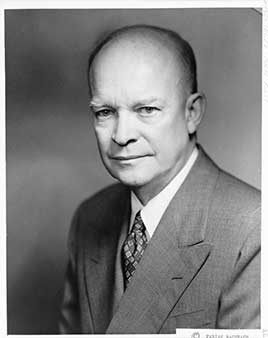
Dwight D. Eisenhower
The Allied commander in Europe in World War II. He ended the Korean War with a 1953 armistice, built the Interstate Highway System, ran three budget surpluses, sent troops to enforce school desegregation in Little Rock and signed the first civil rights laws since Reconstruction. His farewell address warned of the 'military-industrial complex'.
The economy, first day to last
Shaded areas show the years in office, with a few years before and after for comparison. Budget years ran July to June until 1976 (now October to September), so each year's figures cover parts of two calendar years.
National debt
June 30, 1952 (end of fiscal 1952): $259.11 billion → June 30, 1960 (end of fiscal 1960): $286.33 billion
Daily debt figures don't exist before 1993, so Eisenhower's numbers use the fiscal years closest to his terms. Before 1977 the budget year ran July to June.
Debt compared with the economy
Debt as a share of GDP. Above 100% means the debt is bigger than a year of everything the country produces.
Deficits and surpluses
Money borrowed each budget year (below the line) or paid down (above).
Unemployment
Jan 1953: 2.9% → Jan 1961: 6.6%. Monthly rates; the chart shows yearly averages.
Inflation
How much prices rose each year (consumer price index).
Cost of living
What everyday prices and paychecks did while in office.
Prices use the consumer price index (MeasuringWorth). The minimum wage is the federal rate set by Congress.
Executive orders
482 orders, numbered 10432–10913. The American Presidency Project counts 484, including two lettered orders such as 10695-A.
Orders signed each year
Source: Wikipedia: list of Eisenhower's executive actions (full list of every order).
Notable orders
Security rules for federal workersEO 10450April 27, 1953
Expanded loyalty screening and made 'sexual perversion' grounds for firing, which barred gay people from federal jobs for two decades.
Federal RegisterTop Secret, Secret, ConfidentialEO 10501November 5, 1953
Set up the three-level classification system for government secrets that is still used.
Federal RegisterNo discrimination by contractorsEO 10557September 3, 1954
Required a nondiscrimination clause in federal contracts.
Federal RegisterCode of Conduct for the militaryEO 10631August 17, 1955
Set rules for U.S. troops if captured, after the treatment of prisoners in Korea.
Federal RegisterTroops to Little RockEO 10730September 24, 1957
Sent the 101st Airborne and federalized the Arkansas National Guard to protect nine Black students integrating Central High School.
Federal RegisterEvery executive order 483Search, filter by topic or year, and open any order's full text
- EO 10432January 24, 1953Establishing the President's Advisory Committee on Government Organization
- EO 10433February 4, 1953Further Providing for the Administration of the Defense Production Act of 1950, as Amended
- EO 10434February 6, 1953Suspension of Wage and Salary Controls Under the Defense Production Act of 1950, as Amended
- EO 10435February 6, 1953Inspection of Income, Excess-Profits, Declared Value Excess-Profits, Capital Stock, Estate, and Gift Tax Returns by the Senate Committee on Government Operations
- EO 10436February 20, 1953Reserving Kahoolawe Island, Territory of Hawaii, for the Use of the United States for Naval Purposes and Placing it Under the Jurisdiction of the Secretary of the Navy
- EO 10437February 20, 1953Designating the Honorable Benjamin Ortiz To Act, Under Certain Circumstances, as Judge of the United States District Court for the District of Puerto Rico During the Year 1953
- EO 10438March 13, 1953Transferring Certain Functions of the National Security Resources Board and of the Chairman Thereof to the Director of Defense Mobilization
- EO 10439March 19, 1953Amendment of Executive Order No. 10163 of September 25, 1950, Establishing the Armed Forces Reserve Medal
- EO 10440March 31, 1953Amendment of Civil Service Rule VI
- EO 10441March 31, 1953Continuing in Effect Certain Appointments as Officers and Warrant Officers of the Army and the Air Force
- EO 10442March 31, 1953Inspection of Income, Excess-Profits, Declared Value Excess-Profits, Capital Stock, Estate, and Gift Tax Returns by the Senate Committee on Interstate and Foreign Commerce
- EO 10443April 7, 1953Suspension of the Eight-Hour Law as to Laborers and Mechanics Employed by the Atomic Energy Commission on Public Work Essential to the National Defense
- EO 10444April 10, 1953Amendment of Executive Order No. 8809 of June 28, 1941, Establishing the Good Conduct Medal, as Amended by Executive Order No. 9323 of March 31, 1943
- EO 10445April 10, 1953Reserving Certain Lands Acquired Under Title III of the Bankhead-Jones Farm Tenant Act as Parts of National Forests
- EO 10446April 17, 1953Specification of Laws From Which the Escapee Program Administered by the Department of State Shall Be Exempt
- EO 10447April 22, 1953Inspection of Returns by Senate Committee on the Judiciary
- EO 10448April 22, 1953Establishing the National Defense Service MedalAmended
- EO 10449April 24, 1953Creating an Emergency Board To Investigate a Dispute Between the New York, Chicago, & St. Louis Railroad Company and Certain of its Employees
- EO 10450April 27, 1953Security Requirements for Government Employment
- EO 10451April 28, 1953Inspection of Certain Returns by the Committee on the Judiciary, House of Representatives
- EO 10452May 1, 1953Providing for the Performance by the Chairman of the Civil Service Commission of Certain Functions Relating to Personnel Management
- EO 10453May 18, 1953Restoring Certain Lands Comprising Portions of the Fort Ruger Military Reservation to the Jurisdiction of the Territory of Hawaii
- EO 10454May 18, 1953Restoring Certain Lands of the Schofield Barracks Military Reservation to the Jurisdiction of the Territory of Hawaii
- EO 10455May 22, 1953Inspection of Income, Excess-Profits, Declared Value Excess-Profits, Capital Stock, Estate, and Gift Tax Returns by the Committee on Government Operations, House of Representatives
- EO 10456May 27, 1953Delegating to Secretary of Defense and the Director of Defense Mobilization Certain Functions Relating to Critical Defense Housing Areas
- EO 10457May 27, 1953Designating the Department of Justice as a Defense Agency for Certain Purposes
- EO 10458June 1, 1953Providing for the Administration of Certain Foreign Aid Programs and Related Activities
- EO 10459June 2, 1953Amendment of Executive Order No. 10422 of January 9, 1953, Prescribing Procedures for Making Available to the Secretary General of the United Nations Certain Information Concerning United States Citizens Employed or Being Considered for Employment on the Secretariat of the United Nations
- EO 10460June 16, 1953Providing for the Performance by the Director of Defense Mobilization of Certain Functions Relating to Telecommunications
- EO 10461June 17, 1953Delegating and Transferring Certain Functions and Affairs to the Office of Defense Mobilization Provided for in Reorganization Plan No. 3 of 1953
- EO 10462June 19, 1953Delegation of Certain Functions of the President to the Housing and Home Finance Administrator
- EO 10463June 25, 1953Amendment of Section 6.4 of Civil Service Rule VI
- EO 10464June 25, 1953Delegation of Functions of the President Respecting the Transfer of Wheat to Pakistan
- EO 10465June 30, 1953Suspension of Certain Provisions of the Officer Personnel Act of 1947, as Amended, Which Relate to Officers of the Marine Corps
- EO 10466June 30, 1953Continuing in Effect Certain Appointments as Commissioned Officers and Warrant Officers of the Army and of the Air Force
- EO 10467June 30, 1953Further Providing for the Administration of the Defense Production Act of 1950, as Amended
- EO 10468July 7, 1953Appointment of William C. Strand, Director, Office of Territories, Department of the Interior, as Administrator of the Puerto Rico Reconstruction Administration
- EO 10469July 11, 1953Amending the Selective Service Regulations
- EO 10470July 17, 1953Amending Executive Order No. 10408, Transferring the Administration of a Certain Portion of the Trust Territory of the Pacific Islands From the Secretary of the Interior to the Secretary of the Navy
- EO 10471July 17, 1953Authorizing the Heads of Departments and Agencies To Grant Leaves of Absence to Certain Persons
- EO 10472July 20, 1953Establishing the National Agricultural Advisory Commission
- EO 10473July 22, 1953Amendment of the Foreign Service Regulations Relating to United States Foreign Service Fees
- EO 10474July 31, 1953The Honorable Robert A. Taft
- EO 10475July 31, 1953Administration of the Housing and Rent Act of 1947, as Amended
- EO 10476August 1, 1953Administration of Foreign Aid and Foreign Information Functions
- EO 10477August 1, 1953Authorizing the Director of the United States Information Agency To Exercise Certain Authority Available by Law to the Secretary of State and the Director of the Foreign Operations Administration
- EO 10478August 5, 1953Delegating to the Secretary of Defense the Authority of the President To Order Certain Members of Reserve Components of the Armed Forces Into Active Federal Service and To Prescribe Regulations Governing the Appointment, Reappointment, and Promotion of Such Members
- EO 10479August 13, 1953Establishing the Government Contract Committee
- EO 10480August 14, 1953Further Providing for the Administration of the Defense Mobilization ProgramRevoked
- EO 10481August 15, 1953Designation of Certain Officers of the Department of Agriculture To Act as Secretary of Agriculture
- EO 10482August 15, 1953Providing for an Additional Member of the Government Contract Committee
- EO 10483September 2, 1953Establishing the Operations Coordinating Board
- EO 10484September 3, 1953Providing for the Administration of the President's Management Improvement Fund
- EO 10485September 3, 1953Providing for the Performance of Certain Functions Heretofore Performed by the President With Respect to Electric Power and Natural Gas Facilities Located on the Borders of the United States
- EO 10486September 12, 1953Providing for the Establishment of the Advisory Committee on Government Housing Policies and Programs
- EO 10487September 16, 1953Providing for the Administration of the Refugee Relief Act of 1953
- EO 10488September 23, 1953Providing for the Issuance of Regulations Governing the Purchase, Custody, Transfer, or Sale of Foreign Exchange by the United States
- EO 10489September 26, 1953Providing for the Administration of Certain Loan and Loan Guarantee Functions Under the Defense Production Act of 1950, as Amended
- EO 10490October 1, 1953Creating a Board of Inquiry To Report on Certain Labor Disputes Affecting the Maritime Industry of the United States
- EO 10491October 13, 1953Amendment of Executive Order No. 10450 of April 27, 1953, Relating to Security Requirements for Government Employment
- EO 10492October 14, 1953Establishing a Seal for the National Advisory Committee for Aeronautics
- EO 10493October 14, 1953Delegating Certain Functions of the President to the Administrator of the Small Business Administration
- EO 10494October 14, 1953Disposition of Functions Remaining Under Title IV of the Defense Production Act
- EO 10495October 14, 1953Prescribing the Order of Succession of Officers To Act as Secretary of Defense, Secretary of the Army, Secretary of the Navy, and Secretary of the Air Force
- EO 10496October 14, 1953Restoring Certain Lands Reserved for Military Purposes to the Jurisdiction of the Territory of Hawaii
- EO 10497October 27, 1953Amendment of the Regulations Relating to Commissioned Officers and Employees of the Public Health Service
- EO 10498November 4, 1953Delegating to the Secretaries of the Military Departments and the Secretary of the Treasury Certain Authority Vested in the President by the Uniform Code of Military Justice
- EO 10499November 4, 1953Delegating Functions Conferred Upon the President by Section 8 of the Uniformed Services Contingency Option Act of 1953Amended
- EO 10500November 4, 1953Designation of the Power Authority of the State of New York and Establishment of the United States Section of the St. Lawrence River Joint Board of Engineers
- EO 10501November 5, 1953Safeguarding Official Information in the Interests of the Defense of the United States
- EO 10502December 1, 1953Suspending Certain Statutory Provisions Relating to Employment in the Canal Zone
- EO 10503December 1, 1953Amendment of Executive Order No. 10011, as Amended, Authorizing the Secretary of State To Exercise Certain Powers of the President With Respect to the Granting of Allowances and Allotments to Government Personnel On Foreign Duty
- EO 10504December 1, 1953Transferring Certain Functions, Powers, and Duties to the Small Business Administration
- EO 10505December 10, 1953Amending the Selective Service Regulations
- EO 10506December 10, 1953Delegating Certain Functions of the President Under the Public Health Service Act
- EO 10507December 10, 1953Further Amendment of Executive Order No. 9805, Prescribing Regulations Governing Payment of Certain Travel and Transportation Expenses
- EO 10508December 14, 1953Excusing Federal Employees From Duty One-Half Day on December 24, 1953, and One-Half Day on December 31, 1953
- EO 10509December 16, 1953Creating an Emergency Board To Investigate a Dispute Between the Railway Express Agency, Inc., and Certain of its Employees
- EO 10510December 17, 1953Establishing a Seal for the Department of Health, Education, and Welfare
- EO 10511December 28, 1953Creating an Emergency Board To Investigate Disputes Between the Akron, Canton and Youngstown Railroad Company and Other Carriers and Certain of Their Employees
- EO 10512January 19, 1954Revocation of Executive Order No. 9047, Exempting Certain Officers and Employees of the Government From Automatic Separation From the Service
- EO 10513January 19, 1954Designating Certain Officers To Act as Secretary of LaborRevoked
- EO 10514January 19, 1954Revocation of Executive Order No. 2414 of June 30, 1916
- EO 10515January 22, 1954Amendment of Executive Order No. 10739 of August 2, 1952, Suspending the Operation of Certain Provisions of the Officer Personnel Act of 1947 Applicable to the Retirement of Colonels of the Regular Army and the Regular Air Force
- EO 10516January 26, 1954Transferring Certain Lands to the Secretary of Agriculture for Use, Administration, and Disposition Under Title III of the Bankhead-Jones Farm Tenant Act
- EO 10517February 10, 1954Designating the Honorable A. Cecil Snyder to Act, Under Certain Circumstances, as Judge of the United States District Court for the District of Puerto Rico During the Year 1954
- EO 10518February 11, 1954Inspection of Returns by the Special Committee of the House of Representatives Authorized by House Resolution 217, 83d Congress, to Investigate Tax-Exempt Foundations
- EO 10519March 5, 1954Specification of Laws From Which Functions Authorized by Mutual Security Act of 1951, as Amended, Shall be Exempt
- EO 10520March 10, 1954Transferring Certain Lands From the Department of Agriculture to the Department of the Army
- EO 10521March 17, 1954Administration of Scientific Research by Agencies of the Federal Government
- EO 10522March 26, 1954Authorizing the Director of the United States Information Agency to Carry Out Certain functions of the Board of the Foreign Service
- EO 10523March 26, 1954Designating March 31, 1954, as the Day For Dedication of the Memorial to Major General George W. Goethals and Excusing Federal Employees on the Isthmus of Panama From Duty on That Day
- EO 10524March 31, 1954Delegating Certain Functions of the President Respecting School-Construction Assistance
- EO 10525April 1, 1954Transferring From the Secretary of the Navy to the Secretary of the Interior Interest in and Control Over Certain Funds
- EO 10526April 17, 1954Transferring Certain Lands in Mississippi From the Department of Agriculture to the Department of the Army
- EO 10527April 19, 1954Inspection of Income, Excess-Profits, Declared Value Excess-Profits, Capital Stock, Estate, and Gift Tax Returns by the Senate Committee on Banking and Currency
- EO 10528April 22, 1954Addition of the Marginal Wharf Area to Sand Island Military Reservation, Territory of Hawaii
- EO 10529April 22, 1954Participation by Federal Employees in State and Local Civil Defense Pre-Emergency Training Programs
- EO 10530May 10, 1954Providing for the Performance of Certain Functions Vested in or Subject to the Approval of the President
- EO 10531May 27, 1954Amendment of Executive Order No. 10450 of April 27, 1953, as Amended, Relating to Security Requirements for Government Employment
- EO 10532May 28, 1954Amendment of the List of Communicable Diseases Contained in Executive Order No. 9708 of March 26, 1946
- EO 10533June 3, 1954Designating the Organization of American States as a Public International Organization Entitled To Enjoy Certain Privileges, Exemptions, and Immunities
- EO 10534June 9, 1954Providing for the Supervision and Direction of the Saint Lawrence Seaway Development Corporation
- EO 10536June 9, 1954Authorizing Certain Functions of Heads of Departments and Agencies Under Section 16 of the Federal Airport Act To Be Performed Without the Approval of the President
- EO 10537June 22, 1954Amending Executive Orders Nos. 10219 and 10480 With Respect to the Designation of a Commissioner of the Interstate Commerce Commission To Perform Certain Functions
- EO 10538June 22, 1954Establishing a Seal for the United States Marine Corps
- EO 10539June 22, 1954Providing for the Administration of Functions Respecting Rubber, Tin, and Abaca Heretofore Administered by the Reconstruction Finance Corporation
- EO 10540June 29, 1954Designating Certain Officers of the Government to Which the Annual and Sick Leave Act of 1951, as Amended Shall Not Apply, and Delegating the Authority To Make Such Designations to the Chairman of the United States Civil Service Commission
- EO 10541June 30, 1954Further Extension of the Existence of Quetico-Superior Committee
- EO 10542July 6, 1954Creating a Board of Inquiry To Report on a Labor Dispute Affecting the Operations of Atomic Energy Facilities
- EO 10543July 6, 1954Creating a Board of Inquiry To Report on a Labor Dispute Affecting the Operations of Atomic Energy Facilities
- EO 10544July 12, 1954Inspection of Income Tax Returns by Federal Trade Commission
- EO 10545July 15, 1954Amendment of Executive Order No. 5952 of November 23, 1932, Prescribing the Army Ration
- EO 10546July 16, 1954Suspension of Certain Provisions of the Officer Personnel Act of 1947, as Amended, Which Relate to Officers of the Marine Corps of the Grades of First Lieutenant and Captain
- EO 10547July 27, 1954Inspection of Statistical Transcript Cards by the Board of Governors of the Federal Reserve System
- EO 10548August 2, 1954Amendment of Executive Order No. 10450 of April 27, 1953, Relating to Security Requirements for Government Employment
- EO 10549August 2, 1954Providing for the Placing of Positions in the Department of Defense in Grades 16, 17, and 18 of the General Schedule of the Classification Act of 1949
- EO 10550August 5, 1954Amendment of Executive Order No. 10450 of April 27, 1953, Relating to Security Requirements for Government Employment
- EO 10551August 6, 1954Inspection of Income, Excess-Profits, Declared Value Excess-Profits, Capital Stock, Estate, and Gift Tax Returns by the Committee on Education and Labor of the House of Representatives
- EO 10552August 10, 1954Delegating to the Civil Service Commission the Authority of the President To Promulgate Regulations Under Which Certain Government Employees May Be Prevented or Relieved From Working by Administrative Order
- EO 10553August 18, 1954Amending Executive Order No. 10539 With Respect to the Administration of the Abaca Production Act of 1950
- EO 10554August 18, 1954Delegating the Authority of the President To Prescribe Regulations Authorizing Occasions Upon Which the Uniform May Be Worn by Persons Who Have Served Honorably in the Armed Forces in Time of WarAmended
- EO 10555August 23, 1954Establishing a Seal for the President's Committee on Employment of the Physically Handicapped
- EO 10556September 1, 1954Authorizing Regulations for the Permanent Promotion and Reassignment of Federal Employees
- EO 10557September 3, 1954Approving the Revised Provision in Government Contracts Relating to Nondiscrimination in Employment
- EO 10558September 8, 1954Amendment of Executive Order No. 10154, Designating Certain Officers of the Post Office Department To Act as Postmaster General
- EO 10559September 8, 1954Providing for the Administration of the President's Management Improvement Appropriation
- EO 10560September 9, 1954Administration of the Agricultural Trade Development and Assistance Act of 1954
- EO 10561September 13, 1954Designating Official Personnel Folders in Government Agencies as Records of the Civil Service Commission and Prescribing Regulations Relating to the Establishment, Maintenance, and Transfer Thereof
- EO 10562September 20, 1954Amending the Selective Service Regulations
- EO 10563September 25, 1954Revocation of Executive Order No. 10266 of June 30, 1951, Suspending Certain Provisions of the Officer Personnel Act of 1947, as Amended
- EO 10564September 28, 1954Inspection of Income, Excess-Profits, Declared Value Excess-Profits, Capital Stock, Estate, and Gift Tax Returns by the Subcommittee of the Committee on the Judiciary of the House of Representatives
- EO 10565September 28, 1954Amendment of Paragraphs 76a and 127c of the Manual for Courts-Martial, United States, 1951
- EO 10566September 29, 1954Amendment of Executive Order No. 10455, Authorizing the Inspection of Certain Tax Returns
- EO 10567September 29, 1954Further Designation Pursuant to Section 103(a) of the Renegotiation Act of 1951
- EO 10568October 1, 1954Suspending Certain Statutory Provisions Relating to Employment in the Canal Zone
- EO 10569October 5, 1954Amendment of Executive Order No. 10334 of March 26, 1952, Exempting Frederick C. Mayer From Compulsory Retirement for Age
- EO 10570October 16, 1954Creating an Emergency Board To Investigate a Dispute Between the Pullman Company and Certain of Its Employees
- EO 10571October 18, 1954Including Certain Lands in the Nantahala National Forest
- EO 10571AOctober 26, 1954Assignment of Frequencies to Government Radio Stations
- EO 10572October 26, 1954Inspection of Income, Excess-Profits, Declared-Value Excess-Profits, Capital Stock, Estate, and Gift Tax Returns by the Senate Committee on Labor and Public Welfare
- EO 10573October 26, 1954Amending Executive Order No. 10530 To Authorize the Housing and Home Finance Administrator To Exercise Certain Authority of the President
- EO 10574November 5, 1954Amendment of Executive Order No. 10480 Providing for the Administration of the Defense Mobilization Program
- EO 10575November 6, 1954Administration of Foreign-Aid Functions
- EO 10576November 16, 1954Creating an Emergency Board To Investigate a Dispute Between the Capital Airlines, Inc., National Airlines, Inc., Northwest Airlines, Inc., Trans World Airlines, Inc., United Airlines, Inc., Eastern Airlines, Inc., and Certain of Their Employees
- EO 10577November 22, 1954Amending the Civil Service Rules and Authorizing a New Appointment System for the Competitive Service
- EO 10578November 23, 1954Creating an Emergency Board To Investigate a Dispute Between Certain Carriers Represented by the Eastern, Western, and Southeastern Carriers' Conference Committees and Certain of Their Employees
- EO 10579November 30, 1954Regulations Relating to the Establishment and Operation of Interagency Motor-Vehicle Pools and Systems
- EO 10580December 4, 1954Excusing Federal Employees From Duty on December 24, and for One-Half Day on December 31, 1954
- EO 10581December 10, 1954Approving a Seal for the Saint Lawrence Seaway Development Corporation
- EO 10582December 17, 1954Prescribing Uniform Procedures for Certain Determinations Under the Buy-American ActRevoked
- EO 10583December 18, 1954Amendment to Executive Order No. 10289, Relating to the Performance of Certain Functions Affecting the Department of the Treasury
- EO 10584December 18, 1954Prescribing Rules and Regulations Relating to the Administration of the Watershed Protection and Flood Prevention Act
- EO 10585January 1, 1955Designating the Date of Termination of Combatant Activities in Korea and Waters Adjacent Thereto
- EO 10586January 13, 1955Designating Certain Officers To Act as Secretary of the Treasury
- EO 10587January 13, 1955Administration of Section 32(h) of the Trading With the Enemy Act
- EO 10588January 14, 1955Establishing the President's Commission on Veterans' Pensions
- EO 10589January 15, 1955Amendment of Executive Order No. 6783 of June 30, 1934, Creating the Quetico-Superior Committee
- EO 10590January 18, 1955Establishing the President's Committee on Government Employment Policy
- EO 10591January 20, 1955Waiving the Age Requirements To Permit Otto K. Olesen To Compete in the Competitive Civil-Service Examination for the Position of Postmaster at Los Angeles, California
- EO 10592January 21, 1955Amendment of Executive Order No. 10524 of March 31, 1954, Delegating Certain Functions of the President Respecting School-Construction Assistance
- EO 10593January 27, 1955Amending Executive Order No. 10296, as Amended, To Authorize the Director of the Office of Defense Mobilization To Perform Additional Functions of the President
- EO 10594January 31, 1955Amending the Selective Service Regulations
- EO 10595February 7, 1955Amendment of Executive Order No. 9746 of July 1, 1946, Relating to the Panama Canal and the Canal Zone
- EO 10596February 15, 1955Revocation of Executive Order No. 9908 of December 5, 1947
- EO 10597February 15, 1955Providing for the Restoration of Certain Lands to Kaakaukukui, Honolulu, Hawaii, to the Jurisdiction of the Territory of Hawaii and Transfer of Title Thereto to the Territory
- EO 10598February 28, 1955Amending Executive Order No. 10483, Establishing the Operations Coordinating Board
- EO 10599March 14, 1955Designating the Honorable A. Cecil Snyder To Act, Under Certain Circumstances, as Judge of the United States District Court for the District of Puerto Rico During the Year 1955
- EO 10600March 15, 1955Amending Executive Order No. 9260 of October 29, 1942, Entitled "Legion of Merit"
- EO 10601March 21, 1955Administration of Commodity Set-Aside
- EO 10602March 23, 1955Designating the Secretary of the Interior as the Representative of the President To Approve the Obligation and Expenditure of Certain Moneys by the Government of the Virgin Islands
- EO 10603April 19, 1955Amendment of Executive Order No. 10309, Providing for the Restoration of Possession, Use, and Control of Certain Lands Reserved for Military Purposes to the Territory of Hawaii and Transfer of Title to Such Lands to the Territory
- EO 10604April 22, 1955Delegating to the Director of the Bureau of the Budget the Authority of the President To Approve Regulations Relating to the Operation of Vending Stands on Federal Property by Blind Persons
- EO 10605April 22, 1955Amendment of Executive Order No. 10119 of March 27, 1950, Prescribing Regulations Governing the Payment of Basic Allowances for Subsistence to Members of the Uniformed Services
- EO 10606May 3, 1955Inspection of Income, Excess-Profits, Declared-Value Excess-Profits, Capital-Stock, Estate, and Gift Tax Returns by the Senate Committee on Government Operations
- EO 10607May 3, 1955Inspection of Income, Excess-Profits, Declared-Value Excess-Profits, Capital-Stock, Estate, and Gift Tax Returns by the Committee on Government Operations, House of Representatives
- EO 10608May 5, 1955United States Authority and Functions in Germany
- EO 10609May 7, 1955Delegating to the Secretary of State Authority To Appoint Alternate United States Commissioners to the Caribbean Commission
- EO 10610May 9, 1955Administration of Mutual Security and Related Functions
- EO 10611May 11, 1955Establishing the Civil Defense Coordinating Board and Defining its Duties
- EO 10612May 11, 1955Restoring Certain Lands Reserved for Military Purposes to the Jurisdiction of the Territory of Hawaii
- EO 10613May 16, 1955Amendment of Executive Order No. 10393 of September 4, 1952, Establishing the Clemency and Parole Board for War Criminals
- EO 10614May 25, 1955Regulations Governing the Payment of General-Average Contributions in Connection With the Transportation of Certain Baggage and Household Goods and Effects of Military and Civilian Personnel of the United States
- EO 10615June 17, 1955Creating an Emergency Board To Investigate a Dispute Between Certain Carriers Represented by the Eastern, Western, and Southeastern Carriers' Conference Committees and Certain of Their Employees
- EO 10616June 21, 1955Suspension of Certain Provisions of the Officer Personnel Act of 1947, as Amended, Which Relates to Officers of the Marine Corps of the Grade of Brigadier General
- EO 10617June 28, 1955Suspension of the Operation of Certain Provisions of the Officer Personnel Act of 1947 Applicable to the Retirement of Colonels of the Regular Army
- EO 10618June 28, 1955Amendment of Executive Order No. 10152, Prescribing Regulations Relating to the Right of Members of the Uniformed Services to Incentive Pay for the Performance of Hazardous Duty Required by Competent Orders
- EO 10619June 29, 1955Inspection of Individual Income Tax Returns by the Department of Health, Education, and Welfare
- EO 10620July 1, 1955Inspection of Income, Excess-Profits, Declared-Value Excess-Profits, Capital-Stock, Estate, and Gift Tax Returns by the Senate Committee on the Judiciary
- EO 10621July 1, 1955Delegation of Certain Functions of the President to the Secretary of Defense
- EO 10622July 1, 1955Creating an Emergency Board To Investigate a Dispute Between the Railway Express Agency, Inc., and Certain of Its Employees
- EO 10623July 23, 1955Amendment of Certain Provisions of Executive Orders No. 10000 and No. 10011, as Amended, Pertaining to Salary Differentials and Allowances for Officers and Employees of the Foreign Service Serving Outside the United States
- EO 10624July 28, 1955Regulations Relating to Personnel of the Department of Agriculture Assigned to Service Abroad
- EO 10625August 2, 1955Further Providing for the Administration of Foreign Aid Functions
- EO 10626August 4, 1955Establishment of the Interdepartmental Committee for Voluntary Payroll Savings Plan for the Purchase of United States Savings Bonds
- EO 10627August 5, 1955Inspection of Income, Excess-Profits, Declared-Value Excess-Profits, Capital-Stock, Estate, and Gift Tax Returns by the Committee on Un-American Activities, House of Representatives
- EO 10628August 5, 1955Restoring Limitations Upon Punishments for Violations of Articles 82, 85, 86(3), 87, 90, 91(1) and (2), 113, and 115 of the Uniform Code of Military Justice
- EO 10629August 13, 1955Authorizing Enlistments in the Ready Reserve of the Army Reserve and Marine Corps Reserve
- EO 10630August 13, 1955Creating an Emergency Board To Investigate a Dispute Between the New York Central System, Lines East, and Certain of Its Employees
- EO 10631August 17, 1955Code of Conduct for Members of the Armed Forces of the United StatesAmended
- EO 10632August 19, 1955Suspension of Certain Provisions of the Officer Personnel Act of 1947, as Amended, Which Relate to the Promotion of Officers of the Medical Corps and Dental Corps of the Navy
- EO 10633August 19, 1955Establishing an Airspace Reservation Over the Las Vegas Project, Las Vegas, Nevada
- EO 10634August 25, 1955Providing for Loans To Aid in the Reconstruction, Rehabilitation and Replacement of Facilities Which Are Destroyed or Damaged by a Major Disaster and Which Are Required for National Defense
- EO 10635September 1, 1955Creating an Emergency Board to Investigate a Dispute Between the Pennsylvania Railroad and Certain of its Employees
- EO 10636September 16, 1955Amendment of Executive Order No. 10000 of September 16, 1948, Prescribing Regulations Governing Additional Compensation and Credit Granted Certain Employees of the Federal Government Serving Outside the United States
- EO 10637September 16, 1955Delegating to the Secretary of the Treasury Certain Functions of the President Relating to the United States Coast GuardAmended
- EO 10638October 10, 1955Authorizing the Director of the Office of Defense Mobilization To Order the Release of Strategic and Critical Materials From Stock Piles in the Event of an Attack Upon the United States
- EO 10639October 10, 1955Amendment of the Tariff of United States Foreign Service Fees
- EO 10640October 10, 1955The President's Committee on Employment of the Physically Handicapped
- EO 10641October 26, 1955Amending the Civil Service Rules by Adding Rule VIII—Appointments to Overseas Positions
- EO 10642October 26, 1955Suspending Certain Statutory Provisions Relating to Employment in the Canal Zone
- EO 10643November 7, 1955Creating an Emergency Board To Investigate Disputes Between the Albany Port District Railroad and Other Carriers and Certain of Their Employees
- EO 10644November 7, 1955Administration of Title II of the International Claims Settlement Act of 1949, as Amended, Relating to the Vesting and Liquidation of Bulgarian, Hungarian, and Romanian Property
- EO 10645November 22, 1955Amendment of Executive Order No. 9 of January 17, 1873, To Permit an Officer or Employee of the Federal Government To Hold the Office of Member of the State Board of Agriculture of the State of Michigan
- EO 10646November 22, 1955Designating the Secretary of Defense To Coordinate and Facilitate Actions Required To Discharge Federal Responsibilities Under the Federal Voting Assistance Act of 1955
- EO 10647November 28, 1955Providing for the Appointment of Certain Persons Under the Defense Production Act of 1950, as AmendedRevoked
- EO 10648December 8, 1955Restoring Certain Lands Comprising Portions of the Fort Ruger Military Reservation to the Jurisdiction of the Territory of Hawaii
- EO 10649December 28, 1955Amendment of Executive Order No. 10153 Prescribing Regulations Relating to Certain Travel Time of Members of the Uniformed Services Called to Active Duty in Excess of Thirty Days
- EO 10650January 6, 1956Prescribing Regulations Governing the Selection of Certain Persons Who Have Critical Skills for Enlistment in Units of the Ready Reserve of the Armed Forces
- EO 10651January 6, 1956Providing for the Screening of the Ready Reserve of the Armed Forces Established Under the Provisions of Part II of the Armed Forces Reserve Act of 1952, as Amended
- EO 10653January 6, 1956Designating the Honorable A. Cecil Snyder To Act, Under Certain Circumstances, as Judge of the United States District Court for the District of Puerto Rico During the Year 1956
- EO 10652January 10, 1956Amendment of Paragraph 126e of the Manual for Courts-Martial, United States, 1951
- EO 10654January 20, 1956Delegating Certain Functions of the President to the Director of the Bureau of the Budget
- EO 10655January 28, 1956Air Coordinating Committee
- EO 10656February 6, 1956Establishing the President's Board of Consultants on Foreign Intelligence Activities
- EO 10657February 14, 1956Transferring to the Housing and Home Finance Administrator Certain Functions of the Atomic Energy Commission Under the Atomic Energy Community Act of 1955
- EO 10658February 15, 1956Amendment of Executive Order No. 10478 of August 5, 1953, Delegating Certain Authority of the President to the Secretary of Defense
- EO 10659February 15, 1956Amending the Selective Service Regulations
- EO 10660February 15, 1956Providing for the Establishment of a National Defense Executive Reserve
- EO 10661February 27, 1956Delegating to Certain Officers of the Government the Authority Vested in the President To Designate Persons From Foreign Countries Who May Be Permitted To Receive Instruction at the Military, Naval, Air Force, and Merchant Marine Academies
- EO 10662March 13, 1956Amendment of Executive Order No. 10480 and Revocation of Executive Order No. 10160, Relating to the Administration of the Defense Production Act of 1950
- EO 10663March 24, 1956Administration of the Escapee Program
- EO 10664April 2, 1956Restoring Certain Lands Comprising Portions of the Waianae-Kai Military Reservation to the Jurisdiction of the Territory of Hawaii
- EO 10665April 23, 1956Restoring Certain Lands of the Schofield Barracks Military Reservation to the Jurisdiction of the Territory of Hawaii
- EO 10666April 27, 1956Restoring Certain Land at Humuula, North Hilo, Hawaii, to the Possession, Use, and Control of the Territory of Hawaii
- EO 10667May 9, 1956Amendment of Executive Order No. 10629, Authorizing Enlistments in the Ready Reserve of the Army Reserve and Marine Corps Reserve, To Authorize Enlistments in the Naval and Coast Guard Reserves
- EO 10668May 10, 1956Amendment of Executive Order No. 2859, of May 11, 1918, Relating to the National Research Council
- EO 10669May 18, 1956Amendment of Executive Order No. 10495, Prescribing the Order of Succession of Officers To Act as Secretary of Defense, Secretary of the Army, Secretary of the Navy, and Secretary of the Air Force
- EO 10670June 12, 1956Establishing a Flag for the United States Army
- EO 10671June 26, 1956Fleet Admiral Ernest J. King
- EO 10672July 9, 1956Withholding of District of Columbia Income Taxes by Federal Agencies
- EO 10673July 16, 1956Fitness of American Youth
- EO 10674July 31, 1956Exempting Certain Officers and Employees in the Executive Branch of the Government From Automatic Separation From the Service
- EO 10675August 21, 1956Amendment of Section 203 of Executive Order 10577 of November 22, 1954, Providing for the Conversion of Certain Career-Conditional Appointments to Career Appointments
- EO 10676September 1, 1956Designating the World Meteorological Organization as a Public International Organization Entitled To Enjoy Certain Privileges, Exemptions, and Immunities
- EO 10677September 1, 1956Amendment of Executive Order 10629, as Amended, To Authorize Enlistments in the Ready Reserve of the Air Force Reserve
- EO 10678September 20, 1956Administration of the Functions of the Rubber Producing Facilities Disposal Commission
- EO 10679September 20, 1956Withholding of Compensation of Certain Civilian Employees of the Army National Guard and the Air National Guard for State Employee Retirement System Purposes
- EO 10680October 2, 1956Designating the International Finance Corporation as a Public International Organization Entitled To Enjoy Certain Privileges, Exemptions, and Immunities
- EO 10681October 22, 1956Amendment of Executive Order No. 10152, Prescribing Regulations Relating to Incentive Pay for the Performance of Hazardous Duty
- EO 10682October 22, 1956Amendment of Section 2(c) of Executive Order 10530, Delegating to the Civil Service Commission the Authority of the President To Exempt Certain Employees From Automatic Separation From the Service
- EO 10683October 26, 1956Including Certain Lands in the Cherokee National Forest
- EO 10684October 26, 1956Including Certain Lands in the Cherokee National Forest
- EO 10685October 27, 1956Providing for the Administration of the Agricultural Trade Development and Assistance Act of 1954, as Amended
- EO 10686November 1, 1956Amendment of Executive Order No. 10154, Designating Certain Officers of the Post Office Department To Act as Postmaster General
- EO 10687November 16, 1956Suspension of a Portion of Section 5762(a) of Title 10 of the United States Code Relating to the Recommendation of Officers for Promotion to Certain Grades
- EO 10688November 16, 1956Restoring Certain Lands Comprising Portions of the Waianae-Kai Military Reservation to the Jurisdiction of the Territory of Hawaii
- EO 10689November 22, 1956Creating a Board of Inquiry To Report on Certain Labor Disputes Affecting the Maritime Industry of the United States
- EO 10690November 23, 1956Suspension of Compliance With Certain Statutory Provisions Relating to Employment in the Canal Zone
- EO 10691December 5, 1956Creating an Emergency Board To Investigate a Dispute Between the Spokane, Portland & Seattle Railway Company and Certain of Its Employees Represented by the Brotherhood of Locomotive Engineers
- EO 10692December 22, 1956Amendment of Executive Order No. 9080, To Provide for the Designation of Members of the Joint Mexican-United States Defense Commission by the Secretary of Defense
- EO 10693December 22, 1956Creating an Emergency Board To Investigate Disputes Between the Akron & Barberton Belt Railroad and Other Carriers and Certain of Their Employees
- EO 10694January 10, 1957Authorizing the Secretaries of the Army, Navy, and Air Force To Issue Citations in the Name of the President of the United States to Military and Naval Units for Outstanding Performance in ActionAmended
- EO 10695January 16, 1957Revoking Paragraph 2(b) of Executive Order No. 10096 of January 23, 1950, Entitled "Providing for a Uniform Patent Policy for the Government With Respect to Inventions Made by Government Employees and for the Administration of Such Policy"
- EO 10695AJanuary 16, 1957Radio Frequencies
- EO 10696January 25, 1957Creating an Emergency Board To Investigate a Dispute Between the Railway Express Agency, Incorporated, and Certain of Its Employees Represented by the International Brotherhood of Teamsters, Chauffeurs, Warehousemen and Helpers of America
- EO 10697February 6, 1957Tariff of United States Foreign Service Fees
- EO 10698February 8, 1957Amendment of Executive Order No. 10648, Restoring Certain Portions of the Fort Ruger Military Reservation to the Jurisdiction of the Territory of Hawaii
- EO 10699February 19, 1957Inspection of Income, Excess-Profits, Declared-Value Excess-Profits, Capital-Stock, Estate, and Gift Tax Returns by the Senate Committee on Government Operations
- EO 10700February 25, 1957Further Providing for the Operations Coordinating Board
- EO 10701March 12, 1957Inspection of Income, Excess-Profits, Declared-Value Excess-Profits, Capital-Stock, Estate, and Gift Tax Returns by the Committee on Un-American Activities, House of Representatives
- EO 10702March 12, 1957Rear Admiral Richard E. Byrd
- EO 10703March 17, 1957Inspection of Income, Excess-Profits, Declared-Value Excess-Profits, Capital-Stock, Estate, and Gift Tax Returns by the Select Committee of the Senate Established by Senate Resolution 74, 85th Congress, To Investigate Improper Activities in Labor-Management Relations, and for Other Purposes
- EO 10704March 25, 1957Change in Membership of the President's Council on Youth Fitness
- EO 10705April 17, 1957Delegations of Certain Authority of the President Relating to Radio Stations and Communications
- EO 10706April 25, 1957Inspection of Income, Excess-Profits, Declared-Value Excess-Profits, Capital-Stock, Estate, and Gift Tax Returns by the Senate Committee on the Judiciary
- EO 10707May 6, 1957Establishing a Seal for the United States Coast Guard
- EO 10708May 6, 1957Further Providing for the Administration of the Agricultural Trade Development and Assistance Act of 1954, as Amended
- EO 10709May 9, 1957Creating an Emergency Board To Investigate a Dispute Between the Toledo, Lorain & Fairport Dock Company, the Toledo Lakefront Dock Company, and the Cleveland Stevedore Company, and Certain of Their Employees
- EO 10710May 14, 1957Creating a Board of Inquiry To Report on a Labor Dispute Affecting the Operations of Atomic Energy Facilities
- EO 10711May 14, 1957Restoring Certain Lands Comprising Portions of the Lualualei Military Reservation to the Jurisdiction of the Territory of Hawaii
- EO 10712May 17, 1957Inspection of Income, Excess-Profits, Declared-Value Excess-Profits, Capital-Stock, Estate, and Gift Tax Returns by the Senate Committee on the Judiciary
- EO 10713June 5, 1957Providing for the Administration of the Ryukyu Islands
- EO 10714June 13, 1957Amending the Selective Service Regulations
- EO 10715June 17, 1957Revoking Executive Order No. 9775 of September 3, 1946
- EO 10716June 17, 1957Administration of the International Cultural Exchange and Trade Fair Participation Act of 1956
- EO 10717June 27, 1957The President's Award for Distinguished Federal Civilian Service
- EO 10718June 27, 1957Delegating to the Secretary of State Authority To Prescribe the Rates or Tariffs of Fees for Official Services at United States Embassies, Legations, and Consulates
- EO 10719July 3, 1957Restoring Certain Lands of the Schofield Barracks Military Reservation to the Jurisdiction of the Territory of Hawaii
- EO 10720July 11, 1957Amendment of Executive Order No. 10678, Placing Certain Matters Under the Administration or Jurisdiction of the Federal Facilities Corporation
- EO 10721August 5, 1957The Honorable Walter F. George
- EO 10722August 5, 1957Amendment of Executive Order No. 10590, Establishing the President's Committee on Government Employment Policy
- EO 10723August 6, 1957Creating an Emergency Board To Investigate a Dispute Between the General Managers' Association of New York Representing the New York Central Railroad, New York Central Railroad Company, Brooklyn Eastern District Terminal, Jay Street Connecting Railroad, New York Dock Railway, Bush Terminal Railroad, Baltimore & Ohio Railroad Company, the Pennsylvania Railroad, Erie Railroad Company, Reading Company, Delaware, Lackawanna & Western Railroad, and the Central Railroad Company of New Jersey, and Certain of Their Employees
- EO 10724August 12, 1957Establishing a Career Executive Committee
- EO 10725August 16, 1957Suspension of the Provision of Section 5751(b) of Title 10, United States Code, Which Relates to Officers of the Marine Corps of the Grade of Captain
- EO 10726August 16, 1957Suspension of Compliance With Certain Statutory Provisions Relating to Employment in the Canal Zone
- EO 10727August 31, 1957Designating the Preparatory Commission of the International Atomic Energy Agency, the International Atomic Energy Agency, and the Universal Postal Union as Public International Organizations Entitled To Enjoy Certain Privileges, Exemptions, and Immunities
- EO 10728September 6, 1957Establishing the President's Committee on Fund-Raising Within the Federal Service
- EO 10729September 16, 1957Special Assistant to the President for Personnel Management
- EO 10730September 24, 1957Providing Assistance for the Removal of an Obstruction of Justice Within the State of Arkansas
- EO 10731October 10, 1957Delegating to the Director of the Bureau of the Budget the Authority of the President To Transfer Certain Records, Property, and Personnel
- EO 10732October 10, 1957Amendment of Executive Order No. 10250, Providing for the Performance of Certain Functions of the President by the Secretary of the Interior
- EO 10733October 10, 1957Providing for an Additional Member and for an Executive Vice Chairman of the Government Contract Committee
- EO 10734October 17, 1957Amendment of Executive Order No. 10657, Relating to the Transfer to the Housing and Home Finance Administrator of Certain Functions Under the Atomic Energy Community Act of 1955
- EO 10735October 17, 1957Amending the Selective Service Regulations
- EO 10736October 23, 1957Adopting an Official Seal for the Department of the Navy
- EO 10737October 29, 1957Further Providing for the Administration of Disaster Relief
- EO 10738November 15, 1957Inspection of Estate and Gift Tax Returns by State Tax Officials
- EO 10739November 15, 1957Amendment of Executive Order No. 10152, Prescribing Regulations Relating to Incentive Pay for the Performance of Hazardous Duty by Members of the Uniformed Services
- EO 10740November 21, 1957Change in the Membership of the President's Council on Youth Fitness
- EO 10741November 25, 1957Establishing the Trade Policy Committee
- EO 10742November 29, 1957Further Providing for the Administration of Foreign-Aid Functions
- EO 10743December 10, 1957Sale of Vessels of the Navy
- EO 10744December 10, 1957Excusing Federal Employees From Duty for One-Half Day on December 24, and One-Half Day on December 31, 1957
- EO 10745December 12, 1957Amendment of Section 203 of Executive Order No. 10577 of November 22, 1954, as Amended, Providing for the Conversion of Certain Career-Conditional Appointments to Career Appointments
- EO 10746December 12, 1957Further Providing for the Administration of the Agricultural Trade Development and Assistance Act of 1954, as Amended
- EO 10747December 31, 1957Designating the Secretary of State To Act for the United States in Certain Matters Pertaining to Japanese War Criminals
- EO 10748January 1, 1958Appointing the Honorable Edward I. P. Tatelman To Act as Special Judge of the United States District Court for the District of the Canal Zone in a Certain Case
- EO 10749January 21, 1958Creating an Emergency Board To Investigate a Dispute Between the Eastern Air Lines, Inc., and Certain of its Employees
- EO 10750January 28, 1958Creating an Emergency Board To Investigate a Dispute Between the Eastern Air Lines, Inc., and Certain of its Employees
- EO 10751February 11, 1958Amendment of Executive Order No. 10127, Establishing Airspace Reservations Over Certain Facilities of the United States Atomic Energy Commission
- EO 10752February 12, 1958Designating the Secretary of the Interior To Execute Certain Powers and Functions Vested in the President by the Act of February 22, 1935, 49 Stat. 30, as Amended
- EO 10753February 15, 1958Designation of Certain Officers of the Department of the Interior To Act as Secretary of the Interior
- EO 10754February 22, 1958Amendment of Executive Order No. 10655, Relating to the Air Coordinating Committee
- EO 10755February 22, 1958Transferring From the Department of the Navy to the Housing and Home Financing Agency, Subject to Reservation of Mineral Rights, Certain Land Located Withing Naval Petroleum Reserve No. 2
- EO 10756February 26, 1958The Honorable Frederick M. Dearborn, Jr.
- EO 10757February 27, 1958Creating an Emergency Board To Investigate a Dispute Between Eastern Air Lines, Inc., Trans World Airlines, Inc., United Air Lines, Inc., Northwest Airlines, Inc., Northeast Airlines, Inc., Capital Airlines, Inc., and National Airlines, Inc., and Certain of Their Employees
- EO 10758March 4, 1958Establishing a Career Executive Program Within the Civil Service System
- EO 10759March 17, 1958Amendment of Executive Order No. 10530, Providing for the Performance of Certain Functions Vested in or Subject to Approval of the President
- EO 10760March 27, 1958Creating an Emergency Board To Investigate a Dispute Between the Trans World Airlines, Inc., and Certain of its Employees
- EO 10761March 27, 1958Government Purchases of Crude Petroleum and Petroleum Products
- EO 10762March 28, 1958Delegating to the Secretary of Defense the Authority of the President To Order to Active Duty Members of the Reserve Components of the Armed Forces Who Are in Medical, Dental, or Allied Specialist Categories and To Prescribe Regulations Governing the Appointment, Reappointment, and Promotion of Such Members
- EO 10763April 23, 1958Amendment of Executive Order No. 10422, as Amended, Prescribing Procedures for Making Available to the Secretary General of the United Nations Certain Information Concerning United States Citizens Employed or Being Considered for Employment on the Secretariat of the United Nations
- EO 10764April 23, 1958Suspension of the Eight-Hour Law as to Laborers and Mechanics Employed by the Civil Aeronautics Administration on Public Work Essential to the National Defense
- EO 10765April 24, 1958Regulations Governing the Award of Life-Saving Medals Under the Medals of Honor Act
- EO 10766May 1, 1958Delegating to the Director of the Bureau of the Budget the Authority of the President To Approve Regulations Relating to the Rental of Substandard Housing for Members of the Uniformed Services
- EO 10767May 9, 1958Further Extension of the Existence of the Quetico-Superior Committee
- EO 10768May 16, 1958Termination of the Airspace Reservation Established by Executive Order No. 7138 Over a Portion of the Aleutian Islands, Alaska
- EO 10769May 29, 1958Designating the International Hydrographic Bureau as a Public International Organization Entitled To Enjoy Certain Privileges, Exemptions, and Immunities
- EO 10770June 19, 1958Creating an Emergency Board To Investigate a Dispute Between American Airlines, Incorporated, and Certain of its Employees Represented by the Air Line Pilots Association, International
- EO 10771June 20, 1958Amendment of Executive Order No. 10534, Relating to the Supervision and Direction of the Saint Lawrence Seaway Development Corporation
- EO 10772June 30, 1958Amendment of Executive Order No. 10673 Relating to the Fitness of American Youth
- EO 10773July 1, 1958Delegating and Transferring Certain Functions and Affairs to the Office of Defense and Civilian Mobilization
- EO 10774July 25, 1958Providing for the Protection of the Civil-Service Rights of Federal Personnel Who Transfer to the International Atomic Energy Agency
- EO 10775July 25, 1958Amendment of Executive Order No. 10633, Establishing an Airspace Reservation Over the Las Vegas Project, Las Vegas, Nevada
- EO 10776July 28, 1958Delegating to the Secretary of Defense Certain Authority of the President Relating to the Modification of Standards and Requirements With Respect to the Induction of Persons Into the Armed, and For Other Purposes
- EO 10777August 6, 1958Amending Executive Order No. 10758 To Increase the Membership of the Career Executive Board
- EO 10778August 20, 1958Authorizing the Appointment of William K. Harris to a Competitive Position Without Compliance With the Civil Service Act and Rules
- EO 10779August 20, 1958Directing Federal Agencies To Cooperate With State and Local Authorities in Preventing Pollution of the Atmosphere
- EO 10780September 2, 1958Suspension of Certain Provisions of Section 5762(a), Title 10, United States Code, Which Relate to Promotion of Officers of Supply Corps, Chaplain Corps, Civil Engineer Corps, and Medical Service Corps of the Navy
- EO 10781September 2, 1958Suspension of Certain Provisions of Section 5764(a), Title 10, United States Code, Which Relate to Establishment of Zones for Promotion of Male Officers of the Navy
- EO 10782September 6, 1958Amending Executive Order No. 10773 of July 1, 1958, Relating to Civil and Defense Mobilization
- EO 10783October 1, 1958Transferring Certain Functions From the Department of Defense to the National Aeronautics and Space Administration
- EO 10784October 1, 1958Specification of Laws From Which Functions Authorized by Mutual Security Act of 1954, as Amended, Shall Be Exempt
- EO 10785October 17, 1958Change in the Membership of the President's Council on Youth Fitness
- EO 10786November 1, 1958Transferring Functions of the Airways Modernization Board to the Administrator of the Federal Aviation Agency
- EO 10787November 6, 1958Transferring Jurisdiction Over Certain Lands From the Department of Agriculture to the Department of the Interior, for Use, Administration, or Exchange Under the Taylor Grazing Act and Other Statutes
- EO 10788November 14, 1958Suspension of Compliance With Certain Statutory Provisions Relating to Employment in Canal Zone
- EO 10789November 14, 1958Authorizing Agencies of the Government To Exercise Certain Contracting Authority in Connection With National-Defense Functions and Prescribing Regulations Governing the Exercise of Such AuthorityAmended
- EO 10790November 28, 1958Amendment of Executive Order No. 10530, Providing for the Performance of Certain Functions Vested in or Subject to the Approval of the President
- EO 10791November 28, 1958Designating Certain Officers To Act as Secretary of State
- EO 10792November 28, 1958Excusing Federal Employees From Duty All Day on December 26, 1958
- EO 10793December 3, 1958Transferring Certain Functions From the Department of Defense to the National Aeronautics and Space Administration
- EO 10794December 10, 1958Establishing the Canal Zone Merit System and Prescribing Regulations Relating to Conditions of Employment in the Canal Zone
- EO 10795December 13, 1958Designating the Intergovernmental Maritime Consultative Organization as a Public International Organization Entitled To Enjoy Certain Privileges, Exemptions, and Immunities
- EO 10796December 24, 1958Amendment of Executive Order No. 10655 Relating to the Air Coordinating Committee
- EO 10797December 24, 1958Delegating to the Director of the Bureau of the Budget Certain Authority Vested in the President by the Federal Aviation Act of 1958
- EO 10798January 3, 1959Flag of the United States
- EO 10799January 15, 1959Providing Further for the Administration of the Agricultural Trade Development and Assistance Act of 1954, as Amended
- EO 10800January 15, 1959Implementing the Government Employees Training Act
- EO 10801January 21, 1959Amendment of Executive Order No. 10703, Authorizing the Inspection of Certain Tax Returns
- EO 10802January 23, 1959Establishing the Committee on Government Activities Affecting Prices and Costs
- EO 10803February 2, 1959Providing for the Terms of Office of the Members of the International Development Advisory Board
- EO 10804February 12, 1959Delegating to the Civil Service Commission the Authority of the President To Prescribe Regulations Under the Federal Employees International Organization Service Act
- EO 10805February 18, 1959Designating the Central Intelligence Agency as Excepted From Certain Provisions of the Government Employees Training Act
- EO 10806March 10, 1959Inspection of Income, Excess-Profits, Estate, and Gift Tax Returns by the Senate Committee on Government Operations
- EO 10807March 13, 1959Federal Council for Science and Technology
- EO 10808March 19, 1959Inspection of Income, Excess-Profits, Declared-Value Excess-Profits, Capital-Stock, Estate, and Gift Tax Returns by the Senate Committee on the Judiciary
- EO 10809March 19, 1959Amending the Selective Service Regulations
- EO 10810April 22, 1959Regulations Governing the Allowance of Travel Expenses of Claimants and Beneficiaries of the Veterans' Administration and Their Attendants
- EO 10811April 22, 1959Creating an Emergency Board To Investigate a Dispute Between Pan American World Airways, Inc., and Certain of its Employees
- EO 10812April 24, 1959Establishing a Flag for the United States Navy
- EO 10813April 29, 1959Including Certain Lands in the Chattahoochee National Forest and the Nantahala National Forest
- EO 10814April 29, 1959Inspection of Statistical Transcript Cards and Corporation and Individual Income Tax Returns by the Securities and Exchange Commission
- EO 10815April 29, 1959Inspection of Income, Excess-Profits, Estate, and Gift Tax Returns by the Committee on Un-American Activities, House of Representatives
- EO 10816May 7, 1959Amendment of Executive Order No. 10501 of November 5, 1953, Relating to Safeguarding Official Information in the Interests of the Defense of the United States
- EO 10817May 8, 1959The Honorable Donald A. Quarles
- EO 10818May 8, 1959Inspection of Income, Excess-Profits, Estate, and Gift Tax Returns by the Committee on Government Operations, House of Representatives
- EO 10819May 8, 1959Amendment of Executive Order No. 10480, as Amended, Relating to the Defense Mobilization Program
- EO 10820May 18, 1959Prescribing the Order of Succession of Officers To Act as Secretary of Defense, Secretary of the Army, Secretary of the Navy, and Secretary of the Air Force
- EO 10821May 20, 1959Amendment of Executive Order No. 10168 of October 11, 1950, Prescribing Regulations Relating to the Right of Enlisted Members of the Uniformed Services to Additional Pay for Sea and Foreign Duty
- EO 10822May 20, 1959Further Providing for the Administration of Foreign-Aid Functions
- EO 10823May 26, 1959Coat of Arms, Seal, and Flag of the President of the United States
- EO 10824May 29, 1959Designating the National Aeronautics and Space Administration as an Agency To Have Certain Contractual Authority Under the Assignment of Claims Act of 1940, as Amended
- EO 10825June 12, 1959Excusing Federal Employees From Duty All Day on July 3, 1959
- EO 10826June 25, 1959Authorizing the Civil Service Commission To Confer Benefits in Certain Cases
- EO 10827June 25, 1959Further Providing for the Administration of the Agricultural Trade Development and Assistance Act of 1954, as Amended
- EO 10828July 15, 1959Designating the Airport Being Constructed in the Counties of Fairfax and Loudoun in the State of Virginia as the Dulles International Airport
- EO 10829July 20, 1959Fleet Admiral William D. Leahy
- EO 10830July 24, 1959Establishing a Seal for the President's Council on Youth Fitness
- EO 10831August 14, 1959Establishing the Federal Radiation Council
- EO 10832August 18, 1959Revocation of Executive Order No. 9887, Designating Certain Public International Organizations Entitled To Enjoy Certain Privileges, Exemptions, and Immunities
- EO 10833August 20, 1959Transferring Title to Certain Lands at Sand Island, Territory of Hawaii, to the Territory of Hawaii
- EO 10834August 21, 1959The Flag of the United States
- EO 10835August 21, 1959Delegating to the Chairman of the Civil Service Commission the Authority of the President To Make Certain Determinations Relating to the Payment of Presidential Awards
- EO 10836September 8, 1959Amendment of Executive Order No. 10530, Providing for the Performance of Certain Functions Vested in or Subject to the Approval of the President
- EO 10837September 14, 1959Amending the Selective Service Regulations
- EO 10838September 16, 1959Further Amendment of Executive Order 10700, as Amended, Providing for the Operations Coordinating Board
- EO 10839September 30, 1959Designating Certain Officers To Act as Secretary of State
- EO 10840September 30, 1959Designating the Federal Aviation Agency as an Agency To Have Certain Contractual Authority Under the Assignment of Claims Act of 1940, as Amended
- EO 10841September 30, 1959Providing for the Carrying Out of Certain Provisions of the Atomic Energy Act of 1954, as Amended, Relating to International Cooperation
- EO 10842October 6, 1959Creating a Board of Inquiry To Report on Certain Labor Disputes Affecting the Maritime Industry of the United States
- EO 10843October 9, 1959Creating a Board of Inquiry To Report on a Labor Dispute Affecting the Steel Industry of the United States
- EO 10844October 9, 1959Enlarging the Wasatch National Forest—Utah
- EO 10845October 12, 1959Further Specification of Laws From Which Functions Authorized by the Mutual Security Act of 1954, as Amended, Shall Be Exempt
- EO 10846October 12, 1959Inspection of Income, Excess-Profits, Estate, and Gift Tax Returns by the Senate Committee on Agriculture and Forestry
- EO 10847October 12, 1959Establishing the Committee for Rural Development Program
- EO 10848October 14, 1959Amendment of Executive Order No. 10843, Creating a Board of Inquiry to Report on a Labor Dispute Affecting the Steel Industry of the United States
- EO 10849November 27, 1959Establishing a Seal for the National Aeronautics and Space Administration
- EO 10850November 27, 1959Modifying the Exterior Boundaries of Certain National Forests in Alabama, Florida, Louisiana, Mississippi, North Carolina, Oklahoma, and South Carolina
- EO 10851November 27, 1959Enlarging the Chattahoochee, Kisatchie, Holly Springs, and Ouachita National Forests
- EO 10852November 27, 1959Amendment of Executive Order No. 10530, Providing for the Performance of Certain Functions Vested in or Subject to the Approval of the President
- EO 10853November 27, 1959Delegating the Authority of the President With Respect to Various Allowances to Certain Government Personnel on Foreign Duty
- EO 10854November 27, 1959Extension of the Application of the Federal Aviation Act of 1958
- EO 10855November 27, 1959Inspection of Income Tax Returns by the Senate Committee on the Judiciary
- EO 10856December 3, 1959Excusing Federal Employees From Duty One-Half Day on December 24, 1959
- EO 10857December 29, 1959Determining the Termination of Certain Federal Functions in Alaska and Delegating to the Secretary of the Interior the Authority of the President To Transfer to Alaska Property Owned or Held by the United States in Connection With Such Functions
- EO 10858January 13, 1960The President's Committee for Traffic Safety
- EO 10859February 5, 1960Revocation of Executive Order 10758 Establishing a Career Executive Program Within the Civil Service System, and Executive Order 10777, Amending Executive Order 10758
- EO 10860February 5, 1960Coat of Arms, Seal, and Flag of the President of the United States
- EO 10861February 11, 1960Suspension of Certain Provisions of Section 5762 of Title 10 of the United States Code Which Relate to the Promotion of Officers of the Supply Corps, Chaplain Corps, Civil Engineer Corps, and Medical Service Corps of the Navy
- EO 10862February 12, 1960Creating an Emergency Board To Investigate a Dispute Between Atchison, Topeka and Santa Fe Railway Company—Coast Lines and Certain of its Employees
- EO 10863February 18, 1960Authorizing the Attorney General To Seize Arms and Munitions of War, and Other Articles, Pursuant to Section 1 of Title VI of the Act of June 15, 1917, as Amended
- EO 10864February 18, 1960Designating the Pan American Health Organization as a Public International Organization Entitled To Enjoy Certain Privileges, Exemptions, and Immunities
- EO 10865February 20, 1960Safeguarding Classified Information Within IndustryAmended
- EO 10866February 20, 1960Designating the Southeast Asia Treaty Organization as a Public International Organization Entitled To Enjoy Certain Privileges, Exemptions, and Immunities
- EO 10867February 20, 1960Readiness of the United States District Court for the District of Alaska To Assume the Functions Imposed Upon It
- EO 10868February 29, 1960Creating an Emergency Board To Investigate a Dispute Between the New York Central System and Certain of Its Employees
- EO 10869March 9, 1960Amendment of Civil Service Rule II, as Prescribed by Executive Order No. 10577 of November 22, 1954
- EO 10870March 15, 1960Designating the Facilities of the National Aeronautics and Space Administration at Huntsville, Alabama, as the George C. Marshall Space Flight Center
- EO 10871March 15, 1960Inspection of Income, Excess-Profits, Estate, and Gift Tax returns by the House Committee on Public Works
- EO 10872March 18, 1960Creating an Emergency Board To Investigate a Dispute Between Pan American World Airways, Inc., and Certain of Its Employees
- EO 10873April 8, 1960Designating the Inter-American Development Bank as a Public International Organization Entitled To Enjoy Certain Privileges, Exemptions, and Immunities
- EO 10874April 18, 1960Creating an Emergency Board To Investigate a Dispute Between the Long Island Railroad Company and Certain of Its Employees
- EO 10875April 22, 1960Creating an Emergency Board To Investigate Disputes Between the Akron & Barberton Railroad and Other Carriers, and Certain of Their Employees
- EO 10876April 22, 1960Amendment of Executive Order 10855, Authorizing the Inspection of Certain Tax Returns
- EO 10877May 20, 1960Creating an Emergency Board To Investigate a Dispute Between the Pennsylvania Railroad Company and Certain of Its Employees
- EO 10878May 23, 1960Creating an Emergency Board To Investigate a Dispute Between the Chicago, Rock Island and Pacific Railroad Company and Other Carriers Represented by the Western Carriers' Conference Committee and Certain of Their Employees
- EO 10879June 1, 1960Establishing the White House Service Certificate and the White House Service Badge
- EO 10880June 7, 1960Permitting Certain Employees To Be Given Career or Career Conditional Appointments
- EO 10881July 6, 1960Amendment of EO 10810, Prescribing Regulations Governing the Allowance of Travel Expenses of Claimants and Beneficiaries of the Veterans' Administration and Their Attendants
- EO 10882July 18, 1960Further Amendment of Executive Order No. 10289, Relating to the Performance of Certain Functions Affecting the Department of the Treasury
- EO 10883August 11, 1960Termination of the Air Coordinating Committee
- EO 10884August 17, 1960Amendment of Executive Order 10560, Providing for the Administration of the Agricultural Trade Development and Assistance Act of 1954, as Amended
- EO 10885August 31, 1960Sale of Vessels of the Navy
- EO 10886September 6, 1960Suspension of Certain Provisions of Section 5231(b) of Title 10 of the United States Code Which Relate to the Number of Officers Serving in the Grades of Admiral and Vice Admiral in the Navy
- EO 10887September 23, 1960Designating the Department of Commerce To Perform Functions With Respect to Participation of the United States in the Century 21 Exposition
- EO 10888September 28, 1960Creating an Emergency Board To Investigate a Dispute Between Certain Carriers Represented by the New York Harbor Carriers' Conference Committee and Certain of Their Employees
- EO 10889October 5, 1960Amendment of Executive Order 10530 Providing for the Performance of Certain Functions Vested in or Subject to the Approval of the President
- EO 10890October 27, 1960Including Certain Lands in the Dixie National Forest and Transferring Certain Lands From the Department of Agriculture to the Department of the Interior
- EO 10891November 1, 1960Establishing a Commission To Inquire Into a Controversy Between Certain Carriers and Certain of Their Employees
- EO 10892November 8, 1960Amendment of Executive Order 10152, Prescribing Regulations Relating to Incentive Pay for the Performance of Hazardous Duty by Members of the Uniformed Services
- EO 10893November 8, 1960Administration of Mutual Security and Related Functions
- EO 10894November 15, 1960Establishing the President's Committee on Migratory Labor
- EO 10895November 25, 1960Extension of the Provisions for Rotation of Civilian Employees of the Defense Establishment Assigned to Duty Outside the United States
- EO 10896November 29, 1960Amendment of Executive Order No. 6260 of August 28, 1933
- EO 10897December 2, 1960Authorizing the Secretary of State To Prescribe Rules and Regulations Relating to the Foreign Service Retirement and Disability System
- EO 10898December 2, 1960Establishing the Interdepartmental Highway Safety Board
- EO 10899December 9, 1960Authorization for the Communication of Restricted Data by the Central Intelligence Agency
- EO 10900January 5, 1961Administration of the Agricultural Trade Development and Assistance Act of 1954, as Amended
- EO 10901January 9, 1961Amendment of Executive Order 10501, Relating to Safeguarding Official Information in the Interests of the Defense of the United States
- EO 10902January 9, 1961Providing for the Issuance of Emergency Preparedness Orders by the Director of the Office of Civil and Defense Mobilization
- EO 10903January 9, 1961Delegating Authority of the President With Respect to Regulations Relating to Certain Allowances and Benefits to Government Personnel on Overseas Duty
- EO 10904January 12, 1961Creating an Emergency Board To Investigate a Dispute Between Certain Carriers Represented by the New York Harbor Carriers' Conference Committee and Certain of Their Employees
- EO 10905January 14, 1961Amendment of Executive Order 6260 of August 28, 1933, as Amended
- EO 10906January 17, 1961Inspection by Certain Classes of Persons and State and Federal Government Establishments of Returns Made in Respect of Certain Taxes Imposed by the Internal Revenue Code of 1954
- EO 10907January 17, 1961Inspection by Renegotiation Board of Income Tax Returns Made Under the Internal Revenue Code of 1954
- EO 10908January 17, 1961Inspection by Federal Trade Commission of Income Tax Returns of Corporations Made Under the Internal Revenue Code of 1954
- EO 10909January 17, 1961Amendment of Executive Order 10865, Safeguarding Classified Information Within Industry
- EO 10910January 17, 1961Providing for the Design and Award of the National Medal of Science
- EO 10911January 17, 1961Inspection by Department of Commerce of Income Tax Returns Made Under the Internal Revenue Code of 1954
- EO 10912January 18, 1961Amending Executive Order 10716 of June 17, 1957
- EO 10913January 18, 1961Amending Executive Order 10584 of December 18, 1954, Prescribing Rules and Regulations Relating to the Administration of the Watershed Protection and Flood Prevention Act
Source: Executive Orders Archive, compiled from the American Presidency Project and the Federal Register. Topics are the archive's automated tags; "Revoked" and similar labels come from the Federal Register's records.
Pardons and commutations
A pardon wipes out the punishment for a federal crime; a commutation shortens a sentence but leaves the conviction. Counts are by federal fiscal year (July to June before 1977). Fiscal 1953 covers January 20 to June 30, 1953; fiscal 1961 covers July 1960 to January 20, 1961.
Granted each year
Source: U.S. Dept. of Justice, clemency statistics, which lists every recipient with the crime and sentence.
Notable grants: tap to see the crime
Maurice SchickCommutationMarch 25, 1960
The crime: Murder of an eight-year-old girl at a U.S. base in Japan (court-martial, 1954)
Sentence: Death
Why it drew attention: Eisenhower commuted the death sentence to life with no chance of parole, a condition the Supreme Court upheld in 1974.
SourceInvestigations and legal record
The same checklist for every president. Tap a row for details and sources.
ImpeachedNoNo
No articles of impeachment were voted on.
Criminally chargedNoNo
Never charged.
Aides or cabinet convictedNo — two resignationsPartly
No one was convicted. His chief of staff, Sherman Adams, resigned in 1958 over gifts from a businessman, and Air Force Secretary Harold Talbott resigned in 1955 over conflicts of interest.
SourceSpecial counselsNoNo
None were appointed.
Misuse of DOJ, FBI or IRSPartly — FBI program beganPartly
The FBI started COINTELPRO in 1956 to disrupt the Communist Party; the Church Committee (1975–76) found it later spread to civil rights and other groups. It did not find that Eisenhower's White House directed it.
SourcePeople around the president who were charged or penalized
Controversies and scandals
What happened, what was proven, and how it ended.
The U-2 cover storyProvenMay 1960
After a U.S. spy plane was shot down over the Soviet Union, the administration said a weather plane had strayed off course. The Soviets then produced the wreckage and the captured pilot, Francis Gary Powers.
Outcome: Eisenhower admitted the spying; a planned summit in Paris collapsed.
SourceCoups in Iran and GuatemalaProven1953–1954
The CIA helped overthrow Iran's elected prime minister, Mohammad Mosaddegh, and Guatemala's elected president, Jacobo Árbenz.
Outcome: The CIA formally acknowledged its role in Iran in 2013; the Guatemala operation is documented in released government records.
SourceThe 'Lavender Scare'Proven1953–1960s
Under his 1953 security order, thousands of federal employees were investigated and fired for being gay.
Outcome: The civil service ban was lifted in 1975; the State Department apologized in 2017.
SourceOperation WetbackDisputed1954
A mass deportation campaign aimed at Mexican immigrants. The immigration service claimed more than a million removals; historians say the figure was inflated and that deportees were left in dangerous conditions.
Outcome: Ended in 1954–55; the numbers and methods remain debated.
SourceSherman Adams giftsProven1958
A House subcommittee found his chief of staff had accepted gifts from a businessman who sought his help with federal agencies.
Outcome: Adams resigned; he was never charged.
SourceIn their own words
Widely quoted remarks, with the context they were said in.
In the councils of government, we must guard against the acquisition of unwarranted influence, whether sought or unsought, by the military-industrial complex.
Every gun that is made, every warship launched, every rocket fired signifies, in the final sense, a theft from those who hunger and are not fed, those who are cold and are not clothed.
If you give me a week, I might think of one.