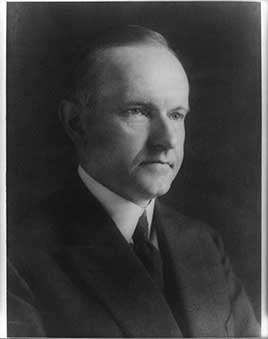
Calvin Coolidge
This presidency falls in the realignment era (1896–1932), when the two parties were trading positions and both had progressive and conservative wings.
Became president when Harding died and was sworn in by his father, a notary, at the family farmhouse in Vermont. He appointed special counsels to prosecute the Harding scandals, cut income taxes twice, ran a surplus every year and paid down about a fifth of the national debt. He signed the Immigration Act of 1924 and the law granting citizenship to all Native Americans, and twice vetoed farm relief.
The economy, first day to last
Shaded areas show the years in office, with a few years before and after for comparison. Budget years ran July to June until 1976 (now October to September), so each year's figures cover parts of two calendar years.
National debt
June 30, 1923 (end of fiscal 1923): $22.35 billion → June 30, 1928 (end of fiscal 1928): $17.60 billion
Daily debt figures don't exist before 1993, so Coolidge's numbers use the fiscal years closest to his term, the same rule as every other page.
Debt compared with the economy
Debt as a share of GDP. Above 100% means the debt is bigger than a year of everything the country produces.
Deficits and surpluses
Money borrowed each budget year (below the line) or paid down (above).
Unemployment
1923: 3.2% → 1928: 4.4%. Yearly averages; monthly figures begin in 1948. Estimates by economist Stanley Lebergott (NBER, 1957).
Inflation
How much prices rose each year (consumer price index).
Cost of living
What everyday prices and paychecks did while in office.
Prices use the consumer price index (MeasuringWorth). The minimum wage is the federal rate set by Congress.
Executive orders
1,203 orders. Count from the American Presidency Project.
Orders signed each year
Yearly counts aren't reliable for this era. Orders were not numbered until 1907, when the State Department numbered the ones already in its files, and many orders were never numbered at all, so only the total is shown.
Source: American Presidency Project: executive orders (full list of every order).
Notable orders
Most orders in this era were routine, such as setting aside public land or exempting jobs from civil service rules.
Every executive order we have 80Search, filter by topic or year, and open any order's full text
Incomplete: orders before 1929 were not numbered or collected consistently. This archive has 80 of the roughly 1,203 orders counted for this president.
- EO 3949January 28, 1924Transferring Lands from the Department of the Interior to the Department of the Treasury
- EO 3987April 4, 1924Commercial Research of Government Officials in Foreign Lands
- EO 4060August 11, 1924Reserving for Naval Use Certain Areas in the Vicinity of the Island of Key West, Florida
- EO 4128January 17, 1925Modification of Executive Order No. 3949
- EO 4175March 17, 1925Transfer of Patent Office to Commerce Department
- EO 4224May 15, 1925Executive Order 4224 1/2—Waiver or Reduction of Application and Visa Fees for Non-Immigrants
- EO 4239June 4, 1925Transfer of Bureau of Mines to Commerce Department
- EO 4268July 16, 1925Remission of Further Payments of Installments of the Chinese Indemnity
- EO 4359ADecember 19, 1925Citizenship, Passports and Protection
- EO 4439May 8, 1926Use of State and Local Officials in Enforcing Prohibition
- EO 4476July 12, 1926Documents Required of Aliens Entering the United States
- EO 4527October 22, 1926Political Activities of Alaska Railroad Employees
- EO 4538November 5, 1926Presidential Postmasterships
- EO 4549December 6, 1926San Carlos Indian Irrigation Project
- EO 4571January 24, 1927Extension of Trust Period on Allotments Made to the Sac and Fox of the Missouri Indians in Kansas and Nebraska
- EO 4601March 1, 1927Distinguished Flying CrossAmended
- EO 4628April 13, 1927Lands in the State of Utah
- EO 4705August 10, 1927Rules of Official Precedence
- EO 4816February 25, 1928Extension of Trust Period on Allotments Made to Indians of the Oakland Reservation in Oklahoma
- EO 4858April 16, 1928Extension of Trust Period on Allotments Made to the Prairie Band of Pottawatomi Indians in Kansas
- EO 4898May 29, 1928Extension of Trust Period on Allotments Made to the Pawnee Indians of Oklahoma
- EO 4929July 7, 1928Lands Within the Carson National Forest, New Mexico
- EO 4979October 16, 1928Extension of Trust Period on Allotments Made to the Indians on the Winnebago Reservation in Nebraska
- EO 4981October 20, 1928Extension of Trust Period on Allotments Made to Indians of the Lower Brule Reservation in South Dakota
- EO 4986November 2, 1928Reserving for Use by the Department of Agricultre Certain Areas in the Vicinity of Osborn, Montana
- EO 4994November 14, 1928Extension of Trust Period on Allotments Made to Indians of the Winnebago Reservation in Nebraska
- EO 5019January 2, 1929Authorizing the Appointment of Mildred Brown McIntosh Without Regard to Civil Service Rules
- EO 5020January 2, 1929Authorizing the Reinstatement of James M.E. Brown Without Regard to Civil Service Rules
- EO 5021January 5, 1929Making Edward V. Sheely Eligible for Nomination Without Examination
- EO 5022January 5, 1929Amendments to Executive Order No. 4728
- EO 5023January 10, 1929Extension of Trust Period on Allotments Made to the Iowa Indians in Kansas and Nebraska
- EO 5024January 14, 1929Authorizing the Appointment of Carrie C. Anderson Without Regard to Civil Service Rules
- EO 5025January 14, 1929Reserving Certain Described Lands in Minnesota in Accordance with the Convention with Great Britain of February 24, 1925
- EO 5026January 14, 1929Enforcement of the Fur Seal Convention
- EO 5027January 15, 1929Making Ward M. Parker Eligible for Nomination Without Examination
- EO 5028January 16, 1929Extension of Trust Period on Allotments Made to the Rosebud Indians in South Dakota
- EO 5029January 18, 1929Reserving Certain Described Lands in New Mexico Pending Resurvey
- EO 5030January 18, 1929Reserving Certain Described Lands in Florida Pending Resurvey
- EO 5031January 18, 1929Reserving Certain Described Lands in New Mexico Pending Resurvey
- EO 5032January 18, 1929Amendment to Chapter XII of the "Instructions to Diplomatic Officers of the United States, March 8, 1927"
- EO 5033January 19, 1929Reserving Certain Described Lands in Oregon for a Lookout Station
- EO 5034January 19, 1929Authorizing the Reinstatement of Arthur J. Dahn Without Regard to Civil Service Rules
- EO 5035January 23, 1929Abolishing Frenchville, Maine as a Customs Port of Entry
- EO 5036January 24, 1929Reserving Certain Described Lands in Alaska for the Department of Agriculture
- EO 5037January 28, 1929Reserving Certain Described Lands in Utah for Classification and Possible Inclusion in the Zion National Park
- EO 5038February 2, 1929Reserving Certain Described Lands in California for Classification and Possible Inclusion in the Pinnacles National Monument
- EO 5039February 4, 1929General Joe Wheeler Dam
- EO 5040February 4, 1929Reserving Certain Described Lands in Wyoming for Elk Refuge Purposes
- EO 5041February 9, 1929Reserving Additional Lands in Utah for the Bear River Migratory Bird Refuge
- EO 5042February 15, 1929Placing the Position of Press Helper in the Bureau of Engraving and Printing Into the Classified Civil Service
- EO 5043February 15, 1929Authorizing the Appointment of Marion Hayes McCarthy Without Regard to Civil Service Rules
- EO 5044February 16, 1929Amendment to Executive Order No. 4987 Correcting Description of Land at the the Fort Tilden Military Reservation
- EO 5045February 16, 1929Amendment to the Consular Regulations
- EO 5046February 16, 1929Modification of Reservation of Certain Described Lands in California to Permit Approval of an Application for Right of Way for a Tramway for the Little River Redwood Company
- EO 5047February 18, 1929Declaring the Panama Canal Zone to be a Military Airspace Reservation
- EO 5048February 18, 1929Revoking in Part, Executive Order No. 4889
- EO 5049February 19, 1929Authorizing the Appointment of Anna M. Stack Without Regard to Civil Service Rules
- EO 5050February 21, 1929Authorizing the Appointment of Samuel H. Thompson Without Regard to Civil Service Rules
- EO 5052February 21, 1929Authorizing the Appointment of Mrs. James E. Golladay Without Regard to Civil Service Rules
- EO 5053February 22, 1929Authorizing the Appointment of Anna M. Archibald Without Regard to Civil Service Rules
- EO 5054February 23, 1929Authorizing the Reinstatement of Mary E. Kelly Without Regard to Civil Service Rules
- EO 5055February 23, 1929Amendment to Subdivision IX, Schedule A of the Civil Service Rules
- EO 5056February 23, 1929Authorizing the Appointment of Mary Scott Mills Without Regard to Civil Service Rules
- EO 5057February 26, 1929Authorizing the Appointment of Gertrude L. George Without Regard to Civil Service Rules
- EO 5058February 26, 1929Authorizing the Appointment of Julia Behneke Without Regard to Civil Service Rules
- EO 5059February 26, 1929Authorizing the Reinstatement of Oliver H. Clarke Without Regard to Civil Service Rules
- EO 5060February 26, 1929Authorizing the Appointment of Barbara Davis Without Regard to Civil Service Rules
- EO 5061February 27, 1929Authorizing the Reinstatement of Clifford C. Marsh Without Regard to Civil Service Rules
- EO 5062February 28, 1929Designating Airspace Over the District of Columbia as a Prohibited Area
- EO 5063February 28, 1929Reserving Certain Described Lands in Oregon for Classification and Pending Legislation
- EO 5064February 28, 1929Authorizing the Appointment of Elizabeth Gibson Without Regard to Civil Service Rules
- EO 5066March 1, 1929Reserving Certain Described Lands in Wyoming Pending Resurvey
- EO 5067March 2, 1929Assignment of Frequencies to Government Radio Stations
- EO 5068March 2, 1929Amendment of Civil Service Rule VI
- EO 5069March 2, 1929Authorizing the Reinstatement of Jeannette J. Donahue Without Regard to Civil Service Rules
- EO 5070March 2, 1929Authorizing the Reinstatement of James W. Girard Without Regard to Civil Service Rules
- EO 5072March 2, 1929Authorizing the Appointment of Virginia Ladd Without Regard to Civil Service Rules
- EO 5073March 2, 1929Authorizing the Appointment of Lee H. Garby Without Regard to Civil Service Rules
- EO 5074March 2, 1929Authorizing the Reinstatement of Raymond F. Mulherin
- EO 5075March 4, 1929Authorizing the Appointment of William M. Stuart Without Regard to Civil Service Rules
Source: Executive Orders Archive, compiled from the American Presidency Project and the Federal Register. Topics are the archive's automated tags; "Revoked" and similar labels come from the Federal Register's records.
Pardons and commutations
A pardon wipes out the punishment for a federal crime; a commutation shortens a sentence but leaves the conviction. Counts are by federal fiscal year (July to June). The Justice Department counts fiscal 1924, which began a month before he took office, and all of fiscal 1929, including Hoover's first four months, under Coolidge. In December 1923 he also freed the remaining prisoners held under the World War I Espionage Act.
Granted each year
Source: U.S. Dept. of Justice, clemency statistics, which lists every recipient with the crime and sentence.
Notable grants: tap to see the crime
Marcus GarveyCommutationNovember 18, 1927
The crime: Mail fraud in selling stock in his Black Star Line shipping company (convicted 1923)
Sentence: Five years; served about three
Why it drew attention: The Black nationalist leader was released on condition that he be deported to Jamaica. Biden granted him a posthumous pardon in 2025.
SourceInvestigations and legal record
The same checklist for every president. Tap a row for details and sources.
ImpeachedNoNo
No articles of impeachment were voted on.
Criminally chargedNoNo
Never charged.
Aides or cabinet convictedNoNo
No one he appointed was convicted. Officials from Harding's administration were prosecuted during his term.
Special counselsYes — two, for Harding's scandalsYes
In 1924 he appointed Owen Roberts, a Republican, and Atlee Pomerene, a Democrat, to prosecute the Teapot Dome cases. Their work led to the conviction of former Interior Secretary Albert Fall.
SourceMisuse of DOJ, FBI or IRSNo findingNo
He forced out Attorney General Harry Daugherty in 1924. His new attorney general, Harlan Stone, put J. Edgar Hoover in charge of the Bureau of Investigation to clean it up.
SourcePeople around the president who were charged or penalized
Controversies and scandals
What happened, what was proven, and how it ended.
The Immigration Act of 1924DisputedMay 1924
Set national quotas based on the 1890 census that sharply cut immigration from southern and eastern Europe and barred almost all immigration from Asia. Coolidge said he objected to the Japanese exclusion but signed the law.
Outcome: The quota system lasted until 1965.
SourceVetoing farm reliefDisputed1927 and 1928
Farmers were in a long depression. Coolidge twice vetoed the McNary–Haugen bill, which would have had the government buy surplus crops, calling it price-fixing.
Outcome: Congress failed to override; farm prices stayed low into the Depression.
SourceThe Great Mississippi FloodDisputed1927
The worst river flood in U.S. history displaced about 700,000 people. Coolidge declined to visit or to call a special session for relief, leaving the response to Commerce Secretary Herbert Hoover. Black refugees were held in camps and forced to work on the levees.
Outcome: Congress passed the Flood Control Act of 1928.
SourceIn their own words
Widely quoted remarks, with the context they were said in.
After all, the chief business of the American people is business.
The collection of any taxes which are not absolutely required ... is only a species of legalized larceny.
I do not choose to run for President in nineteen twenty eight.