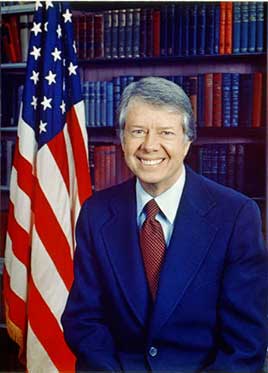
Jimmy Carter
Took office after Watergate promising honest government. He brokered the Camp David Accords between Egypt and Israel, created the Energy and Education departments, and deregulated airlines, trucking and railroads. Double-digit inflation, an energy crisis and the 444-day Iran hostage crisis defined his term, and he lost re-election in a landslide.
The economy, first day to last
Shaded areas show the years in office, with a few years before and after for comparison. Budget years run October to September, so a new president's first budget year starts the fall after they take office.
National debt
June 30, 1976 (end of fiscal 1976): $620.43 billion → Sept 30, 1980 (end of fiscal 1980): $907.70 billion
Daily debt figures don't exist before 1993, so Carter's numbers use the fiscal years closest to his term.
Debt compared with the economy
Debt as a share of GDP. Above 100% means the debt is bigger than a year of everything the country produces.
Deficits and surpluses
Money borrowed each budget year (below the line) or paid down (above).
Unemployment
Jan 1977: 7.5% → Jan 1981: 7.5%. Monthly rates; the chart shows yearly averages.
Inflation
How much prices rose each year (consumer price index).
Cost of living
What everyday prices and paychecks did while in office.
Prices use the consumer price index (MeasuringWorth). The minimum wage is the federal rate set by Congress.
Executive orders
320 orders, numbered 11967–12286.
Orders signed each year
Source: National Archives: Carter executive orders (full list of every order).
Notable orders
Pardon for Vietnam draft evadersEO 11967January 21, 1977
Carried out his first-day proclamation pardoning men who had evaded the draft.
Federal RegisterRules for intelligence agenciesEO 12036January 24, 1978
Set limits on CIA and FBI spying after revelations of abuses, including a ban on assassinations.
Federal RegisterImproving government regulationsEO 12044March 23, 1978
Required agencies to analyze the costs of major regulations and write them in plain language.
Federal RegisterInflation guidelines for federal contractorsEO 12092November 1, 1978
Tied federal contracts to his voluntary wage and price guidelines against inflation.
Federal RegisterCreating FEMAEO 12148July 20, 1979
Set up the Federal Emergency Management Agency to coordinate disaster response.
Federal RegisterFreezing Iranian assetsEO 12170November 14, 1979
Blocked Iranian government property in the U.S. after the embassy in Tehran was seized.
Federal RegisterEvery executive order 320Search, filter by topic or year, and open any order's full text
- EO 11967January 21, 1977Executive Order Relating to Proclamation of Pardon
- EO 11968January 31, 1977Withholding of Income or Employment Taxes by Federal Agencies
- EO 11969February 2, 1977Administration of the Emergency Natural Gas Act of 1977
- EO 11970February 5, 1977Presidential Advisory Board on Ambassadorial Appointments
- EO 11971February 11, 1977Director of the Federal Bureau of Investigation
- EO 11972February 14, 1977United States Circuit Judge Nominating Commission
- EO 11973February 17, 1977President's Commission on Mental Health
- EO 11974February 25, 1977Generalized System of Preferences for Developing Countries
- EO 11975March 7, 1977President's Economic Policy Board
- EO 11976March 11, 1977Executive Schedule
- EO 11977March 14, 1977Public International Organizations
- EO 11978March 18, 1977Trade Involving Southern Rhodesia
- EO 11979March 28, 1977National Commission on the Observance of International Women's Year, 1975
- EO 11980March 29, 1977National Commission on the Observance of International Women's Year, 1975
- EO 11981March 29, 1977Interagency Committee for the Purchase of United States Savings Bonds
- EO 11982April 29, 1977Committee on Selection of the Director of the Federal Bureau of Investigation
- EO 11983May 4, 1977Executive Schedule
- EO 11984May 4, 1977President's Foreign Intelligence Advisory Board
- EO 11985May 13, 1977United States Foreign Intelligence Activities
- EO 11986May 20, 1977Executive Schedule
- EO 11987May 24, 1977Exotic OrganismsRevoked
- EO 11988May 24, 1977Floodplain Management
- EO 11989May 24, 1977Off-Road Vehicles on Public LandsRevoked
- EO 11990May 24, 1977Protection of Wetlands
- EO 11991May 24, 1977Environmental Impact StatementsRevoked
- EO 11992May 24, 1977Committee on Selection of Federal Judicial Officers
- EO 11993May 24, 1977United States Circuit Judge Nominating Commission
- EO 11994June 1, 1977United States Foreign Intelligence Activities
- EO 11995June 8, 1977Executive Schedule
- EO 11996June 14, 1977The Honorable Tom C. Clark
- EO 11997June 22, 1977Withholding of Income or Employment Taxes by Federal Agencies
- EO 11998June 27, 1977President's Commission on Military Compensation -
- EO 11999June 27, 1977Executive Schedule
- EO 12000June 29, 1977Exemption From Mandatory Retirement
- EO 12001June 29, 1977Bicentennial Functions
- EO 12002July 7, 1977Export Administration Act of 1969Amended
- EO 12003July 20, 1977Energy Policy and Conservation
- EO 12004July 20, 1977Federal Pay Administration
- EO 12005July 23, 1977Generalized System of Preferences for Developing Countries
- EO 12006July 29, 1977Exemption From Mandatory Retirement
- EO 12007August 22, 1977Presidential Advisory Committees
- EO 12008August 25, 1977Presidential Management Intern Program
- EO 12009September 13, 1977Department of Energy
- EO 12010September 28, 1977Federal Civilian and Military Pay Increases
- EO 12011September 30, 1977Exemption From Mandatory Retirement
- EO 12012October 3, 1977White House Fellowships
- EO 12013October 7, 1977Statistical Policy Functions
- EO 12014October 19, 1977President's Award for Distinguished Federal Civilian Service
- EO 12015October 26, 1977Work-Study Program StudentsSuperseded
- EO 12016October 31, 1977Exemption From Mandatory Retirement
- EO 12017November 3, 1977American Prisoners of War
- EO 12018November 3, 1977American Prisoners of War
- EO 12019November 3, 1977Defense Meritorious Service Medal
- EO 12020November 8, 1977Educational Benefits for Veterans and Dependents
- EO 12021November 30, 1977Civil Service Rules
- EO 12022December 1, 1977National Commission for the Review of Antitrust Laws and Procedures
- EO 12023December 1, 1977Central Intelligence Agency Retirement and Disability System
- EO 12024December 1, 1977Advisory Committee Functions
- EO 12025December 1, 1977Executive Schedule
- EO 12026December 5, 1977Energy Department Employees
- EO 12027December 5, 1977Executive Development and Other Personnel Functions
- EO 12028December 12, 1977Executive Office of the President
- EO 12029December 14, 1977Quetico-Superior Committee
- EO 12030December 15, 1977Federal Property Council
- EO 12031December 21, 1977Exemption From Mandatory Retirement
- EO 12032December 27, 1977Generalized System of Preferences for Developing Countries
- EO 12033January 10, 1978International Organizations Entitled to Privileges and Immunities
- EO 12034January 10, 1978ACTION Cooperative Volunteers
- EO 12035January 20, 1978Executive Schedule
- EO 12036January 24, 1978United States Foreign Intelligence Activities
- EO 12037January 31, 1978Civil Aeronautics Board
- EO 12038February 3, 1978Department of Energy
- EO 12039February 24, 1978Science and Technology Policy Functions
- EO 12040February 24, 1978Environmental Evaluation Functions
- EO 12041February 25, 1978Generalized System of Preferences for Developing Countries
- EO 12042March 6, 1978Labor Disputes in the Coal Industry
- EO 12043March 7, 1978Civil Service Rules
- EO 12044March 23, 1978Improving Government Regulations
- EO 12045March 27, 1978Domestic Council, Office of Drug Abuse Policy, and Economic Opportunity Council
- EO 12046March 27, 1978Telecommunications Functions
- EO 12047March 27, 1978Imported Objects of Cultural Significance
- EO 12048March 27, 1978International Communication Agency
- EO 12049March 27, 1978Defense Economic Adjustment Programs
- EO 12050April 4, 1978National Advisory Committee for Women
- EO 12051April 7, 1978Waiver under the Trade Act of 1974 with respect to the Hungarian People's Republic
- EO 12052April 7, 1978National Commission for the Review of Antitrust Laws and Procedures
- EO 12053April 14, 1978National Commission on the International Year of the Child, 1979
- EO 12054April 21, 1978President's Commission on Foreign Language and International Studies
- EO 12055April 27, 1978Export of Special Nuclear Material to India
- EO 12056April 28, 1978Civil Aeronautics Board
- EO 12057May 8, 1978National Advisory Committee for Women
- EO 12058May 11, 1978Nuclear Non-Proliferation
- EO 12059May 11, 1978United States Circuit Judge Nominating Commission
- EO 12060May 15, 1978Executive Schedule
- EO 12061May 18, 1978Small Business Conference Commission
- EO 12062May 26, 1978President's Commission on the Coal Industry
- EO 12063June 5, 1978United States Court of Military Appeals Nominating Commission
- EO 12064June 5, 1978United States Tax Court Nominating Commission
- EO 12065June 28, 1978National Security Information
- EO 12066June 29, 1978Inspection of Foreign Assistance Programs
- EO 12067June 30, 1978Equal Employment Opportunity Programs
- EO 12068June 30, 1978Litigation Against Public Sector Employers
- EO 12069June 30, 1978Executive Schedule
- EO 12070June 30, 1978Federal Cost-of-Living Allowances
- EO 12071July 12, 1978President's Commission on Pension Policy
- EO 12072August 16, 1978Federal Space ManagementRevoked
- EO 12073August 16, 1978Federal Procurement in Labor Surplus Areas
- EO 12074August 16, 1978Urban and Community Impact Analyses
- EO 12075August 16, 1978Interagency Coordinating Council
- EO 12076August 18, 1978Executive Schedule
- EO 12077August 18, 1978Mississippi River Commission
- EO 12078September 5, 1978Presidential Commission on World Hunger
- EO 12079September 18, 1978Airport and Airway Development Act Functions
- EO 12080September 18, 1978Commemorative Presidential Proclamations
- EO 12081September 18, 1978Naturalization Based on Military Service
- EO 12082September 19, 1978Armed Forces Promotion and Disability Separation Limitations
- EO 12083September 27, 1978Energy Coordinating Committee
- EO 12084September 27, 1978Judicial Nominating Commission for the District of Puerto Rico
- EO 12085September 28, 1978Emergency Board To Investigate a Railway Labor Dispute
- EO 12086October 5, 1978Equal Employment Opportunity Functions
- EO 12087October 7, 1978Federal Civilian and Military Pay Increases
- EO 12088October 13, 1978Federal Compliance With Pollution Control StandardsPartially revoked
- EO 12089October 23, 1978National Productivity Council
- EO 12090October 31, 1978President's Commission on Foreign Language and International Studies
- EO 12091November 1, 1978Small Business Conference Commission
- EO 12092November 1, 1978Federal Anti-Inflationary Procurement Practices
- EO 12093November 1, 1978President's Commission on the Holocaust
- EO 12094November 1, 1978Special Pay for Sea Duty
- EO 12095November 2, 1978Emergency Board To Investigate an Airline Labor Dispute
- EO 12096November 2, 1978Industry and Trade Administration
- EO 12097November 8, 1978Merit Selection of United States District Judges
- EO 12098November 14, 1978President's Council on Physical Fitness and Sports
- EO 12099November 17, 1978Executive Schedule
- EO 12100November 17, 1978President's Commission on Pension Policy
- EO 12101November 17, 1978Delegation of Functions to the Secretary of State
- EO 12102November 17, 1978Trade Committees
- EO 12103December 14, 1978President's Commission on the Coal Industry
- EO 12104December 15, 1978Imports of Papermaking Machinery From Finland
- EO 12105December 19, 1978Garnishment of Moneys Payable to Employees of Executive Agencies and the District of Columbia
- EO 12106December 28, 1978Equal Employment Opportunity Enforcement
- EO 12107December 28, 1978Federal Civil Service Reorganization
- EO 12108December 28, 1978Employee Retirement Income Security Act Transfers
- EO 12109December 28, 1978Federal Physicians Comparability Allowance
- EO 12110December 28, 1978Federal Advisory Committees
- EO 12111January 2, 1979Executive Schedule
- EO 12112January 2, 1979Seal for the Office of Administration
- EO 12113January 4, 1979Independent Water Project Review
- EO 12114January 4, 1979Environmental Effects Abroad of Major Federal Actions
- EO 12115January 19, 1979Permanent American Cemetery in the Republic of Panama
- EO 12116January 19, 1979Issuance of Food Stamps by the Postal Service
- EO 12117February 6, 1979Imports From Uganda
- EO 12118February 6, 1979Administration of Security Assistance Programs
- EO 12119February 14, 1979Executive Schedule
- EO 12120February 14, 1979The Honorable Adolph Dubs
- EO 12121February 26, 1979Energy Coordinating Committee
- EO 12122February 26, 1979Office of Administration
- EO 12123February 26, 1979Offshore Oil Spill Pollution
- EO 12124February 28, 1979Generalized System of Preferences
- EO 12125March 15, 1979Competitive Status for Handicapped Federal Employees
- EO 12126March 29, 1979Correction to Executive Order 12107 Related to Federal Civil Service Reorganization
- EO 12127March 31, 1979Federal Emergency Management Agency
- EO 12128April 4, 1979Employee-Management Relations in the Foreign Service
- EO 12129April 5, 1979Critical Energy Facility Program
- EO 12130April 11, 1979President's Commission on the Accident at Three Mile Island
- EO 12131May 4, 1979The President's Export CouncilAmended
- EO 12132May 8, 1979Emergency Board To Investigate a Railway Labor Dispute
- EO 12133May 9, 1979Drug Policy Functions
- EO 12134May 9, 1979Printing Services Within the Executive Office
- EO 12135May 9, 1979President's Advisory Committee for Women
- EO 12136May 15, 1979President's Commission on Executive Exchange
- EO 12137May 16, 1979Peace CorpsAmended
- EO 12138May 18, 1979Women's Business Enterprise
- EO 12139May 23, 1979Foreign Intelligence Electronic SurveillanceAmended
- EO 12140May 29, 1979Gasoline End-User Allocation
- EO 12141June 5, 1979Independent Water Project Review
- EO 12142June 21, 1979Alaska Natural Gas Transportation System
- EO 12143June 22, 1979Maintaining Unofficial Relations with the People on TaiwanSuperseded
- EO 12144June 22, 1979Equal Employment Opportunity Commission
- EO 12145July 18, 1979Foreign Service Retirement and Disability System
- EO 12146July 18, 1979Management of Federal Legal ResourcesAmended
- EO 12147July 19, 1979United States International Development Cooperation Agency
- EO 12148July 20, 1979Federal Emergency ManagementPartially revoked
- EO 12149July 20, 1979Federal Regional Councils
- EO 12150July 23, 1979United States Sinai Support Mission
- EO 12151August 14, 1979President's Commission on the Holocaust
- EO 12152August 14, 1979Federal Government Organization and Employees
- EO 12153August 17, 1979Price Controls on Heavy Crude Oil
- EO 12154September 4, 1979Executive ScheduleAmended
- EO 12155September 10, 1979Strategic and Critical Materials
- EO 12156September 10, 1979Federal Emergency Management Agency; Department of Energy
- EO 12157September 14, 1979President's Management Improvement Council
- EO 12158September 18, 1979Presidential Scholars
- EO 12159September 20, 1979Emergency Board To Investigate a Railway Labor Dispute
- EO 12160September 26, 1979Federal Consumer ProgramsAmended
- EO 12161September 28, 1979Anti-Inflation Program
- EO 12162September 28, 1979Amendment to Executive Order 12140: Gasoline End-User Allocation
- EO 12163September 29, 1979Administration of Foreign Assistance and Related FunctionsAmended
- EO 12164September 29, 1979Multilateral Development Institutions
- EO 12165October 9, 1979Federal Civilian and Military Pay Increases
- EO 12166October 19, 1979Export-Import Bank
- EO 12167October 23, 1979United States-People's Republic of China Trade Relations
- EO 12168October 24, 1979President's Commission for a National Agenda for the Eighties
- EO 12169October 26, 1979United States Holocaust Memorial Council
- EO 12170November 14, 1979Blocking Iranian Government Property
- EO 12171November 19, 1979Exclusions From the Federal Labor-Management Relations ProgramAmended
- EO 12172November 26, 1979Iranian Aliens
- EO 12173November 29, 1979Panama Canal
- EO 12174November 30, 1979Federal Paperwork Reduction
- EO 12175December 7, 1979International Trade Functions
- EO 12176December 7, 1979President's Commission on the Coal Industry
- EO 12177December 10, 1979Federal Government Pension Plans
- EO 12178December 10, 1979Foreign Assistance Functions
- EO 12179December 11, 1979Holiday for Federal Employees
- EO 12180December 11, 1979Generalized System of Preferences for Developing Countries
- EO 12181December 11, 1979Generalized System of Preferences for Developing Countries
- EO 12182December 14, 1979Emergency Board To Investigate a Railway Labor Dispute
- EO 12183December 16, 1979Revoking Rhodesian Sanctions
- EO 12184December 17, 1979President's Special Commission for the Study of Ethical Problems in Medicine and Biomedical and Behavioral Research
- EO 12185December 17, 1979Conservation of Petroleum and Natural Gas
- EO 12186December 21, 1979Price Controls on Heavy Crude Oil
- EO 12187December 29, 1979Decontrol of Marginal Oil Wells
- EO 12188January 2, 1980International Trade FunctionsAmended
- EO 12189January 16, 1980Price Controls on Heavy Crude Oil
- EO 12190February 1, 1980Advisory Committee on Small and Minority Business Ownership
- EO 12191February 1, 1980Federal Facility Ridesharing Program
- EO 12192February 12, 1980State Planning Council on Radioactive Waste Management
- EO 12193February 12, 1980Nuclear Cooperation With EURATOM
- EO 12194February 21, 1980Radiation Policy Council
- EO 12195February 22, 1980President's Commission on United States-Liberian Relations
- EO 12196February 26, 1980Occupational Safety and Health Programs for Federal Employees
- EO 12197March 5, 1980Central Intelligence Agency Retirement and Disability System
- EO 12198March 12, 1980Prescribing Amendments to the Manual for Courts-Martial, United States, 1969 (Revised Edition)
- EO 12199March 12, 1980Executive Schedule
- EO 12200March 12, 1980Federal Civilian and Military Pay Rates
- EO 12201March 14, 1980Credit Control
- EO 12202March 18, 1980Nuclear Safety Oversight Committee
- EO 12203March 26, 1980Panama Canal
- EO 12204March 27, 1980Generalized System of Preferences
- EO 12205April 7, 1980Economic Sanctions Against Iran
- EO 12206April 7, 1980Iranian Aliens
- EO 12207April 12, 1980Emergency Board To Investigate a Railway Labor Dispute
- EO 12208April 15, 1980Consultations on the Admission of RefugeesAmended
- EO 12209April 16, 1980Decontrol of Marginal Oil Wells
- EO 12210April 16, 1980Administration of Arms Export Controls
- EO 12211April 17, 1980Sanctions Against Iran
- EO 12212May 2, 1980The Department of Education
- EO 12213May 2, 1980United States Holocaust Memorial Council
- EO 12214May 2, 1980Administration of the Export Administration Act of 1979
- EO 12215May 27, 1980Delegation of Panama Canal Functions
- EO 12216June 18, 1980President's Committee on the International Labor OrganizationAmended
- EO 12217June 18, 1980Federal Compliance With Fuel Use Prohibitions
- EO 12218June 19, 1980Export of Special Nuclear Material and Components to India
- EO 12219June 19, 1980Presidential Commission on World Hunger
- EO 12220June 27, 1980Agricultural Trade Development
- EO 12221June 27, 1980Improving Government Regulations
- EO 12222June 28, 1980Generalized System of Preferences for Developing Countries
- EO 12223June 30, 1980Occupational Safety and Health Programs for Federal Employees
- EO 12224July 1, 1980Implementation of the International Sugar Agreement
- EO 12225July 3, 1980Credit Control Revocation
- EO 12226July 22, 1980Administration of Foreign Assistance
- EO 12227July 22, 1980United States Sinai Support Mission
- EO 12228July 24, 1980Allowances for Personnel on Foreign Duty
- EO 12229July 29, 1980White House Coal Advisory Council
- EO 12230July 30, 1980Drug Enforcement Administration
- EO 12231August 4, 1980Strategic Petroleum Reserve
- EO 12232August 8, 1980Historically Black Colleges and Universities
- EO 12233September 1, 1980Amendments to the Manual for Courts-Martial, United States, 1969 (Revised Edition)
- EO 12234September 3, 1980Enforcement of the Convention for the Safety of Life at Sea
- EO 12235September 3, 1980Management of Natural Gas Supply Emergencies
- EO 12236September 4, 1980Executive Schedule
- EO 12237September 4, 1980Executive Schedule
- EO 12238September 12, 1980International Maritime Satellite Organization
- EO 12239September 21, 1980Suspension of Certain Armed Forces Promotion and Disability Separation Limitations
- EO 12240September 26, 1980Nuclear Safety Oversight Committee
- EO 12241September 29, 1980Accidents at Nuclear Power Facilities
- EO 12242September 30, 1980Synthetic Fuels
- EO 12243October 3, 1980Variable Housing Allowance
- EO 12244October 3, 1980Cuban and Haitian Refugees
- EO 12245October 6, 1980Peace Corps Advisory Council
- EO 12246October 10, 1980Cuban and Haitian Entrants
- EO 12247October 15, 1980Federal Actions in the Lake Tahoe Region
- EO 12248October 16, 1980Federal Civilian and Military Pay Increases
- EO 12249October 25, 1980Foreign Service Salary Schedule
- EO 12250November 2, 1980Leadership and Coordination of Nondiscrimination LawsAmended
- EO 12251November 15, 1980Cuban and Haitian Entrants
- EO 12252November 24, 1980The Honorable John William McCormack
- EO 12253November 25, 1980Central Intelligence Agency Retirement and Disability System
- EO 12254December 3, 1980National Advisory Community Investment Board
- EO 12255December 5, 1980Holiday for Federal Employees
- EO 12256December 15, 1980Census Statistics on Legal Immigrants
- EO 12257December 18, 1980Civil Service Status for CETA Participants
- EO 12258December 31, 1980Continuance of Certain Federal Advisory Committees
- EO 12259December 31, 1980Leadership and Coordination of Fair Housing in Federal ProgramsRevoked
- EO 12260December 31, 1980Agreement on Government ProcurementAmended
- EO 12261January 5, 1981Gasohol in Federal Motor Vehicles
- EO 12262January 7, 1981Interagency Employee Benefit Council
- EO 12263January 8, 1981Contribution to Tin Buffer Stock
- EO 12264January 15, 1981Export of Banned or Significantly Restricted Substances
- EO 12265January 15, 1981Federal Consumer Programs
- EO 12266January 15, 1981Food Security Wheat Reserve
- EO 12267January 15, 1981Generalized System of Preferences
- EO 12268January 15, 1981Hostage Relief Act of 1980
- EO 12269January 15, 1981President's Committee on Small Business Policy
- EO 12270January 15, 1981President's Council on Spinal Cord Injury
- EO 12271January 15, 1981Continuance of Certain Federal Advisory Committees
- EO 12272January 16, 1981Foreign Service Retirement and Disability System
- EO 12273January 16, 1981Central Intelligence Agency Retirement and Disability System
- EO 12274January 16, 1981Military Pay and Allowances
- EO 12275January 16, 1981Design Liaison Council
- EO 12276January 19, 1981United States-Iran Agreement on Release of the American Hostages
- EO 12277January 19, 1981United States-Iran Agreement on Release of the American Hostages
- EO 12278January 19, 1981United States-Iran Agreement on Release of the American Hostages
- EO 12279January 19, 1981United States-Iran Agreement on Release of the American Hostages
- EO 12280January 19, 1981United States-Iran Agreement on Release of the American Hostages
- EO 12281January 19, 1981United States-Iran Agreement on Release of the American Hostages
- EO 12282January 19, 1981United States-Iran Agreement on Release of the American Hostages
- EO 12283January 19, 1981United States-Iran Agreement on Release of the American Hostages
- EO 12284January 19, 1981United States-Iran Agreement on Release of the American Hostages
- EO 12285January 19, 1981United States-Iran Agreement on Release of the American Hostages
- EO 12286January 19, 1981Responses to Environmental Damage
Source: Executive Orders Archive, compiled from the American Presidency Project and the Federal Register. Topics are the archive's automated tags; "Revoked" and similar labels come from the Federal Register's records.
Pardons and commutations
A pardon wipes out the punishment for a federal crime; a commutation shortens a sentence but leaves the conviction. Counts are by federal fiscal year. His first-day proclamation pardoning Vietnam-era draft evaders covered hundreds of thousands of people and is not counted individually.
Granted each year
Source: U.S. Dept. of Justice, clemency statistics, which lists every recipient with the crime and sentence.
Notable grants: tap to see the crime
Vietnam-era draft evadersPardon (proclamation)January 21, 1977
The crime: Evading the draft between 1964 and 1973 (military deserters were not included)
Sentence: Up to five years in prison, or exile abroad
Why it drew attention: A campaign promise. Veterans' groups condemned it as rewarding lawbreakers; others said it did not go far enough.
SourceG. Gordon LiddyCommutationApril 12, 1977
The crime: Burglary, conspiracy and illegal wiretapping in the Watergate break-in
Sentence: Up to 20 years; about 4½ served
Why it drew attention: The Watergate break-in's planner. Carter cut his sentence to match the other burglars'.
SourcePatty HearstCommutationFebruary 1, 1979
The crime: Bank robbery (1976), committed after she was kidnapped by a militant group
Sentence: Seven years; 22 months served
Why it drew attention: Supporters argued she was coerced. Clinton later granted her a full pardon.
SourceFour Puerto Rican nationalistsCommutationSeptember 6, 1979
The crime: The 1954 shooting in the U.S. Capitol that wounded five congressmen, and the 1950 attack on Blair House aimed at President Truman
Sentence: Life and long terms; about 25 years served
Why it drew attention: Their release was welcomed in parts of Puerto Rico and criticized as rewarding political violence.
SourcePeter YarrowPardonJanuary 19, 1981
The crime: Taking indecent liberties with a 14-year-old girl (pleaded guilty 1970)
Sentence: 1 to 3 years; served three months
Why it drew attention: A member of the folk group Peter, Paul and Mary; the pardon drew renewed criticism years later.
SourceInvestigations and legal record
The same checklist for every president. Tap a row for details and sources.
ImpeachedNoNo
No articles of impeachment were voted on.
Criminally chargedNoNo
A special counsel investigated loans to the Carter family peanut business and found no wrongdoing (1979).
SourceAides or cabinet convictedNoNo
Budget director Bert Lance was indicted for bank fraud from before he joined the government and was acquitted (1980). Drug policy adviser Peter Bourne resigned over a prescription written under a false name; he was not charged.
Special prosecutorsYes — threeYes
The first under the post-Watergate Ethics in Government Act: the peanut warehouse loans (Paul Curran), a cocaine allegation against chief of staff Hamilton Jordan (Arthur Christy) and a similar one against aide Tim Kraft. None produced charges.
SourceMisuse of DOJ, FBI or IRSAlleged — one episodePartly
In 1978 the Justice Department removed Philadelphia U.S. Attorney David Marston, a Republican investigating Democratic congressmen, after a congressman under investigation asked Carter to have him replaced. The congressman later pleaded guilty.
SourcePeople around the president who were charged or penalized
Controversies and scandals
What happened, what was proven, and how it ended.
Bert Lance affairCharged1977–1980
His budget director's past overdrafts and loans at his Georgia bank came under investigation.
Outcome: Lance resigned; later indicted and acquitted.
Source'Billygate'Disputed1980
The president's brother took money from Libya's government and was accused of lobbying for it.
Outcome: A Senate subcommittee found poor judgment and White House missteps but no illegal acts by the president.
SourceFiring a prosecutor investigating DemocratsAlleged1978
He had a Republican U.S. attorney removed after a Democratic congressman under investigation complained.
Outcome: Carter said he did not know of the investigation; the congressman later pleaded guilty to conflict of interest.
SourceFailed Iran hostage rescueProvenApril 1980
A secret mission to free 52 American hostages in Tehran was aborted in the desert; a helicopter collided with a plane.
Outcome: Eight U.S. servicemen died; a military review found planning and equipment failures.
SourceSoviet grain embargo and Olympic boycottDisputed1980
He halted grain sales to the Soviet Union and led a boycott of the Moscow Olympics after the invasion of Afghanistan.
Outcome: Farmers and athletes bore the costs; whether it pressured the Soviets is debated.
SourceIn their own words
Widely quoted remarks, with the context they were said in.
I'll never tell a lie. I'll never make a misleading statement.
I've looked on a lot of women with lust. I've committed adultery in my heart many times.
It is a crisis of confidence.