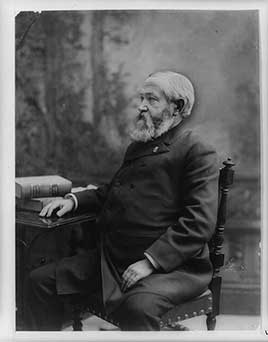
Benjamin Harrison
Grandson of President William Henry Harrison. He won the electoral vote in 1888 while losing the popular vote. He signed the Sherman Antitrust Act, the Sherman Silver Purchase Act, the McKinley Tariff and a large expansion of Civil War pensions, and six new states joined the Union. His Congress was the first in peacetime to spend a billion dollars.
The economy, first day to last
Shaded areas show the years in office, with a few years before and after for comparison. Budget years ran July to June until 1976 (now October to September), so each year's figures cover parts of two calendar years.
National debt
June 30, 1888 (end of fiscal 1888): $1.69 billion → June 30, 1892 (end of fiscal 1892): $1.59 billion
Daily debt figures don't exist before 1993, so Harrison's numbers use the fiscal years closest to his term, the same rule as every other page.
Debt compared with the economy
Debt as a share of GDP. Above 100% means the debt is bigger than a year of everything the country produces.
Deficits and surpluses
Money borrowed each budget year (below the line) or paid down (above). The White House budget office's yearly figures begin in 1901.
Unemployment
1890: 4.0% → 1892: 3.0%. Yearly averages. National estimates by economist Stanley Lebergott begin in 1890.
Inflation
How much prices rose each year (consumer price index).
Cost of living
What everyday prices and paychecks did while in office.
Prices use the consumer price index (MeasuringWorth). The minimum wage is the federal rate set by Congress.
Executive orders
143 orders. Count from the American Presidency Project.
Orders signed each year
Yearly counts aren't reliable for this era. Orders were not numbered until 1907, when the State Department numbered the ones already in its files, and many orders were never numbered at all, so only the total is shown.
Source: American Presidency Project: executive orders (full list of every order).
Notable orders
Most orders in this era were routine, such as setting aside public land or exempting jobs from civil service rules.
Every executive order we have 67Search, filter by topic or year, and open any order's full text
Incomplete: orders before 1929 were not numbered or collected consistently. This archive has 67 of the roughly 143 orders counted for this president.
- OrderMarch 11, 1889Executive Order
- OrderApril 17, 1889Executive Order—Amendment of Civil Service Rules
- OrderApril 23, 1889Executive Order—Regulations for the Distribution of Arms, Ordinance Stores, Quartermaster's Stores, and Camp Equipage to Territories in the District of Columbia
- OrderMay 4, 1889Executive Order—Amendment of Civil Service Rules
- OrderMay 6, 1889Executive Order—Creation of Mission Indian Reservation
- OrderMay 27, 1889Executive Order—Amendments of Civil Service Rules
- OrderMay 29, 1889Executive Order
- OrderJune 7, 1889Executive Order
- OrderJune 10, 1889Executive Order—Amendments of Civil Service Rules
- OrderJune 18, 1889Executive Order—Amendment of Civil Service Rules
- OrderJuly 26, 1889Executive Order—Amendment of Civil Service Rules
- OrderJuly 26, 1889Executive Order—Amendment of Civil Service Rules
- OrderAugust 17, 1889Executive Order—Amendment of Civil Service Rules
- OrderAugust 20, 1889Executive Order—Amendment of Civil Service Rules
- OrderOctober 29, 1889Executive Order—Amendment of Civil Service Rules
- OrderNovember 1, 1889Executive Order—Amendments of Civil Service Rules
- OrderNovember 18, 1889Executive Order—Amendment of Civil Service Rules
- OrderJanuary 29, 1890Executive Order—Amendments of Civil Service Rules
- OrderJanuary 29, 1890Executive Order—Amendment of Civil Service Rules
- OrderMarch 10, 1890Executive Order—Amendment of Civil Service Rules
- OrderMarch 10, 1890Executive Order—Amendment of Civil Service Rules
- OrderMarch 28, 1890Executive Order—Amendments of Civil Service Rules
- OrderApril 24, 1890Executive Order
- OrderMay 27, 1890Executive Order
- OrderMay 31, 1890Executive Order—Amendments of Civil Service Rules
- OrderJuly 14, 1890Executive Order—Death of John C. Fremont
- OrderJuly 30, 1890Executive Order—Amendments of Civil Service Rules
- OrderJuly 30, 1890Executive Order—Amendment of Civil Service Rules
- OrderSeptember 2, 1890Executive Order—Amendment of Civil Service Rules
- OrderOctober 31, 1890Executive Order—Amendment of Civil Service Rules
- OrderJanuary 19, 1891Executive Order—Death of George Bancroft
- OrderJanuary 26, 1891Executive Order—Amendment of Civil Service Rules
- OrderJanuary 30, 1891Executive Order
- OrderFebruary 13, 1891Executive Order
- OrderFebruary 14, 1891Executive Order
- OrderFebruary 16, 1891Executive Order
- OrderFebruary 18, 1891Executive Order—Amendment of Civil Service Rules
- OrderFebruary 21, 1891Executive Order—Amendment of Civil Service Rules
- OrderFebruary 26, 1891Executive Order
- OrderMarch 4, 1891Executive Order—Amendment of Civil Service Rules
- OrderMarch 16, 1891Executive Order—Amendment of Civil Service Rules
- OrderApril 3, 1891Executive Order—Amendment of Civil Service Rules
- OrderApril 13, 1891Executive Order—Civil Service: Classification of Indian Service
- OrderApril 13, 1891Executive Order—Amendments of Civil Service Rules
- OrderMay 25, 1891Executive Order
- OrderJuly 6, 1891Executive Order—Death of Hannibal Hamlin
- OrderAugust 6, 1891Executive Order—Amendments of Civil Service Rules
- OrderOctober 1, 1891Executive Order—Civil Service: Indian Rules
- OrderOctober 9, 1891Executive Order—Amendment of Civil Service Rules
- OrderOctober 16, 1891Executive Order—Extension of Hoopa Valley Reservation Boundaries
- OrderNovember 24, 1891Executive Order—Amendment of Civil Service Rules
- OrderDecember 4, 1891Executive Order
- OrderJanuary 12, 1892Executive Order—Amendment of Civil Service Rules
- OrderJanuary 20, 1892Executive Order—Amendment of Civil Service Rules
- OrderFebruary 23, 1892Executive Order—Amendments of Civil Service Rules
- OrderMay 5, 1892Executive Order
- OrderMay 7, 1892Executive Order—Amendment of Civil Service Rules
- OrderMay 7, 1892Executive Order—Amendment of Civil Service Rules
- OrderSeptember 16, 1892Executive Order
- OrderSeptember 23, 1892Executive Order—Amendment of Civil Service Rules
- OrderNovember 19, 1892Executive Order—Utah and Arizona Land to Public Domain
- OrderNovember 21, 1892Executive Order—Expansion of Red Lake Indian Reservation Boundaries
- OrderNovember 28, 1892Executive Order—Approving Interior Order on Yakima Reserve
- OrderJanuary 5, 1893Executive Order—Amendment of Civil Service Rules
- OrderJanuary 18, 1893Executive Order—Death of Rutherford B. Hayes
- OrderJanuary 19, 1893Executive Order
- OrderJanuary 19, 1893Executive Order
Source: Executive Orders Archive, compiled from the American Presidency Project and the Federal Register. Topics are the archive's automated tags; "Revoked" and similar labels come from the Federal Register's records.
Pardons and commutations
A pardon wipes out the punishment for a federal crime; a commutation shortens a sentence but leaves the conviction. The Justice Department's published counts begin in 1900.
Granted each year
The Justice Department's published clemency counts begin in fiscal 1900, so there are no reliable yearly totals for this presidency.
Source: U.S. Dept. of Justice, clemency statistics, which lists every recipient with the crime and sentence.
Notable grants: tap to see the crime
Mormon polygamistsAmnestyJanuary 4, 1893
The crime: Polygamy and 'unlawful cohabitation' under the Edmunds Act
Sentence: Various
Why it drew attention: Granted after the Latter-day Saints church renounced plural marriage in 1890, for those who had since obeyed the law. Cleveland broadened it in 1894.
SourceInvestigations and legal record
The same checklist for every president. Tap a row for details and sources.
ImpeachedNoNo
No articles of impeachment were voted on.
Criminally chargedNoNo
Never charged.
Aides or cabinet convictedNoNo
No member of his cabinet or White House staff was convicted.
Special counselsNoNo
None were appointed.
Misuse of DOJ, FBI or IRSNo findingNo
No official investigation found he used federal agencies against opponents.
People around the president who were charged or penalized
Controversies and scandals
What happened, what was proven, and how it ended.
'Blocks of five' vote buyingCharged1888
A letter from the Republican national treasurer, William Dudley, told Indiana party workers to 'divide the floaters into blocks of five' and put a trusted man in charge of each, which critics read as a plan to buy votes.
Outcome: Dudley was indicted, but the case was dropped after the judge narrowed the law.
SourceThe Wounded Knee massacreProvenDecember 29, 1890
The Army's 7th Cavalry killed about 250 to 300 Lakota, many of them women and children, while disarming a camp at Wounded Knee Creek, South Dakota.
Outcome: An Army inquiry cleared the commander, and 20 soldiers received the Medal of Honor. Congress expressed 'deep regret' in 1990.
SourceThe McKinley TariffDisputed1890
Raised average tariff rates to about 49 percent, and prices on many goods went up.
Outcome: Republicans lost the House in a landslide that fall; Harrison lost in 1892.
SourceIn their own words
Widely quoted remarks, with the context they were said in.
Providence has given us the victory.
I pity the man who wants a coat so cheap that the man or woman who produces the cloth or shapes it into a garment will starve in the process.