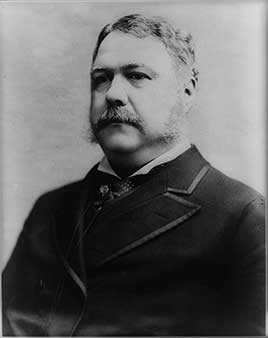
Chester A. Arthur
A product of Senator Roscoe Conkling's New York machine whom Hayes had fired as customs collector. He became president when Garfield died and surprised his critics by signing the Pendleton Act, which created the merit-based civil service. He also signed the Chinese Exclusion Act, began rebuilding the Navy, and hid that he had a fatal kidney disease.
The economy, first day to last
Shaded areas show the years in office, with a few years before and after for comparison. Budget years ran July to June until 1976 (now October to September), so each year's figures cover parts of two calendar years.
National debt
June 30, 1881 (end of fiscal 1881): $2.07 billion → June 30, 1884 (end of fiscal 1884): $1.83 billion
Daily debt figures don't exist before 1993, so Arthur's numbers use the fiscal years closest to his term, the same rule as every other page.
Debt compared with the economy
Debt as a share of GDP. Above 100% means the debt is bigger than a year of everything the country produces.
Deficits and surpluses
Money borrowed each budget year (below the line) or paid down (above). The White House budget office's yearly figures begin in 1901.
Unemployment
No national estimates before 1890. Economist Stanley Lebergott's yearly estimates, the earliest national series, begin in 1890
Inflation
How much prices rose each year (consumer price index).
Cost of living
What everyday prices and paychecks did while in office.
Prices use the consumer price index (MeasuringWorth). The minimum wage is the federal rate set by Congress.
Executive orders
96 orders. Count from the American Presidency Project.
Orders signed each year
Yearly counts aren't reliable for this era. Orders were not numbered until 1907, when the State Department numbered the ones already in its files, and many orders were never numbered at all, so only the total is shown.
Source: American Presidency Project: executive orders (full list of every order).
Notable orders
Most orders in this era were routine, such as setting aside public land or exempting jobs from civil service rules.
Every executive order we have 72Search, filter by topic or year, and open any order's full text
Incomplete: orders before 1929 were not numbered or collected consistently. This archive has 72 of the roughly 96 orders counted for this president.
- OrderOctober 19, 1881Executive Order
- OrderDecember 20, 1881Executive Order—Establishment of Vermilion Lake Indian Reservation
- OrderJanuary 5, 1882Executive Order—Defining Land for Uncompahgre Utes Indians
- OrderJanuary 24, 1882Executive Order—Adding Land to Sioux Reserve
- OrderMarch 30, 1882Executive Order
- OrderMarch 31, 1882Executive Order—Suppai Reserve
- OrderMay 5, 1882Executive Order—Reservation of Land for Pima and Maricopa Indians in Arizona
- OrderMay 5, 1882Executive Order—Chilocco Industrial School Reserve
- OrderMay 19, 1882Executive Order—Canceling Mescalero Apaches Land in New Mexico
- OrderMay 19, 1882Executive Order—Canceling Mescalero Apaches Land
- OrderMay 26, 1882Executive Order
- OrderJune 27, 1882Executive Order—Establishment of California Mission Indian Reserves in San Bernadino
- OrderJuly 13, 1882Executive Order
- OrderJuly 24, 1882Executive Order—Revocation of Executive Order Regarding Mission Indian Lands
- OrderAugust 4, 1882Executive Order—Restoration of Lands to Public Domain
- OrderDecember 12, 1882Executive Order—Establishment of Gila Bend Reserve
- OrderDecember 16, 1882Executive Order—Establishment of Moqui (Hopi) Reserve
- OrderDecember 21, 1882Executive Order—Drawing Turtle Mountain Reserve Boundaries
- OrderJanuary 4, 1883Executive Order—Establishment of Hualpai [Walapai] Reserve
- OrderFebruary 5, 1883Executive Order—Restoration of Lands for Mission Indians
- OrderFebruary 23, 1883Executive Order—Land of Chief Moses Back to Public Domain
- OrderMarch 24, 1883Executive Order—New Mexico Mescalero Apaches Land
- OrderMarch 26, 1883Executive Order
- OrderApril 2, 1883Executive Order
- OrderMay 1, 1883Executive Order—Amending Land for Zuni Pueblo Indians
- OrderMay 7, 1883Executive Order
- OrderMay 21, 1883Executive Order
- OrderJune 13, 1883Executive Order—Cancellation of Reservation in Minnesota
- OrderJune 19, 1883Executive Order—Reservation for Mission Indians in California
- OrderJune 30, 1883Executive Order—Reservation for Boise Fort Band of Chippewa in Minnesota
- OrderJuly 6, 1883Executive Order - Yuma Reserve
- OrderJuly 17, 1883Executive Order—Fort Reno Military Reserve
- OrderAugust 15, 1883Executive Order—Iowa Reserve Boundary
- OrderOctober 13, 1883Executive Order
- OrderNovember 15, 1883Executive Order—Pima and Maricopa Indian Reserve
- OrderDecember 5, 1883Executive Order
- OrderDecember 17, 1883Executive Order
- OrderJanuary 9, 1884Executive Order—Canceling Yuma Indian Reservation
- OrderJanuary 18, 1884Executive Order
- OrderFebruary 8, 1884Executive Order
- OrderMarch 12, 1884Executive Order
- OrderMarch 20, 1884Executive Order—Withdrawing Sioux Indian Land
- OrderMarch 29, 1884Executive Order—Chippewa Land Restored to Public Domain
- EO 22April 9, 1884Establishing a Board to Represent the Executive Departments at the World's Industrial and Cotton Centennial Exhibition
- OrderApril 23, 1884Executive Order
- OrderApril 23, 1884Executive Order
- OrderMay 13, 1884Executive Order
- OrderMay 15, 1884Executive Order—Jicarilla Apache Territory Restored to Public Domain
- OrderMay 17, 1884Executive Order—Arizona and Utah Indian Territories
- OrderMay 17, 1884Executive Order—Added Navajo Lands
- OrderMay 26, 1884Executive Order
- OrderJune 3, 1884Executive Order—Restoring Chippewa Indian Land to Public Domain
- OrderJune 12, 1884Executive Order
- OrderJuly 8, 1884Executive Order
- OrderJuly 10, 1884Executive Order
- OrderJuly 16, 1884Executive Order
- OrderJuly 18, 1884Executive Order
- OrderJuly 22, 1884Executive Order
- OrderSeptember 5, 1884Executive Order
- OrderOctober 4, 1884Executive Order—Defining Pueblo Industrial School Reserve Boundaries
- OrderNovember 10, 1884Executive Order
- OrderNovember 26, 1884Executive Order—Northern Cheyenne Reserve
- OrderNovember 26, 1884Executive Order—Northern Cheyenne Reserve
- OrderDecember 5, 1884Executive Order
- OrderJanuary 24, 1885Executive Order
- OrderFebruary 9, 1885Executive Order—Returning Niobrara and Santee Sioux Land To Public Domain
- OrderFebruary 11, 1885Executive Order
- OrderFebruary 17, 1885Executive Order
- OrderFebruary 26, 1885Executive Order
- OrderFebruary 27, 1885Executive Order
- OrderMarch 3, 1885Executive Order—Expanding Boundaries of Zuni Indian Reservation
- OrderMarch 3, 1885Executive Order
Source: Executive Orders Archive, compiled from the American Presidency Project and the Federal Register. Topics are the archive's automated tags; "Revoked" and similar labels come from the Federal Register's records.
Pardons and commutations
A pardon wipes out the punishment for a federal crime; a commutation shortens a sentence but leaves the conviction. The Justice Department's published counts begin in 1900.
Granted each year
The Justice Department's published clemency counts begin in fiscal 1900, so there are no reliable yearly totals for this presidency.
Source: U.S. Dept. of Justice, clemency statistics, which lists every recipient with the crime and sentence.
Notable grants: tap to see the crime
No individual grants from this presidency are highlighted yet.
Investigations and legal record
The same checklist for every president. Tap a row for details and sources.
ImpeachedNoNo
No articles of impeachment were voted on.
Criminally chargedNoNo
Never charged.
Aides or cabinet convictedNoNo
No member of his cabinet or White House staff was convicted. Defendants in the Star Route postal fraud cases, including his 1880 campaign ally Stephen Dorsey, were acquitted.
Special counselsYes — for the Star Route casesYes
His Justice Department hired outside special prosecutors to try the Star Route mail-contract fraud cases in 1882–83.
SourceMisuse of DOJ, FBI or IRSNo findingNo
No official investigation found he used federal agencies against opponents.
People around the president who were charged or penalized
Controversies and scandals
What happened, what was proven, and how it ended.
The Chinese Exclusion ActDisputed1882
After vetoing a 20-year version, Arthur signed a 10-year ban on Chinese laborers, the first U.S. law to bar immigrants by nationality.
Outcome: It was extended and made permanent, and repealed in 1943. Congress formally expressed regret in 2011 and 2012.
SourceThe Star Route trialsCharged1882–1883
Contractors and postal officials were accused of padding payments for rural mail routes by millions of dollars.
Outcome: All the main defendants were acquitted.
SourceThe New York Custom House machineProven1871–1878
As collector of the Port of New York, Arthur ran a patronage operation in which employees were hired for party loyalty and expected to pay political assessments.
Outcome: A federal commission found the office overstaffed and politicized in 1877; Hayes fired him in 1878.
SourceHiding a fatal illnessProven1882–1885
Arthur learned he had Bright's disease, a fatal kidney condition, early in his term and kept it secret.
Outcome: He made only a token effort for the 1884 nomination and died in November 1886.
SourceIn their own words
Widely quoted remarks, with the context they were said in.
Men may die, but the fabrics of our free institutions remain unshaken.