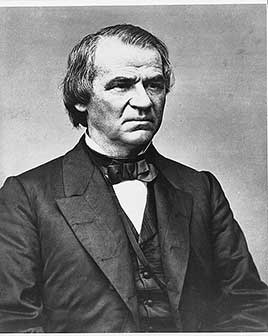
Andrew Johnson
A Tennessee Democrat who stayed loyal to the Union and was put on Lincoln's 1864 ticket. After the assassination he pardoned most former Confederates and let Southern states rejoin with governments that passed 'Black Codes'. He vetoed the Civil Rights Act of 1866 and the Freedmen's Bureau bill, and Congress overrode him. He opposed the 14th Amendment. He was the first president impeached and was acquitted by one vote. The purchase of Alaska happened on his watch.
The economy, first day to last
Shaded areas show the years in office, with a few years before and after for comparison. Budget years ran July to June until 1976 (now October to September), so each year's figures cover parts of two calendar years.
National debt
June 30, 1864 (end of fiscal 1864): $1.82 billion → June 30, 1868 (end of fiscal 1868): $2.61 billion
Daily debt figures don't exist before 1993, so Johnson's numbers use the fiscal years closest to his term, the same rule as every other page. Almost all of the rise came in fiscal 1865 (July 1864 to June 1865), the last year of the war, which was mostly Lincoln's; from June 1865 to June 1868 the debt fell from $2.68 billion to $2.61 billion.
Debt compared with the economy
Debt as a share of GDP. Above 100% means the debt is bigger than a year of everything the country produces.
Deficits and surpluses
Money borrowed each budget year (below the line) or paid down (above). The White House budget office's yearly figures begin in 1901.
Unemployment
No national estimates before 1890. Economist Stanley Lebergott's yearly estimates, the earliest national series, begin in 1890
Inflation
How much prices rose each year (consumer price index).
Cost of living
What everyday prices and paychecks did while in office.
Prices use the consumer price index (MeasuringWorth). The minimum wage is the federal rate set by Congress.
Executive orders
79 orders. Count from the American Presidency Project.
Orders signed each year
Yearly counts aren't reliable for this era. Orders were not numbered until 1907, when the State Department numbered the ones already in its files, and many orders were never numbered at all, so only the total is shown.
Source: American Presidency Project: executive orders (full list of every order).
Notable orders
Most orders in this era were routine, such as setting aside public land or exempting jobs from civil service rules.
Every executive order we have 70Search, filter by topic or year, and open any order's full text
Incomplete: orders before 1929 were not numbered or collected consistently. This archive has 70 of the roughly 79 orders counted for this president.
- OrderApril 29, 1865Executive Order
- OrderApril 29, 1865Executive Order
- OrderMay 1, 1865Executive Order
- OrderMay 3, 1865Executive Order—Rescinding Regulations Prohibiting the Exportation of Arms, Ammunition, Horses, Mules, and Live Stock
- OrderMay 4, 1865Executive Order
- OrderMay 6, 1865Executive Order—Special Orders: 211
- OrderMay 7, 1865Executive Order
- OrderMay 9, 1865Executive Order—Special Orders: 216
- OrderMay 9, 1865Executive Order—To Reestablish the Authority of the United States and Execute the Laws Within the Geographical Limits Known as the State of Virginia
- OrderMay 27, 1865Executive Order
- OrderMay 31, 1865Executive Order
- OrderJune 2, 1865Executive Order—General Orders: 107
- OrderJune 2, 1865Executive Order
- OrderJune 2, 1865Executive Order
- OrderJune 6, 1865Executive Order—General Orders: 109
- OrderJune 6, 1865Executive Order
- OrderJune 7, 1865Executive Order
- OrderJune 9, 1865Executive Order
- OrderJuly 5, 1865Executive Order—General Court-Martial Orders: 356
- OrderJuly 5, 1865Executive Order
- OrderJuly 15, 1865Executive Order
- OrderAugust 7, 1865Executive Order
- OrderAugust 25, 1865Executive Order
- OrderSeptember 7, 1865Executive Order
- OrderSeptember 16, 1865Executive Order—General Orders: 138
- OrderSeptember 19, 1865Executive Order—Special Orders: 503
- OrderOctober 9, 1865Executive Order—General Orders: 145
- OrderOctober 11, 1865Executive Order Paroling Alexander H. Stephens and Others
- OrderNovember 11, 1865Executive Order
- OrderNovember 24, 1865Executive Order—General Orders: 164
- OrderFebruary 27, 1866Executive Order—Establishing the Niobrara Reserve for the Santee Sioux Tribe in Nebraska
- OrderApril 7, 1866Executive Order
- OrderApril 13, 1866Executive Order
- OrderMay 1, 1866Executive Order—General Orders: 26—Order in Relation to Trials by Military Courts and Commissions
- OrderMay 29, 1866Executive Order
- OrderJune 5, 1866Executive Order
- OrderJune 18, 1866Executive Order
- OrderJuly 20, 1866Executive Order—Establishing Sioux Indian Reservation in Nebraska
- OrderSeptember 22, 1866Executive Order—Approving Interior Order for Shoalwater Reserve
- OrderOctober 26, 1866Executive Order
- OrderOctober 30, 1866Executive Order
- OrderNovember 1, 1866Executive Order
- OrderNovember 2, 1866Executive Order
- OrderMarch 11, 1867Executive Order—General Orders: 10
- OrderMarch 15, 1867Executive Order—General Orders: 18
- OrderJune 20, 1867Executive Order
- OrderAugust 12, 1867Executive Order—Suspending from Office Edwin M. Stanton as Secretary of War
- OrderAugust 12, 1867Executive Order
- OrderAugust 17, 1867Executive Order
- OrderAugust 26, 1867Executive Order
- OrderAugust 26, 1867Executive Order
- OrderSeptember 4, 1867Executive Order
- OrderNovember 15, 1867Executive Order—Expanding Sioux Indian Reservation in Nebraska
- OrderDecember 17, 1867Executive Order
- OrderDecember 28, 1867Executive Order—General Orders: 104
- OrderFebruary 12, 1868Executive Order—General Orders: 10
- OrderFebruary 21, 1868Executive Order—Removing Edwin M. Stanton as Secretary of War
- OrderFebruary 21, 1868Executive Order—Authorizing Lorenzo Thomas to Act as Secretary of War
- OrderMarch 28, 1868Executive Order—General Orders: 17
- OrderMay 28, 1868Executive Order
- OrderJune 1, 1868Executive Order
- OrderJune 3, 1868Executive Order—General Orders: 25
- OrderJune 3, 1868Executive Order
- OrderJune 30, 1868Executive Order—General Orders: 33
- OrderJuly 13, 1868Executive Order—General Orders: 44
- EO 6July 20, 1868Ratification of the Fourteenth Amendment to the United States Constitution
- OrderJuly 28, 1868Executive Order—General Orders: 55
- OrderSeptember 12, 1868Executive Order—Special Orders: 219
- OrderOctober 10, 1868Executive Order—General Orders: 82
- OrderNovember 4, 1868Executive Order
Source: Executive Orders Archive, compiled from the American Presidency Project and the Federal Register. Topics are the archive's automated tags; "Revoked" and similar labels come from the Federal Register's records.
Pardons and commutations
A pardon wipes out the punishment for a federal crime; a commutation shortens a sentence but leaves the conviction. The Justice Department's published counts begin in 1900. Besides four amnesty proclamations for former Confederates (the last, on Christmas 1868, covered everyone), he granted roughly 13,500 individual pardons to Confederate leaders and wealthy planters who applied.
Granted each year
The Justice Department's published clemency counts begin in fiscal 1900, so there are no reliable yearly totals for this presidency.
Source: U.S. Dept. of Justice, clemency statistics, which lists every recipient with the crime and sentence.
Notable grants: tap to see the crime
Samuel MuddPardonFebruary 8, 1869
The crime: Conspiracy in Lincoln's assassination: he set John Wilkes Booth's broken leg and hid what he knew (military commission, 1865)
Sentence: Life in prison; served nearly four years
Why it drew attention: Pardoned for his work fighting a yellow fever outbreak at the Fort Jefferson prison. Johnson also pardoned two other conspirators, Samuel Arnold and Edman Spangler, in his last weeks.
SourceFormer ConfederatesAmnestyDecember 25, 1868
The crime: Treason and rebellion
Sentence: None imposed
Why it drew attention: His final proclamation granted a full, unconditional pardon to everyone who took part in the rebellion, including Jefferson Davis.
SourceInvestigations and legal record
The same checklist for every president. Tap a row for details and sources.
ImpeachedYes — acquitted by one voteYes
The House impeached him in February 1868 on 11 articles, mainly for firing War Secretary Edwin Stanton in violation of the Tenure of Office Act. The Senate voted 35–19 to convict, one vote short of two-thirds.
SourceCriminally chargedNoNo
Never charged.
Aides or cabinet convictedNoNo
No member of his cabinet or White House staff was convicted.
Special counselsNoNo
None were appointed.
Misuse of DOJ, FBI or IRSNo findingNo
No official investigation found he used federal agencies against opponents. The Supreme Court later ruled the Tenure of Office Act unconstitutional (1926).
People around the president who were charged or penalized
Controversies and scandals
What happened, what was proven, and how it ended.
The impeachmentCharged1868
Congress's Radical Republicans impeached Johnson for removing Stanton without Senate approval and for speeches attacking Congress. Many historians see the charges as a proxy for the fight over Reconstruction.
Outcome: Acquitted by one vote; he served out his term.
SourceUndoing ReconstructionProven1865–1868
Johnson let Southern states rejoin under governments that passed Black Codes restricting freed people's work and movement, returned confiscated land to planters, and vetoed civil rights and Freedmen's Bureau bills.
Outcome: Congress overrode his vetoes, passed the 14th Amendment and took over Reconstruction in 1867.
SourceSlaveholdingProven1842–1863
Johnson owned about ten enslaved people in Tennessee.
Outcome: He freed them on August 8, 1863, a date later celebrated as Emancipation Day in Tennessee.
SourceThe 'Swing Around the Circle'Proven1866
On a speaking tour before the midterms, Johnson traded insults with hecklers and accused Radical Republicans of treason.
Outcome: Republicans won veto-proof majorities; the speeches became the basis for an article of impeachment.
SourceIn their own words
Widely quoted remarks, with the context they were said in.
Treason must be made odious, and traitors must be punished and impoverished.
In the progress of nations negroes have shown less capacity for government than any other race of people.